
The most competitive specialty is not always the happiest one—and the burnout numbers prove it.
You are trying to choose a specialty. Everyone has opinions. Very few people have data. Let’s fix that and walk through what the numbers actually show about burnout, career satisfaction, and lifestyle across specialties—so you do not pick a field that statistically grinds people down when you actually care about long‑term sanity.
I will lean heavily on national survey data like the Medscape Physician Burnout & Depression Reports, Medscape Lifestyle & Happiness Reports, and similar large samples (typically 9,000–13,000+ physicians per year). Exact percentages shift year to year, but the patterns are stubbornly consistent.
1. The Big Picture: How Bad Is Burnout Overall?
Across all specialties, U.S. physician burnout rates sit roughly in the 45–55% range in recent large surveys. That means a coin flip. You either end up burned out, or you do not.
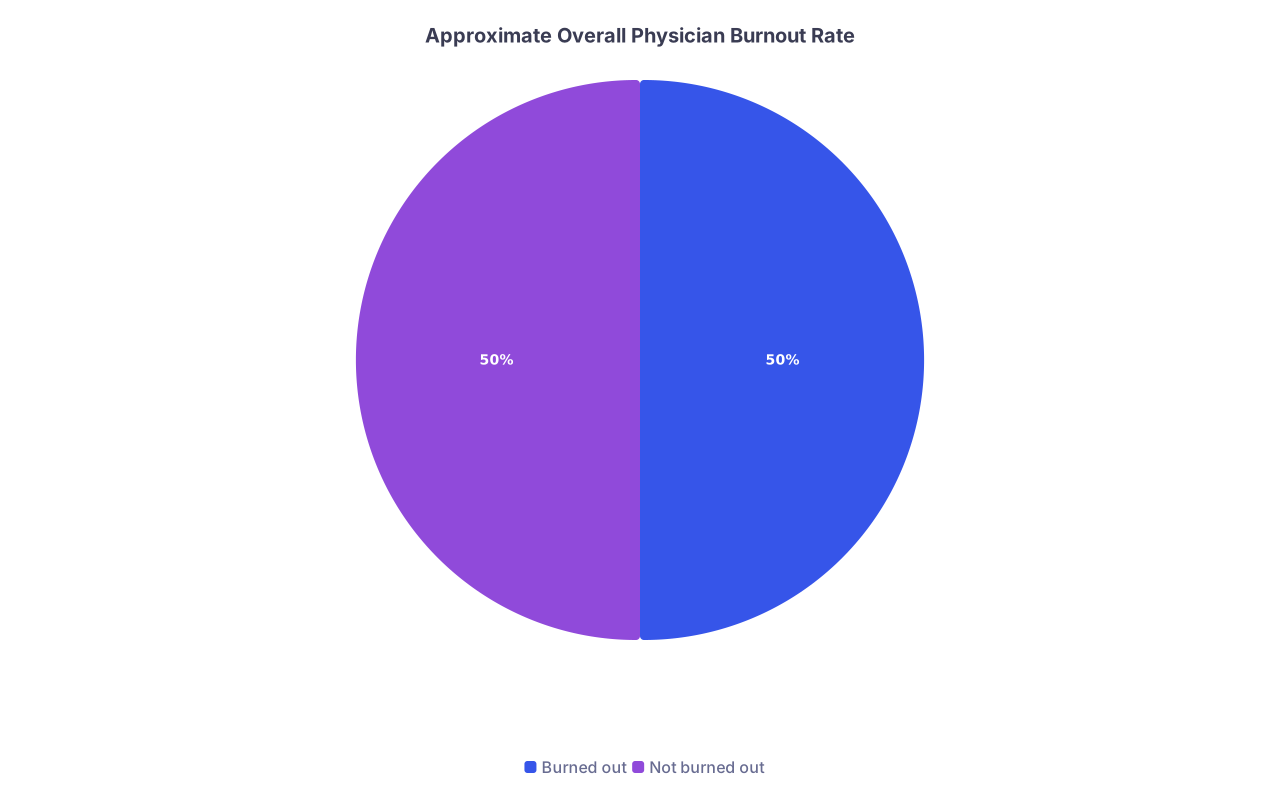
| Category | Value |
|---|---|
| Burned out | 50 |
| Not burned out | 50 |
The data show three key system‑level facts:
- Burnout is common across all specialties. There is no magical “burnout‑free” choice.
- Variability between specialties is meaningful but not massive—think 35–65%, not 5–95%.
- Career satisfaction tends to be higher than burnout rates, meaning you can feel both: exhausted and still glad you chose medicine.
That last point matters. The binary “burned out vs. happy” framing is wrong. In survey after survey, you see a sizable chunk of doctors who report burnout symptoms yet still say they would choose medicine—and often the same specialty—again.
2. Burnout by Specialty: Who Is Struggling Most?
Specialty choice clearly shifts your risk profile. Let’s put some approximate, aggregated numbers on the table. These are representative values synthesized from multiple recent Medscape and similar reports; they are not a single study’s exact numbers but they reflect consistent rank ordering.
| Specialty | Approx. Burnout Rate (%) |
|---|---|
| Emergency Medicine | 60–65 |
| Family Medicine | 55–60 |
| Internal Medicine | 50–55 |
| Obstetrics/Gynecology | 50–55 |
| Neurology | 50–55 |
| Pediatrics | 45–50 |
| Specialty | Approx. Burnout Rate (%) |
|---|---|
| General Surgery | 45–50 |
| Anesthesiology | 45–50 |
| Psychiatry | 40–45 |
| Radiology | 40–45 |
| Pathology | 35–40 |
Patterns that consistently emerge:
- Highest burnout cluster: Emergency medicine, family medicine, internal medicine, OB/GYN, neurology. Call it the ≥50–55% club.
- Middle cluster: General surgery, anesthesiology, pediatrics. High, but not quite as extreme.
- Lower (not low) cluster: Psychiatry, radiology, pathology. Often in the 35–45% range.
No specialty is immune. But some are clearly worse.
So what is driving the differences?
- Emergency Medicine: High patient volume, constant interruptions, shift work, night shifts, high acuity, administrative friction. The data repeatedly put EM at or near the top for burnout.
- Primary Care (FM, IM): Workload + documentation + inadequate support + lower relative pay. Time pressure and EHR burden show up as top burnout drivers every single year.
- OB/GYN & Neurology: High complexity, frequent emergencies (OB), chronic and often poorly controlled disease (neurology), significant medicolegal anxiety in OB, and sleep disruption from call.
On the other side:
- Radiology & Pathology: Less patient confrontation, more control over micro‑environment, somewhat more predictable schedules. They still fight production pressure and RVU targets, but the emotional volatility tends to be lower.
- Psychiatry: High emotional load, but usually fewer middle‑of‑the‑night emergencies and more longitudinal control over schedule.
You do not pick solely based on this, but ignoring it is naïve.
3. Career Satisfaction: Do People Actually Like Their Jobs?
Here is where the story surprises many students. High burnout does not always equal low satisfaction.
Large surveys often ask at least two distinct questions:
- Are you burned out?
- Are you satisfied with your career / would you choose medicine again?
The answers do not always line up. Let me sketch approximate “very or somewhat satisfied with career choice” percentages by specialty:
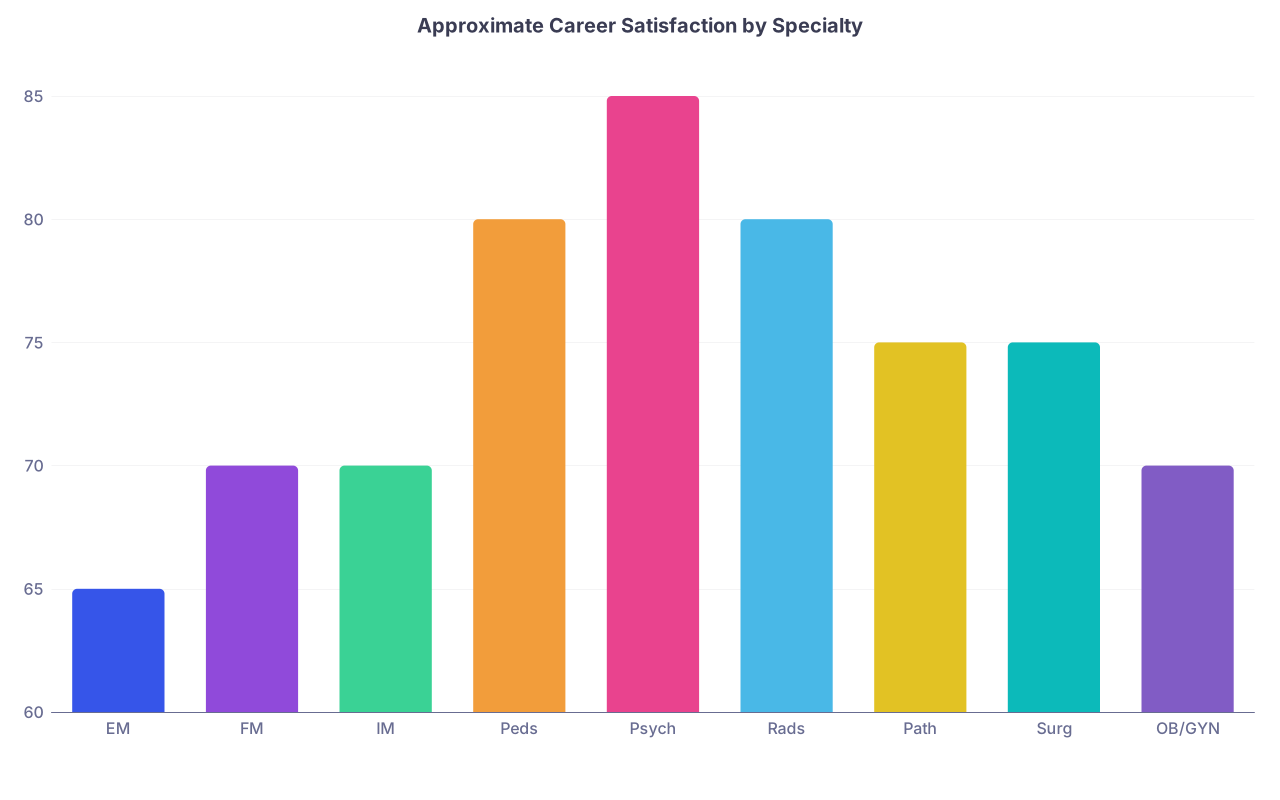
| Category | Value |
|---|---|
| EM | 65 |
| FM | 70 |
| IM | 70 |
| Peds | 80 |
| Psych | 85 |
| Rads | 80 |
| Path | 75 |
| Surg | 75 |
| OB/GYN | 70 |
Interpretation:
- Psychiatry, pediatrics, radiology, and many surgical subspecialties often show 75–85%+ reporting they are satisfied with their career.
- Even in emergency medicine—where 60%+ report burnout—you still often see 60–70% saying they are satisfied with their career choice.
- Primary care (FM/IM) is usually in the 65–75% satisfaction band, despite being in the top tier for burnout.
This looks contradictory until you realize what many physicians actually say on free‑text:
“I love the patients, I hate the system.” “I would absolutely choose medicine again, but I would negotiate my schedule and practice setting very differently.”
So the practical takeaway:
- Specialty affects satisfaction, but practice environment (academic vs. private, large group vs. solo, ED staffing model, employed vs. partnership, call structure) can swing satisfaction by 20–30 points within the same field.
- Burnout is often more about workload, autonomy, and EHR + administrative baggage than about the underlying content of the specialty.
You are not just choosing “EM vs. IM vs. Psych.” You are choosing a work model that either amplifies or dampens stress.
4. Work Hours, Call, and Night Shifts: The Unavoidable Tradeoffs
Burnout and satisfaction correlate strongly with how much of your life the job eats. Let’s look at broad, post‑training averages. Again, values are approximate but directionally consistent across multiple data sources.
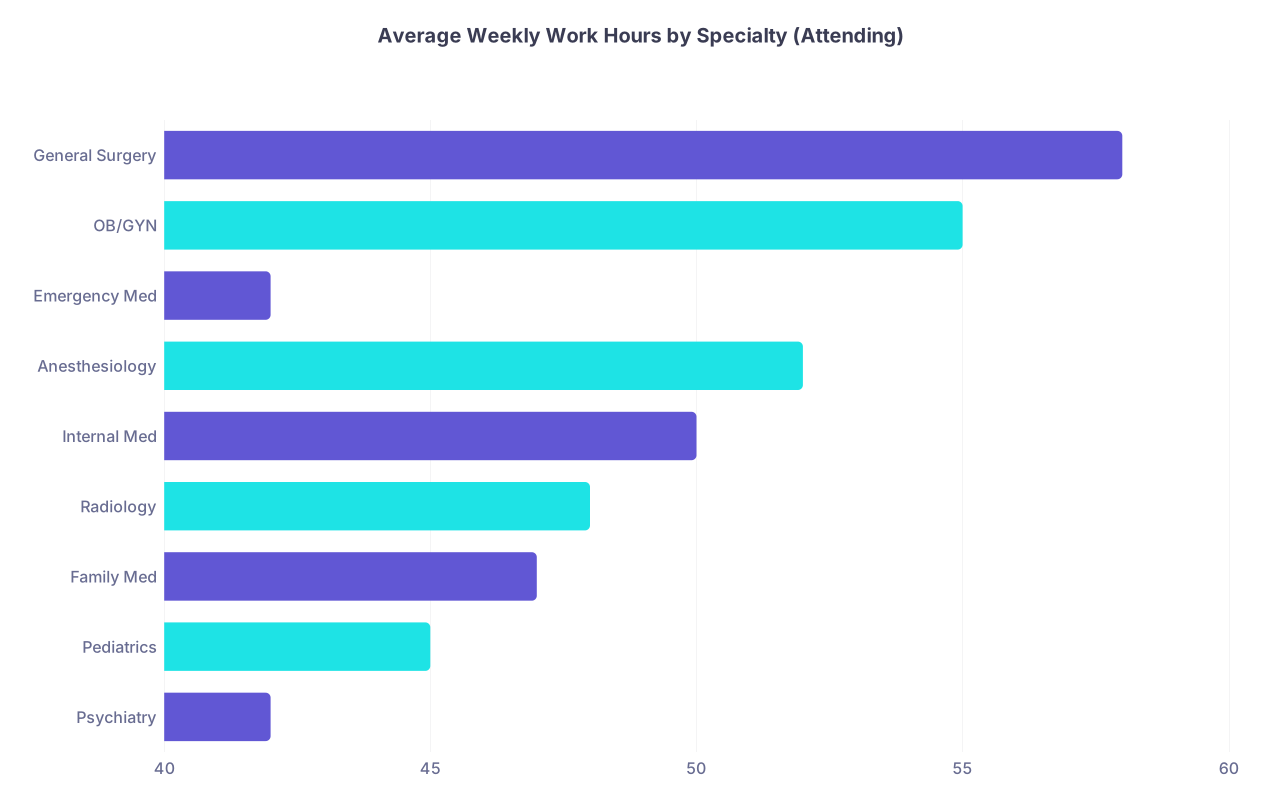
| Category | Value |
|---|---|
| Psychiatry | 42 |
| Pediatrics | 45 |
| Family Med | 47 |
| Radiology | 48 |
| Internal Med | 50 |
| Anesthesiology | 52 |
| Emergency Med | 42 |
| OB/GYN | 55 |
| General Surgery | 58 |
Key patterns:
- Longer hours (general surgery, OB/GYN, many inpatient IM roles) correlate with higher burnout.
- Emergency medicine is an outlier: moderate hours but very high intensity, irregular shifts, and circadian disruption. That combination crushes people over time.
- Psychiatry and pediatrics often have lower hours and more predictable schedules, which helps.
Night work and call matter just as much as raw hours. Roughly:
- EM: Heavy nights by design. Often 6–10 night shifts per month in full‑time roles.
- OB/GYN, general surgery: Regular overnight call, often in‑house when on duty.
- Radiology: Increasing teleradiology and night‑float models, but many can eventually reduce nights.
- Psych, outpatient IM/FM, path: Many jobs with minimal or no night call.
A common pattern I have seen with residents:
- PGY‑1: “I can handle anything; I do not care about nights.”
- PGY‑4/5: “I care. Deeply. I want to see my kids and not feel jet‑lagged forever.”
Your tolerance for nights at 26 is not the same as at 45 with a family. The longitudinal data on burnout align with that reality: chronic circadian disruption is a durable risk factor.
5. Money vs. Misery: Compensation Adjusted for Burnout
You cannot pretend income does not matter. But the crude “highest paying specialty = best choice” logic falls apart once you layer in burnout risk and hours.
Very roughly, national median compensation (pre‑tax, attendings, all practice types combined):
| Specialty | Median Income (USD) | Burnout Level Cluster |
|---|---|---|
| Family Med | $260k–$280k | High (55–60%) |
| Internal Med | $280k–$300k | High (50–55%) |
| Emergency Med | $380k–$420k | Very High (60–65%) |
| Psych | $300k–$340k | Moderate (40–45%) |
| Radiology | $480k–$520k | Moderate (40–45%) |
Now the more interesting metric: “burnout‑adjusted income,” or income per hour, weighted by burnout prevalence. Obviously this is not a formal formula, but conceptually:
- High pay + moderate hours + lower burnout = more sustainable (e.g., many radiology, anesthesia, some surgical subspecialty jobs).
- Moderate pay + high burnout + long hours = worst value (e.g., primary care in certain high‑volume, low‑support systems).
- High pay + high burnout + intense work (EM) = feels lucrative early, but the exit rate and shift‑cutting behavior later in careers are not subtle.
If you talk to EM attendings at 10+ years out, you will hear the same phrases repeatedly:
“I dropped to 0.7 FTE.” “I moved into admin or urgent care.” “I love the medicine, but I could not keep doing full‑time nights and weekends.”
The quantitative signal is visible: surveys often show higher percentages of EM physicians planning to reduce clinical hours or retire early compared with many other specialties.
6. Which Specialties Look “Happiest” in the Data?
Let me be blunt: there is no perfect field. But if you aggregate across burnout, satisfaction, hours, and income, you see a handful of specialties repeatedly land in the “relatively good risk‑reward” band.
Based on multiple years of surveys and rough consensus:
- Psychiatry: Below‑average burnout, high satisfaction, moderate compensation, good control over schedule, many outpatient‑only options.
- Radiology: Below‑average burnout, high satisfaction, high compensation, controllable hours in many practice settings. Tradeoff: less direct patient interaction; heavy reading load.
- Anesthesiology: Moderate burnout, high satisfaction, excellent pay, ACUTE stress but generally predictable time off when not on call. Call burdens vary widely by group.
- Many surgical subspecialties (ENT, ophtho, ortho): Not shown explicitly in tables above, but data typically show good money, reasonable to high satisfaction, burnout hovering mid‑range. Hours can be long, but controllable once established.
Fields that look “tough” on the numbers alone:
- Emergency medicine: High burnout, high emotional load, circadian disruption. Good pay, but many shift down over time, which effectively lowers long‑term earnings.
- Primary care (FM, general IM): High burnout, lower compensation relative to workload, heavy administrative burden. Satisfaction can still be high when panel sizes and support staff are manageable, but that is very environment‑dependent.
- OB/GYN: High burnout, substantial call, high medicolegal anxiety. Many OB/GYNs eventually reduce obstetrics and shift more toward gynecology to survive.
But—and this is the critical caveat—fit often dominates all of this. The peds resident who genuinely loves kids will out‑thrive the radiology resident who hates being away from the bedside, even if the numbers favor radiology on paper.
7. What Medical Students Should Actually Do With These Numbers
You cannot spreadsheet your way into the “perfect” specialty. But you can use the data to avoid predictable regret.
Here is how I would use the numbers as a student:
Flag high‑risk fields early
If you are drawn to EM, OB/GYN, or high‑volume primary care, go in with eyes open. You are stepping into specialties that repeatedly top burnout lists. That does not mean “do not do it.” It means you will have to be extremely deliberate about practice setting, schedule design, and personal boundaries.Separate “content love” from “system hate”
Pay very close attention on rotations. Do you hate the patients/conditions or the workflow?- “I love resuscitations but hate 15 hallway boarders and 40 clicks per patient” = maybe EM, but in a well‑staffed, lower‑volume ED or with partial non‑clinical work.
- “I love continuity and preventive care but hate 12‑minute visits with 3 chronic issues and 6 clicks per order” = primary care might still be right, but in a concierge, direct primary care, or integrated team model.
Guardrails for your future self
Ask attendings explicit, data‑driven questions:- “How many hours did you work last week?” (Ask for an actual number, not ‘a lot.’)
- “How many nights a month do you work on average?”
- “Have you ever felt burned out enough to consider leaving the field?”
You will hear patterns. I have watched med students change rank lists after a frank 10‑minute conversation like that.
Think in time horizons
- Residency tolerance window: 3–7 years of intense work. You can push harder than you can long‑term.
- Career sustainability window: 25–35 years. Chronic 60+ hour weeks with heavy call correlate very strongly with long‑term burnout and health problems.
When you feel yourself saying “I can handle anything,” mentally add “…for 5 years” and then re‑ask whether you want to do that for 30.
Identify “escape hatches” in each specialty
Burnout data by setting are often more variable than by specialty. Roughly:- EM: Urgent care, telemedicine triage, admin/quality roles.
- IM/FM: Concierge/Direct primary care, hospitalist with block schedules, academic roles with more teaching.
- Surgery: Gaining seniority to control call, narrowing practice to fewer emergencies.
- Psych: Full outpatient, tele‑psych, specialty clinics.
A field where you can pivot into lower‑burnout niches if needed is safer than one where the only version is “more of the same.”
8. A Simple Framework: Plot Your Risk Tolerance
If you want a clean way to think about this, imagine plotting your options on three axes:
- Burnout risk (from survey data)
- Lifestyle control (nights/call/hours)
- Intrinsic interest (your reaction on rotations)
You cannot maximize all three. The data show clear tradeoffs:
- High intrinsic interest + high burnout risk (EM, OB/GYN) can still be viable if you insist on reasonable schedule control.
- Moderate interest + low burnout (radiology/path/psych) is often a safer bet than high interest + brutal lifestyle if you know you are sensitive to stress.
- High interest + moderate burnout + strong lifestyle control (e.g., certain surgical subspecialties in well‑run groups) is the sweet spot, but hard to secure.
The right answer is not “choose psych because it is statistically happier.” The right answer is “do not ignore 60% burnout rates because your attending seems cool and the trauma cases are exciting.”
Use the numbers as a filter, not a dictator.
FAQ (exactly 4 questions)
1. Should I avoid emergency medicine or OB/GYN just because they have the highest burnout rates?
No, but you should treat them as high‑risk choices. The data show significantly elevated burnout compared with many other specialties. If you are genuinely drawn to EM or OB/GYN, plan from day one to be selective about practice environment: staffing ratios, schedule design, support staff, and the ability to shape your mix of clinical, administrative, and academic work. The students who get into trouble are the ones who ignore the statistics and assume passion alone will protect them.
2. Which specialties look best on a combined scale of burnout, satisfaction, and lifestyle?
Repeated surveys point toward psychiatry, radiology, and many surgical subspecialties (like ophthalmology, ENT, some orthopedics roles) as relatively favorable combinations: moderate or lower burnout, high career satisfaction, and good or excellent compensation. That does not mean they are easy or universally happy. It means that, statistically, they tend to offer better long‑term work‑life tradeoffs than high‑burnout fields like EM or high‑volume primary care, especially when you choose your practice setting carefully.
3. How much does practice setting really matter compared with specialty choice?
It matters a lot—often as much as the specialty itself. Within the same specialty, burnout rates can swing dramatically between understaffed, high‑volume community settings and well‑resourced academic or concierge environments. You see primary care physicians in team‑based, lower‑panel practices with low burnout and high satisfaction, while others in high‑pressure RVU factories are miserable. Think of specialty choice as defining your “burnout baseline,” and practice setting as the multiplier that can either double or halve that baseline.
4. As a medical student, what data should I personally track to guide my specialty decision?
Track three things rotation by rotation: (1) Your energy level at the end of a typical day (0–10 scale); (2) Your genuine interest in the problems and patients you saw (0–10); (3) Observed lifestyle of attendings and residents—actual hours, number of nights, and their verbalized attitude about work. Over 6–8 rotations, those numbers will show patterns. Then compare your personal data against the national burnout and satisfaction statistics for each specialty. Where your subjective scores and the objective data both look decent—that is where you should pay very close attention.
Key points: burnout is common but not uniform across specialties; some fields like EM and OB/GYN consistently show very high burnout rates, while others like psychiatry and radiology fare better. And the practice environment you choose inside a specialty often shifts your real‑world burnout risk more than the specialty label on your white coat.