
The most dangerous part of specialty choice is not competitiveness. It is underestimating your SOAP risk.
Most students obsess over “Can I match dermatology?” when the data shows the bigger question should be “How likely is this specialty to leave me unmatched at all?” Those are not the same question. High fill rate does not always equal high personal risk, and low fill rate does not always mean “backup.”
Let me walk through the numbers the way program directors and NRMP statisticians see them, not the way Reddit threads mangle them.
1. The Two Numbers That Actually Matter
You are not trying to “match a specialty.” You are trying to “avoid SOAP.”
From a data perspective, two metrics dominate that outcome:
- Program fill rate by specialty – what percentage of offered positions fill in the main Match.
- Proportion of positions filled by U.S. MD/DO seniors vs independent applicants (IMGs, previous grads, etc.)
Fill rate tells you how many slots go empty. The MD/DO-senior share tells you who is actually winning those slots.
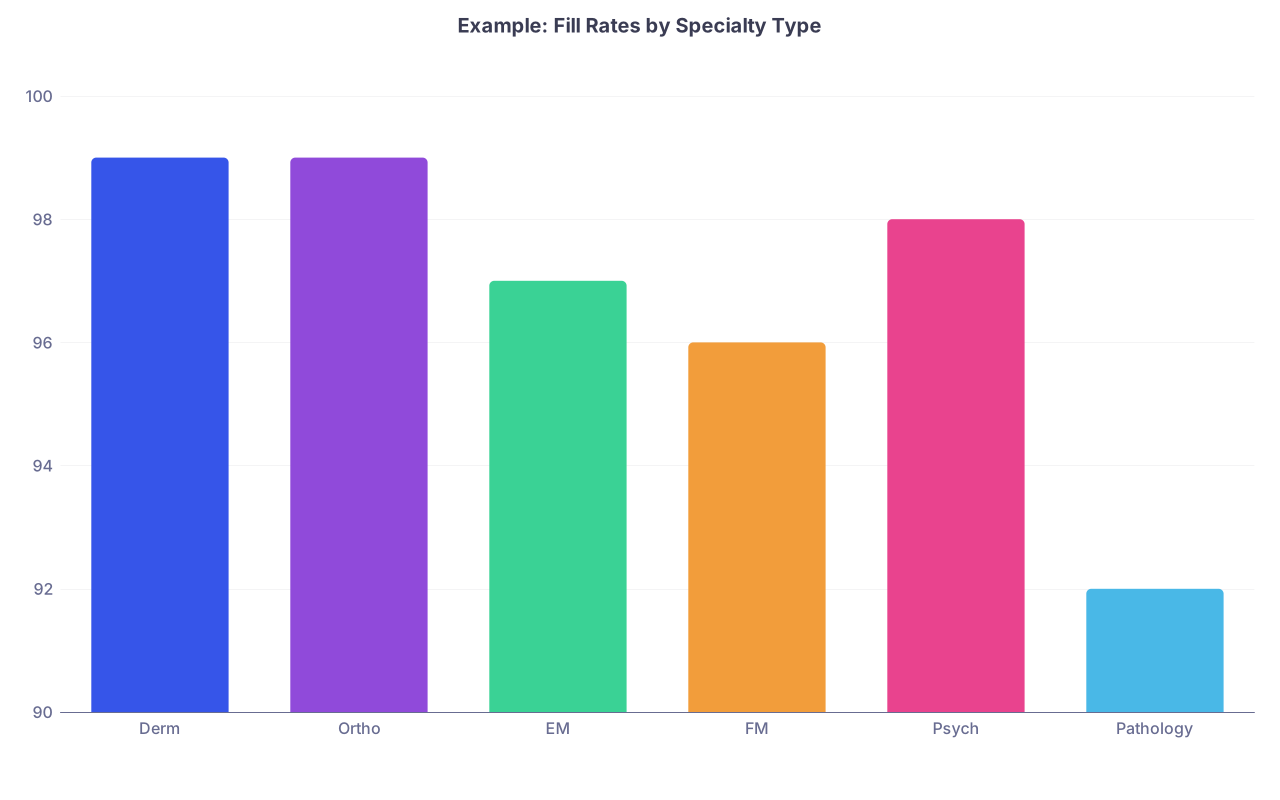
| Category | Value |
|---|---|
| Derm | 99 |
| Ortho | 99 |
| EM | 97 |
| FM | 96 |
| Psych | 98 |
| Pathology | 92 |
Interpretation, using representative NRMP-style patterns from recent years:
- Dermatology, Orthopedic Surgery, Plastic Surgery, Otolaryngology, Neurosurgery:
Fill rates ~99–100%. Almost no unfilled spots. If you miss, you usually miss the whole Match and land in SOAP without strong same-specialty options. - Family Medicine, Internal Medicine, Pediatrics:
Fill rates typically in the mid- to high-90s, but thousands of positions. A few percent unfilled still means hundreds of SOAP-eligible spots. - Pathology, Psychiatry, Prelim Surgery, some IM subspecialty tracks:
Often have higher unfilled proportions relative to their size, which means more “safety net” volume per applicant.
The raw fill rate hides the practical question: If I fail to match my target specialty, how large and realistic is the SOAP pool for me?
That is where the proportion of U.S. seniors vs others comes in.
In the NRMP “Charting Outcomes” and “Results and Data” reports, every specialty is broken down into who fills the spots:
- U.S. MD seniors
- U.S. DO seniors
- U.S. grads (non-seniors)
- IMGs (U.S. and non-U.S.)
If a specialty has:
- High total fill rate AND high U.S. senior share → brutal for SOAP; programs rarely dip into SOAP with open categorical spots.
- Moderate total fill rate AND high IMG share → these are the places where SOAP can be a real escape valve for a U.S. grad.
The mistake I see repeatedly: a student targets a mid-competitive specialty thinking “It is not derm,” but ignores that the SOAP pool is tiny or skewed toward programs that do not want U.S. seniors with failed matches.
2. High-Risk vs Low-Risk Specialties for SOAP: Data Patterns
Let us put some approximate, representative numbers on this. The exact percentages fluctuate year to year, but the pattern is stable.
2.1 Classic “High SOAP-Risk” Specialties
These are specialties where:
- Total fill rate ~99–100%.
- U.S. MD/DO seniors typically fill 80–95%+ of positions.
- Very few unfilled categorical spots remain for SOAP.
Think of:
- Dermatology
- Orthopedic Surgery
- Otolaryngology (ENT)
- Plastic Surgery (Integrated)
- Neurosurgery
- Radiation Oncology (recently a bit more volatile but still high-risk for U.S. seniors)
- Integrated Vascular and Thoracic Surgery
For a U.S. MD senior applying these specialties without a solid backup, the historical data is blunt: if you do not match in the main round, the SOAP does not save you in that same field. You are suddenly competing for prelim spots or scrambling to pivot.
2.2 “Moderate SOAP-Risk” Specialties
These sit in the middle:
- Fill rates high (96–99%) but not absolute.
- Heavy U.S. senior presence, but some programs will dip into non-traditional or IMG-heavy pools and occasionally leave seats open.
Examples:
- Emergency Medicine (recently with more vacancies, but that volatility cuts both ways)
- General Surgery (categorical)
- Anesthesiology
- OB/GYN
- Diagnostic Radiology
Historically, these specialties had minimal SOAP escape room. In recent cycles, some (like EM and Anesthesia) saw meaningful unfilled numbers. For instance, the last few Matches have had several hundred unfilled EM positions. That sounds like safety, but you need to account for a surge of unmatched and reapplicant interest flooding those empty spots.
So your SOAP risk in these fields is not binary. The data shows that:
- You are less likely to find yourself with zero options than in derm/ortho.
- But you cannot rely on SOAP to plan an EM or anesthesia career. It is a rescue mechanism, not a primary strategy.
2.3 “Lower SOAP-Risk” Core Specialties
Then you have the classic “sponge” specialties:
- Internal Medicine (categorical)
- Family Medicine
- Pediatrics
- Psychiatry
- Transitional Year and some Prelim Medicine
These specialties:
- Offer the most positions nationally.
- Still fill >90–95%, but small percentage unfilled equals large absolute numbers.
- Have sizeable IMG contingents, which correlates with more SOAP openings at less competitive programs.
| Specialty Group | Typical Fill Rate | SOAP Pool Size (Relative) | U.S. Senior Share | SOAP Risk if You Overreach |
|---|---|---|---|---|
| Derm/Ortho/Plastics/etc. | 99–100% | Tiny | Very High | Extremely High |
| EM / Anes / OB / DR | 96–99% | Small–Moderate | High | High |
| IM / FM / Peds / Psych | 94–98% | Large | Moderate | Lower (if you apply broadly) |
| Path / Prelim / TY | 90–96% | Variable–Moderate | Lower–Moderate | Highly Variable |
Interpretation: the group you choose shapes the background probability that SOAP can catch you. You are not choosing in a vacuum. You are choosing a risk distribution.
3. How Program and Applicant Behavior Drive SOAP Risk
Numbers do not exist in isolation; they come from behavior.
I have watched this play out with real applicants:
- The straight-A, 260+ Step 2 CK student who aimed only at integrated plastics and ENT with no real backup. Unmatched, then stunned there were essentially zero categorical plastics or ENT seats in SOAP.
- The mid-pack student with a 220s Step 2 CK, no research, who applied to 40 anesthesia programs and “a couple” of family medicine “just in case.” Their SOAP risk was obvious the moment I saw the ERAS list.
Here is what the data says about behavior.
3.1 Program Strategy in Competitive Fields
Highly competitive programs:
- Rank lists are long, heavy with U.S. MDs and top DOs.
- They aggressively fill in the main Match.
- They rarely leave categorical spots open. If they do, it is usually a late disaster (visa issues, funding, accreditation, etc.) not a systemic failure to fill.
Which means:
- SOAP in derm, ortho, plastics, neurosurgery is more of a theoretical concept than a realistic path for U.S. seniors.
- Any SOAP availability tends to be either:
- Prelim surgery/medicine spots.
- Outlier programs in flux or with major location/culture constraints.
If you play in this arena, you are implicitly accepting high all-or-nothing risk.
3.2 Program Strategy in Large-Core Fields
In IM, FM, Peds, Psych:
- Many programs expect to fill with a mix of:
- U.S. MD seniors
- U.S. DO seniors
- IMGs
- Some deliberately “aim high” in the rank list and accept they will fill the remainder via SOAP or post-match recruitment.
There is a reason the NRMP SOAP reports show:
- Dozens to hundreds of unfilled FM and IM categorical positions each year.
- Consistent presence of Peds and Psych in the SOAP listing, especially in less-desired geographic regions.
This is why students who carry a broad backup application in these fields significantly reduce their overall unmatched probability.
4. SOAP Risk by Specialty: Category-by-Category Reality Check
Let me synthesize this into something you can actually use while choosing.
4.1 Very High SOAP Risk: “Binary Bet” Specialties
Representative pattern:
- Fill rate: ~99–100%.
- Majority U.S. seniors.
- Very few SOAP spots, often none in stable programs.
Includes:
- Dermatology
- Orthopedic Surgery
- Otolaryngology
- Plastic Surgery (Integrated)
- Neurosurgery
- Integrated Vascular and Thoracic Surgery
For these, the data-backed rule is:
- Only go all-in without a serious backup if:
- You have top-decile metrics for that specialty (board scores, research, audition rotations, strong letters).
- You can emotionally and financially absorb a gap year or reapplication.
If your Step 2 CK is around the median for matched applicants in these specialties, you are already playing a risky game. If it is below, your SOAP risk skyrockets.
4.2 High SOAP Risk, Some Volatility: “Prestige but Not Ultra-Elite”
These specialties have grown or shrunk unevenly in recent cycles:
- Emergency Medicine
- Anesthesiology
- OB/GYN
- Diagnostic Radiology
- General Surgery (categorical)
A few data-based observations from recent NRMP cycles:
- EM went from over-applied to under-filled in some years, with hundreds of unfilled slots. That triggered a wave of “EM is dead” hot takes. The data shows something different: a temporary mismatch between applicant perceptions and workforce forecasts.
- Anesthesia and Radiology have had rising interest, but also program expansion. That tends to stabilize fill rates around the high 90s.
- Categorical Surgery is always tight. Prelim spots are plentiful; categorical SOAP spots are not.
For you, this means:
- SOAP can sometimes offer a second chance in these fields, but it is highly unpredictable.
- Those unfilled EM positions in SOAP are not all “easy wins.” Many require geographic flexibility, borderline working conditions, or a willingness to accept less academic environments.
- If you are a mid-range applicant in these specialties, laddering down to a more forgiving backup (Psych, IM, FM) in your ERAS strategy reduces unmatched risk far more than pretending SOAP will fix it.
4.3 Lower SOAP Risk: “Core Safety Net” Specialties
The primary specialties that consistently soak up unmatched U.S. grads:
- Internal Medicine
- Family Medicine
- Pediatrics
- Psychiatry
Some representative patterns from recent match data:
- IM and FM each with thousands of spots, often 100–300+ unfilled positions in SOAP across all programs combined.
- Psychiatry has tightened but still produces non-trivial SOAP volume in specific regions.
- Pediatrics remains moderately competitive in desirable programs, but lower-tier and less-central locations often under-fill.
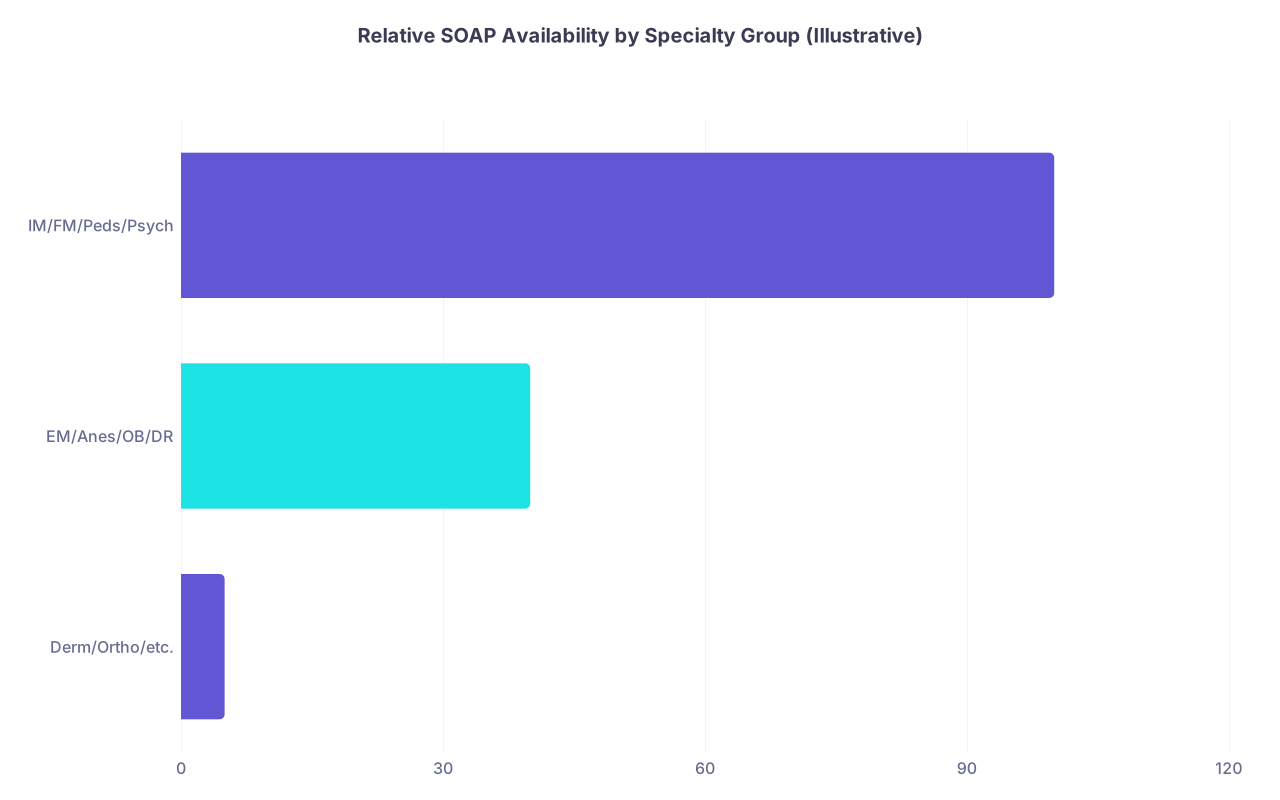
| Category | Value |
|---|---|
| Derm/Ortho/etc. | 5 |
| EM/Anes/OB/DR | 40 |
| IM/FM/Peds/Psych | 100 |
Interpreting that chart:
- The absolute numbers are illustrative, not literal, but the ratios are real.
- SOAP safety is an order-of-magnitude better in IM/FM/Peds/Psych than in derm/ortho.
So if you:
- Apply to a competitive specialty + 30–40 apps in IM or FM as a true backup.
- Are willing to rank those backup programs above “no rank.”
Then your personal SOAP risk drops sharply. You might match at a location or program you originally considered a “last resort,” but you will not be sitting on your couch Monday of SOAP trying to cold-email PDs.
5. Personal SOAP Risk: Turning Specialty Data into a Plan
Macro data is meaningless unless it changes your micro decisions.
Here is how to convert specialty fill rates into your own risk profile.
5.1 Step 1: Benchmark Yourself Against Matched Applicants
NRMP “Charting Outcomes” gives:
- Median and interquartile board scores for matched vs unmatched per specialty.
- Match rates by number of contiguous ranks in that specialty.
- Match probability by Step 2 CK ranges.
If you are:
- Above the 75th percentile of matched applicants in your target specialty on scores and research → your individual SOAP risk is mainly about your application strategy (geography breadth, number of ranks).
- Between 25th and 75th percentile → risk is moderate. Strategy and backup planning matter a lot.
- Below 25th percentile → the data shows match probabilities fall off fast. You are borrowing trouble if you do not build a real backup.
5.2 Step 2: Combine That with Specialty SOAP Profile
Now overlay your personal competitiveness onto the specialty’s structural risk:
- You low in derm/ortho/plastics/ENT?
High baseline SOAP risk × below-average applicant → statistically reckless to go all-in. - You average in anesthesia/EM/OB/rads?
High-ish risk field, moderate SOAP escape. You can try, but only with:- Broad geography.
- Sufficient program count (often 40–60+ in some specialties).
- Genuine backup field on your rank list.
- You average in IM/FM/Peds/Psych?
Lower SOAP risk, but not zero. Match probability still correlates with number of programs and how realistic your list is.
6. Strategic Scenarios: How This Plays Out in Real Life
Let me put numbers to a few patterns I have seen repeatedly.
Scenario A: High-Risk Bet, No Backup
- US MD, Step 2 CK: 245
- Target: Orthopedic Surgery
- Applications: 80 ortho, 0 backup
- Interviews: 6 ortho
- Rank list: 6 ortho
Orthopedic match data (illustrative):
- Matched median Step 2: ~250–255.
- Unmatched median Step 2: lower 240s.
- Fill rate: ~99–100%, almost no SOAP seats.
This applicant is right in the borderline group. Data suggests:
- Match probability perhaps in the 40–60% band depending on the rest of the app.
- If they fail, odds of finding an ortho categorical position in SOAP: essentially zero.
SOAP risk: high and obvious. If they had added 25–30 IM or prelim medicine programs and ranked them, their chance of being completely unmatched would fall dramatically.
Scenario B: Medium-Risk Specialty, Weak Backup
- US DO, Step 2 CK: 232
- Target: Anesthesiology
- Applications: 45 anesthesia, 8 IM
- Interviews: 7 anesthesia, 2 IM
- Rank list: 9 total programs
Anesthesia pattern:
- High 90s fill rate.
- Some SOAP availability, but limited.
This student is not disastrously underqualified, but borderline. The small IM backup list is the issue:
- If they miss anesthesia, 2 IM interviews is not a serious safety net.
- SOAP will have some anesthesia, some IM/FM, but they are competing against a large pool of similarly unmatched or reapplying candidates.
SOAP risk: still high. The data suggests they should either:
- Increase IM backup to 25–30+ programs.
- Or recalibrate expectations and commit to a core specialty from the start.
Scenario C: Smart Use of Low-Risk Specialties
- US MD, Step 2 CK: 230
- Target: Psychiatry, “but maybe I like IM”
- Applications: 45 psychiatry, 25 IM
- Interviews: 12 psych, 7 IM
- Rank list: 19 programs across both
Psych and IM:
- Large national footprints.
- Significant IMG share.
- Consistent SOAP presence.
This applicant has:
- Realistic primary target.
- Genuine, broad backup in another relatively forgiving field.
Match probability across some program is high. SOAP risk is relatively low, even if they are not a stellar candidate on paper.
7. Practical Rules to Manage SOAP Risk When Choosing a Specialty
Compressing all this data down to something you can remember:
Derm, Ortho, ENT, Plastics, Neurosurg, Integrated Vasc/Thoracic = binary bets.
You either match in the main round or you are essentially shut out of that field for that cycle. SOAP is not your friend here.Emergency Medicine and Anesthesia are not “safe” just because you heard about unfilled spots.
The recent surpluses are noisy, not guaranteed. They reduce risk somewhat but do not make SOAP a reliable entry path.Internal Medicine, Family Medicine, Pediatrics, Psychiatry are where SOAP actually works.
They consistently have enough unfilled seats to absorb a portion of unmatched U.S. grads. If you need a safety net, this is where it lives.Your personal SOAP risk = (specialty’s structural risk) × (how close you are to that specialty’s median matched profile) × (quality of your backup applications).
You control the third factor completely, and the second partially.“No backup” in a 99% fill-rate specialty is a conscious decision to accept a high unmatched probability.
Not heroic. Just numerically unwise for most applicants.
8. Final Synthesis: How to Use This Before You Click “Submit”
Before you finalize your specialty and ERAS list, do three concrete things:

| Step | Description |
|---|---|
| Step 1 | Choose Target Specialty |
| Step 2 | Check Fill Rate & U.S. Senior Share |
| Step 3 | High SOAP Risk: Add Real Backup Specialty |
| Step 4 | Moderate/Low SOAP Risk: Still Add Breadth |
| Step 5 | Benchmark Your Scores vs Matched Data |
| Step 6 | Decide Program Count & Backup Depth |
| Step 7 | 99-100% Fill? |
- Pull the latest NRMP “Results and Data” and “Charting Outcomes” for your target field. Look at:
- Fill rate.
- U.S. senior share.
- Matched vs unmatched score distributions.
- Be honest about whether you are above, at, or below the median matched profile.
- Based on that, choose a backup strategy:
- For ultra-competitive fields: a true second specialty with 20–40+ applications.
- For moderate fields: geographic breadth + at least one lower-risk field with meaningful representation on your rank list.
If you do those three things with clear eyes, you will not eliminate risk. But you will stop pretending SOAP is a magic safety net in specialties where the data shows it is nearly nonexistent.
Key takeaways:
- Fill rate and U.S.-senior share by specialty define your background SOAP risk; ultra-competitive fields (99–100% filled) give you essentially no SOAP cushion.
- Your personal unmatched probability is driven by how you compare to matched applicants and how seriously you invest in a realistic backup field, not just by how “competitive” you think a specialty sounds.