
The data shows that your specialty options start narrowing the moment your Step scores post. Not officially. But in practice.
If you ignore that reality, you make bad bets: overreaching in hyper-competitive specialties or under-shooting where you could be a strong candidate. Let’s walk through where typical Step profiles actually land across specialties and how to read your own numbers like a program director does.
I am going to speak in USMLE Step 1/Step 2 CK terms. If you are on a COMLEX-only track, the patterns are parallel: higher relative scores open more doors; lower relative scores restrict them. The exact number is less important than where you fall in the national distribution.
1. The Score Landscape: Where You Sit in the Distribution
Think like a statistician for a minute. Step scores are not magic. They are just noisy measures of test-taking ability, knowledge, and, frankly, logistical luck. But programs use them because they correlate (weakly but consistently) with board pass rates and offer an easy first-pass filter.
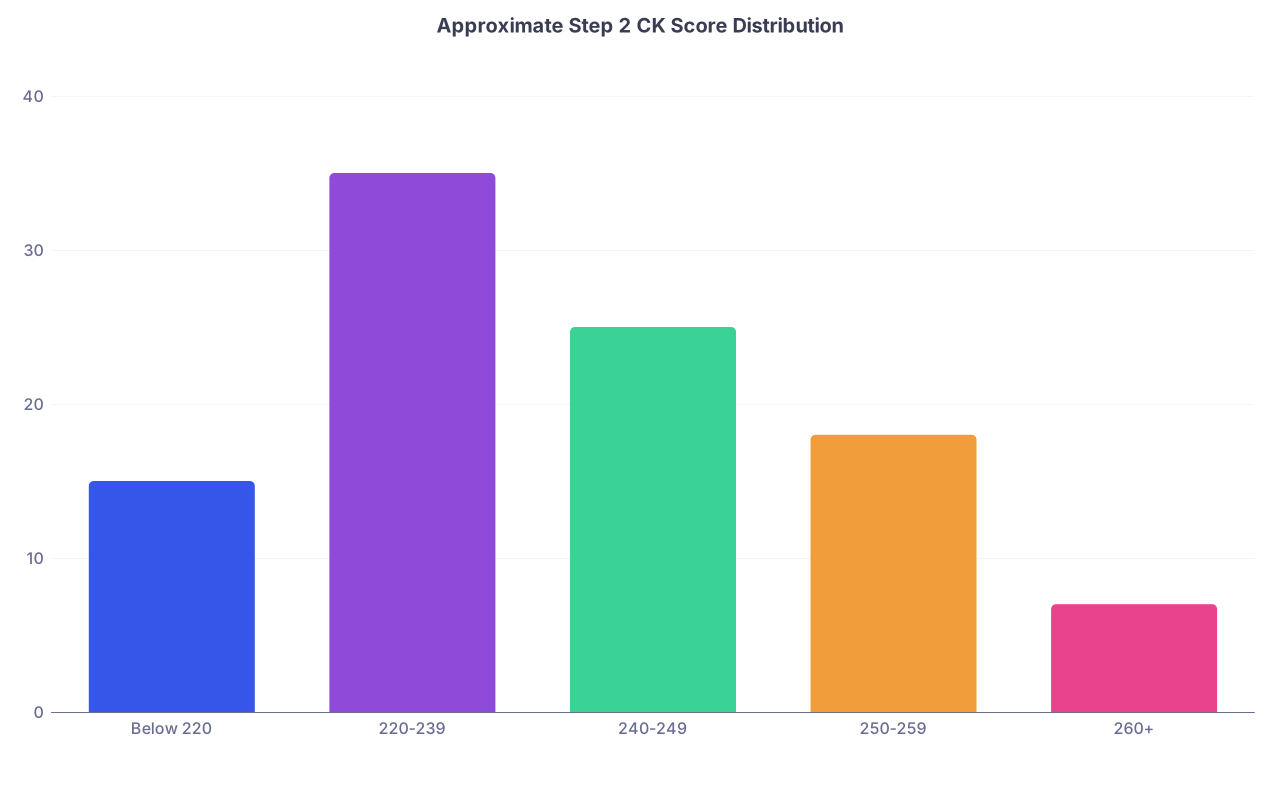
Here is the rough distribution you are playing inside for Step 2 CK (since Step 1 is now pass/fail and programs lean harder on Step 2):
| Category | Value |
|---|---|
| Below 220 | 15 |
| 220-239 | 35 |
| 240-249 | 25 |
| 250-259 | 18 |
| 260+ | 7 |
Interpretation:
- Bottom ~15%: < 220
- Large middle: 220–249 (~60%)
- Upper-middle: 250–259 (~18%)
- Top tail: ≥ 260 (~7%)
Everything that follows is essentially: “How do different specialties sample from this distribution?”
2. Score Bands and Specialty “Tiers”
Most students ask this the wrong way: “Can I do dermatology with a 245?”
Better question: “At my score bracket, what is the probability profile across specialties if the rest of my application is average? And what levers can move that?”
Let’s define functional score bands for Step 2 CK and how they map, on average, to competitiveness.
| Band | Score Range | Typical Position in Pool | Competitive Outlook |
|---|---|---|---|
| A | ≥ 260 | Top ~5–7% | Competitive everywhere with decent application |
| B | 250–259 | Top ~10–25% | Strong for most, viable for top specialties with support |
| C | 240–249 | Above average | Good fit for broad range, selective limits in top specialties |
| D | 230–239 | Slightly below/around mean | Solid for core fields, uphill for very competitive ones |
| E | < 230 | Below average | Fine for less competitive specialties and community programs |
Now overlay specialties. Think of three broad “score demand” buckets, based on NRMP data, program director surveys, and what I have seen in actual Match lists:
- Very high-demand: Dermatology, Plastic Surgery, Neurosurgery, Orthopedics, ENT, Integrated Vascular, some Integrated Thoracic
- High-demand: Diagnostic Radiology, Radiation Oncology (still), Anesthesiology at top places, EM at top places, some Gen Surg programs
- Core / moderate: Internal Medicine, Pediatrics, Family Medicine, Psychiatry, Neurology, OB/GYN, Pathology, PM&R, community General Surgery
3. Specialty-by-Specialty: What Profiles Actually Match
Let’s get specific. I will group specialties by competitiveness and show typical Step 2 CK ranges for matched U.S. MD seniors. These are approximate but directionally correct and consistent with NRMP Charting Outcomes patterns.
3.1 Hyper-Competitive Surgical and Lifestyle Fields
These are the “lottery ticket” specialties where the score bar is high and the variance is enormous.
| Specialty | Typical Matched Range (Step 2 CK) | Weak Zone (High Risk) | Safer Zone (If Other Factors Strong) |
|---|---|---|---|
| Dermatology | 255–265+ | < 245 | 255+ |
| Plastic Surgery | 255–265+ | < 245 | 255+ |
| Neurosurgery | 250–260+ | < 240 | 250+ |
| Orthopedics | 245–258 | < 235 | 245+ |
| ENT (Otolaryng.) | 250–260 | < 240 | 250+ |
The data shows a consistent pattern: above ~250, the probability of matching in these fields increases sharply, assuming you have:
- Strong home or away rotation performance with honors
- At least some research or concrete academic output
- No red flags
A 260 without a home program, research, or strong letters can lose to a 248 with glowing letters from a known department chair. But if you are in band C (240–249), and especially below 245, you are fighting uphill in this group. Not impossible. Just low probability unless:
- You have a very strong home department that truly advocates for you
- You have an unusual research footprint (multiple pubs, national presentations)
- You apply very broadly and are flexible about geography and prestige
If you are in the 230s and dead set on ortho or neurosurgery, you are making a high-risk gamble. The historical unmatched rates in these groups are not theoretical. They are ugly.
3.2 Competitive but More Forgiving: Rads, Anesthesia, EM, Some Surgery
These specialties value strong scores but do not concentrate exclusively at the extreme right tail.
| Specialty | Typical Matched Range | Competitive Zone | Still Viable With Support |
|---|---|---|---|
| Diagnostic Radiology | 245–255 | 250+ | 240–249 |
| Radiation Oncology | 245–255 | 250+ | 240–249 |
| Anesthesiology | 240–252 | 245+ | 235–244 |
| Emergency Medicine | 235–248 | 240+ | 230–239 |
| Categorical Gen Surg | 238–250 | 242+ | 232–240 |
Radiology: Programs like scores. They worry about physics boards and written boards. With 250+, doors are open across academic and community. In the 240s, you are competitive at many places, less so at the most elite. Below 240, you are not done, but you need strong letters, maybe a home program that knows you, and realistic expectations.
Anesthesia and EM are interesting. Historically, EM was very score-sensitive; more recently, application inflation and departmental culture have made SLOEs and rotations at least as important. With a 230-something, I have seen people match EM at solid programs when their SLOEs say “Top 10% student I have ever worked with.”
General Surgery: Pure score cutoffs are common. Many academic programs start glancing seriously at 240+. Community programs are often more flexible. I have seen 230–235 applicants match categorical surgery when they had:
- A home gen surg department advocating for them
- Multiple away rotations with strong evaluations
- A big application list (40–60 programs)
3.3 Core Specialties: IM, Peds, FM, Psych, Neuro, OB/GYN
This is where most students actually land. The score distributions are wide. Scores matter, but not in the way they do for derm.
| Specialty | Common Matched Range | Strong Applicant Zone | Risk Zone (US MD) |
|---|---|---|---|
| Internal Med | 230–250 | 240+ | < 225 |
| Pediatrics | 225–245 | 235+ | < 220 |
| Family Med | 215–240 | 225+ | < 210 |
| Psychiatry | 225–245 | 235+ | < 220 |
| Neurology | 225–245 | 235+ | < 220 |
| OB/GYN | 230–245 | 238+ | < 225 |
In these fields, the data shows a different kind of stratification:
- Scores determine which tier of program is accessible, not whether you match at all (for U.S. MDs with no major red flags).
- A 260 in Internal Medicine does not just “get you IM.” It gets you into the consideration set at MGH, UCSF, Hopkins, Penn, etc., if the rest of the application holds.
- A 225–230 tends to steer you toward mid-tier academic and strong community programs, which are perfectly fine training environments.
Family Medicine is the least score-sensitive; once you clear the boards comfortably, other factors start to dominate: geographic ties, language skills, commitment to primary care, and clinical performance.
Psychiatry used to be the backup; now it is steadily more competitive. But still nowhere near derm. A 230 might not open the door at the most elite coastal academic programs, but you will not be shut out of psych unless there are other issues.
OB/GYN and Neurology sit in the middle—enough competition that being under 225 as a U.S. MD begins to hurt, especially with multiple fails or leaves.
3.4 The Hidden Variable: Program Type
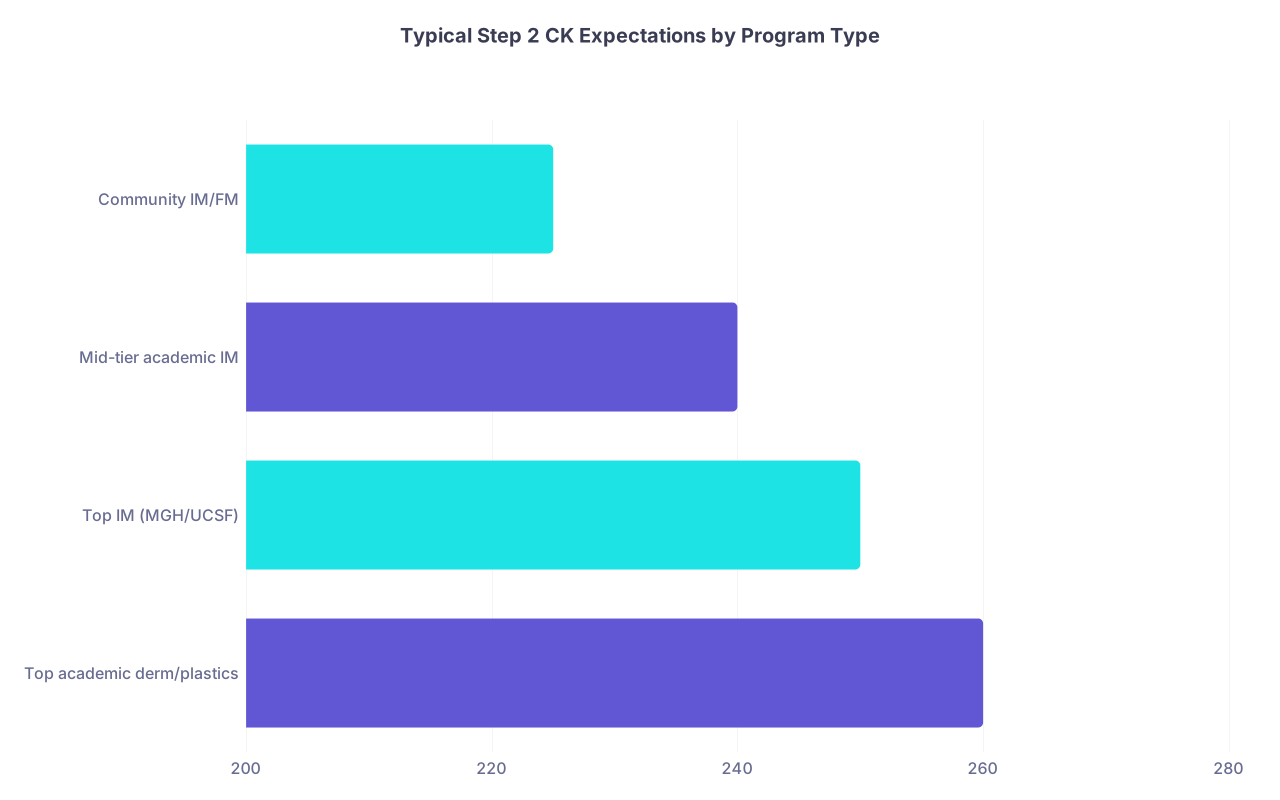
Scores mean different things at different program tiers.
| Category | Value |
|---|---|
| Top academic derm/plastics | 260 |
| Top IM (MGH/UCSF) | 250 |
| Mid-tier academic IM | 240 |
| Community IM/FM | 225 |
Rough interpretation of “comfortable” scores:
- Top academic derm/plastics: 260+ is where you stop being disqualified by scores alone
- Top academic IM: 245–255, with 250+ making your file easier to champion
- Mid-tier academic IM: 235–245
- Community IM/FM: 215–230 is usually fine if passes are clean
This is why two applicants with “the same specialty” can have wildly different experiences depending on where they aim.
4. Reading Your Own Profile: Probabilities, Not Absolutes
Now the part you actually care about: “Where do my numbers realistically fit?”
Let us define a simple framework with three components:
- Step 2 band
- Specialty competitiveness group
- Application strength outside scores (weak / average / strong)
4.1 Quick Probability Matrix
Assume U.S. MD, one pass on each Step, no major professionalism issues.
| Step 2 Band | Hyper-Competitive (Derm/Ortho/ENT etc.) | Competitive (Rads/Anes/EM/Gen Surg) | Core (IM/Peds/FM/Psych/Neuro/OB) |
|---|---|---|---|
| ≥ 260 | Moderate–High if rest strong | High | Very high across tiers |
| 250–259 | Low–Moderate; needs strong app | Moderate–High | Very high |
| 240–249 | Low; needs exceptional support | Moderate | High |
| 230–239 | Very low; rare success stories | Low–Moderate (community, some acad.) | High (excluding top academic) |
| < 230 | Essentially negligible | Low (select programs) | Moderate–High (FM, many Peds/IM) |
You can move one “probability step” up with a very strong application outside scores:
- Real research productivity (not one poster; think multiple outputs or one serious project)
- Outstanding clinical evaluations and letters, especially from known faculty
- A home department that wants you badly
- Strategic away rotations where you perform at the top of the group
You can also move one or two steps down with:
- Fails on any Step
- Big gaps without explanation
- Weak or generic letters
5. Step 1 Pass/Fail: How Programs Now Weight Step 2
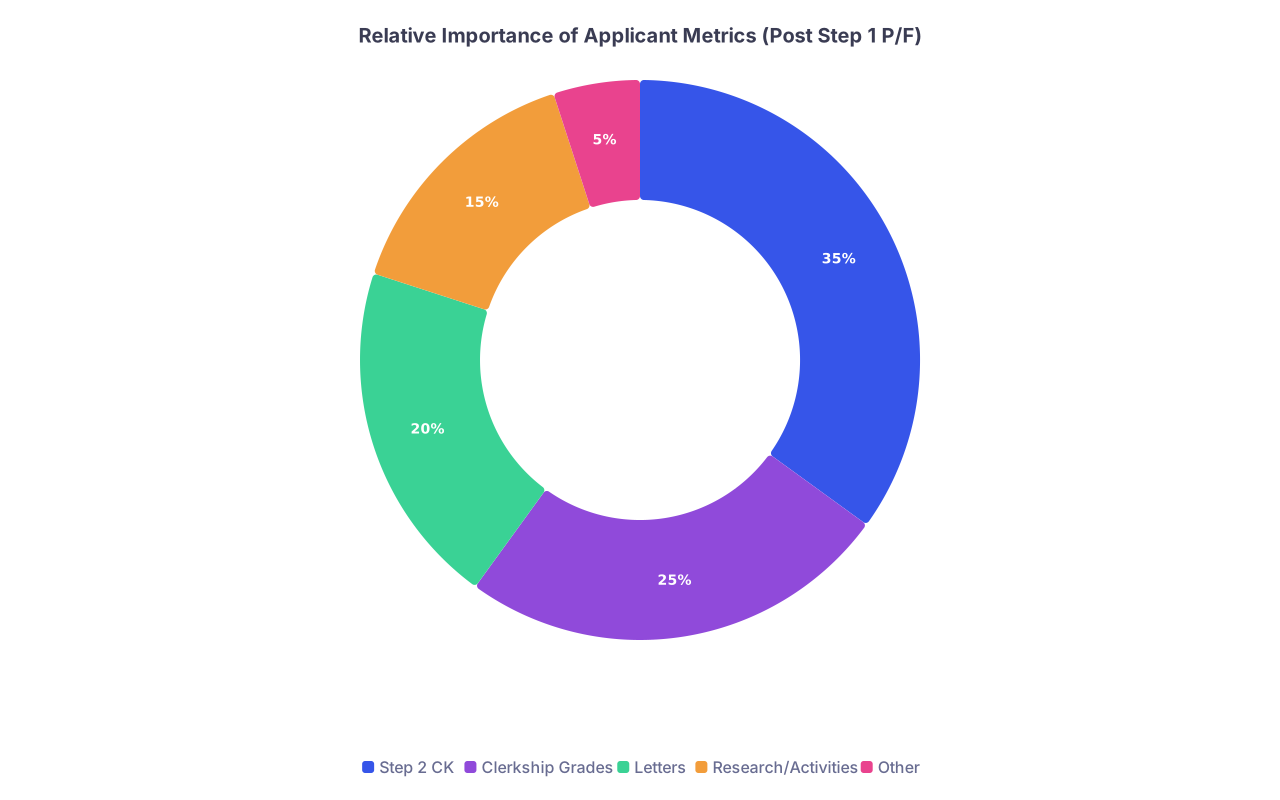
The Step 1 pass/fail change did not remove standardized test pressure. It shifted it. Program director surveys post-change show a few clear trends:
| Category | Value |
|---|---|
| Step 2 CK | 35 |
| Clerkship Grades | 25 |
| Letters | 20 |
| Research/Activities | 15 |
| Other | 5 |
Step 2 CK is now the main quantitative filter:
- For competitive specialties, a high Step 2 becomes essential to offset the missing Step 1 stratification.
- For core specialties, Step 2 still matters, but clerkship grades piece in more heavily.
If your Step 1 was a marginal pass after multiple attempts, you are not doomed, but programs will ask: “Was it a fluke, or a pattern?” A very strong Step 2 (say, 245+ after a barely passing Step 1) sends a clear signal that you course-corrected.
6. Strategy by Score Band: Where to Lean In or Pivot
You cannot change a posted score. You can absolutely change your strategy.
6.1 If You Are ≥ 260
You are in the top tail. The worst move here is fear-driven under-aiming without reason.
- Hyper-competitive specialties are on the table. Choose them only if your clinical likes/dislikes align, not just because your score allows it.
- For core specialties, your score gives you access to the top academic programs. Use it if you care about research-heavy careers, subspecialty fellowships, or academic medicine.
I have watched 260+ applicants sleepwalk into generic program lists and end up in good but not great fits because they assumed “I am fine anywhere.” Use your leverage intentionally.
6.2 If You Are 250–259
You are in a sweet spot: strong everywhere, including many competitive fields, but not automatically guaranteed at the very top.
- Competitive surgical/lifestyle fields: You are viable, but you will still see rejections and silence from some places. That is normal.
- Rads/Anesthesia/EM/Gen Surg: You are a highly attractive candidate if clinical performance is solid.
- Core fields: You are likely above average at most programs; doors open widely.
Your biggest risk is over-concentrating your list in top 10–15 programs in any specialty. Even at 255, send a balanced list.
6.3 If You Are 240–249
This is the real hinge group. You are above average, but not by a huge margin.
For hyper-competitive specialties, every other part of your application must pull hard:
- A 246 with 5 first-author pubs in orthopedics and a chairman letter is materially different from a 248 with no research.
- You need a large, geographically flexible list.
For rads/anesthesia/EM/gen surg, you are very much in the game. Programs in major metros and high-prestige places will still be selective, but you will have a thick match list if you are realistic.
For core specialties, you are doing well. Use your score to target environments that match your career plans: research-heavy? community-focused? global health?
6.4 If You Are 230–239
Here is where rational pivot conversations usually need to happen.
- Hyper-competitive fields become long-shot bets. One or two such programs on your list is fine. Building your whole application around them is denial.
- Rads/anesthesia/gen surg/EM remain possible but require broad applications, open geography, and strong non-score strengths.
- Core specialties will treat you as a pretty standard applicant at many programs, especially outside the top academic tier.
At this level, clinical performance is often the tie-breaker. Outstanding comments on medicine/surgery rotations can easily outweigh a 10-point score gap.
6.5 If You Are < 230
The data shows that U.S. MDs below 230 still match very well—just into different clusters of specialties and program types.
- Family Medicine, many Pediatrics and Internal Medicine programs, Psychiatry, and Neurology remain accessible.
- Your focus should be on: passing everything cleanly, building strong relationships on rotations, and articulating a clear, believable specialty interest.
Trying to force your way into derm or plastics from this band is not “shooting your shot.” It is gambling residency itself.
7. Practical Next Steps: Turning Data into Decisions
Let me condense the analytics into actions.
7.1 Map Yourself Against Typical Match Ranges
Take your Step 2 CK. Pick 2–3 specialties you are genuinely considering. Drop yourself into that specialty’s approximate range from earlier. Ask:
- Am I in the typical matched range, above it, or below it?
- Am I aiming mostly at programs where my score is an asset, neutral, or liability?
If you are below the typical range for a hyper-competitive field and have no compensating strengths, you are in fantasy territory.
7.2 Build a Tiered Application List
Regardless of specialty, aim for something like:
- 20–30% reach programs (score below their typical average, but you have other strengths)
- 50–60% target programs (score in their typical range)
- 20–30% safety programs (you are clearly above their usual cutoffs)
For derm/ortho/ENT/neurosurgery, the absolute number of applications needs to be higher due to lower base probabilities.
7.3 Use Non-Score Signals Intelligently
Scores open the door. Letters, clinical performance, and coherent interest get you in the room.
Be very strategic about:
- Rotations where you can be observed and strongly advocated for
- Research that actually produces lines on your CV
- Personal statements that show genuine specialty fit, not generic enthusiasm
8. The Bottom Line: Where Your Numbers Fit
You cannot rewrite your score report. You can absolutely avoid lying to yourself about what it means.
Three takeaways:
- Scores stratify which programs and which specialties you are competitive for; they do not alone determine your fate, but they sharply shape probabilities.
- Hyper-competitive specialties are heavily right-tailed. For most applicants outside the 250+ band, they require either exceptional non-score strengths or a willingness to accept a high risk of not matching.
- For the majority of students in the 230–249 range, core specialties and many competitive-but-accessible fields are wide open. The real differentiators become clinical performance, letters, and a smart, data-informed application strategy.
Use your numbers the way program directors do: as one quantitative input, not your entire identity. Then make choices that match both the data and the life you actually want.