
The belief that “you can practice any specialty anywhere” is wrong. The data show that your choice of specialty heavily constrains where you can realistically live and work.
If you care about geography—and most students do, even if they pretend otherwise—you need to treat “location flexibility” as a core variable, not an afterthought. This is not about vibes. It is about numbers: headcount, market saturation, and how hospitals are distributed across the country.
Below I will walk through which specialties offer wide geographic choice, which lock you into metro areas, and how this plays out in training (residency) versus long‑term practice.
The core problem: supply, demand, and hospital dependence
Look at specialty geography through three quantitative lenses:
Absolute workforce size – How many physicians are there in this specialty nationally?
More bodies → more positions → more cities have at least one job.Setting dependence – Does this specialty require a hospital with advanced infrastructure?
The more hospital‑dependent you are, the more you get tethered to larger cities or regional hubs.Population threshold – What minimum catchment population is needed to justify one FTE (full‑time equivalent) in that field?
If you need a metro of 1 million people to support a single practice, you are not moving to rural Montana.
Each specialty is basically a different combination of those three variables.
Let me quantify this a bit. Using AMA Physician Masterfile counts and AAMC distribution reports as broad reference points (numbers rounded for clarity):
| Specialty Group | Approx. Active Physicians |
|---|---|
| Internal Medicine (all) | ~120,000 |
| Family Medicine | ~90,000 |
| Pediatrics | ~60,000 |
| General Surgery | ~25,000 |
| Emergency Medicine | ~45,000 |
| Anesthesiology | ~40,000 |
| Psychiatry | ~50,000 |
Even before subspecialties, you can see where the “mass” is. Primary care and broad generalist fields dwarf highly focused subspecialties. That mass translates directly into more cities and towns having that specialty represented.
Broad winners: specialties with the highest geographic flexibility
Let’s start with the specialties that actually give you a wide location choice—both for residency and for practice.
1. Family Medicine: the clear leader in geographic freedom
If you want maximum control over location, Family Medicine wins by a large margin.
Family physicians are spread across:
- Major academic centers
- Suburbs
- Mid‑sized cities
- Small towns
- Truly rural counties where they are the only physician within 30–50 miles
Family Medicine has:
- A huge residency footprint (over 750+ programs), with positions from Boston and Seattle down to towns you have never heard of.
- A practice footprint that covers almost every county with any meaningful population.
The data on rural distribution are brutal for other specialties. For example:
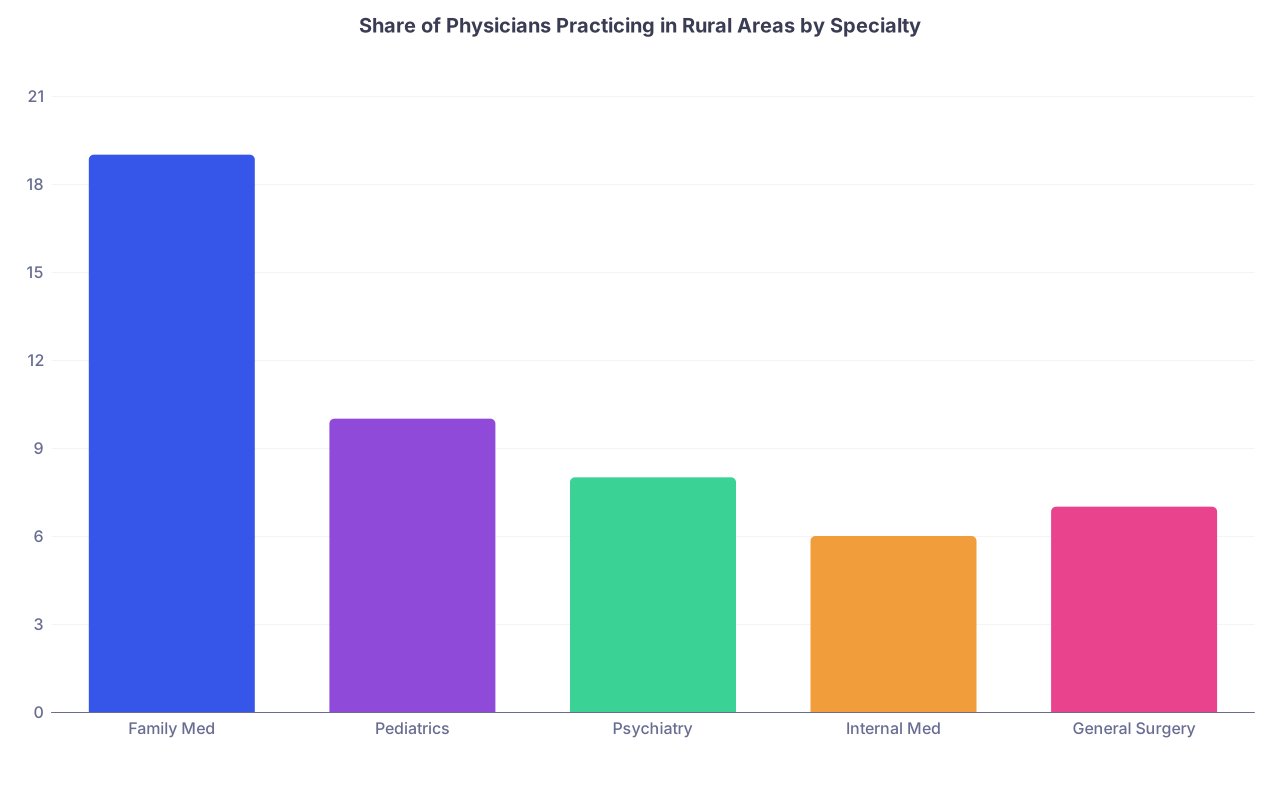
| Category | Value |
|---|---|
| Family Med | 19 |
| Pediatrics | 10 |
| Psychiatry | 8 |
| Internal Med | 6 |
| General Surgery | 7 |
Those percentages (rounded, pulled from multiple workforce reports over recent years) show one consistent pattern: Family Medicine is roughly 2–3x more likely than other major specialties to have physicians in rural areas.
In practice, what this means for you:
- If you want the option to live in a town of 10,000–30,000 people, Family Medicine is your most reliable path.
- If you want to move for a partner’s job in a random midwestern city, you will almost always find work.
- Telemedicine is expanding options further, but the baseline geographic flexibility is already very high.
Trade‑off: You give up procedure‑heavy work and high average compensation compared with many hospital‑based specialties. But pure location flexibility? Hard to beat.
2. Internal Medicine (general and hospitalist): flexible, but more urban‑tilted
General Internal Medicine and hospitalist work offer significant flexibility, but with a bias toward populated areas.
Why? The data structure is straightforward:
- Hospitalists need hospitals.
- Hospitals cluster in population centers.
- Critical access hospitals exist in rural areas, but many are small and may have limited FTE slots.
Even with that, Internal Medicine physicians are everywhere from tertiary care centers to community hospitals in towns of 30–50k. The number of residency programs is also very large and widely distributed—over 550+ programs—giving you a lot of training location flexibility.
Where Internal Medicine starts to lose geographic freedom is when you subspecialize.
- Cardiology, GI, Heme/Onc, Pulm/CC—these fields require robust inpatient volumes, imaging, cath labs, infusion centers, etc.
- Many of those jobs cluster around metro areas and regional hubs (say, population 100k+ at minimum, more often 250k+).
So if you stay generalist or hospitalist, Internal Medicine is high‑flexibility. If you push into a procedure‑heavy subspecialty, you gradually constrain your geographic range to mid‑sized and larger cities.
3. Pediatrics: broad, but less rural than FM
Pediatrics has a wide geographic range but a different pattern:
- General outpatient peds: widely distributed, decent presence in mid‑sized cities and large towns.
- Subspecialty peds (NICU, peds cards, heme/onc, peds GI): strongly concentrated at children’s hospitals and academic centers.
The problem is demographic arithmetic. Pediatric panels are smaller, and kids are a subset of the population. Many rural and small town settings cannot support a full‑time pediatrician, so those patients get seen by Family Medicine.
Result: Pediatrics is flexible if you are okay with at least mid‑sized city or strong regional hub. Less flexible if your dream is a clinic in a rural town. And very geographically constrained if you go into a peds subspecialty that requires a tertiary children’s hospital.
4. Psychiatry: almost as flexible as Family Medicine, but less rural
Psychiatry sits in an interesting middle ground.
The shortage is nationwide. Demand is high in:
- Large cities
- Suburbs
- Small cities
- Many rural regions
But the practice model often skews toward:
- Community mental health centers
- Hospital‑based consult services
- Group practices in decently populated areas
Telepsychiatry pushes the field toward more geographic freedom—many psychiatrists now live in metro areas and treat patients statewide, including rural communities. But if you want physical presence in a very small town, Psychiatry is moderately less represented than Family Medicine.
From a raw distribution perspective, though, Psychiatry offers strong flexibility: you can reasonably expect to find jobs in almost any state and in a wide range of community sizes.
Mid‑range: specialties with moderate but not universal location choice
Now we move to fields where you still have options, but the map narrows.
5. Emergency Medicine: broad, but tied to hospital density
Emergency Medicine positions are anchored to EDs. No ED, no EM job.
Every:
- Trauma center
- Community hospital
- Many critical access hospitals
need some level of emergency coverage. So you do see EM physicians in rural and semi‑rural areas. But:
- Larger EDs and higher‑acuity centers are clustered in more urban regions.
- Smaller hospitals may use a mix of EM‑trained and non‑EM physicians or locums.
So your geographic flexibility is solid across mid‑sized cities and above, with selective rural options. But if you draw a map of tiny towns with <10k people, you will not see the density that Family Medicine enjoys.
Residency programs also cluster around hospitals with EDs large enough to support teaching; that excludes many smaller locations. So during training, your geography is even more city‑biased than in eventual practice.
6. Anesthesiology: available in many regions, but usually near city centers
Anesthesiologists go where the operating rooms are:
- Large hospitals
- Surgical centers
- Regional referral hubs
Population threshold here is not trivial. A solo anesthesiologist in a town of 8,000 people with a four‑OR hospital is unusual. Most will work in or near mid‑sized cities and above.
The workforce is ~40,000+ anesthesiologists nationwide. That is enough to support a broad spread of job markets, but not enough to saturate very small population centers everywhere.
What you get:
- Good flexibility across metro and mid‑size markets
- Some presence in smaller communities with regional hospitals
- Limited ability to choose any random small town
If you know you want “a biggish town, not NYC‑level, but with a decent hospital,” Anesthesiology can work geographically. If your dream is a farm town with a single stoplight, no.
7. General Surgery: moderate flexibility, but still hospital‑bound
General surgeons follow a pattern similar to anesthesiologists, with a slightly different shape.
They are essential in:
- Regional hospitals
- Critical access facilities with ORs
- Trauma centers
Many small towns still have one or two general surgeons covering a surprising amount of territory. But the total workforce (~25,000) is not large, and work is heavily skewed to hospital settings with adequate OR volume.
Result:
- You have decent geographic spread but fewer “anywhere” options than Family Medicine or Psychiatry.
- Rural general surgeons exist, but positions are limited and turnover is low—so you cannot count on moving to any specific tiny town right after residency.
For training, general surgery residencies align with larger hospitals and academic centers, so your resident years will mostly be spent in mid‑size and larger cities.
Highly constrained: specialties that concentrate in metro and academic centers
Now the bad news for geographic control: the more specialized and tech‑dependent you get, the more your location flexibility collapses.
These specialties generally anchor around:
- Large tertiary hospitals
- Academic medical centers
- Regional subspecialty groups
8. Radiology and Radiation Oncology
Radiology is hospital‑ and imaging‑center dependent. You do see teleradiology, but the physical job markets cluster in:
- Metro regions with multiple hospitals
- Large imaging groups
Radiation Oncology is even tighter:
- Requires linear accelerators and cancer centers
- Often tied to academic or major regional hospitals
- Workforce is relatively small
There are entire rural regions with zero radiation oncologists and limited radiology subspecialists. If you want to live near mountains, beaches, or a specific lifestyle metro, you might be fine. If you want “anywhere on the map,” you are constrained to where the machines and volumes are.
9. Surgical subspecialties (Ortho, ENT, Urology, Neurosurgery, etc.)
These fields require:
- High case volume
- OR infrastructure
- referral streams large enough to sustain them
Population thresholds here often push you into metro or strong regional hubs. Yes, there are orthopedic surgeons in towns of 50k, sometimes less. But neurosurgeons in a town of 12k? No.
The pattern:
- Large and mid‑size cities: multiple groups, steady turnover = multiple viable job markets
- Small towns: rare positions, low turnover, often single‑group monopolies with very specific hiring needs
For many of these fields, you are not only geographically constrained but also market constrained—you may find that a state has only a small number of groups, and they are not all hiring at the same time.
10. Highly niche or tech‑heavy specialties (Dermatology, Ophthalmology, Allergy, etc.)
These are often private‑practice heavy, concentrated where patients can and will pay, and where enough population exists to support narrow scopes of practice.
- Dermatology: heavily urban/suburban, with some presence in mid‑size towns. Few positions in very small towns.
- Ophthalmology: needs surgical volume and equipment. Some smaller cities have one or two, but the distribution is not as dense as core primary care.
- Allergy/Immunology, Rheumatology, Endocrinology, etc.: outpatient subspecialties that are present mostly in metro and large regional hubs.
You may see odd exceptions (a lone dermatologist in a rural state capital), but as a rule the data skew urban.
Residency vs. practice: two separate geography questions
Medical students often mix two separate questions:
- Where can I do residency in this specialty?
- Where can I eventually practice and live long term?
These are related but not identical.
Distribution of residency programs
Family Medicine, Internal Medicine, and Pediatrics have the largest number of residency programs, scattered across:
- Academic centers
- Community programs
- Rural training tracks
On the other hand:
- Neurosurgery, ENT, Urology, Integrated Plastics, Rad Onc have far fewer programs, tightly clustered at large hospitals.
So if you care about living in a specific state during residency, you get:
- High odds with FM/IM/Peds/Psych/EM.
- Much lower odds with highly specialized or small‑footprint fields.
Job markets after training
The job market geometry shifts again post‑residency. A simple mental model:
- Primary care and Psychiatry → positions almost everywhere, including small and mid‑sized markets.
- Hospital‑based broad specialists (EM, Anesthesia, Gen Surg) → positions in any town with a real hospital.
- Subspecialties → positions concentrated in cities with tertiary centers or large private groups.
To visualize this, imagine a rough “location flexibility index” from 1 (very constrained) to 10 (almost anywhere). This is not an official metric, but it captures the broad reality:
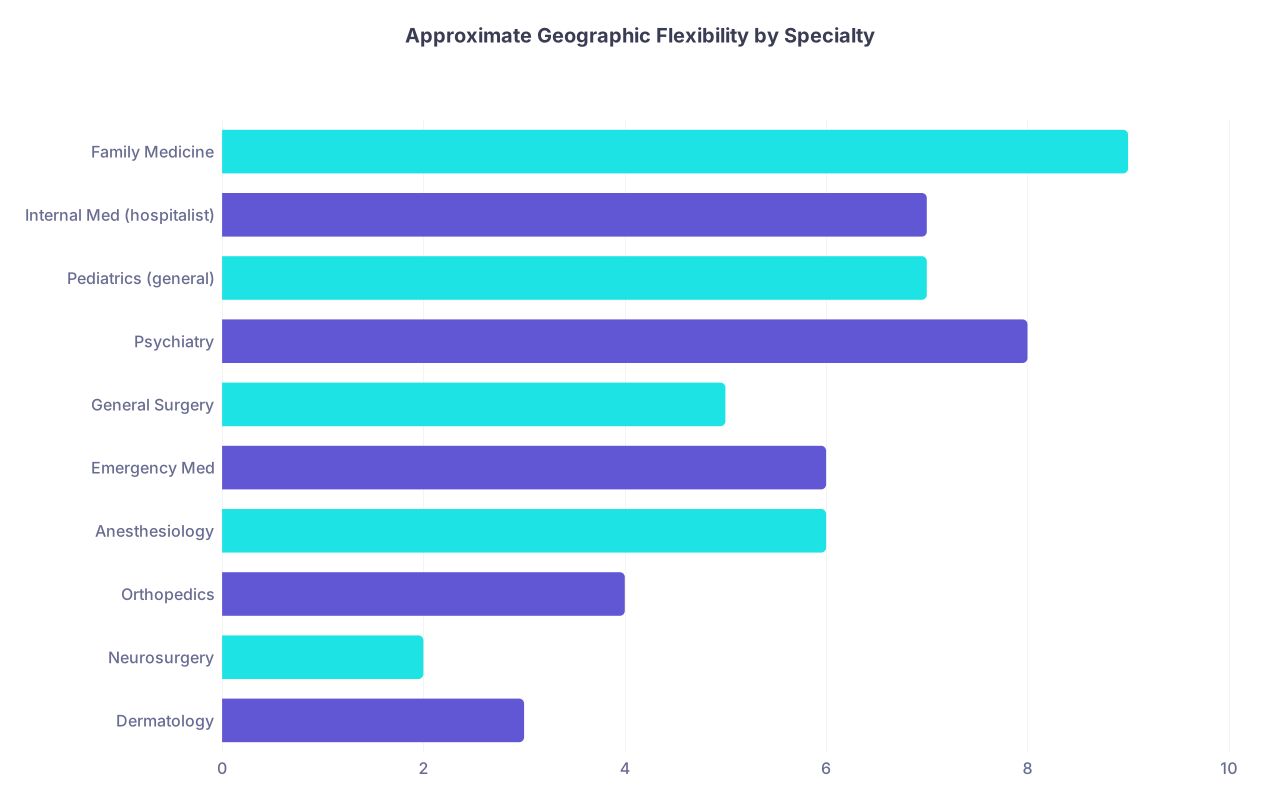
| Category | Value |
|---|---|
| Dermatology | 3 |
| Neurosurgery | 2 |
| Orthopedics | 4 |
| Anesthesiology | 6 |
| Emergency Med | 6 |
| General Surgery | 5 |
| Psychiatry | 8 |
| Pediatrics (general) | 7 |
| Internal Med (hospitalist) | 7 |
| Family Medicine | 9 |
You can fight about whether Psychiatry is an 8 or a 9. That is not the point. The point is relative ranking. And that ranking aligns with where physicians actually work.
How to use this data when you are still in medical school
Let me be direct: if you have strong geographic preferences, pretending “I will just figure it out later” is how you end up angry at match lists.
Here is how you can be more quantitative about it.
Define your acceptable population range.
Are you okay only with cities >500k population? Or do you want the option of a town <50k? Different specialties fit different ranges.Map specialty to population threshold. Roughly:
- Can live in very small towns: Family Med > some General Surgery > some IM/Peds
- Needs at least mid‑size city or strong regional hub: EM, Anesthesia, Psych, most IM subspecialties
- Mostly metro/large city: Derm, Neurosurg, Rad Onc, many surgical subspecialties
Look at state‑level workforce maps. AAMC, state medical boards, and some specialty societies publish distribution maps. If a specialty has entire swaths of the country with 0–1 physician, your geographic flexibility is low.
Talk to recent graduates in that field. Ask exactly what cities they got offers in, and which regions were “dead zones.”
Quick specialty snapshots: location choice in one paragraph each
I will compress the key geography datapoints:
Family Medicine – Highest geographic freedom. Meaningful presence from major metros down to very small towns. Strong rural footprint. Huge residency spread.
Internal Medicine (general / hospitalist) – High flexibility across mid‑size and large cities, some presence in smaller towns with hospitals. Subspecialization reduces rural options.
Pediatrics (general) – Good flexibility in larger towns and cities; rural areas often covered by FM. Peds subspecialties are tightly linked to children’s hospitals and big systems.
Psychiatry – High flexibility, strong demand everywhere, increasingly powered by telehealth. Physical presence in the smallest towns is less common, but job options are excellent in most regions.
Emergency Medicine – Solid flexibility wherever there are EDs, from regional hospitals to urban trauma centers. Limited in regions with few hospitals.
Anesthesiology – Good spread across cities with hospitals and surgical centers. Limited presence in very small towns without robust OR volumes.
General Surgery – Present in many towns with ORs, including some rural regions. But the small absolute workforce makes jobs fewer and more competitive in desired small markets.
Radiology / Rad Onc – Heavily metro and large‑hospital based, though teleradiology blurs geography. Rad Onc is particularly tied to cancer centers and is very location‑constrained.
Surgical subspecialties (Ortho, ENT, Urology, Neurosurg, etc.) – Concentrated in larger cities and regional hubs. Some presence in mid‑size towns for certain fields (Ortho, Urology), but overall much less flexible than primary care.
Dermatology, Ophthalmology, Allergy, other niche outpatient subspecialties – Mostly urban and suburban. Jobs exist in some mid‑size cities, but you cannot assume presence in every small town.
The bottom line
Three key points:
- Primary care (especially Family Medicine) and Psychiatry offer the widest geographic choice, including rural and small‑town options.
- Hospital‑based generalists (EM, Anesthesia, General Surgery, hospitalist IM) give solid flexibility, but mostly within the universe of cities and towns that have real hospitals.
- Subspecialized and tech‑heavy fields cluster in metro and academic centers, limiting your ability to “live anywhere” regardless of salary or prestige.
If geography is a high‑priority constraint for you, the numbers push you toward broad, generalist specialties. The more niche you go, the smaller your map gets.