
The worst specialty decision you can make isn’t picking the “wrong” field. It’s pivoting too late and blowing your shot at matching safely.
You’re not actually choosing a specialty once. You’re re-choosing it every month from late third year until ERAS opens. Let me walk you through exactly when you can still pivot, when you’re in the danger zone, and what you must have done by each point if you change directions.
This is your timeline for safely changing specialty before ERAS opens—month by month, then week by week as you approach the edge.
Big Picture: Safe vs Risky Pivot Windows
At this point, you need a simple mental model.
| Timeframe Relative to ERAS | Pivot Risk Level | What’s Realistic |
|---|---|---|
| 9–12 months before | Low | Full pivot, strong application |
| 6–8 months before | Moderate | Solid pivot with planning |
| 3–5 months before | High | Targeted pivot, fewer programs |
| <3 months before | Very High | Only if new specialty is non-competitive |
And here’s the brutal truth:
Your pivot window is defined by letters, rotations, and Step/COMLEX timing. Not your feelings. Not your “dream specialty.”
Phase 1: Early Third Year – Exploration with Optional Pivot Potential (≈ 12–9 Months Before ERAS)
At this point (start of M3 to about 9–12 months before ERAS opens), everything is still cheap. You can be wrong. You can change your mind. Safely.
What you should be doing now
Run every core rotation as if you might choose it.
- Medicine, surgery, peds, OB/GYN, psych, family, neuro.
- Get at least one potential letter writer from each core. That’s your pivot insurance.
- Even if you hate surgery, don’t sabotage your evals. You may need that “work ethic” comment later.
Document concrete experiences, not vague vibes. Keep a running note on your phone with:
- Patient encounters that moved you
- Attendings/residents you want to emulate
- Cases that bored you to tears
- Your actual daily schedule and how drained or energized you were
This is the data you’ll need when you realize in May that ortho isn’t it and you’re flirting with anesthesia.
Protect your exam timeline.
- If Step 2/COMLEX 2 is still ahead, plan to have your score back by early ERAS season in case your new specialty cares about it.
- Competitive specialties (derm, ortho, ENT, plastics, neurosurg, IR) basically assume you’re committed by early M3. If you’re already mid-M3 and unprepared, understand you’re behind for those.
Safe pivot moves in this window
At this point, you can:
- Go from “maybe IM” to “maybe neurology” or “maybe cards later” with no drama.
- Float between peds vs family vs med-peds.
- Start thinking about lifestyle-heavy vs procedure-heavy paths (radiology, anesthesia, EM, etc.).
This is your lowest-risk time to change your mind repeatedly. Just don’t burn bridges. You’ll need those letters.
Phase 2: Mid–Late Third Year – The Real Commitment Window (≈ 9–6 Months Before ERAS)
This is where people screw up. They think they’re “just exploring” while the calendar is quietly locking them into a path.
At this point (roughly January–April for a traditional May/June ERAS opening), you must start aligning your schedule with at least two possible specialties: your front-runner and a backup you’d actually do.
Timeline: Month by Month
9 Months Before ERAS (Approx. November–December of M3)
At this point, you should:
- Have finished several core rotations with:
- 1–2 realistic letter writers identified
- Evaluations that say “hard worker,” not “disengaged”
- Narrow to 2–3 specialties you’re seriously considering.
If you’re still “open to anything,” you’re behind. Time to cut options.
Actions this month:
- Email 1–2 attendings in each maybe-specialty:
- “I’m considering [X] as a possible career and would love your advice about rotations and timing.”
- Talk to your dean/advising office:
- Ask explicitly: “If I decided on [X] in March, would that be too late?”
8 Months Before ERAS (Approx. December–January of M3)
Now you’re planning your M4 schedule. This is the biggest structural pivot decision.
At this point, you should:
- Lock in at least 1 home sub-I in your main specialty by July–September.
- Keep 1–2 open “flex” slots in the early part of M4 (July–September) that you can aim at:
- Another sub-I in your main specialty
- Or a sub-I in a backup specialty if you pivot
Example:
- Interested in IM but flirting with anesthesia?
- July: Medicine sub-I
- August: Flex (can be ICU, cards consults, or anesthesia if you pivot)
- September: Elective in related field (pulm/CC, nephro, anesthesia)
This “flex slot” strategy is how you give yourself a safe escape hatch if your heart changes in late spring.
7–6 Months Before ERAS (Approx. January–February of M3)
At this point, you should have:
- A tentative primary specialty declared to yourself (even if you keep it quiet).
- A clear backup specialty that:
- You’d actually be okay matching into
- You can realistically build an application for in 3–4 months
Reasonable backup moves:
- Ortho → General surgery
- Derm → Internal medicine prelim or TY with later derm attempt
- EM → IM or FM
- Anesthesia → IM or FM
- Competitive surgical subspecialty → Categorical surgery
Unrealistic late backup:
- “I’ll just do dermatology as backup to plastics.” No. That’s not a backup.
This is the last genuinely comfortable window to pivot to a new non-ultra-competitive field while still planning:
- A sub-I in that new field
- 2–3 specialty-specific letters
- Maybe 1 away rotation (if that specialty values them)
Phase 3: Late Third Year / Early Fourth – Hard Pivot vs Soft Pivot (≈ 6–3 Months Before ERAS)
Now we’re in the real “when to pivot” danger zone.
At this point (approximately March–June), a late-changing mind has consequences. You can still pivot, but you have to be surgical about it.
6–5 Months Before ERAS (March–April of M3)
If you’re genuinely miserable on your key rotations (for example, you thought you wanted surgery, but on your actual surgery rotation you hate the OR), this is your point to admit it. Not in July. Not after you’ve scheduled four surgery aways.
At this point, you should:
Decide if this is a hard pivot or a soft pivot.
- Hard pivot = completely different specialty (e.g., EM → psych, surg → radiology).
- Soft pivot = closely related (e.g., surgery → anesthesia, IM → neurology, peds → FM).
Hard pivots require more structural change: new sub-I, new letters, maybe different Step 2 timing.
Immediately rework your M4 schedule.
- Turn that flex slot into:
- New-specialty sub-I (ideal)
- Or at least a clearly relevant elective where you can get a letter.
- Turn that flex slot into:
Start relationship building yesterday.
- Get your face known in the new department:
- Shadow a day or two
- Attend grand rounds
- Ask for a meeting with the program director or clerkship director
- Phrase it like this:
- “I’ve done [x] rotations and realized [y] matters to me most. I’m strongly considering [new specialty] and want to know what I’d need to be a realistic applicant if I commit now.”
- Get your face known in the new department:
I’ve seen students pivot to anesthesia in April, nail a July anesthesia sub-I, grab 2 letters, and match fine. But they moved fast in this window.
4–3 Months Before ERAS (May–June before ERAS)
This is where the “safe” in “safely changing specialty” starts to wobble.
At this point, you cannot casually change to a competitive specialty you haven’t prepared for. That’s fantasy.
You can still pivot reasonably to:
- IM, FM, psych, peds, neurology in many cases
- Some mid-competitive fields if your scores and evaluations are very strong and your school backs you
But you must hit these minimums for a late pivot to work:
- At least 1 sub-I (or heavy clinical elective) in the new specialty planned for July–August.
- 2 letters from attendings in the new specialty, even if one comes from:
- An elective
- A sub-I finishing late August (letter can arrive after ERAS opens, but before programs download files heavily)
- A personal statement story that actually makes sense:
- “I realized during [X rotation] in March that I consistently found myself drawn to [elements of new specialty]. I acted on that by [subsequent steps].”
If at this point you have no path to:
- A sub-I
- Strong letters
- Coherent narrative
then your real choice isn’t “which specialty?” It’s:
- Stick with the original plan, or
- Take a gap year, do research/extra clinical time, and apply properly next cycle
Phase 4: 8–0 Weeks Before ERAS Opens – Week-by-Week Reality Check
Now we’re inside two months of ERAS opening. You’re no longer strategizing in theory. You’re on a countdown.
Let’s assume ERAS opens in early June and submission starts mid-late September (traditional schedule). I’ll anchor to early June as “opens” since that’s your stated focus.
8–6 Weeks Before ERAS Opens
At this point, you should not be pivoting cold unless:
- You’re moving to a broadly less competitive field
- You have genuinely outstanding metrics (strong Step 2, honors, great comments)
- A faculty advisor in that field tells you it’s not insane
Checklist for this window:
- You have:
- 1–2 sure-thing letter writers confirmed in your current specialty
- At least one rotation scheduled in July in the specialty you’ll apply to
- You’ve opened ERAS and started:
- Updating experiences
- Drafting at least one personal statement (even if it changes)
If you’re thinking of pivoting now, ask yourself bluntly:
- “Can I get 2 letters and do a meaningful rotation in this new specialty by late August?”
If the answer is no, you’re not pivoting safely. You’re gambling.
5–3 Weeks Before ERAS Opens
This is where students start panicking: “I loved my last rotation, should I switch?”
At this point, you should:
- Commit. In writing. To yourself, to your advisor, to at least one attending.
- Stop trying to keep every door open. That’s how you end up with a weak, generic application that doesn’t signal commitment to any field.
If you still want to pivot now:
- You must:
- Get immediate meetings with:
- Specialty advisor
- Dean or career services
- Ask one question:
“If I switch to [new specialty] today, will your office support that, and how many people from our school have successfully done that this late?”
- Get immediate meetings with:
If they hesitate, that’s your answer.
2–0 Weeks Before ERAS Opens
You’re done pivoting. Or at least, you should be.
At this point, you should be doing:
- Finalizing your:
- Personal statement
- CV in ERAS
- Program list draft
- Chasing letters:
- Gently reminding attendings
- Confirming at least 3–4 total, with 2 in your specialty
Pivoting now basically only works in one scenario:
- Your original field was competitive
- Your new field is significantly less competitive
- And you’re okay applying with:
- 1 non-specialty letter explaining your story
- 1 specialty letter from a short elective
- A very small, targeted program list
Is it “safe”? No. But sometimes it’s better than forcing yourself into a field you truly can’t stand.
Special Cases: Ultra-Competitive vs Flexible Fields
Not all specialties tolerate late pivots equally. Some expect long courtship. Others are fine with “I realized this in April and loved it.”
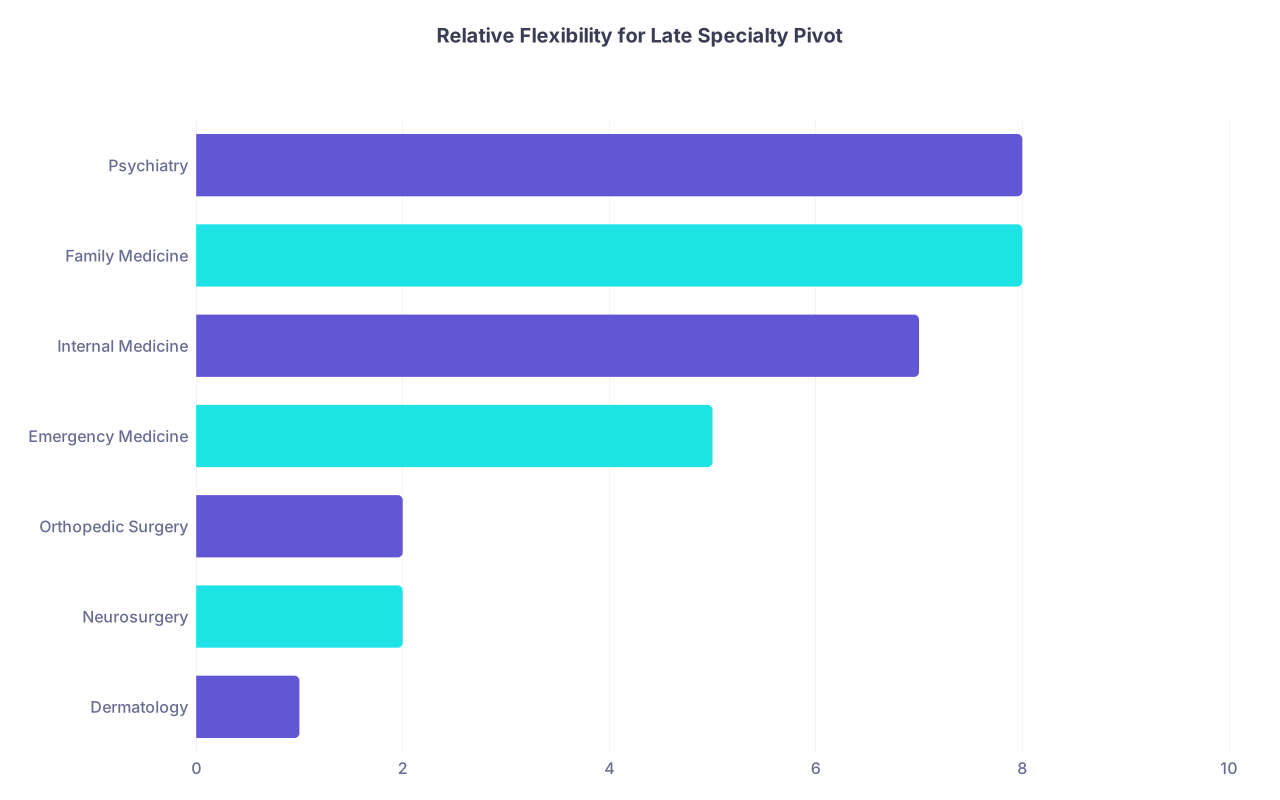
| Category | Value |
|---|---|
| Dermatology | 1 |
| Neurosurgery | 2 |
| Orthopedic Surgery | 2 |
| Emergency Medicine | 5 |
| Internal Medicine | 7 |
| Family Medicine | 8 |
| Psychiatry | 8 |
Ultra-Competitive (low flexibility for late pivot):
- Dermatology
- Plastic surgery
- Neurosurgery
- ENT
- Ortho
- Integrated vascular, CT surgery, IR in many places
If you’re not already building this application by early–mid M3, a late pivot into these is usually a bad idea unless you’re:
- From a powerhouse home program
- Sitting on standout stats and research in the field
- Willing to take a gap year
Moderately Competitive with Some Pivot Room:
- Anesthesia
- Radiology
- EM (though tightening)
- OB/GYN in many regions
Late M3 / early M4 pivots can work if:
- You get a strong sub-I
- You have 2+ letters from the field
- You apply broadly
More Flexible / Pivot-Friendly:
- Internal medicine
- Family medicine
- Psychiatry
- Pediatrics
These fields regularly see students realizing “this fits me” in late M3. You can often pivot as late as spring and still assemble a convincing application—if you move quickly.
Red Flags That You’re Pivoting for the Wrong Reasons
Quick reality check. You’re in dangerous territory if your reasons sound like:
- “I heard [new specialty] is easier to match.”
- “I liked that one attending more than my whole last rotation.”
- “I’m scared of [procedure/lifestyle/all-nighters] so I’m running away without exploring properly.”
At this point, you should:
- Differentiate between:
- Disliking a rotation culture (bad team, malignant resident)
- Disliking the core work of the specialty (clinic-based, OR all day, high-volume notes)
Talk to at least two people in that field:
- One attending
- One senior resident or chief
If they both say, “Yeah, based on what you’re saying, your instincts are right,” that’s meaningful. If they’re lukewarm or confused, slow down.
Practical “If You Pivot Now, Do This Immediately” Checklist
If you pivot 9–6 months before ERAS:
- Rebuild M4 schedule:
- 1–2 sub-I/electives in new specialty (July–September)
- Identify 2–3 potential letter writers in new field
- Start showing up:
- Grand rounds
- Department events
- Update dean/advisors so they’re aligned with your story
If you pivot 6–3 months before ERAS:
- Convert any open/flex slots into:
- Sub-I in new specialty
- Or clearly related elective
- Lock in:
- 2 letters in new specialty (even if one will come in late)
- Draft a personal statement that:
- Clearly explains the pivot
- Shows action, not just feelings (“So I…” not just “I realized…”)
If you pivot <3 months before ERAS:
- Have a brutal talk with:
- Specialty advisor
- Dean
- Choose either:
- Apply this cycle to a less-competitive new specialty with:
- 1–2 letters and a thin narrative
- Broad, realistic program list
- Or:
- Hold, take a research/clinical year, and apply strong next cycle
- Apply this cycle to a less-competitive new specialty with:
Two Things to Remember
Your application tells a story over time. If you pivot, you must show that story changing with actions on the calendar—new rotations, new mentors, new responsibilities. Not just new feelings.
The safest pivot is the early one you prepare for quietly. Get letters from every core, keep a flex slot in your M4 schedule, and assume you might change your mind once. Because most people do.
Use the calendar as your guardrail. If you’re inside three months of ERAS and still undecided, the problem is not the specialty—it’s the timeline.


