

The worst way to choose a specialty is to “see what speaks to you” during MS3. That’s not a plan; that’s gambling with your next 30 years.
If you treat third year like a structured experiment instead of a tour, you win. Your “specialty hypotheses” get tested rotation by rotation, month by month, instead of decided in a panic during ERAS season.
Here’s how to run MS3 like a disciplined trial instead of a vibes-based field trip.
Before MS3 Starts: Build Your Hypotheses, Not Your Fantasy
At this point (2–3 months before your first core rotation), you should stop saying, “I have no idea what I want to do.” You do have ideas. You just have not written them down or tested them.
Step 1: Define 3–5 concrete specialty hypotheses
Not “medicine vs surgery.” That’s lazy. Aim for specific, realistic options:
- Internal medicine → maybe cardio/ID later
- General surgery vs ortho
- Pediatrics
- EM
- Psych
- OB/GYN
- Anesthesia
- Neurology
Pick 3–5 that seem plausible based on:
- What you liked in pre-clinical (organ systems, problem types)
- Shadowing
- Personality and lifestyle needs (night person? hate chaos? like continuity?)
Write them as hypotheses:
- “I think I might like internal medicine because I enjoy complex diagnostics and long-term patient relationships.”
- “I might like EM because I like quick decisions and procedures without follow-up clinic.”
If you can’t write one sentence like that for a specialty, it’s not a real hypothesis yet.
Step 2: Clarify what you’re actually testing
Each hypothesis needs testable traits. Stuff you can observe on the wards. Think in categories:
| Category | What You’re Looking For |
|---|---|
| Tempo | Fast/chaotic vs slow/deliberate |
| Cognitive style | Algorithms vs ambiguity vs detective work |
| Patient relationship | Long-term vs one-time vs none |
| Procedures | Many vs few vs none |
| Team dynamic | Hierarchy, culture, communication style |
| Schedule | Days, nights, weekends, call expectations |
Turn these into yes/no or 1–5 ratings in a simple note on your phone or small notebook. You’re going to fill this in every month.
Step 3: Sequence your year strategically (if you still can)
If your school lets you rank or rearrange rotations, do it with intent:
- Put “likely” specialties earlier: IM, surgery, peds, EM if those are front-runners
- Put the rotations that commonly spawn interest (EM, anesthesia, radiology electives) before ERAS decision time if possible
- Do not front-load super easy rotations just “to adjust” — you’ll waste high-energy months
If your schedule is fixed, fine. You still use this framework. You just accept that some hypotheses get tested later.
Month 1: Orientation to Reality & Baseline Testing
At this point (first month on the wards), your job is not to fall in love. Your job is to calibrate:
What does real clinical medicine actually feel like—pace, workload, emotional load?
Weekly breakdown
Week 1: Survival + observation
- Learn: how to preround, write notes, present, not annoy the residents
- Start a simple daily log:
- 2–3 bullet points: what you actually did (admissions, notes, procedures observed, family meetings)
- 1 line: “Energy at end of day: 1–10”
- 1 line: “Would I want this life long-term? Why/why not today?”
Do not judge the specialty yet based on week 1. You’re mostly judging your anxiety.
Week 2: First round of structured specialty testing
Now start filling your hypothesis grid. Even if the current rotation is not one of your top options, it still informs what you want or don’t want.
Ask yourself (and write it down):
- Tempo: too fast, too slow, or actually good for you?
- Notes vs talking vs procedures: which dominates your day?
- Team culture: would you want to be these residents in 5 years?
Week 3–4: Distinguish “rotation noise” from “specialty signal”
You’ll see:
- Toxic teams in good specialties
- Great attendings in specialties you’d hate long-term
Log both. But separate:
- “I like cardiology consults”
from - “My current attending is kind and teaches well.”
By the end of Month 1, you should have:
- A written baseline of what a typical day in one specialty is like
- First-pass answers to: Do I need more pace? More thinking time? More procedures? More continuity?
That baseline will anchor the rest of the year.
Months 2–4: Core Rotation Block – Systematic Specialty Testing
This is the main experimental phase. For most schools, this includes some mix of:
- Internal medicine
- Surgery
- OB/GYN
- Pediatrics
- Psychiatry
- Family medicine
- Neurology
- EM (sometimes here, sometimes later)
At this point, you should treat each month like a dedicated lab experiment on your hypotheses.
At the start of each new rotation (Day 1–2)
Do three things:
- Write a short “pre-rotation hypothesis”
Example:
- “I predict I’ll like OB/GYN’s procedures but not the lifestyle.”
- “I think I’ll dislike inpatient psych because of chronicity and lack of procedures.”
- Create a mini-rotation plan
- 2–3 specific experiences you must see:
- Example for IM: MICU, subspecialty rounds, admissions night
- Surgery: OR time, clinic, post-op day management
- Peds: well-child clinic, inpatient bronchiolitis season, maybe NICU shadow
- Set one career-oriented question you’ll answer by the end
- “Could I tolerate this call schedule long term?”
- “Do I actually enjoy the OR environment?”
- “Do I feel drained or energized at 4 pm?”
You’re not just trying to honor the shelf. You’re testing a life.
Within Each Rotation: Weekly Focus
Let’s walk through how to use each week, regardless of specialty.
Week 1: Learn the job + watch the residents
- Focus: Workflow, not identity
- What to observe:
- What do interns/PGY-2s actually do between 8–5?
- How often do they stay late, and why?
- What are they stressed about: volume, acuity, documentation, family drama, OR time?
If looking at the interns you think, “I’d never want their life,” that’s data.
Week 2: Try on the specialty “identity”
You’ve got basic function down. Now you imagine being the attending.
Questions to ask yourself daily:
- If I had their knowledge/skill, would I want to do what they do all day?
- Do I like the kinds of problems they get consulted for?
- Do I like their interaction style with nurses, consults, patients?
End of Week 2, write a short note:
- “If I had to pick today, this specialty would rank: A/B/C/D/F for me, because…”
Week 3: Push for breadth (not just babysitting your team)
Now you deliberately test edge cases.
For IM:
- Ask to see subspecialty services: cardiology, GI, ID
- Sit in on a family goals-of-care meeting if you can
For surgery:
- Try a full OR day
- Then try a full floor/clinic day
- Contrast: which drained you more?
For psych:
- Inpatient acute vs outpatient mood/anxiety clinic if possible
Your goal: Don’t let one narrow slice define an entire field.
Week 4: Synthesize and document hard
Last week of each rotation:
- Ask 1–2 residents: “What made you choose this specialty over [your other interest]?”
- Ask 1 attending (if it feels appropriate): “If you could go back, would you pick this again?”
Then you write a 1-page debrief for yourself:
- What surprised me?
- What parts of the day felt best? Worst?
- Would I want the life of the happiest attending I saw here?
- Where does this specialty sit in my current rank list? Why?
Do this every rotation. If you skip the writing, you’ll forget how you really felt and rewrite history later.
Mid-Year (Around Month 5–6): The First Hard Decisions
At this point, you should stop saying “I’m keeping an open mind about everything.” That’s not open-minded; that’s indecisive.
Step 1: Build your mid-year specialty ranking
Sit down for 1–2 uninterrupted hours. Open all your rotation debriefs and daily logs.
Rank everything you’ve seen into 4 buckets:
- Strong contenders (1–3 specialties)
- Probable but weaker options
- Backup/flexible options (FM, IM, psych for many students)
- Ruled out
Force yourself to actually put things in “ruled out.” No, you’re not “betraying your future self.” You’re making space to think clearly.
Step 2: Reassess your testing plan for remaining months
Look ahead: What rotations are still coming?
- If a strong contender is still ahead (e.g., EM in month 8), you plan to scrutinize that one brutally.
- If your top contender is already completed (e.g., you loved IM in month 2), you plan targeted electives and sub-I’s for MS4.
You also identify gaps:
- Haven’t really seen outpatient life? You’ll need an ambulatory or elective block.
- Haven’t done nights in a field you’re considering? You need at least one acute or call-heavy stretch.
Months 7–9: Turning Interest into Commitment
By this point, patterns are emerging. You’re no longer blind.
Now you start acting like someone who’s actually going to apply.
At this point, you should…
- Lock in 1–2 “primary” specialty hypotheses.
Example:
- #1: Internal medicine (aiming cards or heme/onc later maybe)
- #2: EM as a serious alternative
- Identify your realistic backup path.
Sometimes:
- IM or FM is backup for EM, neuro, psych, etc.
- FM or IM is backup for some surgical fields (if you’re late and underpowered in scores/letters).
- Start relationship-building deliberately.
On rotations that match your hypotheses:
- Show up early. Stay somewhat late. Be reliable.
- Tell 1–2 attendings: “I’m seriously considering [specialty] and would appreciate any feedback or advice.”
- Ask for letters soon after a strong performance, not months later when they barely remember you.
Day-by-Day During a Rotation You Think You Might Actually Choose
When you’re on a potential future specialty, the bar is higher. Here’s how you use each day.
Each morning
- Set one specific learning goal: “Today I will understand volume status better” (IM), “I will follow wound care and drains more closely” (surgery), etc.
- Set one career-testing question: “Did I feel bored or engaged during downtime today?” / “Did I resent being in the OR during this emergency add-on?”
During the day
Track 3 things mentally:
Time distortion
- Which hours feel like they evaporate? Which drag?
- If 4 hours in clinic feel like 40, that’s a problem.
Emotional load
- How do you feel after difficult patient interactions, codes, bad news conversations?
- Some people are fine doing this daily; others are wrecked. Believe your nervous system.
Micro-annoyances
- Every specialty has them: consult wars, documentation insanity, surgery delays, psych bed hunts.
- The right field is the one where the annoyances are tolerable.
Each night (5-minute reflection)
Write:
- 1–2 sentences: “Best thing about today.”
- 1–2 sentences: “Worst thing about today.”
- 1 line: “Net direction: pulls me toward this specialty, away, or neutral?”
This is the data you’ll trust when you’re tired and confused later.
Using Specific Core Rotations to Clarify Your Specialty Path
Let’s be explicit about how each big core can test hypotheses.
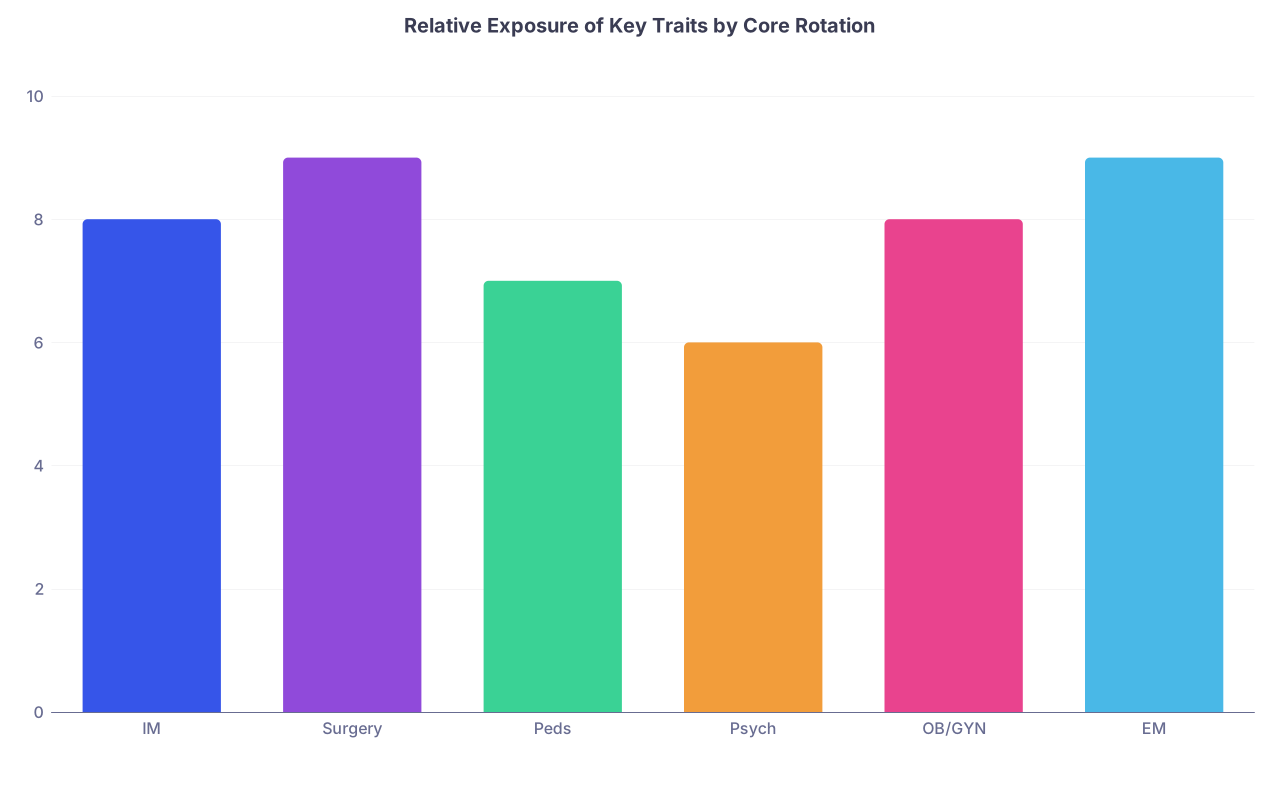
| Category | Value |
|---|---|
| IM | 8 |
| Surgery | 9 |
| Peds | 7 |
| Psych | 6 |
| OB/GYN | 8 |
| EM | 9 |
(Interpret this not as “quality” but as “how strongly rotations will reveal tempo, acuity, and lifestyle realities.)
Internal Medicine
Use IM to test:
- Do you actually like diagnostic puzzles and chronic disease management?
- Can you tolerate long notes and complex medication lists?
- Do you enjoy long-term relationships (via clinic) or find them draining?
Good specialty tests: IM, cards, GI, heme/onc, nephro, hospitalist, maybe neuro.
Surgery
Use surgery to test:
- Do you like the OR enough to accept pre-/post-op grind?
- How do you feel standing still, scrubbed in, for hours?
- Do you crave procedures or just tolerate them?
This rotation usually kills or confirms surgery/ortho/ENT/uro interest very fast.
OB/GYN
Use OB to test:
- Can you handle unpredictable nights and emergencies?
- How do you feel about high-stakes, reproductive health conversations?
- Is the mix of clinic, OR, and L&D appealing or chaotic?
OB also helps test: Do you like women’s health enough to anchor your whole career around it?
Pediatrics
Use peds to test:
- Can you actually tolerate sick kids + parents, day after day?
- Are you patient explaining things 4 times in different ways?
- Do you care enough about growth/development to make it your main language?
Peds is also a good stress-test of your emotional resilience.
Psychiatry
Use psych to test:
- Do you like primarily conversational, cognitive work?
- Are you okay with chronic, recurrent conditions and limited “cure”?
- Can you handle uncertainty and vague boundaries between medical and social problems?
Psych also often clarifies whether you need procedures in your life or not.
EM (when you get it)
Use EM to test:
- How you feel with constant interruptions and no continuity
- Whether shift work (days/nights/weekends) is appealing or awful
- If you like breadth more than depth
For many students, EM rotation snaps other choices into focus: “Oh. I actually hate this tempo,” or “This is the only time I’ve actually enjoyed being at the hospital at 2 a.m.”
Late MS3 (Months 10–12): Convergence and Preparation for MS4
By late MS3, hand-waving is over. You’re heading into the ERAS runway.
At this point, you should be able to say:
- “I’m 70–90% likely to apply in [specialty].”
- “I’ve identified 1–2 realistic backups.”
- “I know which attendings I can ask for letters.”
Month 10: Lock your primary choice (or top 2)
If you’re still truly split between >2 specialties this late, you’ve either:
- Not been honest with your own data, or
- Not gathered it systematically
Go back to:
- Your rotation debriefs
- Your daily logs
- Your mid-year ranking
Then ask bluntly:
- Which rotation days did I dread the least?
- Which residents’ life looked least misaligned with mine?
- Which work could I tolerate at 3 a.m. when I’m exhausted?
Month 11–12: Positioning yourself
Now you use the remaining time to:
- Schedule sub-I’s in your chosen field early MS4 (set them up now)
- Arrange any missing letters (especially from your chosen specialty)
- Refine your “why this specialty” story from your logs and debriefs
Also: accept that no choice will be perfect. You’re picking a direction, not a prison sentence.
Visualizing Your MS3 Testing Plan
Here’s how a full-year specialty-testing approach might look.
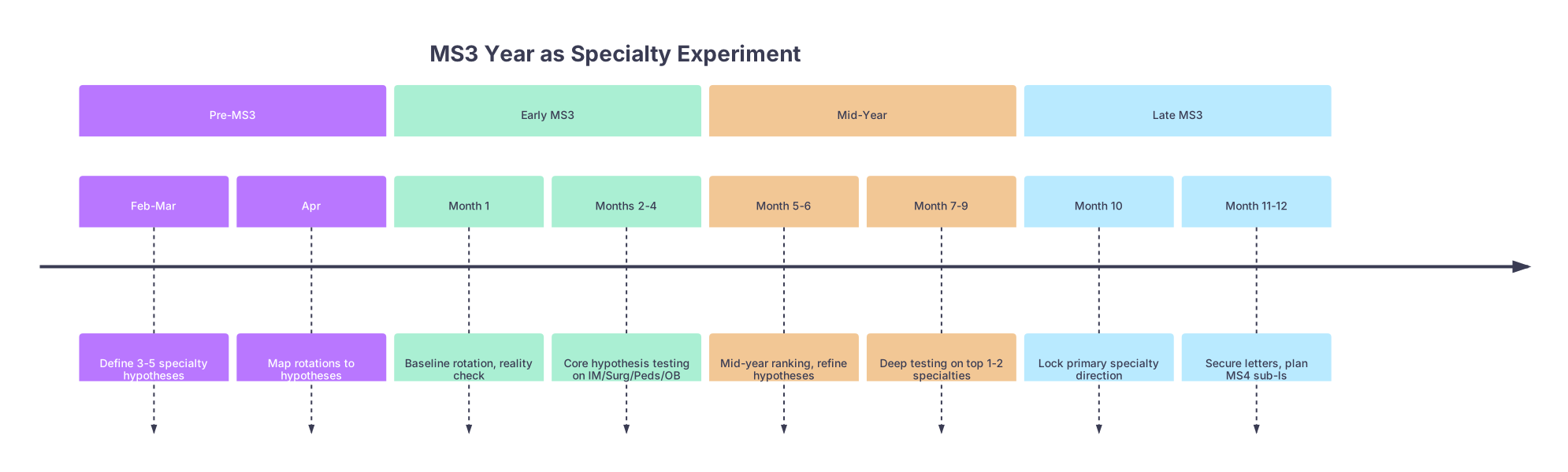
| Period | Event |
|---|---|
| Pre-MS3 - Feb-Mar | Define 3-5 specialty hypotheses |
| Pre-MS3 - Apr | Map rotations to hypotheses |
| Early MS3 - Month 1 | Baseline rotation, reality check |
| Early MS3 - Months 2-4 | Core hypothesis testing on IM/Surg/Peds/OB |
| Mid-Year - Month 5-6 | Mid-year ranking, refine hypotheses |
| Mid-Year - Month 7-9 | Deep testing on top 1-2 specialties |
| Late MS3 - Month 10 | Lock primary specialty direction |
| Late MS3 - Month 11-12 | Secure letters, plan MS4 sub-Is |
Use this kind of structure, even if your actual months/sequence differ.
Final Checkpoints Before You Call It
By the end of MS3, you should have:
- A written ranking of your specialties with specific reasons (“Tempo fits,” “Hate documentation burden,” “Can’t handle nights,” etc.)
- 3–5 rotation debriefs that directly feed your personal statement and “Why this specialty?” answers
- At least 2 attendings in your chosen field who’ve seen you work and can write credible letters
If you do not have those, you don’t need another inspirational speech about “finding your passion.” You need to sit down for two hours with your own MS3 data and make adult decisions.
Key Takeaways
- Treat MS3 as a structured experiment, not a sightseeing tour. Go rotation by rotation with explicit hypotheses and written debriefs.
- Use each core rotation to test specific traits: tempo, cognitive style, procedures, emotional load, and team culture. Don’t confuse a good/bad team with a good/bad specialty.
- By late MS3, force convergence: rank specialties, commit to 1–2 serious options, line up letters, and plan MS4 to strengthen the path you’ve actually chosen—not the one you’re still vaguely “keeping open.”


