

You are here: It is March of MS3 / early MS4, and the clock just started ticking louder
You are somewhere between the last shelf exam and your first real Step 2 CK study block. Match feels “far away” on the calendar, but in reality your specialty choice deadline is measured in weeks, not years.
At this point:
- You have a “top 1–2” specialties in mind.
- You can list a few backup options if pressed.
- You also have lingering doubt: Am I about to commit to the wrong field for the next 30 years?
This is pre-residency spring. The last realistic window to confirm your specialty choice before everything you do becomes an application signal: sub‑Is, letters, away rotations, Step 2 timing, ERAS content.
Let’s walk this chronologically. Month by month, then week by week, then down to specific days and actions.
March–April: Big-Picture Reality Check on Your Top 1–2 Specialties
From now until about late April, your job is not to “fall more in love” with your favorite specialty. Your job is to try to break it. Push hard on your assumptions and see if it still holds.
Weeks 1–2 of Spring: Cold‑Eyed Assessment
At this point you should sit down for 2–3 focused sessions and do a structured self‑audit.
Score and application reality (2–3 evenings)
Pull up your data and be brutally honest:- Step 1: Pass only? Numeric? How strong relative to your class?
- Step 2 CK practice or goal range?
- Class rank / AOA / school reputation.
- Research output: none, 1–2 posters, multiple pubs?
Then compare this to realistic targets for your top specialties.
Typical Competitiveness Snapshot by Specialty Specialty Step 2 CK (median match) Research Needed Backup Sensible For… Dermatology 250+ Strong Almost no one Orthopedics 245–250+ Moderate–High Strong applicants Anesthesiology 235–240+ Helpful Most students Internal Med 225–230+ Variable Wide range Family Med 215–220+ Low Broad safety You are not trying to discourage yourself. You are making a decision anchored in reality, not in fantasy conversations from MS1.
Lifestyle and values inventory (single afternoon)
Pull a blank sheet. Divide into columns:- Daily tasks I enjoy (procedures, continuity, acute care, counseling).
- Things that drain me quickly (paperwork, unstable nights, long cases, pure clinic).
- Non‑negotiables:
- Geographic priorities (must be near partner/family?).
- Lifestyle boundaries (no q3 trauma nights forever?).
- Financial goals (debt level, need for higher income vs. okay with primary care).
Then list your top 2–3 specialties and quickly rate them 1–5 on each of those factors. No overthinking.
“Worst day” exercise (1–2 hours)
For each specialty you are considering:- Describe a typical worst 24 hours in that field.
- Realistic. Not mythical horror stories.
- Could you tolerate that day once a week? Once a month? Once a year?
If the honest answer is “never,” that specialty is probably a bad long‑term fit.
At this point in March, you should:
- Narrow down to 1 primary specialty and 1 realistic backup.
- Drop any field that clearly does not match your values, scores, or tolerance for its “worst day.”
If you still have 3–4 options you “cannot decide between,” that is a red flag. You are not gathering enough targeted data. Which leads to the next block.
Late March–April: Targeted Shadowing and Candid Conversations
Now your priority shifts: move from vague impressions to direct evidence.
Week‑by‑Week Plan
Week 3–4 of Spring: Micro‑shadowing
At this point you should line up 3–4 half‑days of highly targeted shadowing:
- 1–2 half‑days in your tentative primary specialty.
- 1–2 half‑days in your backup option (or closest competitor).
Rules:
- Demand variety:
- One attending who loves teaching.
- One who is more blunt, less “performative” around students.
- Try to see both clinic and procedural/OR/acute care settings if applicable.
During or right after each half‑day, write down:
- How did the team actually talk about their work at 3 pm when everyone was tired?
- Did anyone say some version of “Honestly, some days I wish I had gone into X instead”?
- Could you picture yourself as the attending in 10–15 years?
If direct shadowing is impossible (small school, rotations limited), then:
- Sit in on resident conferences or M&M.
- Ask to observe a clinic half‑day or sign‑out.
End of April: Honest 1:1 Attending Conversations
By late April, you should have had at least 2 brutally honest conversations with attendings or senior residents in each serious option.
Your script can be simple:
- “I am between [Specialty A] and [Specialty B]. Can you tell me which students you think fit poorly in this field, and why?”
- “If your own kid was like me—scores, interests—would you tell them to go into your specialty?”
You are not fishing for compliments. You want friction. Doubt. The “if I could do it again” comments.
Take notes that night. Not a week later when you will have cleaned up the memory.
May–June: Lock the Specialty and Align Your MS4 Year
By early May, you should be converging on a choice. Not perfect certainty, but at least an 80–90% commitment.
This is the pivot point. Once VSLO / away rotations open and sub‑Is get scheduled, indecision becomes expensive.
Early May: Formal Decision Checkpoint
At this point you should do a structured decision session, alone, before talking to anyone else.
Two‑Column Decision Sheet (1–2 hours) For each specialty:
- Column A: Reasons I should choose this field.
- Column B: Reasons I should not choose this field. Force yourself to write at least 5 items per column.
Future‑Self Test Ask three questions:
- “If I do not match this specialty, will I be absolutely devastated or just disappointed?”
- “If all prestige disappeared and salary was equal, would I still pick this?”
- “Can I name three attendings in this field whose life I would actually want?”
If your backup specialty quietly wins these questions, do not ignore that.
Commit on Paper Write:
- “Primary specialty: ____”
- “Backup specialty: ____”
- “I will apply to [X] as primary and [Y/N] as backup in ERAS.”
You can change later, but making a written commitment forces clarity.
Mid–Late May: Build Your MS4 Schedule Around the Decision
Now you move into logistics. This is where late deciders get burned.
At this point you should:
Meet with your dean’s office or specialty advisor and review:
- Sub‑I timing (ideally 1–2 sub‑Is in your chosen field before ERAS opens).
- Away rotations (if your specialty expects them: ortho, ENT, derm, neurosurgery, etc.).
- Step 2 CK timing (often before September if your Step 1 is pass only or mediocre).
Create a rough Gantt of your year:
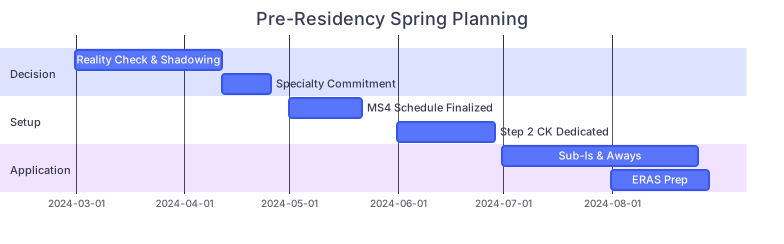
| Task | Details |
|---|---|
| Decision: Reality Check & Shadowing | a1, 2024-03, 6w |
| Decision: Specialty Commitment | a2, after a1, 2w |
| Setup: MS4 Schedule Finalized | a3, 2024-05, 3w |
| Setup: Step 2 CK Dedicated | a4, 2024-06, 4w |
| Application: Sub-Is & Aways | a5, 2024-07, 8w |
| Application: ERAS Prep | a6, 2024-08, 4w |
If your MS4 schedule cannot realistically support a strong application in your “dream” field (no sub‑Is available, no letters, you are late to away rotations), that is not a minor obstacle. That is a hard constraint. Adjust accordingly.
Summer‑Facing Tasks: Are You Actually Competitive in This Field?
Once the specialty is tentatively chosen and your MS4 layout is taking shape, you need one more filter: feasibility.
Late Spring: Competitiveness Cross‑Check
By late May / early June, at this point you should have:
- A realistic Step 2 CK score goal based on early UWorld/self‑assessment performance.
- A list of at least 2 attendings in your chosen specialty who can potentially write letters.
- Clarity about whether you need:
- An away rotation.
- Extra research.
- A dual‑apply strategy.
Use a simple competitiveness matrix:
| Factor | Your Reality | Target for Field | Gap? |
|---|---|---|---|
| Step 1 / Step 2 CK | e.g., P / 238 goal | e.g., 245–250 | Yes |
| Research | 1 poster | 2–3 outputs | Yes |
| Letters | 0 secured | 2+ in specialty | Yes |
| Sub‑Is | 0 scheduled | 1–2 in field | Yes |
If every cell is “Yes, gap,” then your “choice” is not really a choice. It is a fantasy. You either fix the gaps fast (if possible) or pivot to a more realistic field.
Week‑by‑Week: A Structured Spring Checklist
Now let me give you a more concrete, almost calendar‑level guide for a typical March–June pre‑residency spring.
Assume:
- March: Late MS3, finishing core rotations.
- April: Electives / lighter blocks.
- May–June: Step 2 CK prep / beginning MS4 planning.
March, Week 1–2
At this point you should:
- List your top 3 specialties (not 8, not 1).
- Draft your personal values and non‑negotiables.
- Pull your performance data: clerkship comments, shelf percentiles, Step 1 result.
Concrete tasks:
- 1 evening: self‑audit and values list.
- 1 evening: read the last 2 NRMP “Charting Outcomes” PDFs for your candidate specialties.
- Short email to your school’s career advisor:
“I am currently deciding between [A] and [B]. Can I schedule 30 minutes this month to discuss realism and planning?”
March, Week 3–4
At this point you should:
- Have 2–3 micro‑shadowing sessions booked for early April.
- Reach out to 2 residents in each field for 20‑minute calls.
Script your emails tightly:
- Subject: “MS3 exploring [Specialty] – brief chat?”
- Body: 3 lines max—who you are, specialties you are debating, 2–3 specific questions.
Do not send vague “I’d love your thoughts” novels. Nobody reads those.
April: Deep Dives and Hard Conversations
April, Week 1–2: In‑Person Reality
At this point you should:
- Spend time physically in both fields you are considering.
- Collect concrete answers to:
- How busy are the residents, really?
- How much scut vs. meaningful work?
- Are attendings generally content or quietly burned out?
Right after each half‑day, write a one‑page “field note”:
- What surprised me?
- What did I like?
- What did I strongly dislike?
- How did I feel at 4 pm—curious, bored, drained, energized?
Patterns across 3–4 field notes are very telling.
April, Week 3–4: Decision Crunch
Now you synthesize.
At this point you should:
- Sit down with your career advisor or a trusted attending and say explicitly:
- “I am leaning toward [X] with [Y] as backup. Does that make sense given my application?”
- Ask them to be honest about:
- Match probability.
- Whether a dual‑apply is wise or overkill.
- Whether an extra research block or away rotation is necessary.
You also:
- Finalize: “I will apply primarily to ___ and, if needed, also to ___.”
- Start mapping out which rotations during MS4 will showcase that choice.
May–Early June: Aligning Exams, Rotations, and Letters
By May, you are transitioning from “what should I choose?” to “how do I support that choice?”
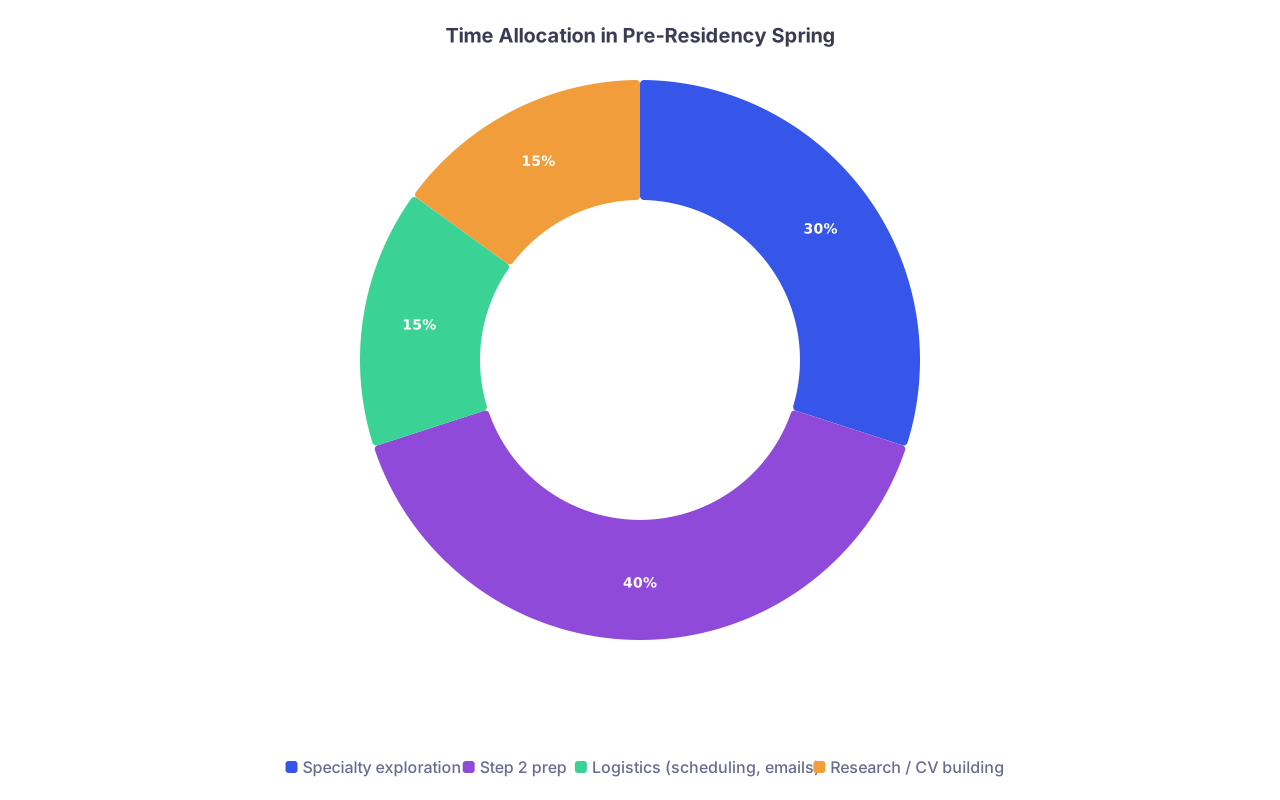
| Category | Value |
|---|---|
| Specialty exploration | 30 |
| Step 2 prep | 40 |
| Logistics (scheduling, emails) | 15 |
| Research / CV building | 15 |
Early May: Confirm Your Story
At this point you should:
- Draft a one‑paragraph “why this specialty” blurb. Not for ERAS yet—just for yourself.
- Make sure it passes three tests:
- Specific (mentions concrete experiences, not “I love helping people” fluff).
- Honest (if you love procedures and hate clinic, say that).
- Sustainable (you could tell this same story to 20 program directors without cringing).
This paragraph becomes the backbone of:
- Your personal statement.
- Your email intros.
- Your interview answers later.
Mid–Late May: Letters and Sub‑Is
At this point you should:
- Identify 2–3 attendings in your chosen field who:
- Know you personally.
- Saw you work hard.
- Can credibly say, “This student is above average for our program.”
Then:
- Ask them explicitly:
“I am applying to [Specialty]. Would you feel comfortable writing me a strong letter of recommendation?”
If they hesitate, move on. A lukewarm letter is worse than no letter.
Simultaneously, confirm:
- Sub‑I in your chosen specialty booked by early MS4.
- Any away rotation applications submitted, if your field expects them.
If you hit hard barriers here (no attendings in your field know you, no sub‑Is available until very late, no away slots), this is your last chance to reconsider your choice or strengthen things aggressively (research block, extra elective, etc.).
Day‑Level Actions: How to Stress‑Test Your Choice Quickly
Let me give you a few “single‑day sprints” you can insert into any week this spring.
One Specialty Decision Day (8–10 hours total)
Morning (3–4 hours):
- Re‑read your clerkship evals for your favored specialty and its competitor.
- Write a candid paragraph: “When I was on [X], I acted like this. On [Y], I acted like that.”
- Pull up 10 random program websites in your chosen specialty and ask:
- “Do I see myself thriving here?”
- “Do I actually want to spend 5–7 years in this training environment?”
Afternoon (3–4 hours):
- Dedicated call/meeting with one mentor in each field.
- Ask them the same 4 questions:
- “What makes people unhappy in your specialty?”
- “What kind of resident struggles the most?”
- “If you had my scores, would you choose this again?”
- “Is there something about this field that outsiders constantly misunderstand?”
Evening (1–2 hours):
- Final two‑column pro/con list.
- Write to yourself: “Barring major new information, I am committing to [X].”
You can repeat this once for your backup specialty on another day.
Subtle Red Flags That Mean “You Are Forcing It”
As you work through this spring, pay attention to these patterns. I have watched students ignore them and regret it.
- You only like the idea of the specialty, not the actual day‑to‑day tasks you have seen.
- You are banking on “it will be different when I am the attending” to justify suffering through residency.
- The only way your application works is if you hit an unrealistic Step 2 CK score increase or produce miracle research.
- You repeatedly tell people, “I know it is not a good fit on paper, but I will work extra hard.”
That is not grit. That is denial.
Visual Snapshot: From Indecision to Commitment

| Step | Description |
|---|---|
| Step 1 | Start of Spring: Unsure Specialty |
| Step 2 | Self-Audit & Values |
| Step 3 | Targeted Shadowing |
| Step 4 | Resident & Attending Conversations |
| Step 5 | Primary & Backup Specialty Selected |
| Step 6 | MS4 Schedule & Sub-Is Aligned |
| Step 7 | Letters & Step 2 Timing Planned |
| Step 8 | Confident Specialty Commitment |
Final 3 Checks Before You Call It Done
By the end of pre‑residency spring, you are ready if you can answer “yes” to all three:
Behavior check
On rotations in this specialty, you naturally:- Showed up early.
- Stayed engaged even when it was slow.
- Found yourself reading about cases at night without forcing it.
Regret check
If you matched your backup specialty instead:- You would be a little disappointed.
- But you would not feel trapped or resentful.
Logistics check
Your MS4 year is actually structured to support your choice:- Sub‑Is scheduled.
- Letters realistically obtainable.
- Step 2 CK timing aligned.
- No major, obvious, unaddressed gaps.
If any of those three are “no,” your task for the next 2–4 weeks is clear: fix that specific problem. Not more vague thinking. Concrete action.
Key Takeaways
- Use pre‑residency spring to stress‑test your favorite specialty, not to romanticize it. Try to break it; if it survives, it is probably right.
- Lock in a primary and realistic backup by late April, then align MS4 schedule, letters, and Step 2 CK around that choice.
- Watch your behavior more than your words: the field you keep gravitating toward on your worst days is usually the field you should trust.


