

The worst mistake medical students make about specialties is deciding either way too early or way too late. Both will cost you.
You need a structured, year‑by‑year, even month‑by‑month plan for specialty exploration. Not vibes. Not “I’ll just see what I like on rotations.” A real timeline.
Below is exactly what you should be doing from MS1 through MS4 to choose and commit to a specialty without panicking in March of third year.
Big Picture: The Four-Year Specialty Planning Arc
At this point, zoom out. This is the skeleton you are working from:
| Year | Primary Focus | Key Decisions |
|---|---|---|
| MS1 | Broad exposure & self-assessment | Rule nothing out; start identity mapping |
| MS2 | Narrowing interests & Step prep | Identify 3–4 contender fields |
| MS3 | Reality testing on rotations | Commit to 1 specialty + 1 backup |
| MS4 | Executing on choice | Finalize applications, letters, away rotations |
You will loop through three questions repeatedly, at different depths:
- Who am I actually on the wards?
- What kind of work do I want at 3 a.m.?
- What is realistically within reach given my performance?
Now let’s go chronologically.
MS1: Exposure, Identity, and Information (Not Decisions)
Orientation to Month 3: “Collect, Do Not Commit”
At this point you should:
- Treat every specialty as potentially viable. Even the ones you think you hate.
- Start learning the language of specialties: lifestyle fields, ROAD, surgical prelims, competitive vs less competitive, etc.
Concrete actions (first 3 months):
Make a running specialty list.
Create four columns in a simple document:- “Intriguing”
- “Neutral”
- “Hard no”
- “No idea yet”
For now, you are allowed to move things out of “hard no,” but not into it permanently. Early impressions are unreliable.
Attend 1–2 interest group events per month.
Not 12. Not zero. Pick a mix:- One “hot” specialty (derm, ortho, ENT, IR, etc.)
- One core specialty (IM, peds, FM, gen surg, psych)
Your goal: hear how residents talk about their day. How they describe their worst shifts says more than their best days.
Shadow in 2 settings by the end of fall semester.
Specifically:- One clinic-heavy field (e.g., family med, IM clinic, pediatrics outpatient)
- One procedure-heavy field (e.g., gen surg OR day, GI lab, cath lab, IR)
After each, write a 5–10 sentence reflection:
- What did I like / dislike?
- Could I see myself in that attending’s shoes?
You are not deciding. You are building intuition.
Months 4–8 (Spring MS1): Start Matching Your Personality to Fields
At this point you should be getting more honest about how you work.
Do a structured self-assessment (once, not endlessly). Use one of the many tools (AAMC Careers in Medicine, etc.). Do not keep retaking; the point is direction, not prophecy.
Ask:
- Do I like long-term relationships vs “fix and move on”?
- Do I like acuity and chaos vs steady and predictable?
- Do I like using my hands vs thinking and talking?
Shadow in 2–3 more fields with contrasting vibes.
Example combos:- EM vs outpatient IM
- OB/GYN L&D vs psychiatry inpatient
- Neurology vs anesthesia
After each, capture:
- Energy level of the team
- How much uncertainty the specialty tolerates
- How much instant vs delayed gratification
By the end of MS1, your specialty board should look like:
- 3–5 specialties in “Intriguing”
- Clear notes: what you like, what worries you about each
- Almost nothing in “hard no” unless you have seen it or know yourself very well
Do not declare your specialty publicly in MS1. I have watched too many students lock onto ortho in October, then discover in MS3 that they hate the OR.
MS2: Narrowing the Field and Planning for Competitiveness
MS2 is about aligning your performance and your preferences.
Months 1–4 (Early MS2): Intentional Narrowing
At this point you should:
- Move from “everything is possible” → “these 4–5 fields are plausible”
- Start matching your board scores, grades, and CV with the competitiveness of those fields
Revisit your specialty list at the start of MS2.
- Promote 2–3 specialties to a “Priority Watchlist”
- Demote 1–2 that no longer make sense based on your exposure or self-knowledge
Targeted shadowing / mentoring. For each “Priority Watchlist” field:
- Identify 1 faculty member or senior resident
- Ask for:
- One meeting about the field
- Possibly 1–2 half-days of shadowing with them
Your questions:
- “What kind of student does well in your specialty?”
- “If you were me, what would you look at to decide?”
- “What are your residents complaining about most this month?”
Start building one professional narrative. You are not doing 6 random research projects in 6 fields. That looks scattered. Example:
- Interested in IM vs cardiology vs heme/onc? → General medicine or cardiology research, medicine interest group, volunteer at free clinic.
- Interested in surgery vs EM? → Trauma research, surgery skills lab, EM shifts.
Your early choices should cluster around 1–2 overlapping areas, not every shiny thing.
Exam Prep Season: Reality Check on Competitiveness
When Step/COMLEX prep gets serious (often winter/spring MS2), your specialty planning becomes more concrete.
At this point you should:
- Understand the Step 1/2 score expectations for your “Priority Watchlist” specialties.
- Have a plan A and a realistic plan B.
Use data (not vibes):
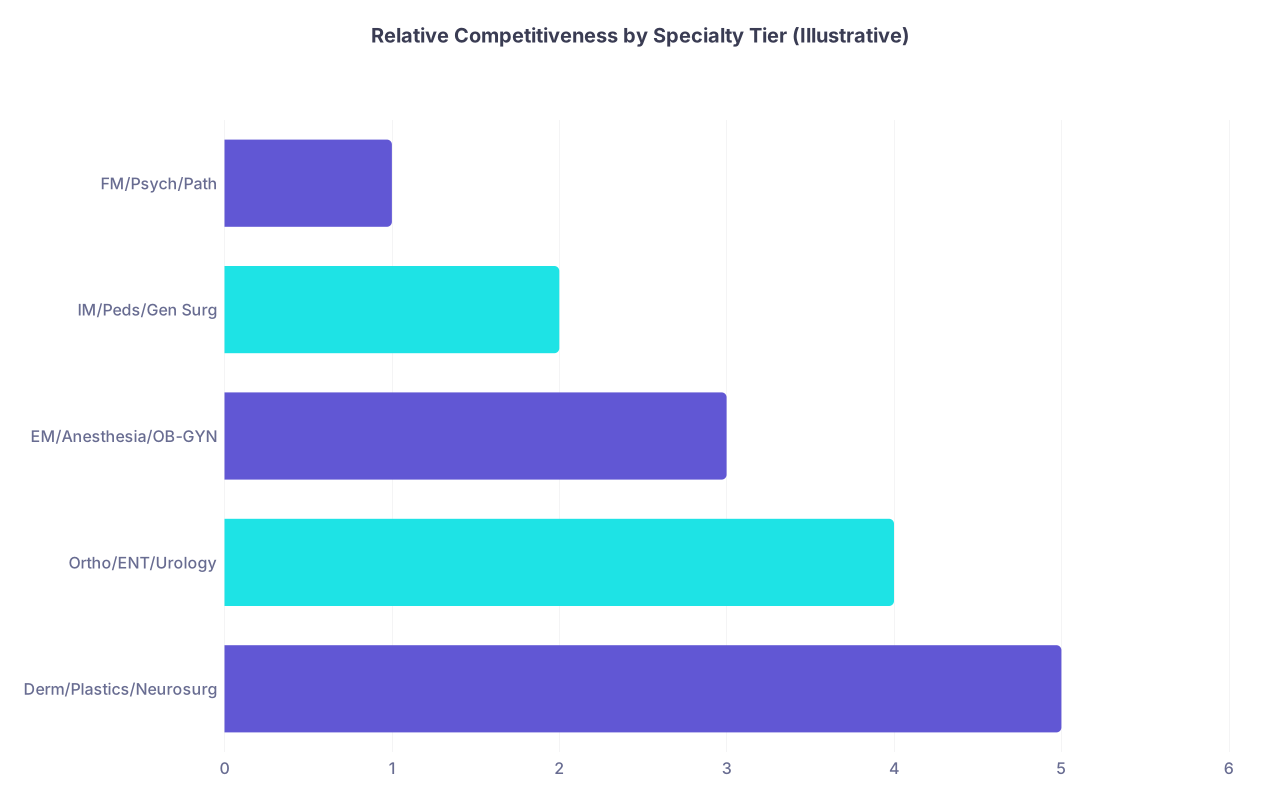
| Category | Value |
|---|---|
| Derm/Plastics/Neurosurg | 5 |
| Ortho/ENT/Urology | 4 |
| EM/Anesthesia/OB-GYN | 3 |
| IM/Peds/Gen Surg | 2 |
| FM/Psych/Path | 1 |
(Scale 1–5: 5 = most competitive nationally.)
Checklist before you take Step 1/Level 1:
- Know your primary 3–4 candidate specialties.
- Know whether Step 1 is Pass/Fail only for you (still matters for competitive fields via school rankings, research, etc.).
- Know whether you will likely need a strong Step 2 (or COMLEX 2) to stay competitive for your top candidate specialties.
If you are aiming at highly competitive fields (derm, plastics, ortho, ENT, neurosurg, urology, IR, optho), you must start vetting backup plans in MS2: e.g., IM, gen surg, FM, etc. I have seen too many people wait until after a disappointing Step 2 score to think about this. That is late.
MS3: The Decision Year (Rotations Force the Issue)
MS3 is where people’s illusions die. In a good way.
You will discover:
- You are not who you thought you were in the OR
- Or you like something you never considered
- Or your “backup” field is actually a better personality fit
The point of MS3 is to turn curiosity into a decision.
Before Rotations Start: Pre-Commitment Shortlist
At this point (late MS2 / early MS3) you should have:
- 3–4 specialties on your shortlist
- 1 or 2 that you suspect will be frontrunners
- A rough sense of competitiveness and your current CV standing
Write this down:
- Likely front-runner: __________
- Second choice / close competitor: __________
- Backup field if primary fails (either performance or scores): __________
You are not binding yourself. You are setting hypotheses to test.
During Core Rotations: Month-by-Month Filters
Every 4–8 week block is a data point. Treat it that way.
Your core rotation slate usually includes:
- Internal Medicine
- Surgery
- Pediatrics
- OB/GYN
- Family Medicine
- Psychiatry
- Neurology (sometimes in MS4, depends on school)
- EM (timing varies)
For each rotation, at this point you should:
- Evaluate 3 things:
- Content: Do you like the problems this specialty solves?
- Environment: Do you like the team dynamics, pace, and culture?
- Version of yourself: Do you like who you are on that rotation?
After each rotation, force yourself to answer:
- Is this:
- A strong contender
- A “nice but not me”
- Or a hard no?
And then adjust your shortlist accordingly.
Month 1–3 of MS3: Early Rotations
You will be overwhelmed. That is normal.
But at this point you should already:
Start a log after each rotation:
- “What I liked”
- “What I hated”
- “Could I do this for 30 years?”
Talk to at least one resident per rotation about:
- Why they chose it
- What they would choose instead if they could go back
Do not decide on your specialty after your first rotation. The first one always feels dramatic. You do not yet know what “normal” is.
Mid-MS3 (Months 4–8): The Critical Window
Most people decide between late fall and early spring of MS3. This is the phase that makes or breaks your timeline.
At this point you should:
Converge on 1–2 primary specialties.
If you still have 4–5 possible choices by January/February of MS3, you are behind. Not doomed, but behind.Start collecting future letters of recommendation. For each serious specialty:
- Identify 2 attendings who know you well
- Ask them explicitly: “Do you feel you could eventually write me a strong letter in [specialty] if I continue to work at this level?”
If they hesitate, that tells you something.
Reality-check against competitiveness and your record. Look at:
- Grades in rotation for that field
- Shelf scores (especially IM, surgery, OB, peds, psych)
- Step 1/2 or COMLEX 1/2 performance
- Research, leadership, meaningful experiences in that direction
If your record is below the median for your dream field and you do not have a realistic story or backup, fix that now, not in MS4.
Late MS3 (Final 3–4 Months): Commit and Plan MS4
By this point you should be:
- 90% certain of your specialty
- 100% clear on your backup plan if the first choice collapses
Your tasks:
Formalize your specialty decision by early spring. For most students, this means:
- You know exactly what you are applying to
- You know whether you will dual apply (e.g., EM + IM, IM + prelim surgery, etc.)
Plan your MS4 schedule to support that choice.
You are racing a calendar now. Use a simple map like this:
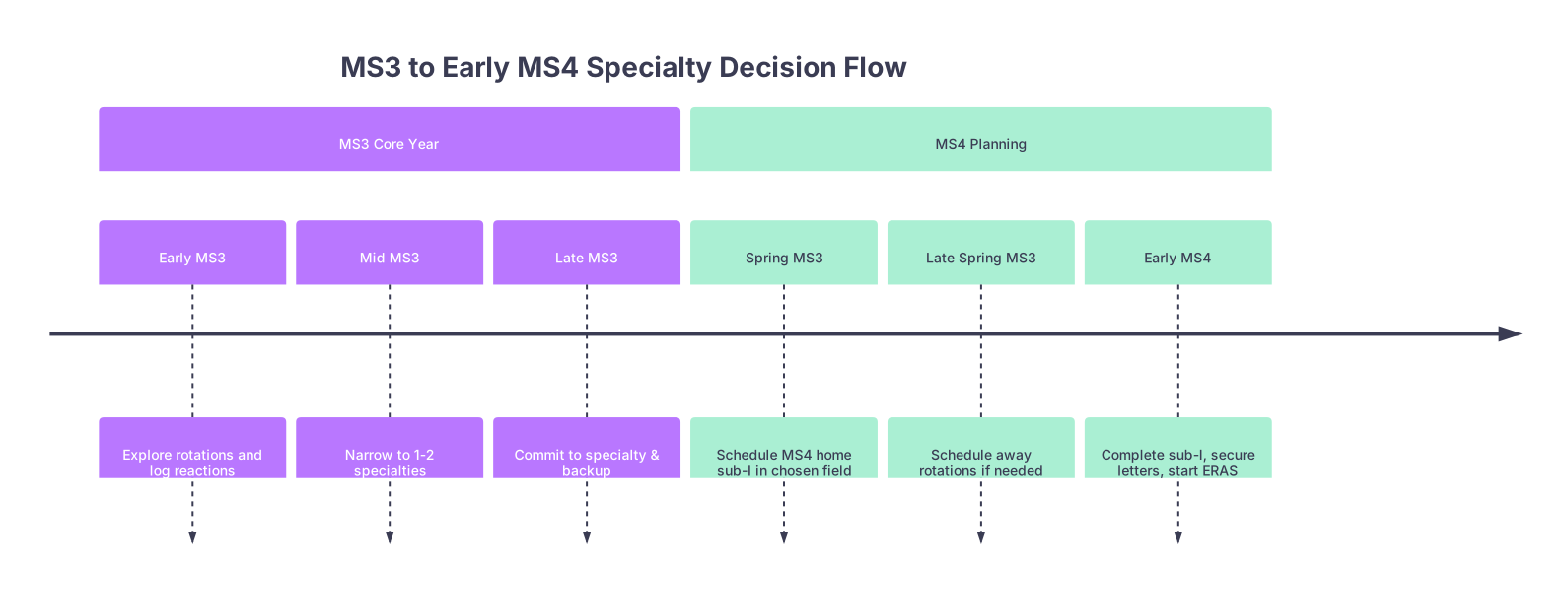
| Period | Event |
|---|---|
| MS3 Core Year - Early MS3 | Explore rotations and log reactions |
| MS3 Core Year - Mid MS3 | Narrow to 1-2 specialties |
| MS3 Core Year - Late MS3 | Commit to specialty & backup |
| MS4 Planning - Spring MS3 | Schedule MS4 home sub-I in chosen field |
| MS4 Planning - Late Spring MS3 | Schedule away rotations if needed |
| MS4 Planning - Early MS4 | Complete sub-I, secure letters, start ERAS |
Key deadlines (approximate; adjust to your school):
By February–March MS3:
- Chosen specialty
- Draft MS4 schedule (home sub-I, potential away rotations, electives)
By April–May MS3:
- Away rotations requested (for fields where this matters: ortho, EM, derm, ENT, neurosurg, etc.)
- Identify letter writers and give them timelines
If you are still undecided heading into MS4 scheduling, you need to sit down with a dean or specialty advisor immediately and design a defensive strategy (like early broad electives, delaying away rotations, or dual-apply prep).
MS4: Execution on a Decision You Already Made
If you are deciding your specialty in MS4, you are late. It happens. But let us assume you followed the plan above.
Early MS4 (Before ERAS Submission)
At this point you should:
- Be consolidating, not exploring.
- Be strengthening your application within your chosen field.
Your priorities:
Do a strong sub-internship (“sub-I”) in your chosen specialty.
- Aim to complete this by late summer if possible.
- Behave like an intern:
- Pre-round without being asked
- Know every lab before the team does
- Volunteer for notes, calls, and scut
This is where some of your best letters come from.
Complete away rotations strategically (if relevant). Do not overdo them. For most competitive fields:
- 1–2 aways are enough
- Choose programs that:
- You would actually rank highly
- Have a track record of interviewing their rotators
Lock in letters of recommendation. Typical targets:
- 2–3 letters from your specialty
- 1 from core faculty who can speak to your overall clinical excellence (IM, surgery, etc.)
Timeline checkpoints:
June–July MS4:
- Sub-I at home institution (or beginning of away)
- Ask for letters formally
August MS4:
- ERAS application drafting complete (PS, activities, experiences framed around your specialty identity)
- Final letters in progress / uploaded
ERAS Season and Interview Months
ERAS is usually due in September.
At this point you should:
- Not be questioning your specialty on every bad day.
- Be evaluating programs, not your field.
Your timeline:
- September: Submit ERAS.
- October–January: Interviews.
- February: Rank list.
- March: Match Day.
During interviews, you need a clear, consistent specialty story:
- Why this field?
- Why not your obvious alternatives?
- How have your MS3/4 experiences confirmed this?
Students who sound tangled usually decided in a panic. The whole point of the MS1–MS3 work is to prevent that.
If You Are Behind the Timeline
This happens. You blink, and it is January of MS3 and you are “keeping an open mind” on six specialties. That is not open-minded. That is avoidance.
Condensed recovery plan by phase:
Late MS2, still lost:
- Pick 3 fields to investigate hard during your first 3 rotations.
- Schedule those rotations earlier if your school allows it.
- Set a hard deadline: you will narrow to 2 by January MS3.
Mid MS3, still lost:
- Meet with a dean or advisor this month.
- Use your remaining rotations as “head-to-head trials” between 2–3 fields.
- Decide by the end of the academic year. MS4 is not for browsing.
Early MS4, still lost (rare but real):
- You are now in damage control. Focus on:
- Preliminary or transitional year applications
- A broad field (IM, prelim surgery, transitional) to buy time
- Be brutally honest with yourself and an advisor about competitiveness and options.
- You are now in damage control. Focus on:
Two Non-Negotiables Throughout All Four Years
To close, anchor on these:
Make time-bound decisions, not indefinite preferences.
You do not “kind of like” four fields forever. By MS3 mid-year you convert preferences into commitments with deadlines.Align your story, your scores, and your schedule.
Your specialty choice is not just what you like. It is what your experiences, performance, and MS4 calendar all point to. When those three line up, interviews go smoothly and Match odds rise.
Follow the timeline, adjust honestly as new data hits you, and you will not be the MS4 trying to reinvent your career on ERAS submission day.


