

It’s March of your clinical year. Step 1 is finally behind you. You’ve deleted half your Anki decks in a petty act of revenge, your NBMEs are closed, and you’re starting real patient care.
But your classmates are suddenly talking in a new language:
- “I’m leaning heme/onc.”
- “If I don’t get ortho, I’ll pivot to anesthesia.”
- “I have to crush Step 2 for derm.”
You? You’re not even sure if you like the OR, clinic, or the ICU. And Step 2 is staring at you from 6–12 months away.
This gap between Step 1 and Step 2 is exactly when the specialty decision window opens. Not on ERAS day. Not on rank list week. Now.
Let me walk you through what you should be doing month-by-month and then tightening down to what to do each rotation, then week-by-week leading into Step 2.
Big Picture: The “Decision Window” Between Step 1 and Step 2
You get one truly useful window to figure out your specialty: from the week you walk out of Step 1 until about 2–3 months before Step 2.
Beyond that, the train starts moving:
- Sub-I’s and aways need to be chosen.
- Letters need to be lined up.
- Step 2 date becomes locked around your application goals.
At this point, you should understand the main constraints on your specialty choice:
- Step 1 is now pass/fail. Your numeric gun is Step 2.
- Competitive specialties will look at:
- Step 2 score
- Honors on core rotations
- Research in the field
- Meaningful mentorship/advocacy letters
So the optimal time window is:
- First 3–4 months post–Step 1: Exploration-heavy, data-gathering about yourself and specialties.
- Months 5–8 post–Step 1: Narrowing, positioning, scheduling sub-I/aways intelligently.
- ~3 months before Step 2: Commitment. Specialty “short list” becomes a primary choice with maybe a backup.
Let’s break this chronologically.
Phase 1: First 4–6 Weeks After Step 1 – “Reset and Observe”
You’ve just finished Step 1. You’re tired and a bit numb. That’s normal.
At this point, you should not be forcing a specialty decision. You should be watching yourself carefully.
Weeks 1–2: Immediate Post-Step 1
You’re starting or about to start your first clerkship (usually IM, surgery, family, or peds).
In these first two weeks:
- Don’t decide. Just observe.
- Keep a tiny running note on your phone with three headings:
- “Tasks I enjoy”
- “Tasks I hate”
- “People I vibe with”
Every day, jot down 2–3 bullets. Examples:
- Enjoy: Presenting new admits; doing focused neuro exams; teaching juniors.
- Hate: Prolonged rounding with no action; endless clinic follow-ups with no diagnosis.
- People: Loved talking to the trauma chief; liked the outpatient attending who ran on time.
You’re building a behavioral log that will later point you toward or away from certain fields.
At this point you should:
- Accept that your first rotation will disproportionately influence your thinking. Recognize this bias so it doesn’t own you.
- Start a “specialty ideas” list. Just names. No commitment:
- IM, EM, OB/GYN, anesthesia, psych, etc.
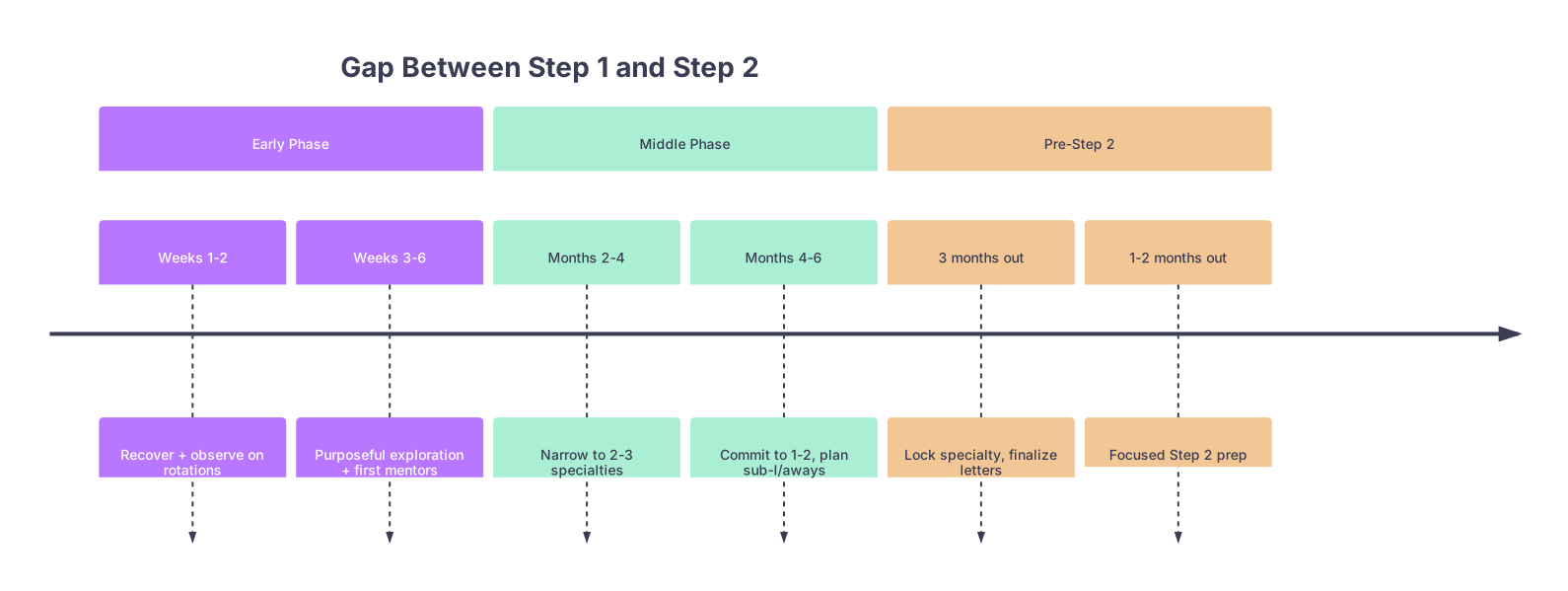
| Period | Event |
|---|---|
| Early Phase - Weeks 1-2 | Recover + observe on rotations |
| Early Phase - Weeks 3-6 | Purposeful exploration + first mentors |
| Middle Phase - Months 2-4 | Narrow to 2-3 specialties |
| Middle Phase - Months 4-6 | Commit to 1-2, plan sub-I/aways |
| Pre-Step 2 - 3 months out | Lock specialty, finalize letters |
| Pre-Step 2 - 1-2 months out | Focused Step 2 prep |
Phase 2: Weeks 3–6 – “Guided Exploration”
By week 3, the fog from Step 1 should be fading. Time to be more deliberate.
At this point, you should start structuring your exploration.
Action Steps Over Weeks 3–6
Identify your “rotational reactions” After 2–4 weeks on a service, ask yourself:
- Did I dread going in?
- Did the days feel fast or endless?
- Did I like the pace? (clinic vs floor vs OR vs ED)
- Did I respect the lifestyle of the attendings?
Write 3–5 sentence summaries after each rotation block:
- “IM wards: liked thinking through complex cases, hated constant discharges and social work bottlenecks. Could do this, but not excited.”
- “Surgery: loved the team, OR was fine but I didn’t crave it. Early mornings okay, but the consults felt chaotic.”
Talk to 2–3 residents informally Coffee chats, 10-minute hallway conversations, lunch in the resident lounge. Ask:
- “What do you like least about your field that you can’t say on interview day?”
- “If you weren’t in this specialty, what would you be doing and why?”
- “What Step 2 score really changes your options in this field?”
Start a reality-check table
Make yourself a quick comparison table of your current interest list vs competitiveness and timing.
| Specialty | Relative Competitiveness | Step 2 Priority | Research Helpful? |
|---|---|---|---|
| Internal Med | Moderate | Solid score | Yes |
| Ortho | Very High | Critical | Yes, often required |
| EM | Moderate-High | Important | Somewhat |
| Psych | Lower-Moderate | Helpful | Helpful but flexible |
| Derm | Extremely High | Critical | Essentially required |
Nothing fancy. Just a forcing function to see what’s realistic if your Step 2 is 5–15 points above or below your NBME trajectory.
Phase 3: Months 2–4 After Step 1 – Narrowing to 2–3 Serious Options
This is the meat of the “gap.” This is the optimal decision window. You’ve seen enough to know what you gravitate toward. You’re not so deep into ERAS that you’re locked in.
By about month 3 post–Step 1, you should have:
- 2–3 specialties you’re seriously considering.
- A clear sense of:
- Clinic vs procedural vs acute care preference.
- Rough competitiveness band you’re comfortable chasing.
Month 2: Pattern Recognition
At this point you should:
Review your rotation notes:
- What settings keep recurring in your “enjoy” list? OR, clinic, wards, ICU, ED?
- What patient populations you mention positively? Kids, OB, cancer, older adults, psych.
Build a simple 2–3 column grid in your notes:
- Column A: Specialty
- Column B: “Pros for me”
- Column C: “Dealbreakers / Concerns”
Do not write generic stuff like “good lifestyle.” That means nothing. Write:
- “Hospitalist schedule: 7-on/7-off could work well for me, I like defined blocks.”
- “Outpatient-only clinic: I get bored after 5–6 chronic care visits in a row.”
Month 3: Meaningful Mentors and First Commitments
This is when your decisions need teeth.
At this point you should:
Pick 1–2 “provisional primary” specialties Example:
- Primary: EM
- Backup: IM (with possible pulm/crit later)
Or:
- Primary: Ortho
- Realistic backup: Anesthesia
Identify mentors in each provisional specialty
Minimum:
- 1 resident you can text quickly
- 1 faculty member who:
- Knows your name
- Has seen you work or is willing to give you small projects
Ask them very direct questions:
- “If I’m targeting your field, what month should I take Step 2?”
- “What Step 2 number changes how competitive I am?”
- “If I get X on Step 2, is there a clear backup specialty you’d recommend?”
Start positioning your schedule
This is where poor planning kills people’s options. You don’t want:
- Step 2 one week after a brutal sub-I.
- Your only EM rotation after your Step 2 score is already set if you’re not sure yet.
Rough guideline:
- Put a core rotation or early elective in your top 1–2 fields before Step 2.
- Plan one sub-I or key acting internship in your chosen field for after Step 2, but before ERAS.
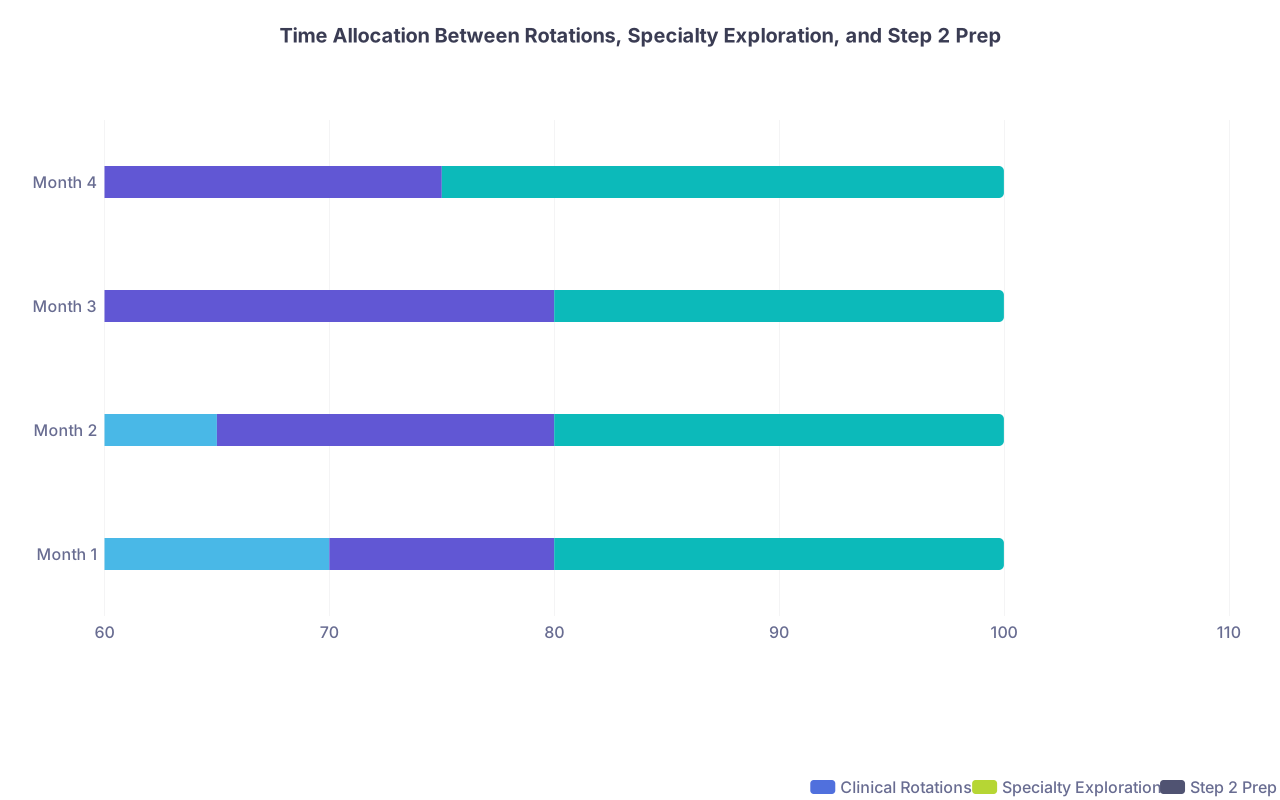
| Category | Clinical Rotations | Specialty Exploration | Step 2 Prep |
|---|---|---|---|
| Month 1 | 70 | 10 | 20 |
| Month 2 | 65 | 15 | 20 |
| Month 3 | 60 | 20 | 20 |
| Month 4 | 60 | 15 | 25 |
Phase 4: 4–6 Months Before Step 2 – Locking the Primary Specialty
By the time you’re 4–6 months away from your planned Step 2 test date, your specialty choice should be more than a vibe. It should influence how you study and what you prioritize.
At this point you should:
Commit to one primary specialty on paper
You’re not signing your soul away, but you are saying:
- “I am preparing as if I will apply to X.”
- “My Step 2 target score is Y based on X’s competitiveness.”
- “My backup is Z if Step 2 underperforms.”
Align your Step 2 timeline with your specialty
Broad guidelines:
Highly competitive specialties (derm, plastics, ortho, ENT, ophtho)
You want Step 2:- On the earlier side (often late spring/early summer before ERAS) so a strong score is on your app.
- At a time you can realistically peak (not post-ICU month where you averaged 4 hours of sleep).
Moderate competitiveness (IM, EM, OB/GYN, gen surg)
Your Step 2 score still matters a lot, but you have a bit more flexibility. Focus on:- Having it back before programs send interview invites.
- Avoiding scheduling it so late that you can’t adjust your specialty choice if the score is way lower than expected.
Lower competitiveness (FM, psych, peds in most areas)
You still need to pass with a reasonable score, but:- You can prioritize clinical learning earlier.
- Step 2 scheduling can be slightly more forgiving.
Start specialty-weighted Step 2 prep
That means:
- Everyone: UWorld, NBME practice, standard resources.
- Specialty-adjusted:
- Future internist or hospitalist-type? Own cardiology, pulm, nephro.
- Future surgeon? Don’t tank surgery/acute care questions. EM, OB/GYN, trauma-type vignettes matter to your confidence and your narrative.
- Future psych? You still need to not embarrass yourself on medicine, but know your psych pharm and diagnostic criteria cold.

Micro-Timeline: The 3 Months Before Step 2
Now we zoom in. Because this is where people panic, overthink, and try to change specialties every other week.
Assume your Step 2 is in late July. Adjust the months to your actual date.
T-minus 12 Weeks (3 Months Out)
At this point you should:
- Lock your primary specialty decision. No more “maybe derm, maybe EM, maybe peds.” Pick one primary path.
- Confirm your exam date with your chosen specialty mentor:
- “Does this timing make sense for my field?”
- Audit your application gaps:
- Do you have at least 1–2 potential letter writers in your field?
- Any small research or QI project you can realistically push forward in the next 2–3 months?
Week goals:
- 200–300 Step 2-style questions per week.
- One weekly check-in: “If I had to apply today, would I still choose this field?” If you’re changing your answer every week, you do not have clarity yet. Talk to someone neutral (not just your equally-confused friends).
T-minus 8 Weeks (2 Months Out)
By now:
- You’ve taken at least one NBME.
- You have a rough sense of your scoring range.
At this point you should:
Do a brutal realism check with your mentor
Example:
- NBME predicts 240–245.
- You’re aiming for ortho at a mid-tier program.
Ask:
- “If I land in this Step 2 range, what kind of ortho applicant am I?”
- “Should I keep ortho as primary and anesthesia as a backup, or flip that?”
Lock your Plan A and Plan B
Think in clear terms:
- “If I get ≥ X, I apply primary to specialty A, secondary to B as backup.”
- “If I get < X, I switch to B as primary, A as a stretch or not at all.”
Write this down before your score comes out. Otherwise, you’ll move goalposts to protect your ego, not your career.
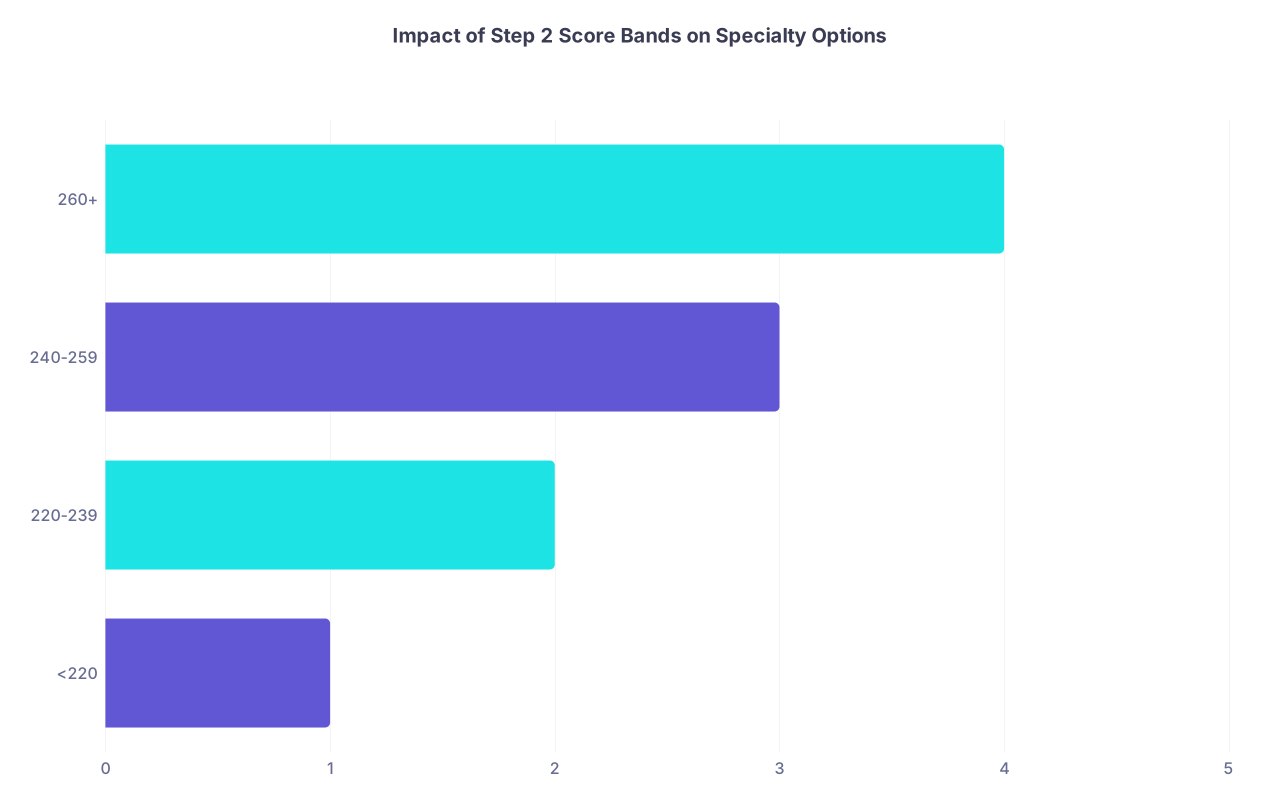
| Category | Value |
|---|---|
| <220 | 1 |
| 220-239 | 2 |
| 240-259 | 3 |
| 260+ | 4 |
(Read as: higher Step 2 opens more specialty doors; the exact mapping depends on your school, research, and narrative.)
T-minus 4 Weeks (1 Month Out)
At this point, specialty decisions should be basically fixed unless something dramatic happens.
You should:
- Be in execution mode for Step 2, not existential-crisis mode.
- Have:
- Your primary specialty
- Your realistic backup
- Your sub-I plan
- Your first-choice letter writers list
If you’re still bouncing between wildly different fields (like derm vs EM vs psych), that’s a flag you avoided hard conversations earlier. Don’t double down on indecision now. Carve out one evening to:
- Re-read your rotation notes.
- Revisit your pros/cons table.
- Call the most blunt attending or resident you know and ask:
“Here is how I work, here’s what I like and hate. What field does that sound like to you?”
Then commit.

How Much Should Step 2 Influence Your Specialty Decision?
This is the part no one likes to say out loud. Step 2 should absolutely influence your specialty decision. But it shouldn’t completely dictate it.
Here’s the rule I’ve seen hold up over and over:
- If you hate a field but your score is perfect for it → do not do it.
- If you love a field but your score is dramatically mismatched for its competitiveness → keep it as a dream, but don’t sacrifice your entire career to chase a 5% chance.
Use the gap between Step 1 and Step 2 to:
- Get honest about:
- How much you value “prestige” vs day-to-day happiness.
- How much risk you’re willing to tolerate.
- Build realistic outcome trees:
- “If I aim high and miss, what is my actual landing spot?”
- “If I choose a middle-of-the-road specialty that fits, can I live with never being a surgeon/derm/ENT/etc.?”

Quick Checklist by Phase
Use this as your sanity check.
Immediately After Step 1 (Weeks 1–6)
- Start daily “enjoy/hate/people” notes during rotations.
- Talk to at least 2 residents in different fields.
- Make an initial list of 4–5 possible specialties.
Months 2–4 Post–Step 1
- Narrow list to 2–3 serious specialties.
- Create a pros/cons grid specific to you, not Reddit.
- Find at least one faculty mentor in each of your top 1–2 fields.
- Start planning rotations and sub-I’s around likely specialty choices.
4–6 Months Before Step 2
- Choose one primary specialty and one backup on paper.
- Confirm with mentors that your Step 2 date works for your field.
- Begin specialty-weighted Step 2 prep (focus areas that align with your field).
3 Months Before Step 2
- Lock primary specialty.
- Take at least one NBME and discuss with mentor.
- Define score thresholds for Plan A vs Plan B.
1 Month Before Step 2
- Stop re-litigating your specialty choice weekly.
- Ensure sub-I/away schedule matches your primary specialty.
- Have a clear letter-writer list for your field.
FAQ (Exactly 3 Questions)
1. What if I still have no clue what specialty I want by the time I’m 3 months from Step 2?
Then you’re not collecting the right kind of data. Stop asking “What do I like?” in a vague way and start asking:
- “What parts of my current day make time disappear?”
- “What tasks consistently drain me?”
- “Which attendings have the kind of life I actually want?”
Force yourself to pick at least one direction as your hypothetical primary and build a concrete plan around it, even if it’s provisional. Indecision is not neutral; it actively harms your positioning.
2. Should I delay Step 2 to improve my score for a more competitive specialty?
Sometimes yes, sometimes that’s a terrible idea. If your practice scores are clearly rising and an extra 4–6 weeks will realistically move you into a different competitiveness tier for your dream specialty, delaying can be rational. If you’re plateaued and just scared, delaying only pushes your anxiety down the road and can screw up sub-I timing and ERAS prep. Always decide this with a mentor in that specialty who understands both your school’s schedule and current match climate.
3. How much does it hurt to change specialties after Step 2 if my score is lower than expected?
It stings, but it’s not terminal. Many people pivot from ultra-competitive fields to solid, fulfilling specialties after seeing their Step 2. The damage happens when people cling to a wildly misaligned specialty and end up with a weak match cycle, SOAP, or no match at all. Use your predetermined score thresholds and be disciplined: if your score lands below your agreed cutoffs, honor the plan you made with your future self.
Today, don’t overcomplicate this. Open a fresh note on your phone labeled “Specialty Log – [Your Name].” After your next clinical day, write three bullets: one thing you enjoyed, one thing you hated, and one person whose job you could see yourself doing. That’s your first real step in using the Step 1–Step 2 gap intelligently.


