

Most MS2s waste the year before boards drifting; the ones who match well treat it like a launchpad.
You are not “too early” to think about specialties. You are also not “too busy” with boards to ignore research and shadowing. If you want real options by MS4, the calendar for MS2 matters. A lot.
I will walk you month-by-month and then week-by-week through MS2, with clear “at this point you should…” milestones for:
- Specialty exploration
- Research setup (not just vague “get a project” nonsense)
- Shadowing and mentorship
- Boards prep balance
Assume this timeline starts in July of MS2 and runs through Step 1 / Level 1 at the end of MS2. Adjust a month or two forward/back if your school differs, but the sequence holds.
Big-Picture MS2 Timeline: Research + Shadowing + Boards
At this scale you need to see how the pieces stack.
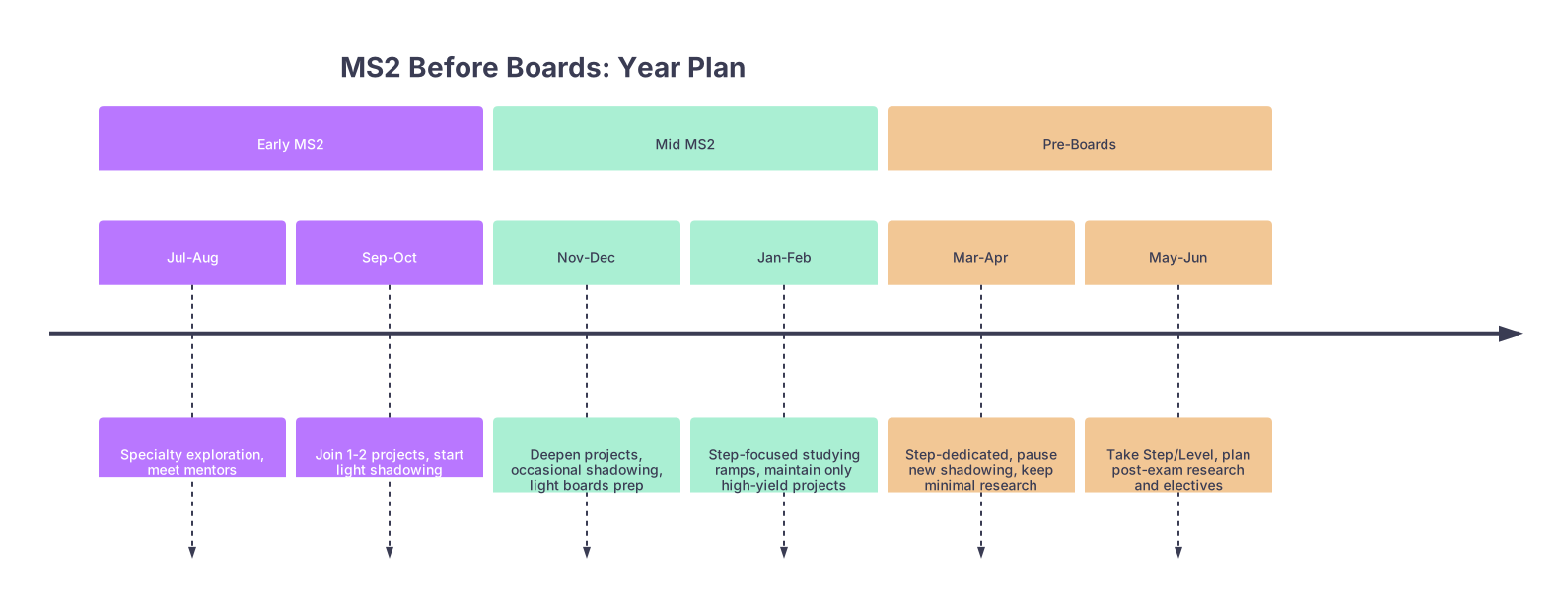
| Period | Event |
|---|---|
| title MS2 Before Boards | Year Plan |
| Early MS2 - Jul-Aug | Specialty exploration, meet mentors |
| Early MS2 - Sep-Oct | Join 1-2 projects, start light shadowing |
| Mid MS2 - Nov-Dec | Deepen projects, occasional shadowing, light boards prep |
| Mid MS2 - Jan-Feb | Step-focused studying ramps, maintain only high-yield projects |
| Pre-Boards - Mar-Apr | Step-dedicated, pause new shadowing, keep minimal research |
| Pre-Boards - May-Jun | Take Step/Level, plan post-exam research and electives |
At each phase, you are deciding three things:
- What specialty directions to explore or eliminate
- Which research work actually helps (vs resume clutter)
- How much shadowing is enough without wrecking boards prep
Let us go through the year.
July–August (Early MS2): Set the Board and Choose Targets
At this point you should be choosing 2–3 “target fields” to explore, not marrying any of them.
Step 1: Shortlist your target fields (2 weeks)
By mid-July you should have a shortlist. Do not pick 8 specialties. That is a cop-out.
- 1–2 “competitive / maybe” fields
- Dermatology, ortho, ENT, plastics, urology, neurosurgery, radiation oncology, ophthalmology
- 1–2 “core / likely” fields
- Internal medicine, pediatrics, EM, OB/GYN, anesthesia, psychiatry, FM
How to choose quickly:
- Think back to MS1 blocks you actually liked: neuro? MSK? endocrine? psych?
- Look at lifestyle vs training length honestly (you are not immune to burnout)
- Ask 1–2 trusted residents: “Given my grades and personality, which 2–3 should I look at?”
By the end of July, you should have something like:
“Right now I am exploring: Internal Medicine, Cardiology-track; Emergency Medicine; and maybe Anesthesia.”
Step 2: Map your school’s ecosystem (1 week)
You need to know where the power lives.
By early August you should have a list of real names for each target field:
- Program director (PD)
- Associate PD
- 2–3 research-active faculty
- Chief resident or enthusiastic PGY-2
Where you find them:
- Department website pages (faculty + research sections)
- Your school’s student specialty interest groups
- Upperclassmen: ask MS3/4 “Who actually mentors students in [field] here?”
Make a simple document with:
- Names, titles, emails
- Their research topics
- Whether they are known for being good student mentors (ask around)
At this point you should not be emailing everyone yet. You are preparing a surgical strike, not a spam campaign.
Step 3: Start the mentor hunt (late August)
By late August, you should send 3–5 targeted emails total, not 20.
Your goal is 1 primary research mentor + 1–2 exploratory meetings in each target field.
Your email should:
- Be short (under 200 words)
- Mention specific interest in their work (“your paper on…”)
- Offer realistic time (“I can commit ~3–5 hours/week this semester”)
- Ask for a brief meeting to see if there is a fit
By the end of August, your goals:
- 2–4 meetings set up for early September
- At least one meeting each in your top 1–2 specialties
September–October: Lock in a Project and Start Shadowing
This is where most people mess up. They either grab busy-work research or they overschedule shadowing and drown.
Step 4: Choose 1–2 concrete research roles (September)
At this point you should be saying no to most vague invitations.
You want projects that:
- Have clear deliverables: database already built, chart review protocol submitted, or draft case report ready
- Have a timeline that fits MS2: start now, paper/poster potential by MS3–early MS4
- Fit your board schedule: can scale down when dedicated starts
An attending saying “we are thinking of starting a cohort study, maybe” is usually a red flag for MS2.
Typical good-fit MS2 projects:
- Chart review in your target field
- Case series in a specific pathology you will see on the wards
- Case report where the resident basically needs someone to drive the references and images
- Simple QI project where IRB is already done
| Project Type | Good for MS2? | Comment |
|---|---|---|
| Existing chart review | Yes | Best balance of effort |
| New prospective trial | No | Too slow and complex |
| Case report | Yes | Fast, low barrier |
| Big basic science | Risky | Only if ongoing pipeline |
| QI with IRB done | Yes | Good for presentations |
By end of September, you should:
- Be actively working on 1 primary project
- Possibly have a second very light project (e.g., case report) if it is low time cost
Step 5: Shadowing setup (September–October)
You do not need 80 hours of shadowing. You need enough reps to decide if you like the work.
Target for before boards:
- 10–20 hours in each of 1–2 target fields
- Spread over 3–4 different days, not one massive day
How to structure:
- Ask residents you met or faculty: “Could I shadow you for one OR day or one clinic half-day?”
- Avoid scheduling during your heaviest exam weeks
- If you are eyeing a surgical field, at least 1 full OR day and 1 clinic day
By late October, at this point you should be able to answer:
- Do I tolerate the OR environment or hate it?
- Do I like acute, fast-turnover work (EM, anesthesia) or longitudinal clinic?
- Am I still genuinely interested in my “competitive maybe” or was that ego?
Step 6: Start a light tracking system
Research and shadowing fall apart when you do not track them.
By October, you should have:
- A simple spreadsheet or note with:
- Dates and hours shadowed (by specialty and attending)
- Project names, roles, and approximate weekly hours
- Abstract / manuscript deadlines, if known
This will save you when ERAS asks you for dates and hours two years from now.
November–December: Deepen Projects, Begin Board Prep
At this point you should shift from setup to productivity while boards prep enters the picture.
Step 7: Move from “on the project” to “useful on the project”
By mid-November, if you are still just “waiting for assignments,” that is a problem.
You should:
- Have concrete tasks: data extraction, chart abstraction, literature search, figure prep
- Know who your day-to-day supervisor is (usually a resident or fellow)
- Have a rough product in mind: poster at local / national meeting, manuscript submission window
Reasonable expectation by end of calendar year:
- For chart review: data collection well underway
- For case report: draft written or close
- For QI: baseline data collected, plan in progress
If you are still in endless “planning meetings” with nothing on paper by December, consider cutting your losses.
Step 8: Shadowing refinement and decisions
November–December, you should stop “tourist” shadowing and get selective.
Questions you should be able to answer now:
- Which 1–2 fields do I want to prioritize for research attention?
- Is there any field I can confidently rule out based on shadowing?
Adjust accordingly:
- If you discovered a surprise love (e.g., you shadowed EM on a whim and loved it), re-run Steps 2–5 for that field in mini-form.
- If you hate a field you thought you liked, stop putting time there. Misplaced loyalty kills options.
Shadowing volume target by winter break:
- ~10–20 hours in your current top choice
- ~5–10 hours in another contender
No need to overdo it. You are about to shift toward heavy board prep.
Step 9: Introduce structured boards prep (light but consistent)
By December, at this point you should be:
- Doing light but regular QBanks (e.g., 10–20 questions/day, 4–5 days/week)
- Protecting 1–2 half-days per week where you do not schedule research meetings or shadowing
This is where discipline matters:
- If a project wants to expand into a time sink and you are not getting authorship-level work, push back.
- Tell your mentor: “Board prep is ramping up; I can commit ~3 hours/week consistently.” Good mentors will respect that. Bad ones are a warning sign.
January–February: Board Prep First, Research on a Leash
This is the danger zone. Everyone says “I can do everything.” Then they bomb NBME assessments.
Step 10: Renegotiate your research bandwidth (early January)
At this point you should proactively reset expectations with research mentors.
What to do:
- Send a short email or talk in person:
- “I am ramping up Step 1 prep. I can realistically give ~2–3 hours/week to finish data collection / revisions.”
- Identify critical tasks only:
- Finish data extraction
- Finalize tables/figures
- Respond to coauthor edits
What you should not be doing now:
- Starting brand new projects
- Taking on roles with vague time requirements
- Adding non-essential meetings
By mid-January, your research should feel like:
- A small ongoing commitment you can maintain
- Not a second job
Step 11: Freeze shadowing, except for high-yield exceptions
From January onward, your default for shadowing is “no” until boards are done.
Exception:
- 1–2 half-days max if:
- It is with a key potential letter writer in your top field
- It fits around your practice exams and dedicated schedule
But if you are still trying to “sample” fields in February, you are off track. Use winter break to lock in your direction; January–February is not for exploration.
Step 12: Weekly rhythm during heavy pre-dedicated
Here is a realistic weekly structure Jan–Feb:
- 5–6 days/week:
- Systems/board content
- 40–80 QBank questions/day
- Research:
- 1 short block of 2–3 hours/week for your main project
- Shadowing:
- 0–1 half-days total in the month (if truly strategic)
If your research work cannot fit into that 2–3 hour block, the project is mis-scoped for MS2 pre-boards.
March–April: Dedicated Boards Period – Protect It Ruthlessly
At this point you should be in full dedicated mode or close.
Step 13: Put most research in “maintenance mode”
Default: no new data collection, no new projects.
What you may reasonably keep:
- Occasional manuscript or abstract edits (1–2 hours/week at most)
- An email here or there to respond to coauthors
If a mentor pushes for more, you need to be blunt:
“I am in my dedicated Step/Level period. I need to focus fully on this until [date]. I am happy to re-engage after my exam.”
You get one real shot at a first-attempt board score. No research line is worth blowing that.
Step 14: Accept that shadowing is done until after boards
During dedicated, shadowing is off the table.
What you can do instead to keep specialty mindset alive:
- Use your target field as a lens for studying
- Example: Interested in cardiology? Pay extra attention during cardio path; look at guideline tables.
- Keep a short list for post-exam:
- Names of attendings to shadow again
- Ideas for follow-up or new projects
But physical presence in clinic/OR during dedicated? No.
May–June: Post-Boards Reset and Next Research Push
You take Step/Level somewhere here. Assume mid-to-late May or early June.
At this point—post-exam—you have a massive opportunity. You are before MS3, before grades, with time and more cognitive bandwidth.
Step 15: Re-open research projects strategically
Within 1–2 weeks after your exam, you should:
- Email your mentors:
- Let them know your exam is done
- Ask where things stand with your project(s)
- Clarify realistic summer bandwidth (which may be higher than during MS2)
Ideal outcomes:
- One project moves toward abstract submission (fall conference)
- Another moves toward manuscript draft before or during MS3
If something is stalled and clearly going nowhere, cut it and move your energy to:
- A new project in the same field with a better-structured team
- Or a new field only if your specialty interest truly changed
Step 16: Targeted shadowing redux (post-boards, pre-clinicals)
Now is when shadowing becomes high yield again.
Focus on:
- Deepening in your top 1–2 fields, not breadth tourism
- Getting on the radar of:
- Program leadership
- Faculty who actually write letters
Volume:
- ~20–40 hours total across the rest of the pre-clinical / pre-clerkship gap
- Mix of clinic, OR, and call if relevant
- Try for repeat contact with the same mentors:
- 2–3 days with the same attending looks better than 10 attendings once each
Step 17: Align everything with your early MS3 schedule
By the time you start MS3, at this point you should:
- Know your top field with at least 70–80% confidence
- Have:
- 1–2 active or completed projects in that field
- Documented shadowing with dates/hours and key names
- At least 1 potential letter writer in mind
Build your third-year elective choices to:
- Front-load rotations in your likely specialty or feeder fields
- Keep contact with research mentors at your home institution
This is how MS2 prep actually pays off on the MS4 interview trail.
Visual: Time Allocation Across MS2
To make this concrete, here is a rough breakdown of how your focus shifts across MS2.
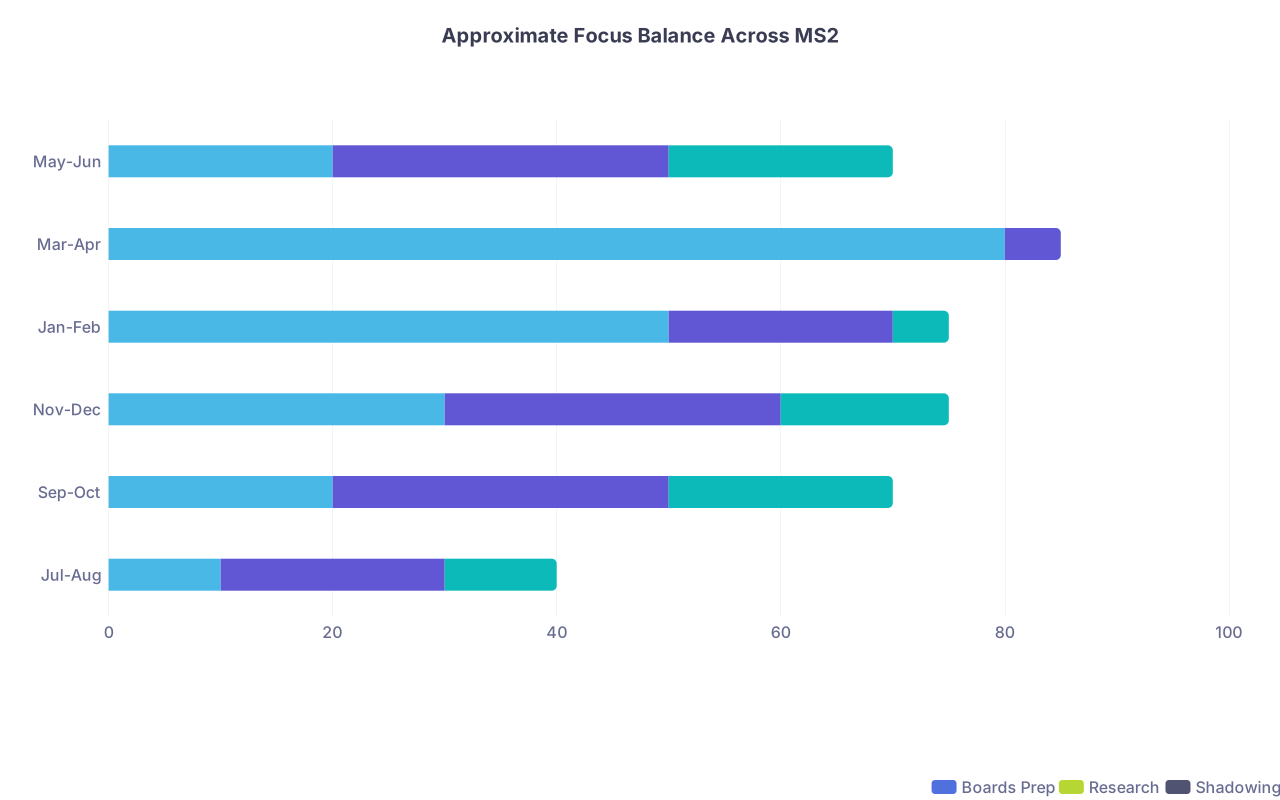
| Category | Boards Prep | Research | Shadowing |
|---|---|---|---|
| Jul-Aug | 10 | 20 | 10 |
| Sep-Oct | 20 | 30 | 20 |
| Nov-Dec | 30 | 30 | 15 |
| Jan-Feb | 50 | 20 | 5 |
| Mar-Apr | 80 | 5 | 0 |
| May-Jun | 20 | 30 | 20 |
Numbers are percentages of your extracurricular energy, not total hours. Exact proportions will vary, but the pattern should look similar.

Quick Month-by-Month Checklist
Use this as a sanity scan.
July–August
- Shortlist 2–3 target specialties
- Identify key faculty and residents in those fields
- Schedule 2–4 mentor meetings
September–October
- Join 1 primary, MS2-friendly research project
- Set up 10–20 hours of targeted shadowing
- Start logging hours, roles, and contacts
November–December
- Move from “on project” to actually producing data/drafts
- Refine specialty interest; drop clear “no” fields
- Start light, consistent Step/Level prep (QBank + content)
January–February
- Renegotiate research time to ~2–3 hours/week
- Freeze new shadowing; only strategic half-days if absolutely needed
- Maintain boards as top academic priority
March–April
- Put research in maintenance mode during dedicated
- Stop all shadowing
- Execute your dedicated study plan without new commitments
May–June (post-exam)
- Re-engage mentors; move projects toward abstracts/manuscripts
- Do deeper, repeat shadowing with key attendings
- Align MS3 schedule and electives with your likely specialty
FAQ (Exactly 3 Questions)
1. If I have zero research now, is it “too late” in early MS2 to start for a competitive specialty?
No, early MS2 is still fine for most fields, even competitive ones. I have seen students start a chart review September of MS2, submit an abstract by spring of MS3, and have a manuscript in review by early MS4. The key is picking ready-to-go projects with mentors who have a track record of publishing with students. Do not waste time on brand-new, unscoped studies. Find an existing dataset, a nearly finished project needing a push, or a streamlined case series.
2. How much shadowing do I actually need before boards to choose a specialty?
You need enough to see the reality, not a brochure. For most students: 10–20 hours in your top candidate field and 5–10 in another is enough before boards. More than that starts to give diminishing returns and often steals time from studying or research. You can always add more shadowing after boards with a clearer sense of direction; what you cannot easily fix is a weak Step/Level score.
3. Should I prioritize Step/Level score or research for competitive specialties like derm or ortho?
The score comes first. A strong Step/Level is the ticket that allows your application to be read seriously in those fields. Research then separates contenders from the pack. A weak score with strong research can sometimes work if you have a very research-heavy profile at a powerhouse program, but that is the exception. Your MS2 strategy should be: set up 1–2 efficient projects early, get real work done before dedicated, then protect your exam prep and come back hard to research after you test.
Key points:
- Use early MS2 to pick 2–3 target fields, meet mentors, and join 1–2 well-scoped projects.
- Treat boards season as sacred: research in maintenance mode, shadowing almost entirely paused.
- Post-boards is not vacation from ambition; it is the launch window where your research and shadowing choices start shaping your eventual match.


