
The myth about away rotations is that programs are judging your “knowledge” and “work ethic.” That’s surface-level nonsense. Competitive programs are actually running a quiet, ruthless audition in their heads: Do I want to be stuck on nights with this person for three years?
I’ve sat in those rooms. I’ve heard the unfiltered comments from PDs, fellowship directors, and senior residents after a long day of “auditioning” students. They’re not pulling up your UWorld stats. They’re remembering how you handed off a patient at 1 a.m., whether you rolled your eyes when given scut, and whether anyone on the team would fight to have you back.
Let me walk you through what’s really being judged on your away, especially for the cutthroat fields: ortho, derm, plastics, ENT, neurosurgery, IR, urology, competitive IM subspecialty tracks, EM at big-name shops, etc.
The Hidden Scorecard Every Competitive Program Uses
No one shows you the scorecard. But it exists.
On paper, away rotations are about “fit” and “clinical evaluation.” In practice, the attending and resident brain runs a quick mental checklist that looks a lot more like this:
| Dimension | Weight in PD Discussions |
|---|---|
| Personality / Team Fit | 30–40% |
| Reliability / Work Ethic | 20–25% |
| Coachability / Growth | 15–20% |
| Initiative / Ownership | 10–15% |
| Baseline Knowledge | 10–15% |
Notice what’s missing: “honors vs HP vs pass,” “research PubMed count,” “Step 2 exact number.” Those got you the away. They don’t get you ranked high after it.
The brutal truth: by the time you show up for an away at a top program, everyone is reasonably smart on paper. The away is about sorting out who they can depend on at 3 a.m. when the ICU is melting down and who’s going to quietly crumble.
Why personality and fit dominate
Here’s what a trauma attending actually said after we discussed three rotators for ortho:
“Honestly, I can teach any of them to nail a tibial nail. I cannot teach not-being-annoying at 4 a.m. We’re ranking the one I wouldn’t hate seeing every day.”
That isn’t softness. It’s survival. Residents are drowning. Faculty are burned out. They’re choosing future co-workers and call partners, not test-takers.
On your away, everything you do feeds into this one question: Would I be okay seeing this person for 60–80 hours a week for years?
Your Step score isn’t saving you if the honest answer is “no.”
What Attendings Actually Notice (And What They Ignore)
Let’s separate the fantasy from how people really talk about you.
Things you think they care about (but they barely do)
- Your ability to rattle off esoteric guidelines from memory
- Your perfectly structured presentations with all the buzzwords
- Your pimp question hit rate
- How many research projects you casually name-drop
Are those helpful? Sure. But they’re supplemental. If you’re a jerk, arrogant, or emotionally high-maintenance, your perfect presentations just make you a high-functioning problem.
Here’s what actually gets remembered:
Micro-behaviors that get discussed behind closed doors
How you handle being wrong in public
You will get a pimp question wrong in front of others. On purpose sometimes. Some faculty do this to stress test you.Two archetypes programs avoid:
- The debater: argues, spins, over-defends, “Well, I read that…”
- The shrinker: visibly shuts down, sulks, speaks less the rest of the day
The one they rank: “I thought it was X, but clearly I’m off. Can you walk me through how you think about it?” Then they actually change practice the next day.
How you treat the “invisible people”
This one is non-negotiable at good programs.I’ve watched PDs ask nurses, scrub techs, unit secretaries: “What did you think of the rotators?” One bad comment from a nurse about disrespect or condescension will sink you faster than missing a diagnosis on rounds.
If you say “thank you” to the unit clerk who prints your list, if you help transport a patient when everyone’s slammed, that stuff gets back to the PD. Every. Single. Time.
Emotional temperature
Your affect is under quiet surveillance.- Visible frustration when left out or when another student shines
- Rolling eyes or making faces when given mundane tasks
- Talking trash about other services or students
The student who’s unflappable gets remembered. Clinical chaos outside, but you’re steady, not melodramatic, not vibrating with anxiety. Residents love that. They are desperate for calm.
Pattern of follow-through
People don’t judge you on what you say you’ll do. They judge you on how often they have to remind you.You write down a task. You do it. You close the loop. If something falls through, you own it without excuses. Over two to four weeks, that pattern becomes your “track record,” fair or not.

Residents: The Shadow Voting Bloc You Underestimate
Let me be blunt: In competitive programs, residents can make or break your rank position.
PDs and attendings pretend it’s a faculty-driven decision. But when rank meeting hits, one sentence from a respected senior resident can move you ten spots up or down.
I’ve seen it happen.
PD: “Let’s talk about Patel from State. I thought they were strong.”
Chief: “Honestly, I don’t trust them on nights. They disappeared a few times, felt like they were hiding from work.”
PD: “Okay, let’s drop them into the middle tier.”
That’s it. Months of work gone.
How residents actually evaluate you
They’re not writing essays. They’re boiling you down to a blunt headline.
| Resident Comment Type | Translation in Rank Meeting |
|---|---|
| "Huge help, no drama" | Strongly support, push up |
| "Fine, kind of invisible" | Neutral, middle of the list |
| "High maintenance" | Soft red flag, pushed down |
| "Would not want on nights" | Hard red flag, near bottom |
Residents care about very different things than attendings:
- Do you anticipate needs, or do you wait to be spoon-fed tasks?
- Are you around when work appears, or do you evaporate at 4:30?
- Do they have to worry about what you might say to patients unsupervised?
- Do you subtly compete against other students and contaminate the vibe?
Your away rotation is basically a prolonged stress interview with people who are tired, underpaid, and very attuned to who makes their life easier vs harder.
The “who do we fight for?” test
Every competitive program has way more excellent rotators than spots. So the real question in the room is:
“Who are you willing to fight for?”
Not “Who was solid?” but “Who would you feel pissed about if we didn’t rank them high?”
If no one is upset you’re not there, you’re gone. Middle of the list, buried behind their home students and a few stand-out aways.
You do not want to be the student everyone “liked fine.” That’s death in a field with 600 applications for 4 spots.
Concrete Behaviors That Move You Into the “Fight For” Category
You want specific? Here are the behaviors that repeatedly separate the top 10% of rotators at big-name programs.
1. Show up like a low-key intern, not a visiting celebrity
Competitive programs don’t want tourists. They want someone who already feels like part of the team within 48 hours.
That looks like:
- Making the list your religion. Knowing your patients better than anyone but the senior.
- Updating the list without needing to be asked. Accurate vitals, labs, imaging, consults.
- Volunteering for the unglamorous tasks: calling consults, tracking down images, clarifying orders.
The students residents rave about are the ones who could disappear into the workflow and no one would flinch if they magically got intern-level access tomorrow.
2. Ask the right kind of questions (this is wildly underappreciated)
There’s a massive difference between:
- Showing off what you know by asking contrived questions
vs - Asking targeted questions to understand how the team actually operates
Examples of good away-rotation questions:
- “When you’re admitting a similar patient, what are the things you always try to make sure you don’t miss?”
- “How do you decide which patients you push to the ICU vs keep on the floor here?”
- “For consult notes, what do you consider a good note vs annoying fluff?”
Questions like this signal you’re thinking like a resident at this program, not like a Step study guide.
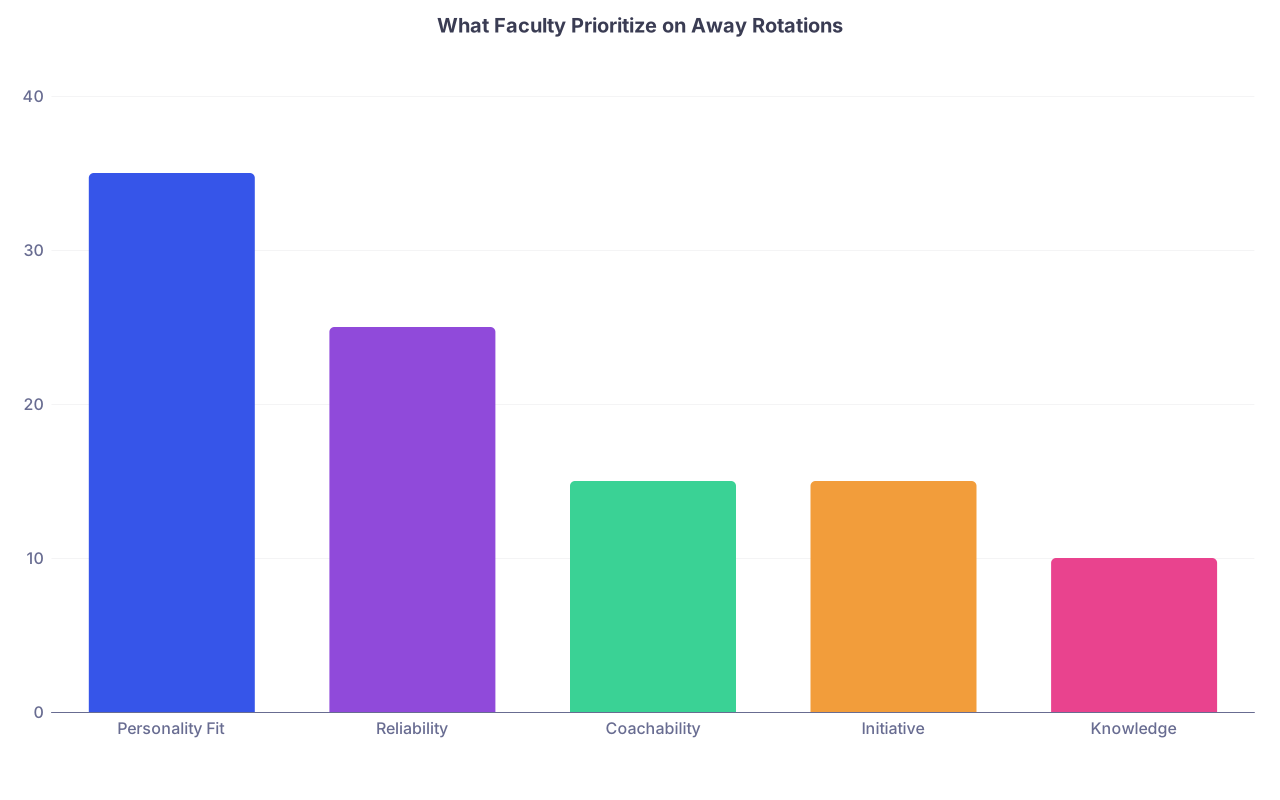
| Category | Value |
|---|---|
| Personality Fit | 35 |
| Reliability | 25 |
| Coachability | 15 |
| Initiative | 15 |
| Knowledge | 10 |
3. Document your value without bragging
Here’s a subtle skill: making sure the team actually knows you’re doing work, without sounding like you’re campaigning.
Bad version:
“I stayed late and called all the families yesterday and updated the consults.”
Better version:
“In case it’s helpful, I spoke with Ms. X’s daughter last night and clarified her goals. I put a note in the chart so it’s there for rounds.”
You’re not just announcing your existence. You’re closing a loop, highlighting value, and giving the team something that actually helps patient care.
4. Handle getting sidelined without sulking
This happens all the time:
- A cooler case goes to another student.
- An attending gives teaching time to someone else.
- You get pulled to cover floor work while others get to scrub.
The away students who quietly die on rank lists are the ones who let this bruise their ego. It leaks out in their tone, body language, or disengagement.
The ones who get ranked high? They double down on being useful wherever they’re placed. They understand they’re being watched for resilience and team orientation, not just how much OR time they can hoard.

What Competitive Programs Think When They Read Your Evaluation
Here’s another behind-the-scenes reality: your final evaluation from the away is only half the data. The informal commentary matters just as much.
A typical scenario at a strong program:
- Clerkship/rotation director drafts the official eval. Almost always positive.
- PD emails or calls the chief: “What’s the real story on this one?”
- Chief gives a 2-minute unfiltered summary. That becomes your actual fate.
The written eval is public relations. The chief’s impression is policy.
How written comments get interpreted
A few translation keys from PD meetings:
“Pleasure to work with, strong fund of knowledge.”
→ Good but not necessarily top. Everyone gets this language.“Functioned at the level of an intern by the end of the rotation.”
→ They seriously liked you. This phrase gets attention.“Will be an excellent resident somewhere.”
→ Notice that “somewhere.” That’s faint praise. Often code for: not here.“We’d be happy to have them in our program.”
→ Strong signal. Usually means ranked to match.“Had some difficulty at first but improved over the month.”
→ This can cut both ways. If paired with strong resident backing, fine. If not, PDs get nervous about how much work you’ll need.
The off-the-record endorsements that really count
What the PD is hoping to hear from chiefs:
- “They were easily in the top 5 students we’ve had all year.”
- “They stayed late with me on a brutal call and never complained.”
- “I trusted them enough to let them run the list.”
- “If they match here, I’ll be thrilled.”
If instead they hear things like:
- “Yeah, they were fine.”
- “Didn’t stand out.”
- “Kind of checked out midway through the month.”
You’re done. Strong eval, great scores, glowing personal statement — still done.
Specialty-Specific Quirks You Should Know
Different competitive specialties weigh certain traits more heavily, even though the core principles are the same.
Surgical fields (ortho, neurosurg, ENT, plastics, vascular, CT)
They watch:
- Stamina and attitude on long cases and late days
- Your hands in simple tasks: suturing, knot tying, basic exposure
- How you handle hierarchy under stress (getting snapped at, corrected sharply)
Huge mistake I see: students trying too hard to be funny or to be “one of the bros.” That can work with some residents but can backfire with attendings who want a professional, not a frat brother.
Derm / competitive IM tracks / heme-onc / cards
They care a lot about:
- Precision in thinking and communication
- How carefully you examine patients and present subtle findings
- Whether you read and actually level up day by day
They’re less impressed by bravado. More impressed by intellectual humility plus visible growth.
EM at big academic shops
They’re watching:
- How you triage your time and attention when multiple things hit at once
- How you handle procedures and fast decision-making
- Whether nurses trust you or roll their eyes after you walk away
The EM away can be deceptively “fun.” You might feel liked. But ranking is merciless. The people who got universally trusted by residents and nurses get the interview and the high rank. The rest fade into the pile.
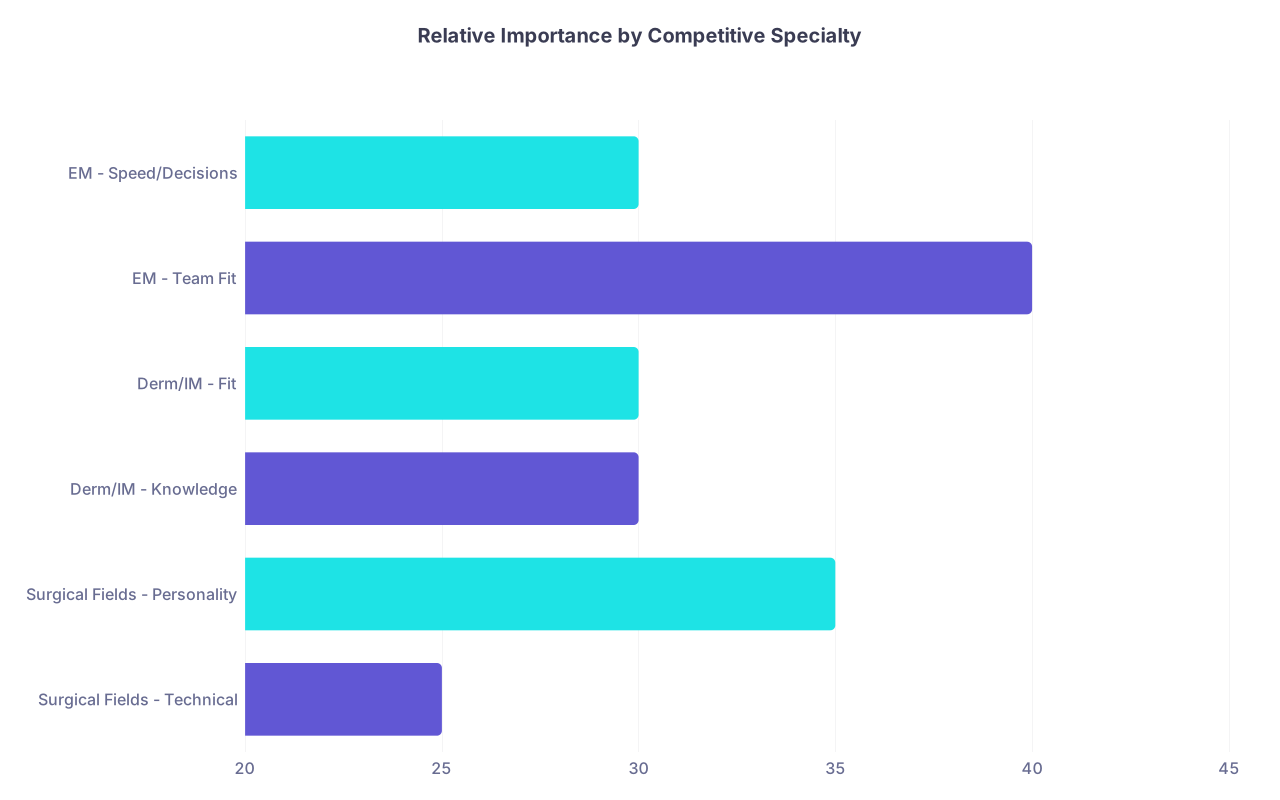
| Category | Value |
|---|---|
| Surgical Fields - Technical | 25 |
| Surgical Fields - Personality | 35 |
| Derm/IM - Knowledge | 30 |
| Derm/IM - Fit | 30 |
| EM - Team Fit | 40 |
| EM - Speed/Decisions | 30 |
The Two Quiet Killers: Entitlement and Anxiety
Let me call out the two patterns that tank otherwise excellent candidates.
1. Subtle entitlement
You may not think you’re entitled. But residents and attendings have radar for it.
Things that read as entitlement:
- Constantly asking when you can scrub into “cooler” cases
- Disappearing when there’s floor work but showing up for OR time
- Hinting at your Step score, research, or famous letter writers
- Acting like the program is lucky you’re there
No one says this to your face, but I’ve heard it in rooms more than once:
“If they’re this high maintenance as a student, imagine them as a PGY-2. Hard pass.”
2. Unmanaged anxiety that spills into the team
Everyone’s anxious. You’re on an away, your future is on the line. That’s normal.
But if your anxiety becomes work for the residents — constant reassurance, hand-holding, melodramatic self-criticism — you’re going to be remembered for the wrong reasons.
The students who do best are visibly prepared, quiet about their panic, and regulate themselves. They ask for help when necessary but don’t outsource their emotional regulation to the team.
The Real Point of An Away: Creating One Clear Story About You
At the end of your rotation, the program should be able to say one sentence about you that everyone nods at.
That sentence can be:
“Top-tier, would love to have them.”
or
“Fine, but not our priority.”
or
“No, do not take.”
Everything you do for four weeks is moving you toward one of those.
Here’s the inside version of what you should be aiming for:
- Residents describe you as low-drama, high-output.
- Attendings think of you as teachable, prepared, and not annoying.
- Support staff see you as respectful and helpful.
- Your overall impression is someone who’ll make our lives easier, not harder.
If you can get that right, your exact fund of knowledge is secondary. Programs in competitive specialties are terrified of malignant personalities and unreliable interns. They will gladly take the slightly less brilliant student who shows every sign of being solid, kind, and relentlessly dependable.
Boiled down to essentials
- Competitive programs use away rotations to answer one question: Do we want this person in our workroom at 2 a.m. for three to seven years? Everything else is noise.
- Residents and nurses are your real jury. Their informal comments often outweigh your polished written eval and test scores when the rank list gets made.
- Your edge isn’t being the smartest — it’s being relentlessly reliable, coachable, ego-controlled, and easy to work with in a high-stress environment. If no one is willing to fight for you in the rank meeting, you’re already off the board.