
The last six months before ERAS can make or break a competitive specialty application. Most people waste this window. You cannot afford to.
This is the Six-Month Sprint: the period where strong applicants separate from merely “solid” ones. I am assuming you are aiming for something in the competitive tier—derm, plastics, ortho, ENT, neurosurgery, urology, ophthalmology, radiation oncology, integrated vascular, or similarly cutthroat fields. The standards are different. The timeline is brutal.
I am going to walk you month-by-month, then zoom into weeks and days when it matters. At each point: what should be done, what is optional, and what is a trap.
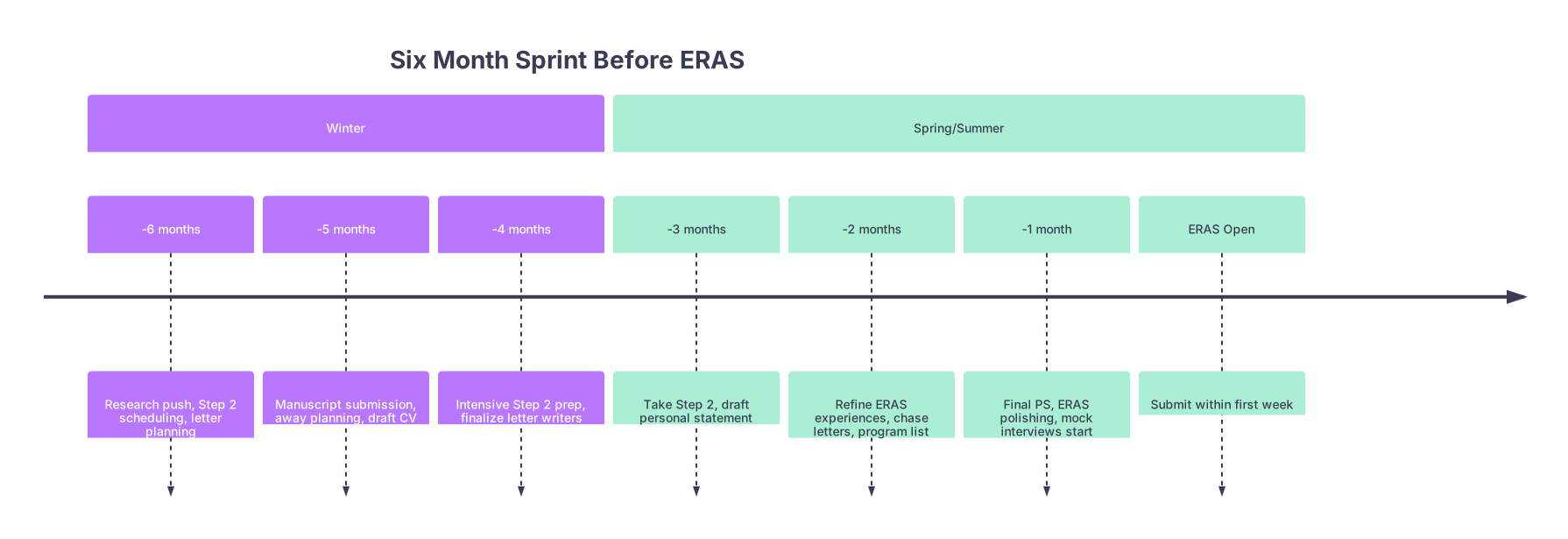
Big-Picture Timeline: Six Months to ERAS Submission
| Period | Event |
|---|---|
| Winter - -6 months | Research push, Step 2 scheduling, letter planning |
| Winter - -5 months | Manuscript submission, away planning, draft CV |
| Winter - -4 months | Intensive Step 2 prep, finalize letter writers |
| Spring/Summer - -3 months | Take Step 2, draft personal statement |
| Spring/Summer - -2 months | Refine ERAS experiences, chase letters, program list |
| Spring/Summer - -1 month | Final PS, ERAS polishing, mock interviews start |
| Spring/Summer - ERAS Open | Submit within first week |
Use this as your spine. Now let us go point by point.
Six Months Before ERAS: Lock the Foundations
Timeframe: ~March (for a September ERAS submission; adjust to your actual year)
At this point you should stop drifting. No “we’ll see how things go.” You decide on:
- Primary specialty target
- Backup strategy (either a less competitive specialty or prelim / transitional plan)
- Testing and research plan that is actually on a calendar, not in your head
At 6 Months Out, You Must:
Finalize your Step 2 CK timing.
- Competitive specialties now treat Step 2 as the new Step 1.
- If your Step 1 is:
- Strong (250+ before pass/fail era / solid pass from top school): schedule Step 2 for about 3–4 months before ERAS so the score is back early.
- Weak or barely pass: you need Step 2 in hand and excellent. Schedule earlier (4–5 months before ERAS) so you have time to react if it is not stellar.
Lock a test date now. Do not overestimate how much studying you can do on an away or heavy rotation.
Clarify your research output reality.
For competitive specialties, by this point, you want at least:
- 1–3 publications (submitted/accepted is acceptable)
- Several abstracts/posters
- Specialty-specific work somewhere on your CV
If you are not there, then at 6 months out:
- Meet with your research mentor this week and say clearly:
“ERAS is in six months. What can we realistically submit / present before then?” - Push to:
- Convert any nearly-done projects into submitted manuscripts.
- Turn data into posters or presentations (even local/regional).
Do not start brand new projects that cannot be completed or submitted before ERAS unless:
- It is high-yield (e.g., multi-center study with famous PI) and
- Your name will be clearly visible (first or second author).
Secure letter writer commitments.
Serious programs expect:
- 2–3 letters from faculty in the specialty, ideally:
- At least one from a well-known name or program director
- At least one who supervised you clinically, not just in a lab
- 1 strong letter from medicine/surgery core or sub-I
At this point you should:
- List 4–5 potential letter writers.
- Meet or email them and say:
“I am applying to [specialty]. Would you feel comfortable writing a strong letter of recommendation for my residency applications?”
You want that word: strong. Anyone who hesitates is an automatic no.
- 2–3 letters from faculty in the specialty, ideally:
Map your next six months in writing.
Create a literal calendar that includes:
- Rotations (home + aways)
- Step 2 study blocks and exam date
- Research deadlines (manuscript submission, abstract due dates)
- Letter request and follow-up dates
- ERAS draft milestones
If it is not on the calendar, it often does not happen.
Five Months Before ERAS: Convert Potential into Tangible Output
Timeframe: ~April
At this point you should be turning in work, not starting to “think about” it.
Your Priorities at 5 Months Out:
Submit manuscripts and abstracts.
- Any near-finished project should be submitted to a journal by this point.
- Push co-authors to finalize:
- “I would like to submit this by [exact date] for ERAS. Can you review your sections by [earlier date]?”
The status “Submitted” looks much better than “In preparation” on ERAS.
Lock in away rotations (if your specialty uses them).
For ortho, derm, ENT, urology, neurosurgery, plastics, ophtho, etc., aways are currency.
If away rotations are not yet finalized:
- Confirm through VSLO / program coordinators where you are actually going.
- Prioritize:
- Programs in your preferred region
- Places where you have some connection (home institution allies, prior research)
- A mix of reach and realistic
Draft a serious CV / ERAS experiences skeleton.
Do not wait for ERAS to open to think about your “Work, Activities, and Experiences.”
At 5 months out:
- Populate a document with:
- All research items (with roles and rough dates)
- Leadership and teaching activities
- Volunteer work that is not fluff
- Awards and honors
- For each major item, sketch out 2–3 bullet points focused on:
- Impact
- Initiative
- Outcomes (numbers when possible)
You are not polishing yet. You are gathering ammo.
- Populate a document with:
Reality-check your competitiveness.
Look honestly at your profile vs typical matched applicants.
| Specialty | Step 2 Target | Publications | Aways Typical |
|---|---|---|---|
| Dermatology | 250+ | 5–10 | 2–3 |
| Ortho | 250+ | 3–6 | 2–3 |
| ENT | 250+ | 3–6 | 2–3 |
| Neurosurg | 250+ | 5–10 | 2–3 |
| Plastics | 250+ | 5–10 | 2–3 |
Numbers vary but you get the point. If you are significantly below, this is the month to:
- Add a few realistic, less competitive specialties to your exploratory list.
- Talk to a trusted advisor who has actually matched people in your field, not just a generic dean.
Four Months Before ERAS: Step 2 and Clinical Performance Peak
Timeframe: ~May
This is where disciplined applicants pull away.
At 4 Months Out, You Should:
Enter focused Step 2 preparation mode.
If Step 2 is in ~8–10 weeks, your life is now:
- UWorld (or similar) in timed, random blocks
- NBME practice exams
- Tracking weak areas and drilling them
You aim for practice scores consistently above your target specialty range before test day. If you are sitting at borderline practice NBMEs, you move your test only if:
- There is clearly more time available later, and
- Moving it will not destroy your away rotation or sub-I performance.
Plan how you will dominate key rotations.
For competitive specialties, several rotations are “letter-generating” and “reputation-defining”:
- Your home sub-I in the specialty
- Critical aways
- Medicine/surgery sub-I’s
At this point you:
- Identify which rotations in the next 3–4 months are high stakes.
- For each:
- Learn names of attendings and residents.
- Ask senior students: “Which residents or attendings are key letter writers?”
- Clarify call schedule and expectations ahead of time.
Lock your letter writers and provide them material.
Anyone who agreed to write a strong letter should now receive:
- Your updated CV
- Brief personal statement draft or paragraph about your career goals
- Bullet points reminding them what you did with them (specific cases, projects, leadership)
- A clear deadline:
“Letters need to be in by [date], ideally a week before ERAS opens.”
Make their life easy. That often means a better letter.
Start a rough personal statement outline.
No, you are not “too early.” Lazy applicants say that.
At this stage, just outline:
- A concrete opening story that actually happened on your rotations or in research.
- 2–3 specific reasons you chose this field (not “I like procedures.” Everyone says that.)
- 2–3 things you bring that are unusual for most applicants in this field.
You can write a messy first draft over 1–2 weekends.
Three Months Before ERAS: Test, Rotate, and Start Crafting Your Narrative
Timeframe: ~June
At this point you are close enough that everything counts.
Step 2: The Make-or-Break Window
If your Step 2 date is this month:
Treat the final 2 weeks like a dedicated block:
- Full-length practice every 3–4 days
- Review incorrects ruthlessly
- Sleep schedule aligned with test time
After the exam:
- Take 24–48 hours off.
- Then immediately pivot back to:
- Clinical performance
- ERAS materials
If your Step 2 is next month, this is your heavy prep month. No half-effort.
Aways / Sub-Is: First Impressions Count
If you are starting an away:
Week 1 checklist:
- Learn every resident’s and attending’s name on your team.
- Show up 15–30 minutes earlier than them.
- Ask interns: “What makes a great student on this service?” then do that.
- Volunteer for cases/consults where you can see the same attendings repeatedly.
You need at least one person on that rotation to later say:
“This student was in the top 5–10% of students I’ve worked with.”
Drafting Your Story
At 3 months out, your personal statement should be at full draft stage:
- Opening paragraph with a scene or moment (not philosophical fluff).
- 2–3 body paragraphs that:
- Show how you have already behaved like a resident in this field: hard weeks, intellectual curiosity, ownership of patients.
- Tie in your research or leadership without listing your CV.
- Final paragraph that:
- States clearly what type of resident you want to become.
- Sketches your long-term goals (academic, community, sub-specialty).
Get one person in the specialty to read it now. Not your parents. Not your random friend in pediatrics.
Two Months Before ERAS: Assemble, Polish, and Pressure-Test
Timeframe: ~July
ERAS opening is close. This is where strong applicants feel busy but controlled, and weak ones start spiraling.
At 2 Months Out, You Should:
Have most letters actually uploaded or confirmed.
- Check ERAS: how many letters are in?
- Any missing? Send a gentle but clear nudge: “I am finalizing my ERAS application soon and wanted to check in about the letter. I am extremely grateful for your support.”
If someone is obviously not going to deliver, identify a backup letter writer.
Turn your CV dump into real ERAS experience entries.
Go through each “Experience” and ask:
- Would a tired PD at midnight understand what I actually did here?
- Can I quantify impact? (“Increased clinic throughput by 20%,” “Taught weekly review sessions to 30+ students.”)
- Is the description concise and outcome-focused?
Avoid:
- Flowery language
- Generic phrases like “I learned a lot about teamwork.”
Build your preliminary program list.
For competitive specialties, over- or under-applying both hurt.
Use your stats (Step scores, school, research) and realistic projections to create tiers:
- “Reach” programs (top 10–15%)
- “Target” programs
- “Safety/realistic” programs (for competitive fields, “safety” is relative, but you get the idea)
Match your away rotations to your list. If you did an away somewhere and performed strongly, that program should be high on your list.
Refine personal statement with specialty eyes.
At this stage, your PS should be:
- On version 3–5, not version 1.
- Reviewed by:
- At least one faculty member in the specialty
- One trusted reader who can fix flow and clarity
If two different attendings say your opening is boring, it is. Change it.
One Month Before ERAS: Final Assembly and Targeted Corrections
Timeframe: ~August
At this point you should stop making big structural changes and start eliminating weaknesses.
4–5 Weeks Before ERAS Submission
Finalize ERAS content.
- All experiences written and polished.
- Personal statement ready for 95% of programs (you can adjust a sentence or two later for specific places if needed).
- Publications and presentations formatted correctly, with statuses (Submitted / Accepted / Published).
Double-check Step 2 status and reaction plan.
If score is back:
- Compare honestly with your target specialty benchmarks.
- If it is significantly below, talk to a specialty mentor this week to adjust:
- Program count
- Backup specialty plan
- Geographic spread
If score is pending:
- Have both a “good score” and “bad score” program list ready.
Request any final letters (only if truly necessary).
Late letter writers exist, but you should not be adding new ones unless:
- You just finished a stellar away with a big-name attending who offers enthusiastically.
- You realize you have no letter from a critical area (e.g., no medicine sub-I letter at all).
2–3 Weeks Before ERAS Submission
This is error-hunting time.
- Print your entire ERAS application.
- Go line by line with a pen:
- Typos
- Date inconsistencies
- Awkward phrasing
- Have someone outside medicine skim for:
- Clarity
- Basic writing quality
Start light interview prep now:
- Build a document with:
- 3–4 patient stories that show who you are clinically.
- 2–3 research stories you can tell clearly.
- 3 talking points on “Why this specialty?”
- 3 on “Why this program type / region?”
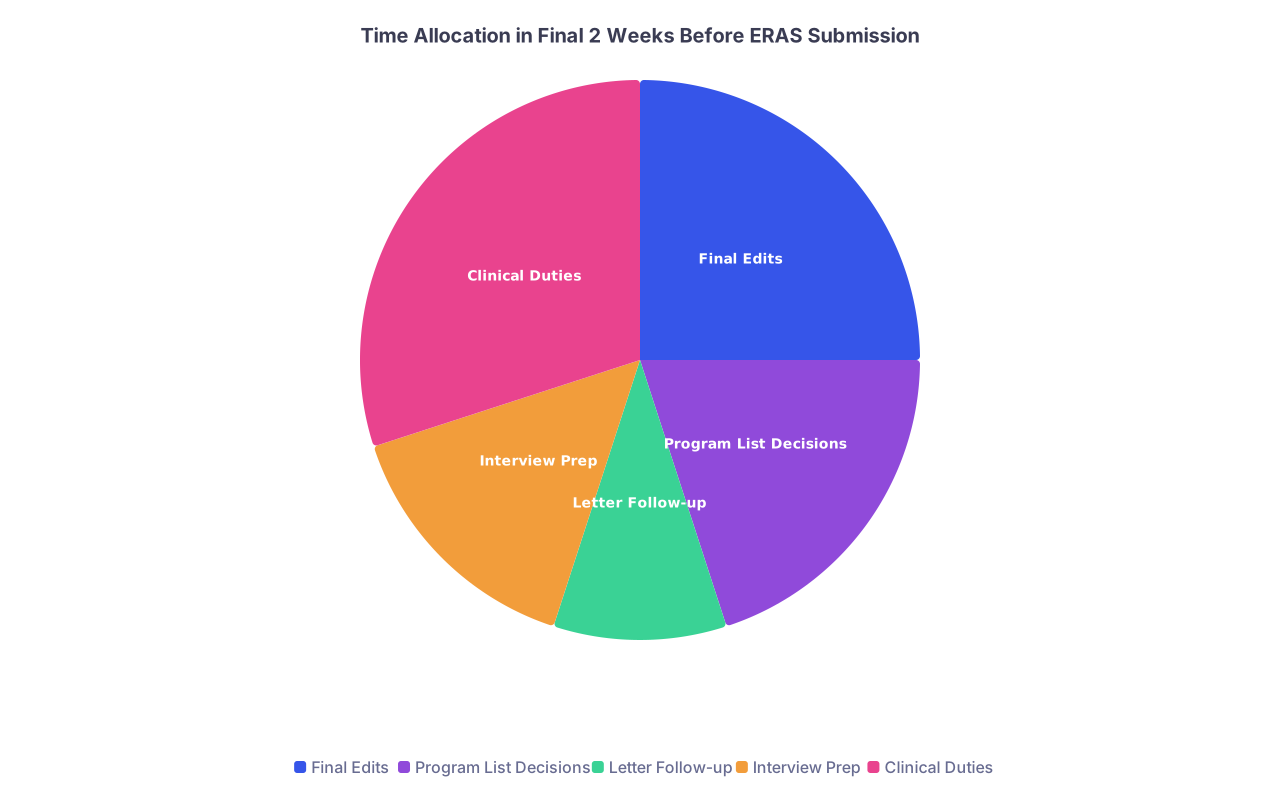
ERAS Opens: The Final Two Weeks
Timeframe: Late August / early September (depending on year)
This is where details matter.
| Category | Value |
|---|---|
| Final Edits | 25 |
| Program List Decisions | 20 |
| Letter Follow-up | 10 |
| Interview Prep | 15 |
| Clinical Duties | 30 |
Week 1 After ERAS Opens
At this point you should:
Have a completed application ready to submit.
You are not “starting” ERAS. You are fine-tuning.
Checklist before you hit submit:
- All sections are green-checked.
- Program list loaded and reviewed (no missing obvious programs, no random programs you would never attend).
- Letters assigned correctly by specialty (no derm letter going to ortho by accident).
Confirm every letter.
- Check which letters are attached and visible.
- Email any missing writers with a very clear, polite request and exact deadline.
Sanity-check with a mentor.
Ask a trusted attending or advisor for a 30-minute review of:
- Your program list
- Your personal statement
- General competitiveness
Do this before submission if possible.
Week 2: Submission Window
For competitive specialties, you should aim to submit within the first week that programs can see applications. ERAS “on time” is not mid-October. It is day 1–3 of release.
When you submit:
- Remember: The application is not “final forever.” You can still:
- Add programs later.
- Update publications if they change status.
- But do not count on “I’ll fix it later” as a strategy. Most PDs read early.
After Submission: Early Interview Prep and Damage Control
Once ERAS is in, you are not done. You are just in a different phase.
First 1–2 Weeks After Submission
At this point you should:
Have:
- A cleaned-up LinkedIn or professional page (if you use one).
- A simple system to track:
- Application status
- Interview invites
- Thank-you emails
Begin:
- Mock interviews with:
- A resident in the specialty
- A faculty member who has actually interviewed applicants
- Mock interviews with:
Prepare for the classic questions with real examples:
- “Tell me about a time you made a clinical mistake.”
- “What is your biggest concern about this specialty?”
- “Walk me through one of your research projects.”
If something goes wrong
If you get:
- A poor Step 2 result
- Awful feedback from an away
- Early signs that interviews are slow compared to peers
You do not wait. You:
- Speak with:
- Your specialty advisor
- Someone on the residency leadership side if possible
- Consider:
- Expanding your program list
- Activating a backup specialty
- Adjusting your expectations on geography or prestige
What You Should Do Today
You are somewhere on this six-month arc right now. Do not just mentally “agree” with this plan.
Open your calendar for the next eight weeks and block three things:
- A hard Step 2 study schedule or revision plan.
- Exact dates to send or follow up on every letter of recommendation.
- Two evenings to build or refine your ERAS experiences document and personal statement outline.
If those blocks are not on your calendar by tonight, you are already behind in this sprint.