
The myth that residency rank lists are built by “holistically reviewing every applicant” is comforting. And wrong. In competitive specialties, those lists are built in crowded committee rooms, under time pressure, with politics, fatigue, and unwritten rules driving more decisions than anyone will admit on the website.
Let me walk you into that room.
How You Get to the Committee Room Board in the First Place
By the time a competitive specialty program (derm, ortho, plastics, ENT, rad onc, neurosurgery, IR, ophtho – pick your poison) sits down for the “rank meeting,” the real bloodbath has already happened.
Here’s the sequence most applicants never see.
First cut is numeric and crude. A coordinator or junior faculty member runs filters on Step scores (and now more heavily Step 2), class rank, maybe school tier. The official line is “we review all applications.” The unofficial reality: if you have a 215 Step 2 and you applied to a top-10 ortho program, you were never seriously in play. Your file opened for 10 seconds, marked “no interview,” and that was that.
Then come the “must see” piles. Home students. People who rotated as sub‑Is. Children of alumni. Friends of the chair. Someone the PD’s trusted colleague at another institution called about. These are tagged from the minute ERAS opens.
By the time interviews are offered, the applicant pool is already stratified:
| Group | Approximate Share | Realistic Match Chance at That Program |
|---|---|---|
| Home & sub‑I students | 10–20% | Very high |
| Strong interview invites | 30–40% | Moderate to high |
| Courtesy & political interviews | 10–20% | Low unless string pulled |
| Filler / uncertainty / wildcards | 20–30% | Highly variable |
By the time the actual rank meeting happens, you’re no longer an application. You’re a name on a big spreadsheet or projected board with short comments: “Strong, great letters, research,” “Quiet, maybe weak with patients,” “Home, chair likes,” “Red flag?” That’s what they’re looking at.
The Pre‑Meeting: Where Your Fate Quietly Gets Decided
The real decisions for competitive specialties are made before the whole committee meets. The formal meeting is mostly about arguing over a relatively small number of names.
Here’s what actually happens in the days before.
1. The PD and a Small Inner Circle Make a Draft List
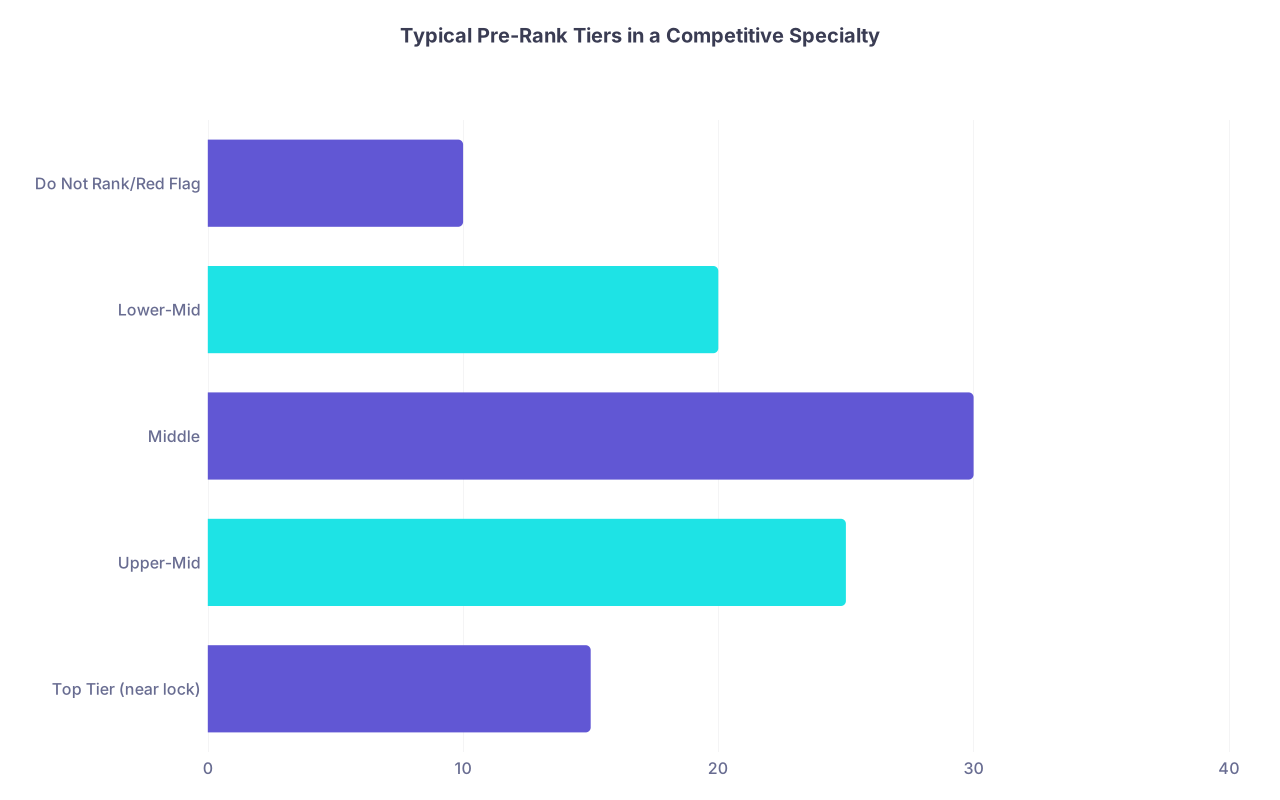
Usually the program director, associate PD, and maybe 1–2 key faculty sit down with the master spreadsheet. Sometimes there’s a color code: green, yellow, red. Sometimes numeric: 1–9. Sometimes a tier system. But there is always a pre‑rank structure.
A common pattern looks like this:
| Category | Value |
|---|---|
| Top Tier (near lock) | 15 |
| Upper-Mid | 25 |
| Middle | 30 |
| Lower-Mid | 20 |
| Do Not Rank/Red Flag | 10 |
Nobody calls it that on the record. But I’ve watched a PD say, “Let’s box our top 15. These are the people we’d be happy with any year.” Those are your top tier. The people with huge scores, phenomenal letters, loved on interview day, maybe already doing research with faculty.
They’ll also mark:
- Home students and rotators: almost always pulled higher than their raw stats.
- “Department priorities”: the chair wants one candidate, the basic science PI wants their mentee, a major donor’s kid is in the pool.
- “Need types”: the program needs a future clinician‑educator, someone likely to do academics, someone local who won’t leave.
Before discussion, the draft list is already biased toward whatever this leadership group cares about: academics, research, service, procedural grit, “personality.” You’re not competing on a blank slate.
2. Faculty Champions Quietly Build Their Cases
Every competitive program has a handful of faculty who act as “champions” for certain applicants. You will not see this on any website.
What it looks like in reality:
- Dr. X in derm has a current resident’s younger sibling applying. They’ve pre‑read that application, interviewed them personally, maybe even had them in clinic. That person comes into the rank meeting with a “bump.”
- The trauma surgeon in ortho loves gritty, blue-collar, “work-horse” types. They latch onto someone from a non‑T20 med school who crushed their away rotation. They will speak loudly in committee.
- The research-heavy ENT department identifies the one MD/PhD with five first-author papers and a K grant in their future. “This is our future faculty” gets said more than once.
If you have no champion, you live or die by your average impression. If you do have a champion, your odds are instantly different. Period.
Inside the Room: How the Rank List Meeting Actually Runs
Picture this: a windowless conference room. It’s 6 pm. People have just finished a full clinical day. There’s lukewarm pizza, cans of LaCroix, everyone has laptops open. The coordinator has a giant spreadsheet pulled up to the projector with 80–120 interviewed applicants.
That’s how most big-name, competitive programs actually do it.
Step 1: The Top of the List Is Done Fast
The surprising part: the top of the rank list often comes together faster than you’d think.
The PD will say something like, “Let’s start with our obvious top candidates—people everyone loved and we’d be thrilled to get.” Then they go through a short subset, already pre‑flagged.
Discussion on these:
- “Is anyone not comfortable with them in our top 5?”
- “Any concerns not reflected in the file?”
- “Anyone you feel is too research‑heavy / not clinical enough?”
Here’s the thing: for a competitive program, the top 5–10 spots are almost always drawn from a mix of:
- One or two home/sub‑I students the department is obsessed with.
- A couple of elite CVs (ridiculous scores, top med school, big‑name letters).
- One or two applicants who completely charmed everyone on interview day and “felt like us.”
Those 10 names rise quickly. Debate may shuffle order, but they’re rarely dislodged from roughly the top tier.

Step 2: The Middle Is Where the Real Fights Happen
The long, grinding part is ranks 10 through maybe 40–50, depending on program size.
This is where comments from interview day, sub‑I feedback, and gut feelings start to matter a lot more than boards or publications. You’ll hear stuff like:
- “He’s clearly brilliant, but did anyone get the sense he might be a little too independent for intern year?”
- “She was quiet in my interview but the residents loved her on the dinner.”
- “Yeah, high Step 2, but the letter from the chair is lukewarm. That makes me nervous.”
- “She’s married with kids in the city and her family’s here. She’s not leaving if we rank her reasonably high.” (People won’t admit how much perceived geographic stability matters, but it does.)
There’s a mental calculus everyone’s doing: how likely is this person to rank us high enough that we actually match them?
No one likes to say it out loud, but they will for certain cases: “He’s interviewing at all the top 5 programs. We should still rank him highly if we love him, but I doubt we’ll get him.” For others: “She only interviewed at one or two ‘bigger name’ places; if we want her, we need to put her in our top 15.”
That’s where the “fit vs. reach” game happens on the program side. They are trying to game-match you just like you are gaming them.
Step 3: The “Do We Even Rank Them?” Arguments
At the bottom of the pool is the uncomfortable group:
- Weird vibe on interview day.
- Questionable professionalism comment in a letter.
- Mediocre evaluations on sub‑I.
- Just… forgettable.
The conversation is blunt here:
- “Anyone arguing for ranking this person?”
- “Is there any scenario where you’d be comfortable with them as your junior?”
- “If we went really deep on the list, would you rather take them or just let the spot go unmatched and SOAP?”
Competitive specialties rarely want to SOAP. It’s bad optics. But they won’t rank someone they see as toxic or unsafe purely to avoid that.
So yes, “Do Not Rank” lists are real. And you can land there simply by coming across as arrogant, disinterested, or dishonest for 20 minutes on Zoom.
What Actually Moves You Up or Down in That Room
Here’s what I’ve watched move people noticeably up or down during rank discussions in competitive fields.
1. Residents’ Opinions Are Louder Than Brochures Suggest
Officially, programs say “residents have input.” Unofficially, in many competitive specialties, a couple of senior residents can make or break you.
Especially if they’re trusted by the PD.
If the senior chief says, “She was the best sub‑I we’ve had in two years. Super prepared, stayed late, never complained,” that alone can move someone up 5–10 spots.
Flip side: “The students loved him, but frankly, he rubbed a few of us the wrong way at dinner. Talked over people, seemed very focused on prestige and fellowship placement.” Translation: he’s dropping.
Residents also care about who they’re actually going to be in the trenches with at 2 am. If you came off as super high‑maintenance or too “precious,” they will speak up.
2. Red Flags Are Taken More Seriously Than Gold Stars
A perfect Step 2 and ten papers don’t erase a bad professionalism comment in a letter. I have seen programs absolutely tank otherwise stellar candidates because of one line from a trusted letter writer: “Requires close supervision for time management” or “Has needed guidance with interpersonal interactions.”
Nobody wants to spend three years managing a headache in their small department.
On the other hand, a glowing letter from a known and trusted writer can compensate for marginal metrics. Example: a 230s Step 2 applying to a top derm program with an unambiguously enthusiastic, specific letter from a legendary derm chair. Suddenly, everyone leans in.
| Category | Value |
|---|---|
| Interview Day Vibe | 90 |
| Letters (trusted sources) | 85 |
| Sub-I Performance | 80 |
| Board Scores | 70 |
| Research Productivity | 60 |
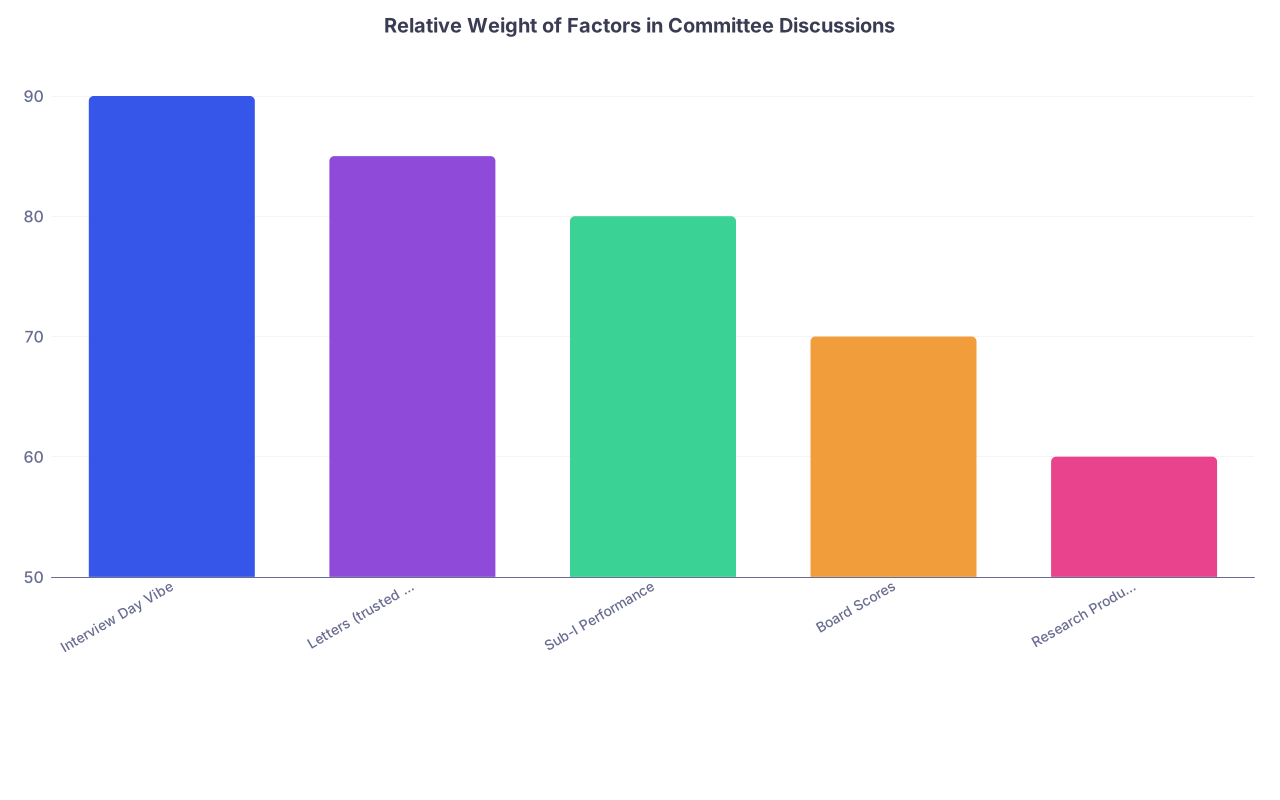
Scores open the door. Your actual behavior determines where you land on the board.
3. Geographic Realism and “Are We Wasting a High Rank?”
Program directors won’t say this publicly, but they do not like “wasting” top‑10 spots on people unlikely to match at their program.
So they read between the lines:
- You grew up locally, med school locally, partner’s job is in the same city, and you said three different times how much you want to stay. They will feel comfortable ranking you aggressively if they liked you.
- You’re from the opposite coast, all your interviews are in a different region, you talked a lot about “going back home long term.” You might still be ranked high if you blew them away, but the subconscious effect is real.
Are they great at predicting where you’ll rank them? No. But they try. And when they think you’re a realistic get, that often nudges you a bit higher than the visiting superstar who seemed to be interviewing everywhere.
4. Departmental Politics and Hidden Quotas
This is the part nobody likes to talk about in public.
Departments have agendas. Chairs push for “our people.” Sometimes there are:
- Soft expectations to take at least one MD/PhD every year.
- Pressure to take someone who will probably stay on as faculty.
- Desire to diversify the resident class (genuinely good) that can bump certain candidates higher.
- Quiet “we promised so‑and‑so we’d take a serious look at their mentee” dynamics.
Does that mean it’s purely political? No. But if a well‑connected candidate and an equally strong “random” candidate are neck‑and‑neck, the person with institutional ties often wins.
The Mechanics: How They Actually Turn Opinions into a List
You probably imagine some sophisticated algorithm or scoring sheet. Truth: it’s often a hybrid of half‑formal, half‑gut.
Here are common approaches I’ve seen for competitive programs:
Numerical Composite Then Adjust
Before the meeting, each faculty interviewer scores applicants across a few categories:
- Academic strength
- Interview performance
- Fit / professionalism
- Letters (if they actually read them)
- Sub‑I feedback (if available)
Then someone creates a composite score. They sort by that score and call it the “starting point.” The rank meeting opens from that list. And then the emotional editing begins.
The committee scrolls down: “Do we agree this person should be this high?” Then people push names up or down based on anecdotes and impressions not captured in numbers.
Tier Buckets, Then Rank Within Tiers
Some places don’t bother with exact numbers initially. They’ll do something like:
- Tier 1: Must‑get if possible
- Tier 2: Very strong, would be happy to match
- Tier 3: Solid, fine if we match
- Tier 4: Questionable / back of list
Then they argue within tiers: “OK, within Tier 2, do we really see applicant 24 ahead of applicant 19?” and so on.
The thing to understand: once you’re in a tier, most small gradations are almost random. Tiny differences in how animated your champion is that night can move you up or down 10–15 spots.

PD Override
In every structure, formal or not, there’s one reality: the PD (and sometimes the chair) can override.
If a PD says, “I know the scores, I know the research, but I’m telling you, this applicant is our program,” that candidate jumps. If the chair says, “We really need to get this person,” it carries weight.
No program will tell you this, but two or three decisions like that can significantly reshape the top of the list.
How Many People Are Actually in the Game for Those Top Spots?
Applicants love to imagine they’re one of “hundreds” being minutely compared. Not so.
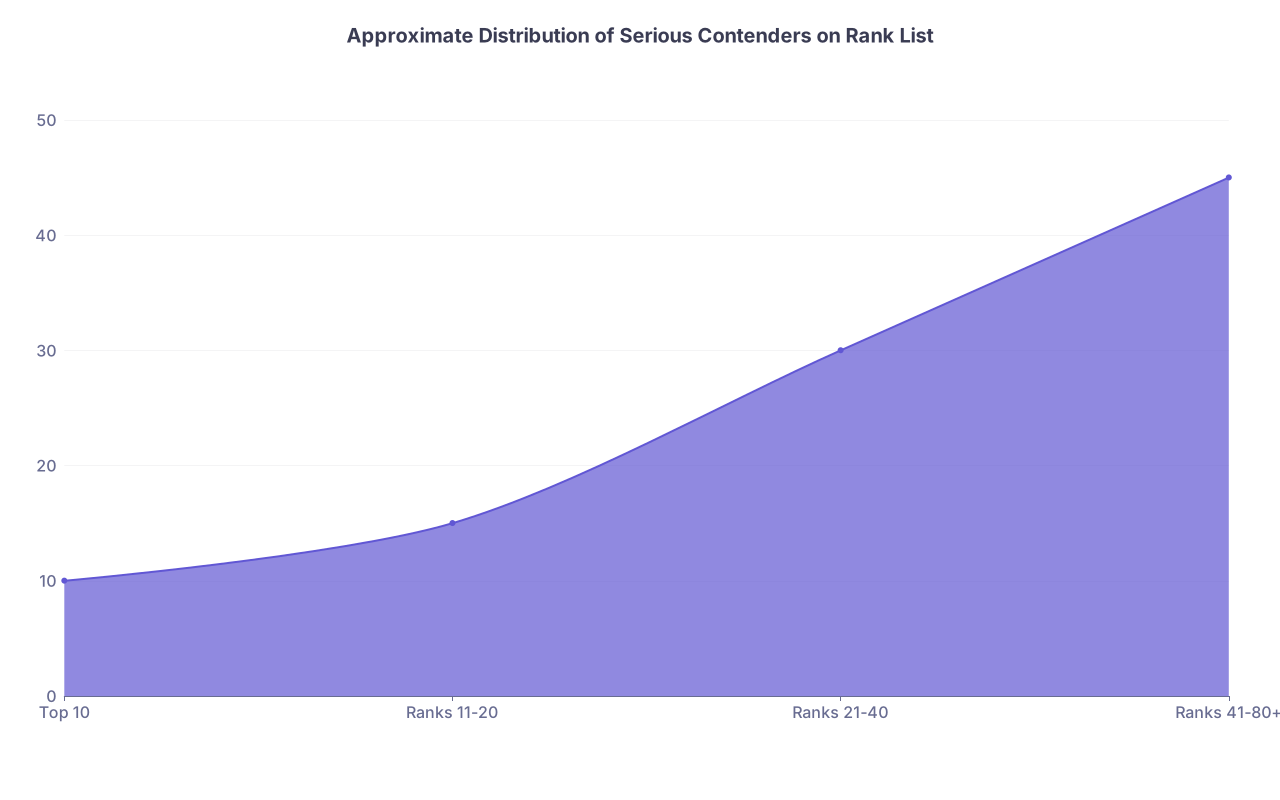
For a mid-large competitive program interviewing 80–120 people, the serious contenders for the top ~15 spots are a much smaller subset. Think 25–40 applicants who either:
- Had outstanding interview days,
- Have very strong internal advocates,
- Or bring some combination of stats, letters, and “fit” that made them memorable.
| Category | Value |
|---|---|
| Top 10 | 10 |
| Ranks 11-20 | 15 |
| Ranks 21-40 | 30 |
| Ranks 41-80+ | 45 |
Everyone else is ranked, sure. But in honest PD conversations after the match, you’ll hear variants of: “We knew we’d almost certainly fill in the top 30–35.” That’s the real battlefield.
If you’re in that zone, small things matter. If you’re sitting in the 60s on their list, your chances at that specific program are slim unless the match goes sideways for them.
What This Means for You, Practically
You do not control the politics, the personalities in that room, or the fact that someone’s resident friend fell in love with another applicant at the pre‑interview dinner.
You do control how you show up in the few data points that actually travel into the committee room:
- Sub‑I performance and the comments residents and faculty make about you.
- The specificity and enthusiasm of your letters, especially from people programs know.
- Your interview day presence: engaged, grounded, self‑aware, not performative.
- How clear and believable your interest in that program and city comes across.
Remember: by the time your name hits that projected spreadsheet, nobody is reciting your entire ERAS or personal statement. They’re operating on short comments, impressions, and a handful of strong or weak signals.
So you want to generate the kind of phrases that get said about you in that room:
“She was the hardest‑working student we had all year.”
“He’s the kind of person I’d want covering my patients.”
“She fits our culture—no ego, just quietly excellent.”
That’s the stuff that moves your name on the board.
Key truths you should walk away with:
- Rank lists in competitive specialties are built on pre‑sorting, politics, and a handful of loud impressions—not a perfectly fair “holistic” review of every detail.
- Champions, resident opinions, and red flags matter more in the committee room than one extra paper or a few points on Step 2.
- By the time they’re arguing over you, they’re not reading your file; they’re reacting to a story about you. Your job during med school and interviews is to make sure that story is the right one.