You’re betting your career on the wrong mentor if you’re not careful.
If your only strong mentor is outside your target competitive specialty, you’re in a fragile position—and most people in your shoes underestimate how fragile. Letters matter. Connections matter. Specialty-specific advocacy matters. You cannot “general good-mentoring” your way into dermatology, ortho, ENT, plastics, or neurosurgery.
But you are not doomed. You just have to play this differently than your classmates who already have an attending in their dream field texting them back at midnight.
I’m going to walk you through what to actually do if:
- You want a competitive specialty (derm, ortho, ENT, plastics, neurosurg, urology, ophtho, rad onc, etc.)
- Your best and maybe only real mentor is in something else (IM, FM, peds, psych, hospitalist, etc.)
- You’re worried this is going to tank your application
Good. You should be worried. That means you’ll take this seriously and not wait until October of fourth year to fix it.
Step 1: Be Honest About What Your Current Mentor Can And Cannot Do
Your non-specialty mentor is not useless. But they are not magic either.
Here’s what a strong out-of-specialty mentor can realistically do well:
- Teach you how to be a good trainee: show up prepared, communicate, follow through, not be a disaster on the wards.
- Help you clean up your personal statement and ERAS language.
- Coach you on professionalism, emails, conflict with residents, when to push and when to shut up.
- Make a strong, detailed letter about your character, work ethic, judgment, and reliability.
- Run interference if you’re in trouble: bad eval, awkward Dean’s letter comment, Step issue.
Here’s what they’re usually bad at for competitive specialties:
- Fine-grained program targeting: “These 12 ortho programs are actually realistic/smart for you.”
- True competitiveness assessment: “Your 250 + X + Y puts you in this tier for derm.”
- Knowing the hidden norms: “This ENT PD really likes home-grown applicants with research from X lab.”
- Making high-impact phone calls to PDs/chairs in that specialty.
- Giving detailed feedback on specialty-specific signals, letters, sub-I timing, away rotation strategy.
So don’t lie to yourself. You have:
- A powerful general career mentor
- But a weak specialty-specific network
You will need both.
Step 2: Get The Maximum Out Of Your Current Mentor (Before You Go Hunting)
Do not abandon your only strong mentor while you chase the shiny name in your target specialty. That’s how people end up with no real advocates at all.
Sit down with your current mentor and explicitly reset the relationship around your goal.
Say something like:
“Dr. X, I really value your mentorship and trust your judgment. I’m leaning strongly toward [dermatology/orthopedics/etc.]. I know that’s not your field, but I’d love your help thinking strategically about:
- How to present my story
- Which strengths to highlight
- Where my application is weak and how to shore it up. I also want to ask your advice on how to find the right mentors in that specialty without losing what we’ve built.”
Then specifically ask them to help with:
Brutal honest assessment.
“If you were my PD, would you rank me highly with what I have now? What would you worry about?”Narrative.
Have them poke holes in your “why this specialty” story. They’ll catch the generic fluff that PDs hate.Letter commitment.
Confirm: “Would you feel comfortable writing a very strong, detailed letter for me? I know it will not be from the field I’m applying to, but your perspective on my reliability and clinical performance would mean a lot.”Doors they can open.
Ask: “Who at this institution (or others) do you know in [target specialty] or in specialties that commonly work with them (radiology, general surgery, etc.) that you’d feel comfortable emailing on my behalf?”
If they’re a truly strong mentor, they’ll be honest and proactive. If they’re vague and noncommittal, note that. You may have overestimated how “strong” this mentor is.
Step 3: Understand What Competitive Programs Expect Mentor-Wise
You can’t guess here. Competitive fields have informal but very real expectations.
Here’s the rough reality:
| Specialty | Expect Home Specialty Letter? | Chair/PD Letter Common? | Research Mentor Letter Common? |
|---|---|---|---|
| Dermatology | Yes, strongly | Often | Often |
| Orthopedics | Yes, essentially required | Very common | Common |
| ENT | Yes, strongly | Very common | Common |
| Plastics | Yes, strongly | Often | Very common |
| Neurosurg | Yes, essentially required | Very common | Very common |
Translation:
- Having zero letters from your target specialty is a red flag for most places.
- Having only one specialty letter and everything else from random fields makes you look like you decided late, could not get on services, or did poorly on the relevant rotations.
So your situation is this:
- You must keep your strong outside mentor.
- You must add specialty mentors and letters quickly.
- You must avoid looking like you cobbled this together last minute.
Step 4: Build A Specialty Mentor Network From Scratch (Fast, Not Desperate)
This is where most students screw up. They “network” by sending vague emails like: “I’m interested in [derm] and would love to chat sometime.” Everyone in that field gets 50 of those a month. It goes nowhere.
You will be strategic and specific.
4A. Start on your own turf
If your school has your specialty:
Identify 3–5 key people:
- Program Director
- Associate PD
- Clerkship/sub-I director
- Research-active attendings with multiple recent publications
- The “student favorite” attending everyone talks about
Use a short, concrete email:
Subject: MS3 interested in [Specialty] – specific help request
Dear Dr. [Name],
I’m a [MS3/MS4] at [School], strongly interested in [specialty] and planning to apply this coming cycle.My main concern is that my primary mentor is in [IM/peds/etc.], and I’d like to make sure I’m building appropriate relationships and experiences within [specialty] itself.
Would you be open to a brief 15–20 minute meeting to get your advice on:
- How best to engage with the [specialty] department this year
- Whether there are ongoing projects or clinical opportunities where a motivated student could contribute
I’ve attached a one-page CV for context but happy to send more details if helpful.
Thank you for considering this,
[Name], MS[2/3/4]
[School]
You’re not asking “please be my mentor.” You’re asking for advice and an entry point. Much lower friction. Much higher yield.
- When you meet, do 3 things:
- Lead with evidence of commitment: prior shadowing, reading, a small project, whatever you actually have.
- Ask explicitly: “What would a strong applicant from this school look like for [specialty]?”
- Ask for one concrete next step: “If I did well on [X rotation/project], would you be comfortable being a letter writer or pointing me toward someone who might be?”
Then follow through like your life depends on it. Because for this field, it kind of does.
4B. If your school does NOT have your specialty
Different game. You need external mentors.
Options:
- Affiliated hospitals with the specialty
- Region-wide academic centers
- Alumni from your school now in that specialty
- National specialty societies and student interest groups
Use your existing mentor here. Ask them to send a warm intro email to one or two people they know even vaguely in that specialty or at that institution. Something like:
“I have a very strong, reliable student interested in [specialty] at a school without a home program. Would you have 10–15 minutes to advise them?”
Those intros land much better than cold emails from random students.
If you absolutely must cold email, keep it honest:
- Be upfront that you have no home program
- Be clear you’re not immediately asking for a rotation or letter
- You’re asking for guidance and possibly early involvement in a project
Step 5: Use Rotations Ruthlessly To Create Specialty Mentors
Your sub-I / audition / away rotations are not just “auditions.” They’re mentor-hunting grounds.
On each specialty rotation, your goals are:
Identify one attending who:
- Actually saw you work (not just once)
- Seems to like teaching
- Gives you feedback more detailed than “good job”
Signal interest early but not obsessively:
“Dr. Y, I’m strongly considering [specialty] and am hoping to apply this year. I’d really appreciate any feedback on how I’m doing and what I should focus on to be a strong candidate.”
- End the rotation with a direct ask if appropriate:
“Dr. Y, I really enjoyed working with you and learned a lot. If you felt you saw enough of my work, would you feel comfortable writing a strong letter of recommendation for my residency applications?”
If they hesitate or say something like “I can write you a letter” without “strong” attached—back away. You want enthusiastic letters, not lukewarm summaries.
- Stay in touch:
- Send one clear follow-up with your CV, draft personal statement, and a bullet list of things you did on the rotation to jog their memory.
- Update them when interview season starts and again when you match.
This is how you turn a 4-week rotation into a multi-year mentor, instead of a name you barely remember on your ERAS.
Step 6: Balance The Letters: How Many From Where?
In your exact situation—strong mentor outside specialty, weaker connections inside—aim for this:
For a competitive specialty, a good mix looks like:
- 2 letters from your target specialty (ideally including a PD/chair or respected faculty)
- 1 letter from your strong general mentor in another field
- Optional 4th: research mentor, sub-I in related field, or another strong clinical letter
Your outside mentor’s letter should emphasize:
- “I have worked with this student across [time period] and in [contexts].”
- “They are among the top [X%] of students I’ve worked with in [Y] years.”
- “Their clinical reasoning, reliability, and professionalism are absolutely at a level that will translate to [competitive field].”
If your mentor is senior and well known, that can actually help offset the “not in the field” concern—if they sound like they genuinely know you and are going to bat for you.
Step 7: Fix The “Why This Specialty” Problem When Your Mentor Is From Another Field
PDs get suspicious when:
- Your “why I love ortho” reads like it came from ChatGPT and UpToDate.
- All your strongest mentors are in, say, primary care, and you suddenly pivot to ENT with no track record.
Your job is to make this coherent:
- Use your outside mentor in your narrative.
Example for derm:
“During my internal medicine rotation with Dr. X, I often found myself drawn to patients whose systemic conditions first presented through skin findings. With Dr. X’s encouragement, I sought out opportunities to work more closely with dermatologists, where I realized I enjoyed the pattern recognition, procedural work, and longitudinal care this field offers.”
Show timeline, not whim.
You want to sound like: “I explored broadly, discovered features I liked in one field, and that naturally led me to this specialty,” not “I liked Step 1 derm questions and the lifestyle.”Anchor with actual experiences in the specialty:
- Clinic stories
- Cases where you followed up with patients
- Projects or QI you did with that department
Use your strong outside mentor to polish this story so it sounds like you, not a marketing brochure.
Step 8: Avoid The Classic Self-Sabotage Moves
I’ve watched students in your situation blow up their own chances with these mistakes:
- Waiting until MS4 fall to get on a single specialty rotation. You cannot fix a weak mentor network that late. Start MS3, or at worst early MS4 with strategically stacked sub-Is and aways.
- Dropping your outside mentor because “they’re not in my field.” Then your one real advocate is gone and the new specialty attendings only saw you for 3 weeks.
- Collecting 5 meaningless letters instead of 3 strong ones. A bland letter from a big-name surgeon who barely remembers you is worse than a glowing letter from a generalist who knows you well.
- Overselling your interest in every room. Telling every attending “this is my dream field” when you told their colleague the same thing last week in a different specialty. Word travels.
- Not being upfront in your Dean’s meeting. If your school asks your target specialty, do not hedge to “keep options open” while you secretly apply to derm or ortho. That often backfires when the school does not advocate for you appropriately.
Step 9: If You’re Late In The Game (Reality Check and Damage Control)
If you’re reading this as an MS4 in August with:
- Only one or zero rotations in your specialty
- One weak specialty letter and one strong outside letter
- No research in the field
You’re in salvage mode.
What you do:
Get real feedback from both your outside mentor and a specialty PD/attending: “Would you apply this year if you were me, or take a year for research or a prelim/transitional year?”
If you apply:
- Cast a wider net geographically and across program tiers.
- Lean on your outside mentor to send targeted emails to specific PDs: “This student is applying from a non-ideal home situation for this specialty, but they are absolutely capable and I would stake my reputation on them.”
If you wait:
- Get a research year or structured post-grad position inside the specialty.
- Treat that year like an extended audition for mentors and letters.
- Keep your original outside mentor involved in those decisions.
A late but well-executed plan beats a rushed, incoherent one that gets you 2 interviews and a SOAP scramble.
Visual: How Your Mentor Mix Should Evolve Over Time
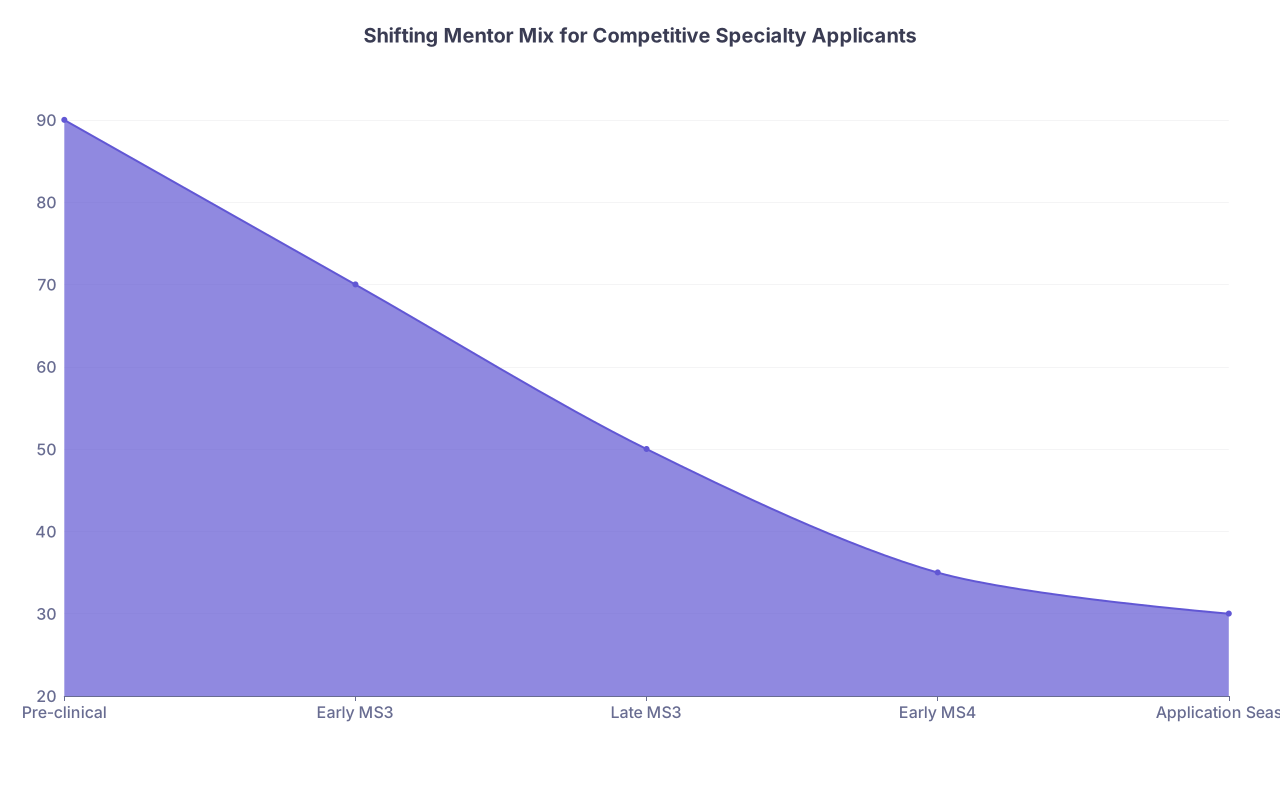
| Category | Value |
|---|---|
| Pre-clinical | 90 |
| Early MS3 | 70 |
| Late MS3 | 50 |
| Early MS4 | 35 |
| Application Season | 30 |
That area represents your percentage of mentorship coming from outside your target specialty. You want it high early (pre-clinical, early MS3), then steadily decreasing as you intentionally add specialty mentors.
You are not cutting off your original mentor. You’re diversifying.
Example Scenarios: What To Actually Do
Scenario 1: MS2, strong IM mentor, interested in ENT, no ENT exposure yet
What you do this year:
Tell your IM mentor your ENT interest and ask them to:
- Help you map out core rotation timing so you can do ENT early MS3.
- Introduce you to any surgeons or ENT folks they vaguely know.
Join the ENT interest group, attend a few grand rounds, talk to the residents afterward.
Schedule a brief meeting with the ENT clerkship director using that “15–20 minute advice” email.
The goal by end of MS3: at least one ENT attending who has actually seen you work and is a candidate for a letter.
Scenario 2: MS3 mid-year, strong peds mentor, now obsessed with derm after a rotation
You:
Ask your peds mentor for an honest read: “With my current scores/evals, am I even in the ballpark for derm?”
Meet derm PD/vice chair with a focused ask:
- “If I do a sub-I here and an away, is that enough time for strong letters?”
- “What kind of project could I realistically complete or contribute to in the next 6–8 months?”
Use your peds mentor to:
- Review your personal statement, which must clearly connect your peds experiences to why derm now makes sense.
- Prepare you for derm interviews where you will absolutely be asked why you pivoted.
Scenario 3: DO student, no home ortho program, strong FM mentor
Hard mode.
You:
Ask FM mentor to actively email:
- Regional ortho chairs/PDs
- Any ortho contacts at hospitals where you rotate
Aggressively arrange:
- Electives/aways at community and academic ortho programs
- Research collaboration with an ortho attending, even if it’s case reports, QI, or retrospective chart reviews
Make sure your FM mentor’s letter:
- Explicitly states that you have no home ortho program
- Emphasizes traits ortho values: work ethic, procedure interest, resilience, team function
This path can work. But only with deliberate design and early action.

| Step | Description |
|---|---|
| Step 1 | Only strong mentor outside target specialty |
| Step 2 | Clarify what current mentor can do |
| Step 3 | Ask for honest assessment and letter |
| Step 4 | Identify needed specialty mentors |
| Step 5 | Meet home or external specialty faculty |
| Step 6 | Use rotations to earn specialty letters |
| Step 7 | Balance letters and refine narrative |
| Step 8 | Apply with mixed mentor support |
FAQs
1. Can I match a competitive specialty with zero letters from that specialty if my outside mentor is very strong?
Technically yes. Realistically, it’s rare and usually requires other huge strengths (ridiculous scores, major research, or a unique background) and/or a very unusual situation (new program, under-the-radar connections, etc.). For most applicants, having no letters from your target specialty looks like you either:
- Did not actually explore the field
- Did but did not impress anyone enough to write for you Both are bad signals. Do everything you can to get at least one truly strong letter from within the specialty, even if it means a late sub-I or a post-grad year.
2. Should I prioritize a mediocre in-specialty letter over a stellar out-of-specialty letter?
No. A bland or lukewarm letter from your target specialty can hurt you more than it helps. Program directors can smell “generic, reluctant letter” instantly: vague praise, no specific examples, short length, lots of filler. If you have to choose, go with:
- 1–2 enthusiastic specialty letters, even if from less-famous attendings
- Plus 1–2 very strong out-of-specialty letters from people who know you well
That mix is far better than padding your file with weak “checkbox” specialty letters.
3. How do I know if my outside mentor actually has the clout to help me?
Look at concrete clues, not vibes:
- Do they hold leadership roles? (Program director, clerkship director, division chief, committee work)
- Have they written successful letters for competitive matches before?
- Do they regularly get emails or calls from PDs about previous students?
- When they talk about helping you, do they say specific things like, “I will email Dr. Y at [program]” or is it vague “I’ll support you”?
If you’re not sure, ask them directly: “Have you written letters for students matching into [your specialty or similar competitiveness]? How did that go?” A real mentor will answer you straight. And that answer will guide how much you lean on them versus how aggressively you need to build new connections.
Bottom line:
- Keep your strong outside mentor—but stop pretending they can replace specialty advocates.
- Aggressively, deliberately build at least 1–2 real mentors within your target field through rotations, projects, and direct asks.
- Make your story coherent: your outside mentor should reinforce, not contradict, why you belong in this competitive specialty.