
It’s late January. You’re on your away rotation in ortho/derm/ENT/anesthesia/IR—pick your poison—and you just scrubbed out of another case where you mostly held retractors and tried not to look lost. On your phone between cases: spreadsheets of Step scores, percentiles, average matched scores by specialty. Your classmates keep texting, “Dude, if I can just get a 255 I’m set for ortho, right?”
Let me ruin that fantasy for you quickly and cleanly.
In the most competitive specialties, at the programs you actually want, the thing that gets ranked first is not your score. Not even close.
Scores are a filter. Not a decider. The people actually deciding who gets ranked to match and who gets quietly buried at the bottom of the list are looking at something much harder to quantify and definitely not listed on FREIDA.
Let me tell you what really happens in those committee rooms.
What Scores Actually Do (and What They Never Will)
Let’s start by putting Step into its real place in the food chain.
Picture the PD of a big-name ortho program. They got 900 applications for 6 spots. Their coordinator has already run the sort:
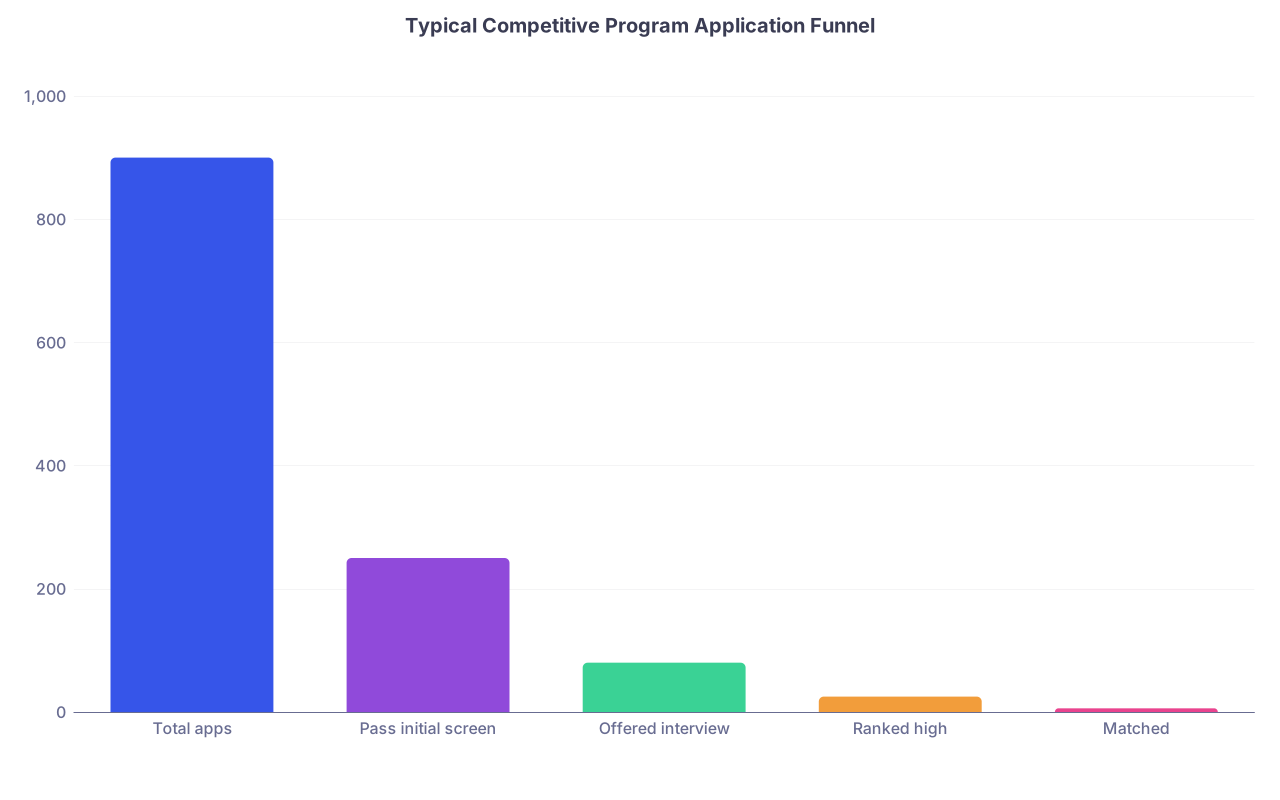
| Category | Value |
|---|---|
| Total apps | 900 |
| Pass initial screen | 250 |
| Offered interview | 80 |
| Ranked high | 25 |
| Matched | 6 |
Those first 650 applications that never get a serious look? That’s where scores do most of their work.
The PD and selection committee use scores like this:
- Below their mental cutoff? Auto-filtered unless someone powerful explicitly advocates for you.
- Solid but not insane (say 235–250 in a Step 2 world)? You’re in the “plausible” bucket.
- Very high (260+)? You get attention, but less than you think.
Now here’s the part nobody tells you during Step prep season: once you’re above that unofficial line, scores stop acting like a ranking tool. They become noise.
I’ve watched it in real time. Spreadsheet up on the screen. Names down the left, columns across: “School,” “Step 2,” “Clerkship honors,” “Home/away,” “Faculty advocate,” “Red flags,” “Interview impressions.”
You know what people don’t do?
They don’t sit there saying, “Let’s rank this 265 above that 253 because…numbers.”
What they actually do is this:
“Yeah, both of these kids are strong on paper. Which one felt like someone we’d want here at 2 a.m.?”
That’s the real currency.
The Real #1: “Would I Trust This Person on My Team?”
This is the actual north star of competitive program directors, even if they never write it down:
“Would I trust this person on my team, with my patients, and in my call room—for years?”
Different specialties phrase it differently:
- In ortho: “Is this someone I want in a 10-hour trauma case without complaining?”
- In derm: “Am I comfortable putting this person in front of high-demand private patients?”
- In ENT: “Will this person grind through a 16-hour OR day without drama?”
- In IR/anesthesia: “Will I trust them when the room is melting down and everyone’s looking at anesthesia?”
But it’s the same core question. Trust and fit.
Program directors rank first: reliability, judgment, and fit with their culture. Everything else is downstream.
How do they assess that? Not from your Step score report. From three main sources:
- Word-of-mouth from people they trust
- Your behavior on rotations (especially aways)
- How you made them feel on interview day
Let’s break those apart.
The Hidden Currency: Trusted Advocacy
Step back and look at this from the PD’s angle. You run a high-risk specialty: spine surgery, peds heart cases, advanced endoscopy, busy ICU. You need residents who won’t implode at 3 a.m.
Who do you trust more?
A three-digit score from an exam that has little to do with OR teamwork and real-time judgment
Or your former co-resident, now faculty at another place, who calls and says:
“Hey, this student rotated with us. They’re the real deal. No ego, worked hard, good hands, my patients liked them. I’d take them here in a second.”
You already know the answer.
This is the piece that blindsides students from non-top-20 or lesser-known schools. They think they’re playing a numbers game. The PD is playing a people game.
Behind the scenes, it works like this:
- October–January: PDs and core faculty text, call, email each other about specific applicants.
- “What do you think of this kid from your place?”
- “We’re interviewing her next week—any concerns?”
- “He rotated with you, right? Was he solid or just a Step jockey?”
Those back-channel comments override marginal differences in scores instantly.
And here’s the part that stings: a lukewarm back-channel is often a death sentence, even with stellar numbers.
“Yeah, she’s smart but…we wouldn’t rank her high here.”
Just like that, you drop from “rank to match” to “somewhere in the middle where you’ll never land.”
What Away Rotations Actually Measure (Hint: Not Only Skill)
You think your away rotation is about showing how much you know. Program directors are watching something else entirely.
They’re asking: “Is this a person we want to see every day for five years?”
On aways, the hierarchy of what actually matters looks more like this:
How you respond to unglamorous work
Do you help transport a patient post-op when you could be scrolling your phone?
Do you quietly help the intern finish notes at 6 p.m. or disappear right at sign-out?I watched a PD in ortho bump a 270-step rotator down and pull a 240-step applicant up because, quote:
“He vanished whenever work needed to be done. The other guy stayed, did scut, and didn’t whine once.”How you handle feedback and minor humiliation
Everyone gets pimped. Everyone gets something wrong.The question is: do you get defensive, sulk, or show you can take a hit and adjust?
One ENT attending put it perfectly during rank meeting:
“He’s smart, but if you correct him he gets tight. I don’t want to deal with that at 3 a.m.”Your interpersonal friction coefficient
Are nurses rolling their eyes after you leave the room?
Does the scrub tech like working with you?
Do co-residents say, “Yeah, they’re cool,” or “Kind of high-maintenance”?PDs weigh this heavily. Because they know: one toxic resident poisons an entire class.
Consistency>Performance spikes
Nobody cares about the one big save you made in clinic if the rest of the month you’re late, scattered, or annoying.They’re asking: “Was this person solid, every day, for four weeks?” Not “Did they have one heroic day?”

PDs are not stupid. They know aways are auditions. They’ll give you some grace. But if multiple people say, “Yeah…not a team player,” your numeric achievements become wallpaper.
The Interview: Not a Quiz, a Vibe Check
Here’s another dirty little secret. By the time you’re sitting on Zoom or in that conference room on interview day, your scores have already done their job.
You’re there because your metrics cleared a bar. Now the committee is probing one question:
“Does this person feel like us?”
Competitive programs have strong cultures—good or bad. High-volume ortho trauma shop. Refined, image-conscious derm group. Academic ICU powerhouse. They’re trying to protect the culture they have.
What PDs and faculty are quietly ranking on interview day:
How you talk about hard things
When they ask you about a conflict, failure, or tough feedback—do you blame others? Minimize? Get vague? Or can you own it without spiraling?Your ego size relative to your stage
You come in talking like an attending as an MS4: huge red flag.
I sat in one anesthesia rank meeting where the PD said flatly, “He already thinks he’s too good for this place. He’ll be miserable here. Hard pass.”Signals about work ethic versus “brand” focus
If 80% of your answers are about big-name research, prestige, and fellowships—but nothing about taking good care of actual patients—that gets noticed.Alignment with their specialty’s unspoken reality
In ortho: are you ready for early mornings, late nights, heavy physical work?
In derm: do you understand clinics, cosmetics, patient expectations?
In IR: do you actually like sick patients, emergencies, call, and procedures? Or are you there for the lifestyle you think it offers?
Nobody will say, “We rejected them because the vibe was off.” But that is exactly what happens.
The Quiet Killer: Enthusiasm That Feels Fake
Programs in competitive specialties are paranoid about one thing: being your backup.
They hate it. They talk about it.
Derm PDs can smell the applicant secretly holding out for one specific coastal program. Ortho faculty can see through “I just love your program” when you can’t name a single actual detail about how they function.
What they actually want to feel from you:
- You’ve done your homework on their program
- You have specific, grounded reasons why you’d be happy training there
- Your questions show genuine curiosity, not generic “I read that on your website” fluff
The red-flag pattern that gets you quietly moved down the rank list:
- Same vague answer about “great training and research” at every program
- No clear understanding of what makes this place different
- No interest in things the program clearly prides itself on (e.g., “we’re a crazy busy county hospital” and you only ask about elective time)
Competitive PDs rank first: “Who actually wants to be here—and would stay if things get hard?”
Because things will get hard.
Culture Fit: The Unwritten Ranking Column
Let me be blunt: “culture fit” gets abused as a fig leaf for bias at some programs. But at the better ones, it means something precise.
They’re looking for residents who:
- Won’t melt down under their usual workload
- Will get along with the particular type of person who gravitates there
- Won’t sue them, implode, or poison the class dynamic
Here’s how it plays out behind closed doors:
- Chair: “We’ve got 30 people we’d be happy with. Who actually feels like one of ours?”
- Chief resident: “These 8 were awesome. Worked well with everyone on the trail.”
- PD: “Okay, those go at the top. Which ones are strong on paper but might be rough in real life?”
That last category? Strong CV, high numbers, decent interview—but people aren’t sure about you. That’s where “culture fit doubts” lives.
They’ll say things like:
- “I worry she’ll be miserable with our volume.”
- “He struck me as someone who’ll be gone at 5 every day.”
- “She seemed more excited about research than patient care. That’s not this place.”
Those comments crush applicants with 99th percentile scores every single year.
What You Should Actually Be Optimizing For
So what does this mean for you in practical terms?
No, I’m not saying ignore Step or blow off your exams. You need to hit the bar. But once you’re in striking distance of competitive programs, your marginal effort has more impact elsewhere.
| Area | Marginal Benefit After Cutoff |
|---|---|
| Raising Step by 5–10 pts | Low to moderate |
| Strong home rotation | Very high |
| Away rotation performance | Extremely high |
| Faculty advocacy | Extremely high |
| Interview authenticity | Extremely high |
If you’re sitting on a 245 trying to kill yourself to turn it into a 255 for a hyper-competitive specialty, understand: that extra 10 points will not outweigh a single strong phone call from a respected faculty member saying, “This student is the kind of resident you want.”
Where to push hard:
- Your home specialty rotation. Treat it like a month-long interview. Because it is.
- Your first away at a realistic reach program. All-in. No half-committed, “let me just see if I like it.”
- Relationships with a small number of faculty who actually know your work and will go to bat for you.
- Self-awareness going into interviews: knowing your own story, your own red flags, and being able to talk about them like an adult.

The question you should constantly ask yourself is not “How do I look on paper?” but:
“Would the people who matter be comfortable putting their name on me?”
Because that is what PDs are really ranking first: trusted, low-drama, high-reliability teammates.
Scores just get you through the metal detector. Being someone they trust to stand next to them when things go sideways—that’s what puts you at the top of their list.
Fast Reality Checks by Specialty (No Sugarcoating)
A few patterns, because I know you’re thinking about specific fields.
Ortho / Neurosurg / ENT / Plastics
These are small-world, high-ego, high-risk fields. Word spreads. PDs care intensely about:
- Work ethic under heavy physical and mental load
- Response to hierarchy and feedback
- Hands, but only after attitude
I’ve seen a ortho PD say: “I’d rather take a 240 with a great attitude than a 260 that nurses hate.” And they meant it.
Derm
Yes, research and numbers. But once you’re in the room, they’re reading:
- Are you going to be a reasonable colleague in a specialty with a lot of patient expectations and money floating around?
- Do you seem like someone who’ll add to their reputation, not embarrass them?
The top derm programs care deeply about how you present yourself and how grounded you are. Quietly arrogant gets nuked.
Anesthesia / IR
They’re thinking: “Will I trust this person when the patient crashes?”
- Calm under pressure matters more than detailed physiology recitation
- How you talk about teamwork with surgery/ICU teams is heavily weighted
- Any hint of unreliability or flakiness? Fatal.
The Part Nobody Wants to Admit
There’s one more layer. Ugly but real.
When PDs are nervous about an applicant—maybe you’re from a school they don’t know, or you had a leave of absence, or your Step is good-but-not-insane—do you know what they’re asking themselves?
“If this goes bad, who gets burned for pushing this person?”
Which is another way of saying: again, trusted advocacy. If someone they respect says, “I’ll own it; this person is strong,” you suddenly become much less risky.
If nobody is saying that? You’d better be flawless elsewhere.
FAQs
1. If scores aren’t ranked first, can a lower score still kill my chances?
Yes. There’s a floor. If you’re below what that specialty and program considers acceptable, you won’t even get to the “real” evaluation. Scores are the bouncer at the door. But once you’re inside, they stop deciding who gets the VIP treatment.
2. How do I actually get a faculty advocate who will go to bat for me?
You earn it over weeks, not days. Show up early. Be prepared. Ask for feedback, then visibly apply it. Do the annoying work without being asked twice. And when the rotation ends, don’t just say “thank you”—say, “Dr. X, I really enjoyed working with you and I’m very interested in [specialty]. I’d be grateful if you’d consider supporting my application.” Make it explicit.
3. I don’t have a home program in my specialty. Am I screwed?
You’re not doomed, but you’re starting behind. You need to treat your aways as “home x3.” Do at least two, sometimes three, at places where your school has any connection. And you must crush them—not just medically, but as a human being people want back. Your away PD essentially becomes your home PD.
4. I’m not naturally extroverted. Will that hurt me on interviews and rotations?
You don’t need to be the loudest. You need to be the most dependable and genuinely engaged. Quiet but prepared, respectful, with good questions, and clearly committed beats chatty and shallow every time. Thoughtful introverts do very well when they own their style instead of pretending to be someone else.
5. How can I tell if I’m giving off “backup program” energy?
If your reasons for liking a place could be copy-pasted to ten other programs, you’re giving backup energy. If you can’t name 2–3 specific, non-generic aspects of their training, culture, or patient population that honestly appeal to you, they’ll feel that. Fix it by doing deeper research and having concrete, program-specific reasons you can talk about without sounding scripted.
Key takeaways?
Scores open the door; they don’t decide who gets the keys. Program directors in competitive specialties rank first: people they trust—on the word of colleagues, on the strength of your behavior during rotations, and on how you made them feel in person.
If you want to rise to the top of a competitive rank list, stop obsessing over squeezing 5 more points out of a standardized test and start becoming the one thing every PD is actually hunting for: a resident they’d willingly stand next to when everything is on fire.