
Most people who miss in competitive specialties never lose on interview day. They are already dead in the water before the first invite goes out.
Let me tell you what really happens.
When we sit down to build the interview list for dermatology, plastics, ortho, ENT, neurosurgery, IR, radiation oncology, urology—the specialties everyone whispers about—nobody is “holistically reviewing” 800 files from scratch. That’s the fantasy.
We’re hunting for reasons to say no. Fast. And we are very, very good at it.
You know the big landmines: low Step scores, failing grades, professionalism violations. That’s not what kills most borderline applicants. The ones who feel “I should be getting more love than this.” They get killed by smaller, boring red flags that quietly push them just below the line while someone with similar stats gets pulled up.
You want competitive? Then you need to understand how committees actually think, in the room, with your ERAS open on a projector.
The Quiet Sorting That Happens Before Anyone “Reviews” You
Here’s the uncomfortable truth: in competitive specialties, a large chunk of screening is effectively automated—even when no formal filter is set in ERAS.
Someone (often the chief resident or a junior faculty) pre-sorts the pile. They know what will fly with the PD and what won’t. They’ve watched it for years.
The first pass is not “Who’s great?”
It’s “Who is not worth fighting for?”
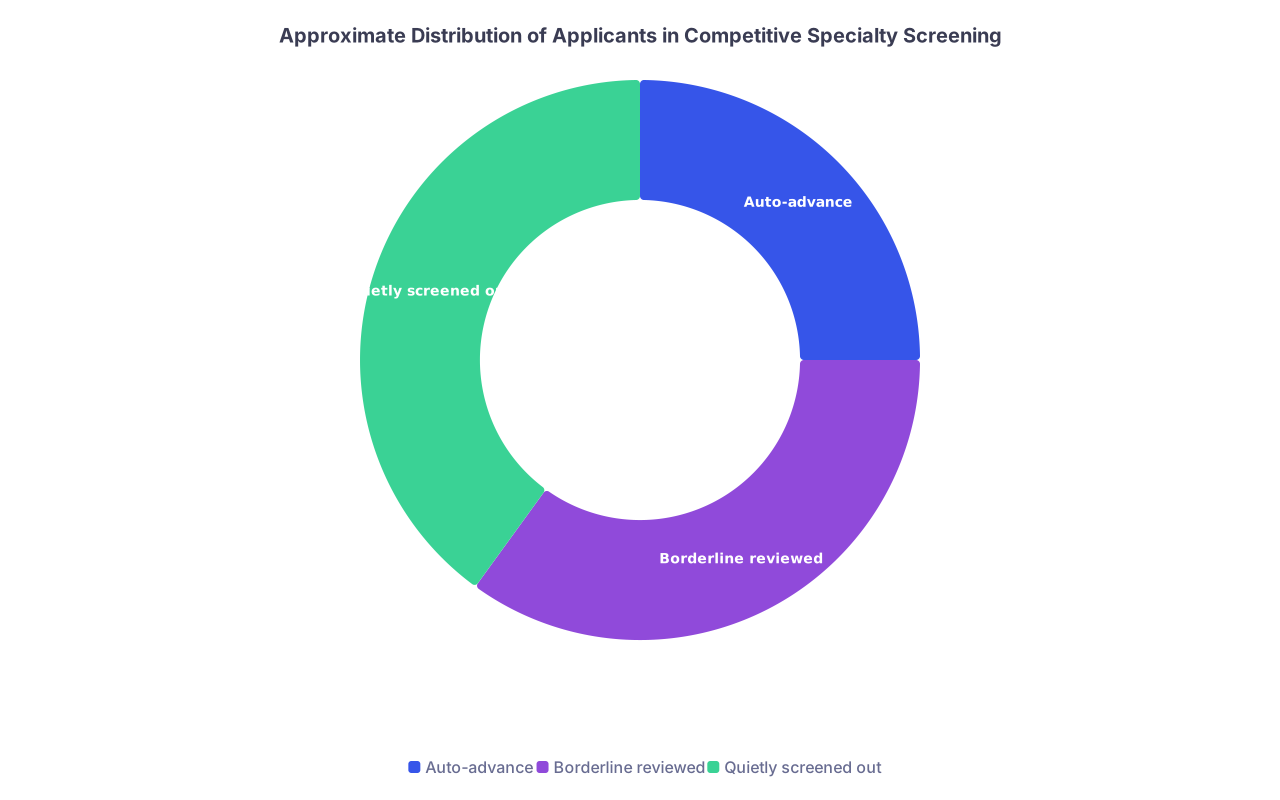
| Category | Value |
|---|---|
| Auto-advance | 25 |
| Borderline reviewed | 35 |
| Quietly screened out | 40 |
Those “quietly screened out” candidates? That’s where subtle red flags do most of their damage. Let’s walk through the ones you do not hear enough about.
The Red Flags You Think Are Harmless (They Aren’t)
These are the ones that I see sink applicants every single cycle while they sit around blaming “Step inflation” and “too many applicants.” The numbers matter, yes. But these patterns push similar numbers in very different directions.
1. The Specialty “Tourist” File
This is often the kiss of death in derm, ortho, ENT, plastics, neurosurg, IR.
On paper, your stats are fine. But your application reads like you picked your specialty in March of M4.
I’ll tell you what people say in the room:
“This person just decided last minute. They’re going to bail or be miserable.”
Here’s what triggers that reaction:
- Only 1 short home rotation in the specialty
- No away rotations in the field despite time and resources to do so
- Research almost entirely in another specialty
- Personal statement that could be swapped between three specialties with minor edits
- No strong, field-specific letters from known names or at least clearly engaged attendings
We don’t need you to have lived in the derm clinic since M1. But for competitive spots, we want evidence of “I’ve wanted this for a while, and people in the field know me.”
File that looks tourist-y vs committed? The committed one wins every time—especially if there’s any other concern.
2. The “Generic Excellence” Applicant
This is the person with great scores, impressive publications, top-20 med school—and they still get weirdly few interview offers in derm, plastics, ortho.
Faculty glance at the file and go: “Okay, they’re strong. But are they ours?”
The subtle problem: nothing in the application points specifically to this field.
Classic example:
- Step 1: 250+
- Step 2: 255+
- AOA
- Publications: 4–6 in internal medicine, oncology, or basic science unrelated to the target specialty
- No meaningful leadership or commitment within the specialty
In medicine or pediatrics, this applicant absolutely cleans up. In dermatology or plastics, they get lost. Why? Because programs are not just picking “smart.” They’re picking future colleagues who will advance the field and not jump ship after PGY-2.
I’ve seen many committees quietly bump down these “generic stars” in favor of someone with slightly lower scores but a tight, specialty-focused narrative: 2–3 relevant projects, a known mentor in the field, a letter that actually says “This person will be an outstanding neurosurgeon,” not “This person is very hardworking and smart.”
The red flag here is subtle: not “bad fit,” but “no clear fit.” In high-volume screening, “no clear fit” becomes a soft no.
3. The Weakly Enthusiastic Letter (You Rarely See It Coming)
You think you have 3 strong letters because no one warned you. What you actually have is 2 ok letters and 1 lukewarm that quietly kills you at top programs.
Here is what a subtle red flag letter looks like from our side:
- Emphasis on “reliable,” “quiet,” “polite,” “pleasant to work with” without any mention of excellence or top-tier
- Length significantly shorter than peers from that writer
- Totally generic, could apply to anyone rotating on the service
- No concrete stories or specific examples of performance
- No comparative language: “one of the strongest,” “top 10%” etc—even when the writer typically uses those phrases
I’ve seen applicants with great numbers sunk at big-name programs because the PD called a colleague who wrote a “safe” letter and heard, “Yeah, they were fine. Good student.” That’s death in competitive specialties.
You need letters where the writer is clearly invested in you. If your best letter is from a non-specialist who loves you, and your field-specific letter is a bland template, that contrast shows.
4. The Slightly Chaotic Academic Record
Not a failure. Not a major professionalism event. Just… a file that feels messy.
Patterns that make committees uneasy:
- A string of Honors/High Pass, then a weird Low Pass or marginal eval on a core rotation with a comment like “needed more supervision than expected”
- Step 1 pass, Step 2 CK just barely over the program’s informal comfort zone for that specialty
- Repeated “improved over time” comments that subtly hint you started off behind your peers
- Shelf scores that are fine overall, but one or two very low outliers in key rotations (e.g., surgery for ortho, neurosurg; medicine for IR)
Here’s the internal monologue I hear from PDs and senior faculty:
“Our residents are under insane pressure. Do I want someone who might need handholding the first year?”
Again, not a hard “no,” but it places you one tier down. And in small fields with insane signal-to-noise ratios, that’s all it takes.
5. The Awkward Gap Between Paper and Performance
This is one of the most damaging subtle red flags—and it almost never gets talked about.
You have high Step scores. Strong school. Good CV. Then we read your clinical comments.
- “Sometimes needed reminders to see more patients.”
- “Knowledge base is solid but clinical application is inconsistent.”
- “Tends to work more slowly than peers.”
- “Pleasant but at times disengaged from the team.”
Now we’re thinking: “Is this person just a Step machine who struggles in the wild?”
Competitive fields do not want purely academic all-stars who go missing on the floor. They want high-performers who can be thrown into an ICU at 2 a.m. and not drown.
The more your numbers suggest “crushing machine,” the more we expect dominance in your evals. When those evaluations are just “fine,” that mismatch itself is a red flag.
6. Sloppy or Inattentive Application Details
You think they don’t matter. They do. Especially in small, competitive fields where professionalism and detail orientation are mission-critical.
A few things that draw silent eye-rolls and quick de-prioritization:
- Personal statement clearly reused from another specialty or last year’s app (we notice)
- Subspecialty name misspelled. You’d be amazed how often “otorhinolaryngology” spawns disasters.
- Institution names wrong in program-specific questions
- Obviously copy-pasted research descriptions with formatting errors, random capitalization, or inconsistent authorship formatting
- Leaving big “gaps” in experience timelines with no explanation
Do I reject someone for a missing comma? No. But when your file feels casual, the interpretation becomes: “They’re not serious enough about us.”
And seriousness is the currency in competitive specialties.
7. The Awkward Interview Geography Pattern
You’re not even thinking about this, but faculty do.
We see applicants who:
- List 10 programs in one region, yet not a single one from the geographic area our institution is in
- Have all their clerkships, research, family connections in one city but apply heavily across the country with no stated reason
- Say “I want to be in the Northeast” in their personal statement but apply widely, including us in the South or Midwest, with no explanation
In highly desired cities (NYC, Boston, SF, LA), if we sense we’re just your “safety top tier” and you really want somewhere else, that’s a subtle red flag. No one wants to be ditched on Match Day or lose a spot to a prestige-chaser.
I’ve watched PDs say: “This one’s probably ranking Columbia and Penn above us. If we have to choose, let’s fight for the person who might actually come here.”
You will not see this in any official guidance. It’s how humans behave when they’re trying to maximize their match yield.
How Committees Really Weigh These Subtle Red Flags
To you, every red flag feels binary: fatal or not. That’s not how this works.
Each subtle red flag is like a small weight on the “maybe not” side of the scale. Some people have one or two and still crush it. Others accumulate six or seven and never realize why they’re getting ghosted.
| File Tier | Typical Outcome | Red Flag Tolerance |
|---|---|---|
| Auto-interview | Many invites, early | Can survive 1–2 |
| Borderline high | Some invites, delayed | 0–1 max |
| Borderline low | Few or no invites | Any red flag hurts |
| Quiet reject | No interviews | Red flags pile up |
A strong, committed derm applicant with one lukewarm letter from a busy attending? Survives.
A borderline ortho applicant from an unranked school with generic letters, thin ortho exposure, and a single low surgery shelf? They get pushed to the “nice, but no” pile.
And that deciding push often happens in 60–90 seconds per file.
Concrete Moves to De‑Risk Yourself Before Interview Season
Let me give you actionable, not wishy-washy.
1. Build a Coherent Specialty Story Early
No, you do not need 10 years of research. But you do need:
- At least one dedicated home rotation where someone in the specialty actually knows you
- Preferably 1–2 aways in programs that will write you real letters, not just check boxes
- A couple of projects (case report, QI, chart review, anything) with someone in the field
Then make sure your personal statement, activities descriptions, and letters all point in the same direction: “I know this field, I’ve tested it, my mentors in this field support me.”
2. Ruthlessly Screen Your Letter Writers
You should be more afraid of a weak letter than of asking someone else.
Ask directly (in person or on Zoom if you can):
“Do you feel you can write me a strong and specific letter for [specialty]?”
If they hesitate or say something vague like “I can write you a supportive letter,” that’s code for “I’ll write something bland.” You don’t want that.
Better to have 1 superstar letter from a mid-tier institution than 3 forgettable ones from giants.
3. Clean Up Inconsistencies Head-On
If you have:
- A weird low grade
- A leave of absence
- Step score dip
- Change in specialty late
You do not hide that. You control it.
Use the “additional information” section or brief mention in your personal statement to give a tight explanation. Faculty are far more forgiving when they know the context, and it doesn’t sound like you’re dodging.
What we hate is having to guess.
4. Obsess Over Application Professionalism
No, it’s not overkill. In competitive fields, small signals matter.
- Triple-check spelling of every program, institution, and person.
- Make your activity descriptions clean, consistent, and free of fluff.
- Cut gimmicks from your personal statement. Clarity beats cuteness.
- Do not broadcast indecision about specialty in your personal statement. If you switched, briefly explain, but end in a clear, committed place.
This convinces us you will not be the resident who forgets to follow up on critical labs or bungles time-sensitive tasks.
5. Manage Geography Intentionally
If you’re applying broadly but genuinely open, then say so—once—somewhere an interviewer or screener can see it (PS, geographic preference field, or secondary questions).
If you have a real tie to a region that does not obviously appear in your ERAS, spell it out:
- Partner doing residency there
- Family you support nearby
- Prior long-term living history in that area
Absence of a stated reason is where the “they won’t actually come here” red flag gets triggered most.
How Timing Interacts With Subtle Red Flags
You know what makes every red flag worse? Being late.
Here’s how interview offer patterns tend to look in hyper-competitive fields:
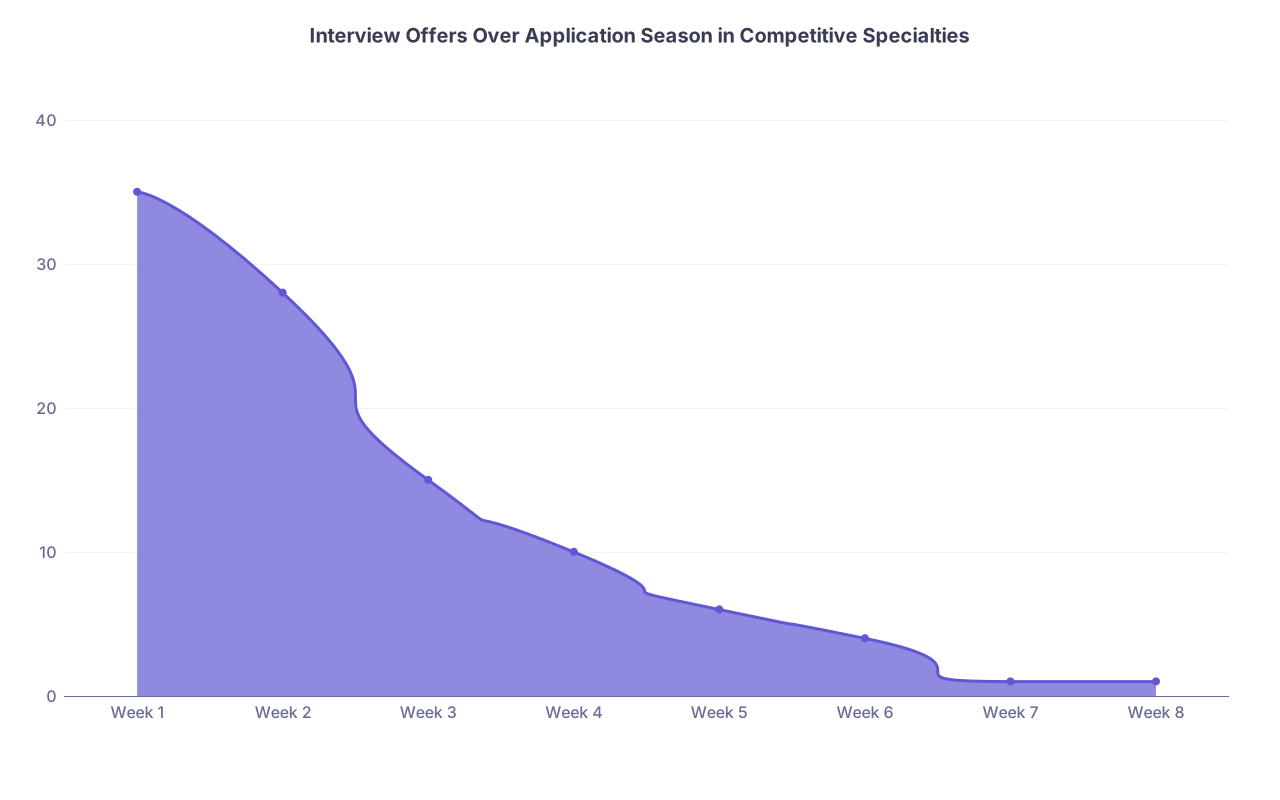
| Category | Value |
|---|---|
| Week 1 | 35 |
| Week 2 | 28 |
| Week 3 | 15 |
| Week 4 | 10 |
| Week 5 | 6 |
| Week 6 | 4 |
| Week 7 | 1 |
| Week 8 | 1 |
Early in the season, programs are still “open-minded.” A small red flag gets weighed against a large pool of uncommitted interview spots.
By Week 4–5, the mindset shifts:
“We’re almost full. Anyone with question marks goes to the hold list. We can always pull them up later.”
“Later” rarely happens.
So if you’re a slightly risky file—a few of those subtle issues I described—you absolutely cannot afford to be:
- Late with Step 2
- Late with ERAS
- Late with letters that keep trickling in weeks after submission
An early, complete file sometimes gets a shot before doubts set in. A late, messy file just reinforces the sense that you’re not on top of things.
The Hard Truth: Most People Never Know Why They Sank
You will never get an email that says:
“Hi, we noticed your personal statement felt generic and your surgery shelf was low, and your ortho letter sounded lukewarm, so we didn’t interview you.”
Instead, you get silence. Or a mass-rejection in January.
But inside the committee room?
I’ve heard:
- “Great numbers, but doesn’t look invested in our field.”
- “All their commitment is to another specialty, feels like a backup play.”
- “Letters are fine, but no one is really going to bat for them.”
- “Do we really want someone whose evals say ‘improved’ 10 times in a row?”
- “If we only have 4 interview spots left, I’d rather give it to someone I know loves this specialty.”
None of this makes it into your inbox. Yet it absolutely shapes your career.
If you’re going after a competitive specialty, you cannot just be “good enough.” You have to be clean. Coherent. Believable as a future colleague that this field is where you belong.
Everything else—scores, research, school name—that’s the entry ticket.
Avoiding these subtle red flags? That’s how you stay in the game long enough to actually get on Zoom or sit down on interview day.
With that under control, then we can talk about how to actually perform on interview day and not sabotage yourself there. But that’s another conversation entirely.