What if you take a research year, sacrifice time and tuition, and still do not match your dream specialty—was it all a waste?
Let me be direct: a dedicated research year can be a power move or a pointless detour. It depends far more on who you are and what your application looks like right now than on the generic prestige of “doing research.”
You’re not really asking, “Is research good?” You’re asking:
- “Do I need a research year for derm/ortho/ENT/neurosurgery/plastics/rad onc, etc.?”
- “Will it actually move the needle for my match chances?”
- “Or am I just doing this because everyone else is panicking?”
Let’s answer that.
First: When a Research Year Actually Makes Sense
Here’s the short version: a dedicated research year is most justified when you’re aiming for a very competitive specialty and you have at least one significant weakness that research can reasonably offset.
That usually means one or more of these:
- Your school is low-prestige or unranked, with limited home specialty presence
- You have average or below-average board scores for your target specialty
- You decided late and have almost no specialty-specific exposure
- You want to break into a hyper-academic field or top 10 program
- You’re switching from another path and need to “rebrand” your application
And the specialties where this question comes up over and over:
| Specialty | Research Year Common? | Why It Helps Most |
|---|---|---|
| Dermatology | Very common | Huge emphasis on publications, academic fit |
| Plastic Surgery | Very common | Small field, high research density |
| Neurosurgery | Very common | Long training, heavy academic culture |
| Orthopedic Surg | Common | Differentiates mid-tier applicants |
| ENT (Otolaryng) | Common | Boosts visibility in a small field |
| Radiation Onc | Common | Research-driven specialty |
If you’re applying to internal medicine, peds, psych, FM, or even most OB/GYN and EM programs, a full research year is usually overkill unless you’re dead-set on an elite academic career.
So the first blunt rule:
If your target specialty’s NRMP charting outcomes show 10–15+ mean publications for matched applicants, a research year is on the table.
If it shows 1–3, you’re probably solving the wrong problem.
A Simple Decision Framework: Do You Need a Research Year?
Let’s cut through the noise. Here’s the framework I’d use with a student in my office.
Step 1: Identify Your Specialty and Target Tier
Be honest with yourself: Are you trying to:
- Just match somewhere in this specialty
- Match at a solid academic program
- Aim for top 10 / big-name, research-heavy centers
The bar rises sharply for that third group.
For something like dermatology at top programs (Penn, UCSF, Harvard-affiliated), no research and no publications is basically a non-starter unless you’re a once-in-a-decade unicorn with insane board scores and connections. They want academic producers.
If you’re okay matching at a mid-tier program that values clinical performance heavily, a research year may not be essential.
Step 2: Audit Your Current Application
Look at your app like a PD would. Harshly.
Ask yourself:
- School: US MD vs DO vs IMG? Highly ranked or not? Home program in your specialty?
- Step 2: Is your score at/above or below the matched mean for that specialty?
- Clinical: Strong clinical narrative? Honors in relevant rotations?
- Research:
- Any publications?
- In the specialty or at least in a related field?
- Posters/abstracts?
- Connections:
- Know any faculty who can call program directors for you?
- Have you rotated at centers you want to match at?
If you’re US MD, decent Step 2, some specialty exposure, and at least a few projects/posters in progress, a research year is maybe helpful but not mandatory.
If you’re DO or IMG targeting derm, plastics, ENT, ortho, or neurosurgery and you currently have zero research, no strong specialty letters, and no home program? A dedicated year may be one of the few levers that actually changes your odds.
What a Research Year Can and Cannot Do
This is where people get it wrong. They think “research year = guaranteed publications = guaranteed interviews.”
Reality is uglier.
What a Research Year Can Do
It can:
- Give you volume: multiple abstracts, posters, possibly several co-authorships
- Plug you into a known academic name/program that PDs recognize
- Get you real advocacy letters from well-known faculty
- Show sustained interest in the specialty (especially for late deciders)
- Create a coherent story: “I’m serious enough about this field to pause my training and contribute”
For derm, plastics, neurosurgery, ENT, ortho, and rad onc, that combination can absolutely bump you from “auto-pass” to “interview potential.”
What a Research Year Cannot Do
It will not:
- Erase a catastrophic Step 2 or multiple course failures
- Turn you into first-author on NEJM papers overnight
- Fix a terrible professionalism history or MSPE comments
- Automatically get you into top programs just by proximity
I’ve seen students spend a year “doing research” where they mostly did data entry, never led a project, and walked away with one middle-authorship on a low-impact paper. That does almost nothing for a competitive match.
If your research year is badly structured, you can waste 12 months and be in almost the same position—just older, more tired, and a year behind your class.
How to Evaluate a Specific Research Year Opportunity
The key is not “Should I do a research year?” but “Is this specific research year actually worth it?”
Here’s how to judge an offer.
, Protected Research Time](https://cdn.residencyadvisor.com/images/articles_svg/chart-key-factors-for-a-high-yield-research-year-9426.svg "Key Factors for a High-Yield Research Year")
| Category | Value |
|---|---|
| Mentor Track Record | 10 |
| Project Ownership | 9 |
| Home Specialty Presence | 8 |
| [Name Recognition](https://residencyadvisor.com/resources/most-competitive-specialties/the-real-weight-of-prestige-school-name-vs-performance-in-competitive-matches) | 7 |
| Protected Research Time | 8 |
Ask these questions directly to the PI or program:
Mentor track record
- How many prior students in this role matched into my specialty?
- Where did they match?
If they can’t name specific people and programs, that’s a red flag.
Expected outputs
- What realistic number of abstracts/manuscripts should I expect if I work hard?
A good environment: 3–6 posters/abstracts and 1–3 manuscripts (even if some are submitted, not yet accepted).
- What realistic number of abstracts/manuscripts should I expect if I work hard?
Type of work
- Am I designing projects, analyzing data, writing, or mostly just collecting data?
If you’re just a data mule, your learning and visibility plummet.
- Am I designing projects, analyzing data, writing, or mostly just collecting data?
Integration with the specialty
- Will I attend departmental conferences, grand rounds, clinics, OR?
- Will I meet the residents and faculty regularly?
You want them to know your name by the time ERAS opens.
Letters of recommendation
- If I perform well, are you comfortable writing a strong letter for my residency application?
You need at least one heavy-hitting specialty letter from this year.
- If I perform well, are you comfortable writing a strong letter for my residency application?
Funding and logistics
- Is it paid or unpaid?
- How does this impact my loan interest and graduation date?
The math matters. You’re trading a resident salary year for unpaid (or low-paid) work.
If you cannot get clear answers or everything feels vague—“We’ll see what happens, lots of opportunities”—assume it will underdeliver.
The Timing Question: When To Take a Research Year
Best timing is usually:
- After core rotations, before dedicated application year
- Or after MS3 and before MS4, so your ERAS includes the bulk of your work
Why not after MS4? Because by then you’ve already applied once, potentially unsuccessfully, and now you’re in salvage mode. Still possible, but harder.
A typical higher-yield path:
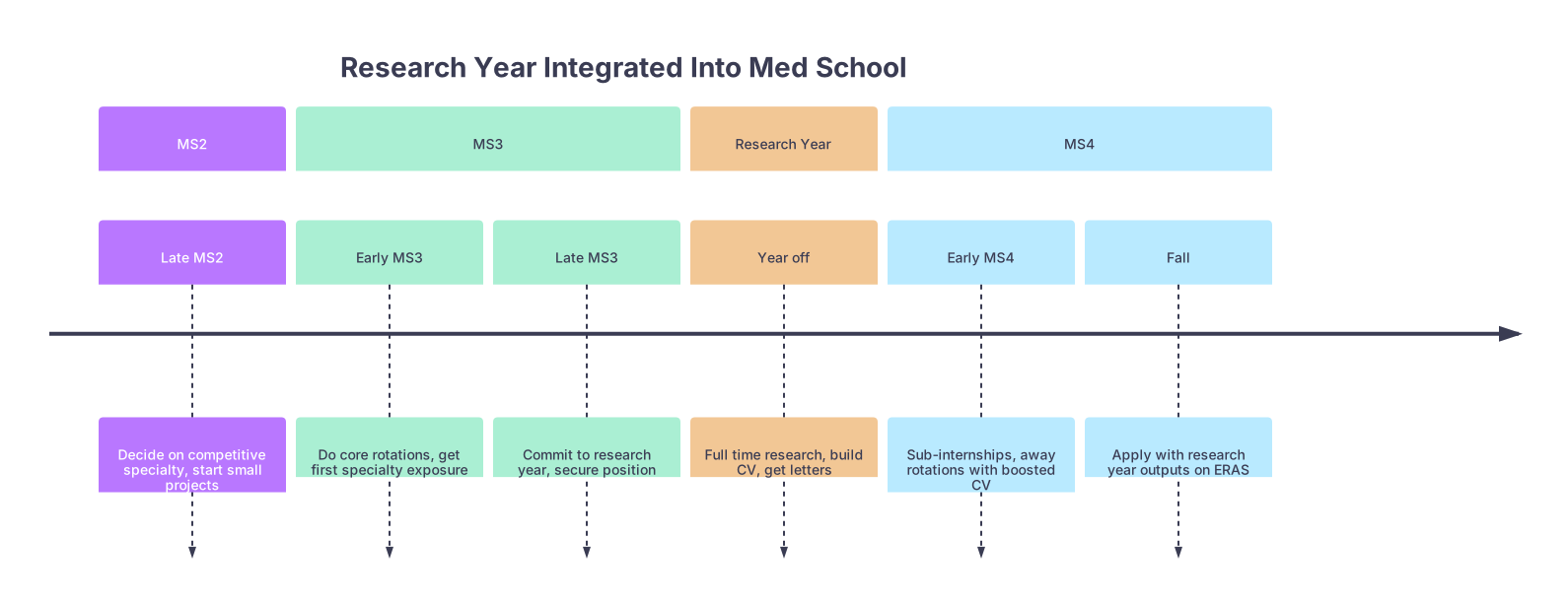
| Period | Event |
|---|---|
| MS2 - Late MS2 | Decide on competitive specialty, start small projects |
| MS3 - Early MS3 | Do core rotations, get first specialty exposure |
| MS3 - Late MS3 | Commit to research year, secure position |
| Research Year - Year off | Full time research, build CV, get letters |
| MS4 - Early MS4 | Sub-internships, away rotations with boosted CV |
| MS4 - Fall | Apply with research year outputs on ERAS |
If you’re already in MS4 about to apply and wondering if you should delay applying to do a research year first, that’s a different calculation: high risk, high reward, especially if your app is currently non-competitive.
Red Flags: When a Research Year Is Probably a Bad Idea
Here’s where I’d usually say “Do not do it” or “You’re solving the wrong problem.”
- Your main issue is professionalism, failed courses, or scary MSPE comments
- You’re applying to a non-competitive or moderately competitive specialty
- Your Step 2 is far below the typical cutoff for your target specialty
- You don’t care about academics at all and just want a clinical job somewhere
- You can’t secure a spot with a clear mentor and defined projects
Also: if you’re only considering a research year because your classmates are panicking in group chats, step back. Herd anxiety is real. That doesn’t mean it’s rational.
Sometimes the right move isn’t a research year—it’s tightening your step prep, doing stellar sub-internships, and applying broadly and strategically.
Money, Time, and Burnout: The Real Costs
You’re trading:
- One year of attending life later
- One lost PGY-level salary (or more, if you’d otherwise graduate earlier)
- Another year of interest accumulation on your loans
- Another year of living like a student
If you’re already on the edge financially or mentally, a research year can push you over. I’ve seen students crawl into residency absolutely drained because they did a brutal pre-residency research year plus away rotations plus Step 2.
On the flip side: if that year moves you from “probably not matching derm/ENT/ortho” to “matched at a good program,” the lifetime career impact dwarfs the one-year delay.
You have to run your math, not some generic “1 year = X dollars lost” calculation.
How To Make a Research Year Actually Worth It (If You Do It)
If you commit, you cannot drift. Treat it like a job with measurable outcomes.
Concrete moves:
- Before starting: Have 2–3 projects defined with realistic timelines
- First 2–3 months: Push to your first abstract submission
- Mid-year: Aim for at least 1 manuscript in drafting or submission
- Throughout: Be present—departmental conferences, clinics, OR, social events
- End of year: Secure 2–3 letters, make sure they know your actual story and growth
Do not disappear into a lab and emerge as “Person who did some research.” You want to emerge as “Oh yeah, that’s Sam, worked with Dr. X on Y projects, great team player.”
FAQ: Research Year for a Competitive Specialty
1. Will a research year guarantee I match a competitive specialty?
No. It increases your odds if your deficiency is academic/research-related, but it does not override terrible scores, professionalism issues, or terrible interviewing. Think “boost,” not “guarantee.”
2. How many publications should I aim for during a research year?
Aim for outputs, not magic numbers. A strong year typically yields 3–6 abstracts/posters and 1–3 manuscripts (submitted or accepted). Quality and specialty relevance beat raw count, but in derm, plastics, and neurosurgery, volume still matters.
3. Is a research year worth it if I’m already at a top med school?
Maybe. If you’re aiming for hyper-elite programs in derm, plastics, neurosurgery, or ENT and your research is currently thin, yes, it can separate you from your equally high-achieving peers. If your app is already strong, it may be marginal benefit.
4. I’m a DO/IMG trying for a very competitive specialty. Do I basically need a research year?
Not universally, but in practice, for derm, plastics, ENT, ortho, neurosurgery, and rad onc, a well-structured research year at a US academic center can be one of your few viable ways to break in. It has to be high-yield, mentored, and specialty-specific.
5. Is it better to do a research year at my home institution or a big-name outside program?
If your home institution has your specialty and strong mentors, staying can work well. If it doesn’t—or the specialty is weak—then going to a big-name program in that field can give you both name recognition and crucial connections. The mentor matters more than the logo.
6. What if I’m late to choosing a competitive specialty—should I delay graduation for research?
If you’re late and your current app is non-competitive (no research, no letters, no exposure), delaying for a tightly structured research year can be smarter than applying prematurely and not matching. But it’s a serious decision—talk through your entire CV with a specialty advisor before you pull that trigger.
7. How do I know if my potential research mentor is “good enough” to justify a year?
Ask pointed questions: How many prior students in this role matched into your specialty? Where? How many abstracts/manuscripts did they produce? Will you get to design/analyze/write, not just collect data? If the answers are vague or unimpressive, keep looking.
Open your CV right now and write down your target specialty, your Step 2 score, and your current research output. Then, find the NRMP charting outcomes for that specialty and compare yourself honestly. That gap—between where you are and where typical matched applicants are—will tell you whether a research year might be a strategic weapon or just an expensive detour.