The way you schedule your clerkships can quietly kill your shot at a competitive specialty.
Not your Step score. Not your letters. Your calendar.
I see this mistake every single cycle: great students who should match Derm, Ortho, ENT, plastics, Rad Onc, IR, Ortho, or competitive IM programs… quietly take themselves out of the running by sloppy timing. They do the right rotations. Just at the wrong time. And timing, for competitive matches, is not a detail. It is strategy.
Let me walk you through the ways smart people sabotage themselves and how you are going to avoid joining them.
The Core Problem: You Are Planning For Graduation, Not For Match
Most students build their schedule around:
- Fulfilling graduation requirements
- Spreading out hard rotations
- Avoiding burnout
- Vacation, weddings, life events
That is the wrong optimization problem if you want a competitive specialty.
You must plan around:
- When programs expect you to have strong letters
- When you need audition rotations done
- When your home specialty sees you and can advocate
- When ERAS opens and MSPEs are written
I have watched a future orthopedic surgeon schedule:
- Ortho elective: February MS4
- Away rotations: April and May MS4
Objectively strong applicant. High Step 2, research, nice personality. But by the time any of that was visible to programs, rank lists were already submitted months earlier. His best work existed in a vacuum.
Here is the framing you need:
Your most important rotations for a competitive specialty must be front‑loaded into late MS3 and early MS4. If they happen after September of MS4, they barely count for the year you are applying.
Deadly Timing Mistake #1: Doing Your First Specialty Rotation Too Late
This is the biggest, most consistent self‑inflicted wound I see.
You decide you are “probably” interested in ENT. You do general surgery MS3 in January, then IM, then Psych, then Peds. ENT elective? You schedule it for December of MS4 because that is when there was an opening.
Translation:
You are asking programs to rank you for ENT before any ENT faculty has actually watched you work.
Competitive specialties expect:
- A home rotation in the specialty by early MS4 at the latest
- Often late MS3 / early MS4 for serious consideration
- Strong letters uploaded early in the ERAS cycle
If your first exposure is late:
- You look undecided or “late to the party”
- You have no realistic way to get strong letters in time
- You miss the early away rotation window for “auditions”
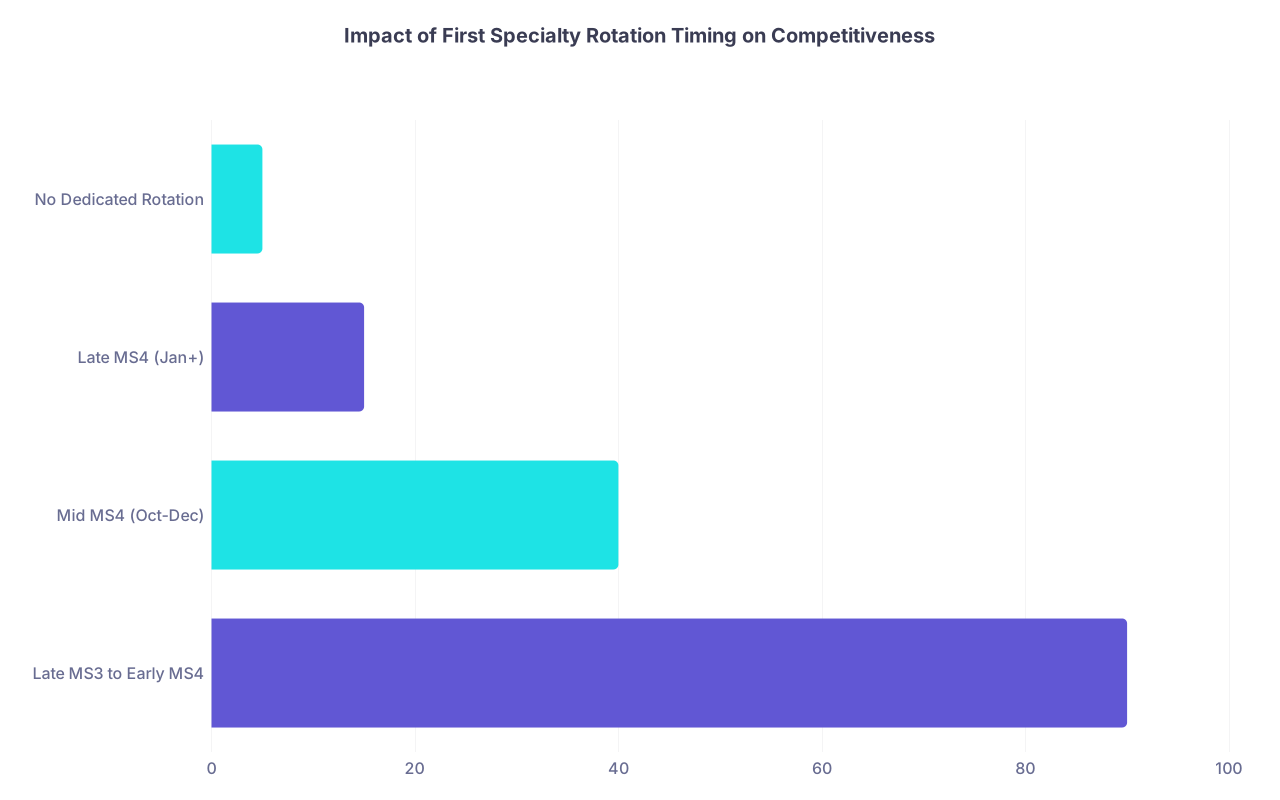
| Category | Value |
|---|---|
| Late MS3 to Early MS4 | 90 |
| Mid MS4 (Oct-Dec) | 40 |
| Late MS4 (Jan+) | 15 |
| No Dedicated Rotation | 5 |
The numbers above are not from an official study; they reflect what I have seen across cycles: your realistic competitiveness falls off a cliff if your first real specialty rotation is after September of MS4.
Avoid this mistake by:
- Targeting your first serious elective in the specialty for March–July of MS3/MS4 transition (depending on your school calendar)
- If you are even mildly considering a competitive field, schedule it earlier, not later
- Accept that you might “waste” an elective if you change your mind; that is still better than discovering your passion in November of MS4 with no way to pivot
If you are thinking: “But our school only lets us do that elective in late MS4,” then you need to hear the hard truth—your school’s structure is already a disadvantage, and you must compensate with earlier exposure, shadowing, or summer rotations where possible.
Deadly Timing Mistake #2: Back‑Loading Away Rotations
Away rotations (audition rotations, sub‑Is, externships—different words, same problem) are currency in competitive matches. They are where:
- You prove you can function in that environment
- You get letters from nationally known faculty
- You become a real person to a program, not just an ERAS PDF
The fatal move is doing your away rotations in October, November, or later.
Here is what actually happens with late away rotations:
- Program has already screened applications
- Interview invites are largely sent by October/November
- Rank list impressions are formed more from early rotators
- PDs are less motivated to build a fresh impression in January

For Derm, Ortho, ENT, Plastics, Neurosurgery, IR, Rad Onc, Urology, even top IM programs:
- Best away months: July, August, September
- Borderline: June, October
- Too late for meaningful impact: November onward (for that same application cycle)
I have seen students do an amazing November away, have the PD say “If we had seen you in August, you would be high on our list.” That is not a compliment. That is a post‑mortem.
Avoid this mistake by:
- Applying for away rotations early (VSLO / VSAS opens in spring; you should be ready)
- Prioritizing July–September for your main audition sites
- Using October as overflow only if you already have strong home letters and earlier away performance
- Not spacing your aways so far apart that you lose momentum; 2–3 clustered in July–September is normal in competitive fields
And do not kid yourself: an away in January is a great networking experience for a future fellowship, not for your current match.
Deadly Timing Mistake #3: Weak Timing of Step 2 Relative to Key Rotations
Another silent killer: poor alignment of Step 2 with your rotation calendar.
Programs in competitive specialties care about Step 2 timing for three reasons:
- They want the score before interview offers
- They use it as the main scored metric again now that Step 1 is pass/fail
- They need data in time for MSPE and departmental letters
Here is how students sabotage themselves:
- Taking Step 2 late August or September, then:
- Score is not back when ERAS opens
- Letters already written without your improved standardized test story
- Programs assume the worst if they do not see a score
- Taking Step 2 right before a critical audition rotation, showing up exhausted and underprepared for clinical performance
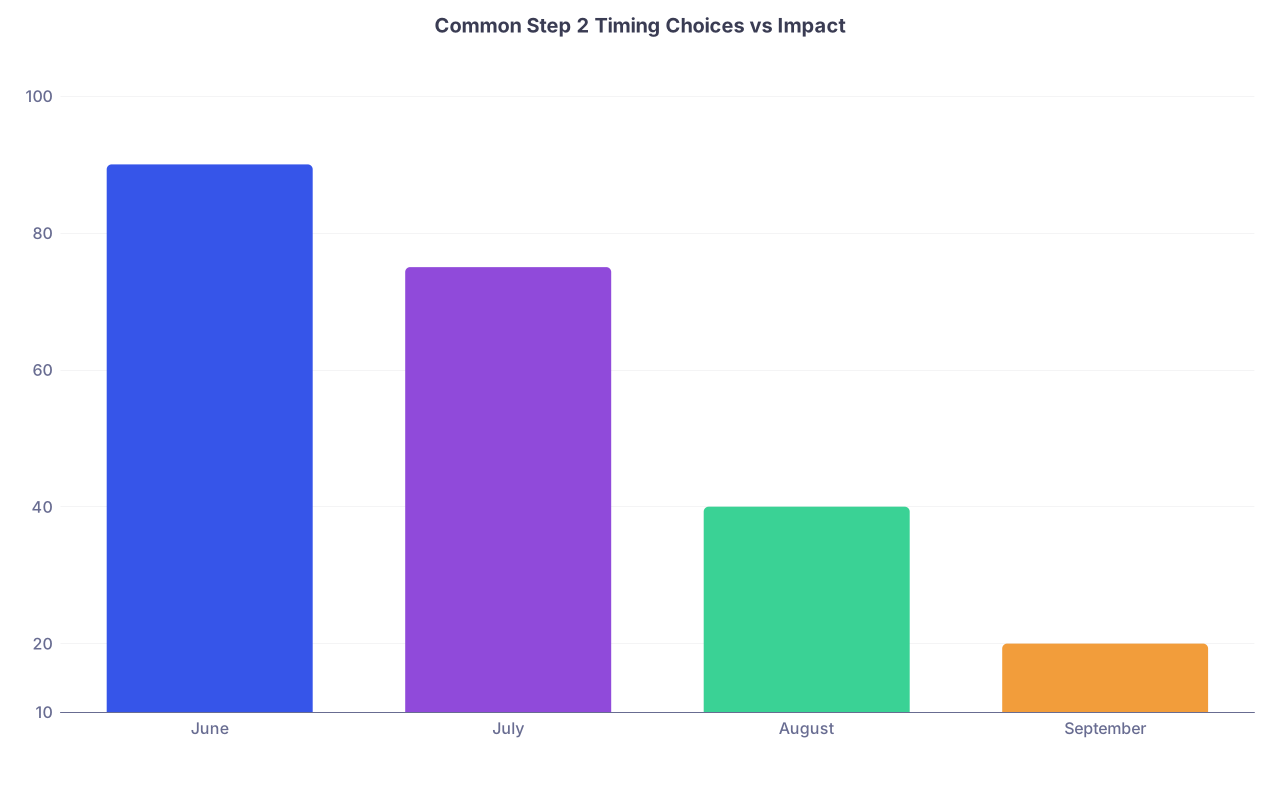
| Category | Value |
|---|---|
| June | 90 |
| July | 75 |
| August | 40 |
| September | 20 |
Again, these values reflect practical impact I have seen, not an official guideline. June is ideal for many students aiming competitive; by September, you are at the mercy of timing.
Avoid this mistake by:
- Planning to take Step 2 no later than mid‑July if you are aiming high‑stakes specialties and need the score to offset a pass/fail Step 1 or a mediocre Step 1
- Avoid scheduling your hardest or most important rotation immediately after Step 2—give yourself 1 week for mental reset if possible
- Coordinating with your specialty advisor: some IM or less timeline‑sensitive specialties can tolerate a later Step 2, but Derm/Ortho/ENT/Plastics often cannot
If your school forces a late testing window, you must compensate with even stronger early clinical performance and home letters. No one will adjust their interview calendar for your institutional quirk.
Deadly Timing Mistake #4: No Early Exposure, So Your Story Looks Fake
Programs in competitive specialties are constantly screening for one thing: authenticity. Are you truly interested in their field, or did you just chase prestige?
When your clerkship timing looks like this:
- No early elective in the field
- Suddenly three back‑to‑back aways in that specialty at the start of MS4
- No prior research or shadowing until after Step 1
You look reactionary. Like you woke up after your Step score and decided “I should do Ortho because I can,” rather than “I have been building toward this.”

The mistake is not just about optics. Late conversion means:
- You had no time to build meaningful mentorship
- No sustained research narrative
- Your letters are based on a tiny sample of time
Avoid this mistake by:
- Doing some level of early shadowing or short elective in MS2 or early MS3 in any field you think might be competitive
- Getting plugged into specialty‑specific interest groups and research early, even if your decision is not final
- Using a single early rotation to either confirm or eliminate a specialty, instead of drifting until MS4
You do not need to know with absolute certainty as an MS2. But your calendar needs to show that you at least took the possibility seriously before the ERAS deadline.
Deadly Timing Mistake #5: Ignoring How MSPE and Departmental Letters Are Written
Most students completely misunderstand when the important evaluations are locked in.
Two critical documents:
- MSPE (Dean’s Letter) – compiled and finalized early fall
- Departmental / Chair’s letter – often based heavily on specific early rotations and faculty consensus meetings held summer or early fall
If your best performance is:
- On a sub‑I in November
- On an away in January
- On a home elective in February
Those glowing comments might never make it into the MSPE or departmental letter that all programs are reading.
I have sat in departmental meetings:
- Faculty ask, “Who worked with this student?”
- Only rotations finished by August / early September are discussed
- Students with late strong rotations are basically invisible in that room
Avoid this mistake by:
- Stacking your strongest effort rotations in the window that feeds into MSPE and departmental letters: usually May–August before ERAS opens
- Making sure your home specialty sees you before they sit down to rank students for letters
- Communicating clearly with your clerkship directors that you are aiming for their field so they know what is at stake
Do not assume that stellar performance “later” will retroactively fix early mediocrity in the eyes of a residency selection committee. It usually does not.
Deadly Timing Mistake #6: Wasting Prime Months on Non‑Strategic Rotations
You cannot treat every month as equal. July–September of the application year are prime real estate.
I routinely see schedules like this for a student planning on Derm:
- July: required EM
- August: global health elective
- September: vacation / Step 2 study
- October: home Derm
- November: first Derm away
They did everything they wanted. They did almost nothing their future programs cared about in time.
| Month Window | Best Use (Competitive) | Common Misuse |
|---|---|---|
| May–June (pre‑ERAS) | Home specialty, Sub‑I, Step 2 | Random elective, light clinic |
| July–September | Aways, home specialty, Sub‑I | Vacation, non‑core elective |
| October–December | Back‑up aways, lighter rotations | First exposure to specialty |
Avoid this mistake by:
- Using July–September for:
- Home sub‑I in target specialty
- Key away rotations
- High‑impact IM sub‑I if you are IM‑bound
- Pushing less critical electives (global health, niche subspecialties, “fun” rotations) to later MS4, once interview invites are already out
- Not burying required but lower‑yield rotations in that prime window if your school allows flexibility
You have very few months that genuinely move your application. Protect them.
Deadly Timing Mistake #7: Overloading Yourself During the Most Visible Months
On the flip side, there is a different category of disaster: doing too much in the visible months and underperforming when eyes are on you.
The classic pattern:
- July: first away in Ortho
- Also studying intensively for a late July Step 2
- Also trying to finish a manuscript deadline
- Also moving between cities every weekend
End result: you are exhausted, distracted, and average. And “average” on an away rotation in Ortho, ENT, Derm, etc., is a quiet rejection.

| Step | Description |
|---|---|
| Step 1 | Ambitious Plan |
| Step 2 | Step 2 in July |
| Step 3 | Away Rotation July |
| Step 4 | Research Deadline |
| Step 5 | Burnout |
| Step 6 | Average Evaluations |
| Step 7 | Weak Letters |
You do not get bonus points for suffering. Programs reward excellent, consistent performance. Overcommitting your visible months is a strategic mistake.
Avoid this mistake by:
- Giving yourself mental bandwidth on key rotations—no major exam in the same window whenever possible
- Not stacking three aways back‑to‑back‑to‑back unless you are very confident about stamina and support
- Accepting that a slightly less aggressive schedule that lets you perform at your best will beat a hero schedule that leaves you mediocre everywhere
Think like an athlete peaking for competition. You want to hit your best form when you are in front of the decision‑makers, not three months earlier or later.
How To Build a “Match‑Savvy” Clerkship Timeline
Let us put this together in a more concrete way. Assume a traditional schedule where ERAS opens September of MS4.
Here is one example structure for a student aiming at a competitive surgical specialty (Ortho/ENT/Plastics/Neurosurg). Adjust for your school, but do not ignore the sequence.
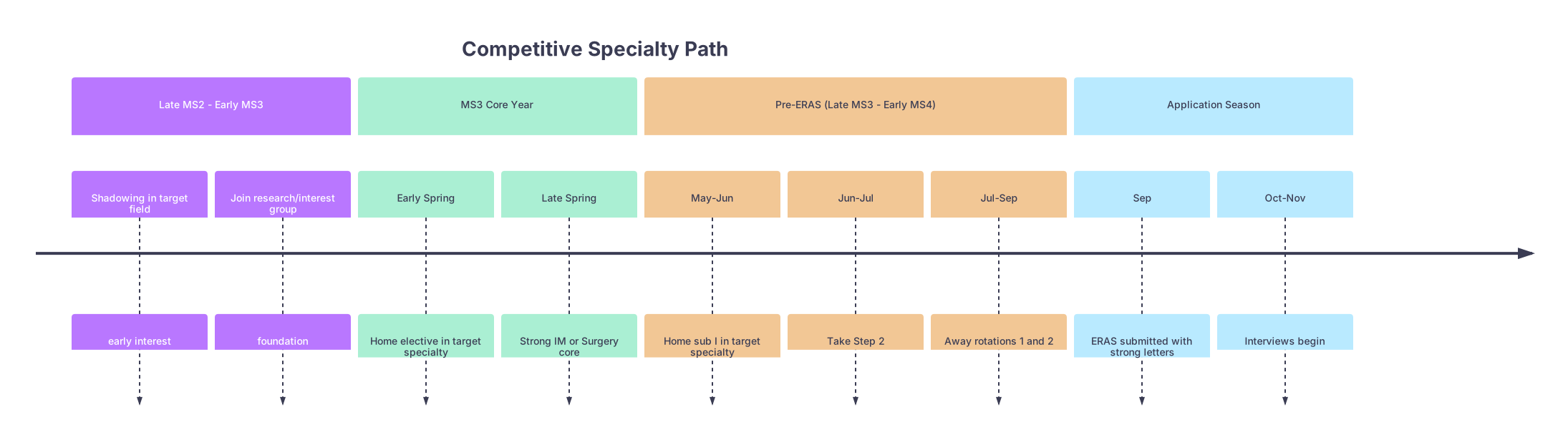
| Period | Event |
|---|---|
| Late MS2 - Early MS3 - Shadowing in target field | early interest |
| Late MS2 - Early MS3 - Join research/interest group | foundation |
| MS3 Core Year - Early Spring | Home elective in target specialty |
| MS3 Core Year - Late Spring | Strong IM or Surgery core |
| Pre-ERAS (Late MS3 - Early MS4) - May-Jun | Home sub I in target specialty |
| Pre-ERAS (Late MS3 - Early MS4) - Jun-Jul | Take Step 2 |
| Pre-ERAS (Late MS3 - Early MS4) - Jul-Sep | Away rotations 1 and 2 |
| Application Season - Sep | ERAS submitted with strong letters |
| Application Season - Oct-Nov | Interviews begin |
Key concepts embedded in that timeline:
- Early exposure (shadowing, early elective) so your interest is believable
- Home rotation before ERAS so your department can vouch for you
- Step 2 timed so your score is visible when PDs are screening
- Aways in July–September rather than November–January
For competitive IM, Cards‑focused, or high‑end academic programs, you follow the same logic:
- Early exposure to IM
- Early sub‑I at your home academic center
- Step 2 visible by ERAS
- Consider an away at a dream academic center in July/August if your school supports it
Who You Need To Involve Early (And When)
Trying to design this alone is another avoidable mistake. You have three categories of people you must pull into your timing decisions before things are locked in:
Specialty Advisor (in your target field)
- Ideal: meet in late MS2 or early MS3
- Ask directly: “For someone at my school, which months matter most for your specialty?”
- Show them a draft schedule and let them tear it apart
Dean’s Office / Registrar
- Know your school’s hard constraints early (which rotations must be done when)
- Clarify how your school writes MSPE and how they weigh late rotations
Recent Grads Who Matched Your Target Specialty
- They will tell you where the brochure‑advice and the real world diverge
- Ask which months they regret, which they would rearrange

If you are reading this as an MS3 and your schedule is already mostly fixed: do not panic. You will not have a perfect calendar. Nobody does. But you can still optimize:
- Move at least one high‑impact rotation into the May–September window
- Reorder electives so your field sees you earlier
- Time Step 2 intelligently around your most visible months
Quick Red‑Flag Checklist
You should be worried about your timing if any of the following are true:
- Your first real rotation in your target specialty is scheduled after October of MS4
- Your home sub‑I in the specialty is after ERAS submission
- Your planned away rotations are in October–January only
- Step 2 is currently scheduled for late August or September, with no earlier score on file
- The rotation that will generate your departmental letter happens after the letter is usually written
- Your July–September months are used primarily for vacation or low‑stakes electives
If you checked more than one, you need a scheduling intervention. Now, not six months from now.
FAQ (Exactly 3 Questions)
1. Is it ever safe to decide on a competitive specialty late (e.g., mid‑MS3) and still match?
Yes, but only if you are ruthless about timing once you decide. That means:
- Immediate early exposure rotation in that field
- Front‑loaded home sub‑I and at least one early away
- Step 2 timed so your strong score is visible by ERAS
Students who “decide late” and then also schedule late are the ones who get burned. Deciding in April of MS3 is survivable. Deciding in November of MS4 is basically unrecoverable for that year’s match.
2. I cannot get a July–August away rotation in my top specialty. Am I doomed?
No, but you cannot ignore the problem. If your aways are pushed to September/October:
- Make your home rotation as strong and early as possible
- Get an outstanding departmental letter before leaving for aways
- Consider one early away at a less famous but still solid program that had July/August availability
You do not need all your aways in July/August, but you need at least some strong performance visible early.
3. My school requires certain cores during prime months (July–September). How do I compete?
You adjust, not surrender:
- Make those required rotations your best work, because they will feed your MSPE
- Shift your home specialty sub‑I and main away to the earliest possible months that your school allows (even if that is May/June or October)
- Communicate your constraints to programs in your personal statement and during interviews when appropriate
Programs know schools differ. What they will not excuse is poor planning within your constraints.
Core Takeaways
- Your calendar is a weapon or a liability; for competitive specialties, timing is strategy, not logistics.
- The months that matter most are those before ERAS and before letters are written—load them with the rotations and exams that showcase you at your best.
- Late excellence does not rescue early invisibility; front‑load your specialty exposure, aways, and key letters, or you will quietly take yourself out of the match you actually want.