
Last fall, a fourth-year from a solid state school sat in my office after bombing a sub‑I at a top-tier orthopedics program. He whispered the question everyone is afraid to say out loud: “Do they just automatically rank their own people higher than us?”
Let me tell you exactly how that conversation goes behind closed doors when the PD sits down with the ranking spreadsheet. Home students vs visiting students. Who gets the benefit of the doubt, who gets cut first, and what “fair” really looks like in competitive fields like ortho, derm, plastics, ENT, neurosurgery, and IR.
The Default Bias: Why Home Students Start Ahead
Here’s the uncomfortable truth: at almost every competitive program, the default setting is “home first, visiting second.”
Not because home students are always better. Because they’re safer.
From the PD chair, a home student isn’t just an applicant. They’re a four-year known quantity. Faculty know their baseline personality. Nurses have already complained (or not complained) about them. Residents know if they melt at 2 a.m. or shrug and write 10 more notes.
A visiting student? You’re a 4-week snapshot under artificial conditions. Best behavior. Max effort. Hard to judge how that ages over 5 years.
So yes, there’s a built-in tilt. I’ve sat in rooms where the PD opens rank meeting with:
“First let’s make sure we’re taking care of our own.”
That sentence alone tells you the hierarchy.
What “taking care of our own” really means
It usually plays out like this in competitive specialties:
- If a home student is clearly excellent → huge push to keep them.
- If a home student is average but not toxic → serious consideration, sometimes ranked higher than stronger visiting students.
- If a home student is actively problematic → then, and only then, do they get cut loose. But it takes a lot.
I’ve seen a mediocre home derm applicant with okay Step 2, limited research, and an “introverted but fine” personality get ranked well above visiting rotators who were objectively more polished and productive. Why?
“Because we know she’ll be low maintenance and she fits here.”
That’s the phrase you’re competing with: “We know them.”
How PDs Actually Score Home vs Visiting Students
Forget what they say on panels. In reality, PDs mentally run two different scoring systems.
The home student rubric
For home students, competitive programs are looking at a multiyear picture:
Longitudinal behavior
- “How were they as an MS2 on consults?”
- “Did they grow across clerkships or flatline?”
- “Did they turn it on only when they needed a letter?”
Pattern of feedback
Attendings remember the trend, not the exact comments:- Always prepared
- Solid but quiet
- Great with patients but disorganized
- Draining to work with
Internal politics (yes, that matters)
- Which faculty are backing this person? Heavy-hitter vs lukewarm junior?
- Did the chair explicitly say, “We should keep this one”? That’s almost a cheat code.
Historical comparisons
PDs literally say things like: “She’s not as strong as the last 3 residents we’ve taken from our own med school, but better than that guy we regretted.”
Home students get compared to previous residents, not just this year’s pool.
The visiting student rubric
Visiting students, especially in ortho/derm/plastics/ENT/NSGY/IR, are graded on a much harsher, short-term standard:
Immediate impact on the team
- Did residents like working with you?
- Did you make their lives easier or add work?
- Did you plug in quickly or need to be hand-held?
Performance under pressure — on a timer
- First 3 days matter more than days 20–28.
I’ve seen residents decide by day 2: “Rank or no rank.”
- First 3 days matter more than days 20–28.
Likeability and fit
Nobody says this out loud on brochures, but inside ranking meetings:- “Would I want to sit next to them for 14 hours in the OR?”
- “Can I see them on trauma call with me at 3 a.m.?”
Signal strength
- Did you rotate there because it’s truly top choice or just “one of 8 aways”?
- How clearly did you communicate interest to the PD and residents?
Visiting students are graded more like one high-stakes audition. Home students are graded like a career trajectory.
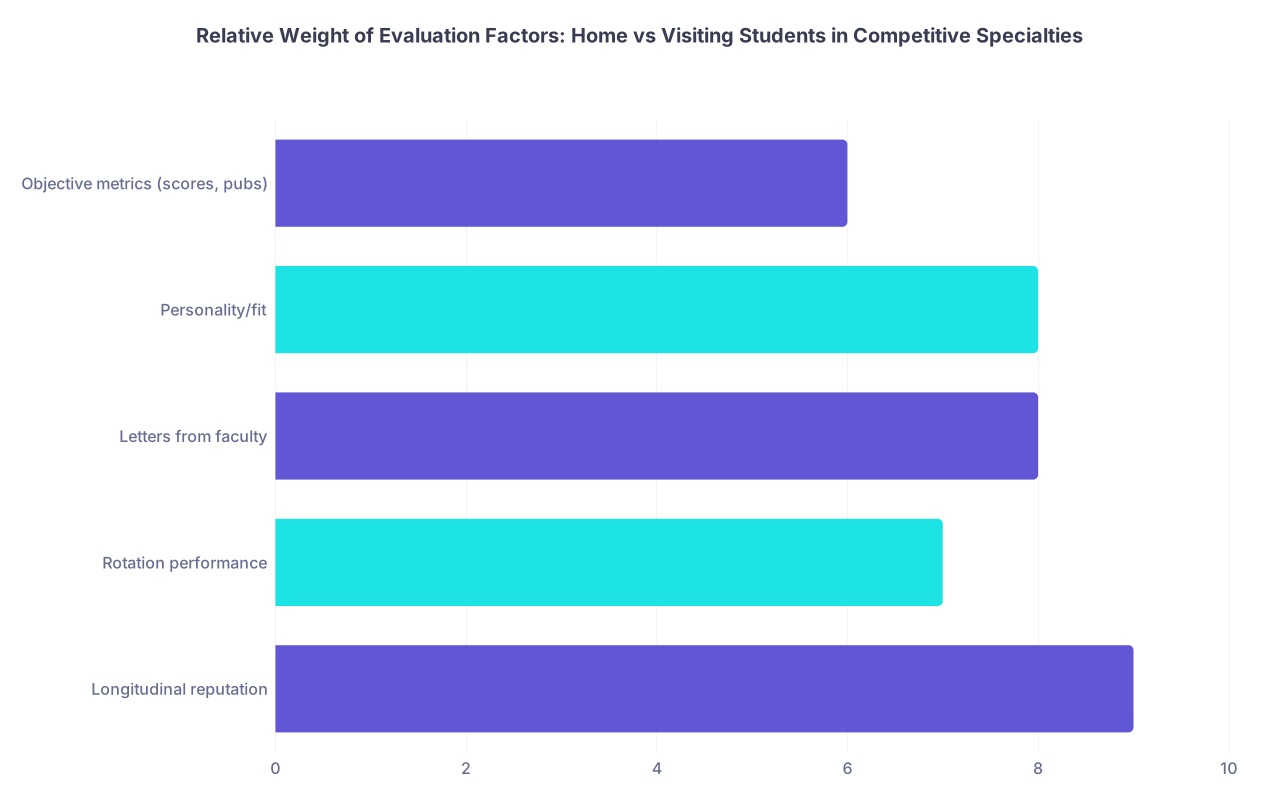
| Category | Value |
|---|---|
| Longitudinal reputation | 9 |
| Rotation performance | 7 |
| Letters from faculty | 8 |
| Personality/fit | 8 |
| Objective metrics (scores, pubs) | 6 |
If I had to crudely score the difference:
- For a home student:
Longitudinal reputation can outweigh a slightly weak rotation. - For a visiting student:
That one rotation is 70–80% of the decision.
On Rotation: How Residents Talk About You
You want the unfiltered part? The people who decide your fate first aren’t the PDs. It’s the residents and fellows you’re paired with.
In ortho:
- “He hustles, but he’s kind of a gunner”
- “She’s slow in clinic but awesome with patients”
- “He disappears when there’s scut”
Those phrases become the entire narrative when the PD says, “So what did you all think of our rotators?”
Here’s the hierarchy of who gets listened to:
- Senior residents (PGY3–5 in surgical fields)
Their word is basically law. If chiefs say “hard no,” your file often dies right there. - Fellows (for IR, spine, hand, onc)
Strong influence when you rotated on their service. - Interns? Mixed. Some PDs heavily discount their opinions, others don’t.
For home students, residents will say things like:
- “Yeah, they’ve gotten much better since third year.”
- “They had a rough start but they’ve really improved.”
That context softens shortcomings.
For visiting students, there’s no “arc” to your story. Just:
- “Crushed the rotation”
- “Fine, but nothing special”
- “No way.”
You don’t want that last one. Ever.
Letters: Home vs Away Letters, How PDs Read Them
Program directors don’t read letters like you think they do. They skim for a few key signals.
Home student letters
For home students in competitive fields, PDs are reading “between the lines” of letters they know are politically constrained.
They know:
- Certain attendings never write negative letters.
- Chairs almost always sound glowing.
- Internal letters may be inflated to “protect” the student.
So they calibrate:
- “Dr. X calling someone ‘one of the best students we’ve ever had’ actually means something.”
- “Dr. Y saying ‘strong’ is basically a C+.”
For home letters, they’re looking for:
- How many heavy-hitter faculty are willing to go to bat.
- Whether anyone quietly chose not to write for you.
Visiting student letters
Visiting letters are a different beast. In competitive specialties, PDs are looking for:
- Are you in the top tier of all rotators they’ve seen?
“Top 10%” from a place that hosts 30 rotators a year is a huge statement. - Do they explicitly say “I would rank this applicant to match in our program”?
The harsh part: a neutral or generic letter from an away rotation almost hurts you. The unspoken question in a ranking meeting is: “If they were good, why didn’t they go stronger in this letter?”
And yes, we absolutely interpret silence as negative. If you rotated at a place and no one wrote for you, every PD in your specialty knows what that means.
Ranking Meetings: Who Beats Whom in a Close Call?
Here’s the scenario that actually matters to you:
You’re a visiting student who did well. There’s also a home student who did “fine.” Who gets ranked higher?
Let’s take a concrete example I’ve seen in ENT and ortho:
Home student:
- Step 2: 246
- 1–2 middle-author papers with department
- Generally liked, not a superstar
- Solid rotation but not dazzling
Visiting student:
- Step 2: 255
- 4–5 publications, some in good journals
- Excellent rotation, strong resident feedback
- Clear interest in program
You’d think the visiting student wins. Often they don’t.
The conversation sounds like:
- “Our home student will be a solid, dependable resident.”
- “The visiting student was great, but we’ve only seen them for 4 weeks. Harder to know how they’ll be long term.”
In close calls, I’d say in competitive fields:
- 60–70% of the time, the tie goes to the home student.
- 30–40% of the time, the superstar visiting rotator leaps over weaker home applicants.
When does a visiting student actually beat a home student? When your performance is so clearly superior that residents go out of their way to argue for you.
I’ve seen it in:
- Ortho: visiting student scrubbed into everything, pre-rounded without being asked, connected with everyone, and then crushed interview day.
- Derm: visiting student with serious research pedigree, outstanding fund of knowledge, and universally loved.
In those cases, residents themselves will say: “We’d rather work with her for 5 years than our own guy.”
That’s what you’re aiming for: make residents choose you over a safe home option.
The Unspoken Risk Calculus: Retention, Attrition, and Drama
PDs in competitive specialties are always thinking about risk. These fields are high-intensity, low-tolerance for drama.
Here’s the quiet math they’re doing:
Home student:
- Already knows the culture and pace.
- Less likely to be shocked by workload.
- Less risk of quitting, failing boards, or blowing up a service dynamic.
Visiting student:
- Unknown long-term stress response.
- Could be overselling interest (especially if they did multiple aways).
- May not actually be happy once the “audition” act is over.
Competitive specialties are brutal when it comes to downstream consequences of a bad resident:
- Failing boards in neurosurgery or ortho is a major problem.
- Personality disasters in plastics or ENT can poison a small department.
Who looks safer on paper? Often the home student.
That’s why if a visiting student seems even slightly higher risk personality-wise—too intense, too gossipy, too abrasive—it’s a quick no, even if their numbers are stellar.
Field-Specific Nuances: Ortho vs Derm vs Plastics vs ENT
Not all competitive fields weigh home vs visiting students the same way.
| Specialty | Typical Home Student Advantage | Value of Away Rotation |
|---|---|---|
| Ortho | High | Very high |
| Derm | Very high | Moderate–high |
| Plastics | Very high | Very high |
| ENT | High | High |
| Neurosurg | Extreme | High |
Orthopedics
Ortho PDs live and die by resident culture. They’re blunt:
- “No jerks.”
- “No lazy people.”
- “No one who can’t grind.”
They love home students who have already proven they can survive that program’s lifestyle. But ortho also leans heavily on aways. A spectacular away can absolutely overcome a mediocre home student.
Key ortho truth:
Your resident advocates matter more than one glowing faculty letter.
Dermatology
Derm is small, political, tightly networked. Home students have a huge edge:
- Long-term research with the department
- Chair letters carry real weight
- People know you personally
A visiting rotator in derm has to be nearly flawless to displace a home student:
- Strong research (ideally derm-specific)
- Appear genuinely passionate, not chasing lifestyle alone
- Fit with the team’s culture
Derm PDs are very suspicious of “act-on-rotation” behavior. They trust what their own people say about you over what they see in one month.
Plastic Surgery
Integrated plastics? Home students are almost royalty if they’re decent.
Programs are tiny, call is intense, and you’re pretty much working with the same ≤10 people for 6 years. A known entity is safer than a brilliant unknown.
But plastics is also heavily network-driven. A visiting student with:
- Serious national-level research
- A heavy-hitter letter from a giant in the field
- Incredible operative presence on their away
can absolutely jump the line.
ENT
ENT blends the culture focus of ortho with the network flavor of derm.
Home students:
- Get a long look.
- Benefit from sponsors: that one senior faculty who says, “We’re keeping her.”
Visiting students:
- Need the residents to fall in love with them.
- A single negative comment from senior residents can sink you.
How You Should Play It (Home vs Visiting)
You cannot change the bias. You can only exploit it or work around it.
If you are a home student in a competitive field
Your job is to avoid giving them reasons to override the home bias.
Don’t coast. PDs can smell the “I’m safe here” attitude from a mile away. That’s how you get quietly downgraded.
Build early relationships. You should not be meeting the PD for the first time on your sub‑I.
Shadow, do research, show up for conferences by MS2/MS3.Make sure someone powerful is willing to say in meetings: “We should take them. They’ll be great here.”
That single sentence has carried more mediocre home students than you’d believe.
If you are a visiting student
You’re not competing on “fair.” You’re competing on undeniable.
Your goal is to make it emotionally difficult for the PD and residents to choose their home student over you.
How?
Day 1–3: over-prepare and over-communicate. Introduce yourself to residents and PD. Know common cases cold. Offer help before being asked.
Become a force multiplier for the team. You should make the service run smoother: pre-chart, follow up labs, help with dressings, track consults.
Residents should look at each other and say: “We’re going to miss them when they leave.”Signal interest without being desperate. PDs need to believe:
“If we rank them high, they’re likely to come here.”
Do not be vague about your interest level if this is a top-choice program.Leave a clean paper trail. You want:
- A strong away letter saying “rank to match.”
- Multiple residents ready to vouch for you by name.
- No small professionalism flags. Ever.

| Step | Description |
|---|---|
| Step 1 | Start Away Rotation |
| Step 2 | First 3 Days Performance |
| Step 3 | Resident Advocacy |
| Step 4 | Low Enthusiasm |
| Step 5 | Strong Letter Offer |
| Step 6 | Generic or No Letter |
| Step 7 | High Rank Consideration |
| Step 8 | Low or No Rank |
What PDs Won’t Tell You Publicly
There are a few things that no one will admit on a panel, but they absolutely drive decisions.
Some programs feel obligated to rank their home students in the top half of the list.
Unspoken politics: med schools don’t like their own students failing to match in-house year after year.If your home school is weak in a specialty, being a home student can actually hurt you at top programs.
PDs think: “Are they really that good, or just the best of a weak home cohort?”
This is especially true in derm and plastics.Programs sometimes “protect” home students by:
- Calling other PDs to quietly advocate for them.
- Saying, “We’re not taking them, but you should give them a serious look.”
A visiting student who ranks a program low and matches elsewhere? Staff remember.
And when your school sends the next wave of students, that history is in the room.
Quick Reality Check: What Actually Moves the Needle
Let’s cut through everything and be blunt.
As a home student, the levers that matter most:
- Long-term relationships with key faculty.
- Solid, consistent performance (no major disasters).
- One or two strong, well-known advocates.
As a visiting student, the levers that matter most:
- Immediate impact on residents’ perception.
- Stellar performance on a single rotation.
- Clear, believable commitment to the program.
- A strong away letter that’s actually specific and comparative.
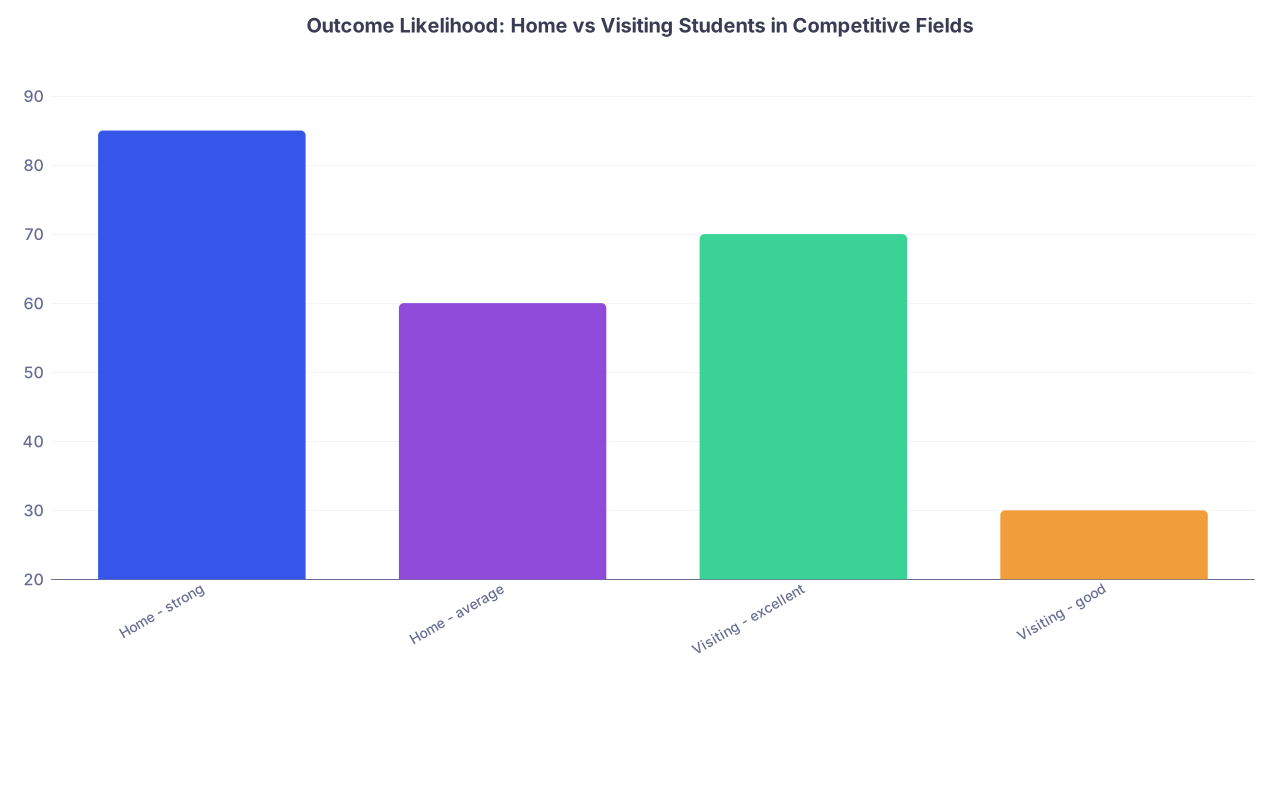
| Category | Value |
|---|---|
| Home - strong | 85 |
| Home - average | 60 |
| Visiting - excellent | 70 |
| Visiting - good | 30 |
Numbers here aren’t exact, but you get the point: being home and strong almost always wins. Being visiting and merely “good” often doesn’t.
FAQs
1. Can a visiting student realistically outrank all home students in a competitive specialty?
Yes, but it’s rare and requires near-flawless execution. The usual scenario: the home cohort is weak or small, and you show up as a visiting student who is clearly exceptional—top-tier performance on rotation, strong national-level research, outstanding interpersonal fit, and vocal resident support. When residents unanimously say, “If we could only take one person this year, it’s them,” the PD listens. You need that level of consensus to leapfrog all home students.
2. How many away rotations do I actually need in fields like ortho, derm, ENT, or plastics?
In most competitive surgical fields (ortho, ENT, plastics, neurosurg), two aways is the sweet spot; three is common; four starts looking like overkill unless you have a specific reason. In derm, one or two targeted aways at realistic programs you’d actually attend is typically enough. More aways do not fix a mediocre personality, poor team play, or weak home support. PDs would rather see a few excellent, well-chosen aways than a frantic shotgun approach.
3. If I’m a weak home student, should I try to “escape” by focusing on aways?
Maybe—but do not kid yourself. Your home department’s impression follows you. PDs in competitive specialties talk to each other. If you’re clearly underperforming at home and suddenly trying to reinvent yourself on aways, that disconnect gets noticed. The better move is to repair your local reputation as much as possible, secure at least one honest but supportive home letter, and then use aways to prove that your upward trajectory is real, not an act.
4. If I don’t get an interview at my home program, how badly does that hurt me elsewhere?
In ultra-competitive fields, it raises eyebrows. PDs absolutely look to see whether you interviewed at your home institution. If you didn’t, the silent question is, “Why didn’t their own place want them?” But it’s not automatically fatal. Strong away rotations, powerful external letters, and a plausible explanation (small department, limited spots, internal politics) can soften the blow. Still, expect to need stronger performance and clearer advocacy to offset that missing home stamp of approval.
Key points:
Home students start with a built-in edge because they’re known quantities; it takes real problems to override that bias. Visiting students aren’t judged “fairly” — they’re judged on whether they’re so good that residents and faculty are willing to choose them over a safe home option. Your job isn’t to complain about that system; it’s to understand it cold and then play your position with brutal clarity.