
It’s late January. You’re sitting in the call room between consults, scrolling through Reddit and GroupMe. Everyone’s posting their interview lists. One of your classmates – the one with the 230-something Step 1, mid-class rank, no huge-name research – just casually mentions they interviewed at a top 10 derm program and a “big-name” ortho place you did not even dare to email.
And you’re staring at your own numbers thinking: How the hell did they get that invite?
Let me tell you what actually happens behind those doors. Because what you see on spreadsheets and score cutoffs is only half the game. Sometimes less than half.
This is the insider version from what I’ve heard and seen in selection meetings, resident rooms, and the side comments attendings don’t put in emails.
The Lie You’ve Been Sold About “Competitiveness”
You’ve been trained to think like this:
High Step score + AOA + 12 pubs = top program.
Average numbers = “be realistic.”
That’s partially true for certain programs and completely wrong for others.
Here is the uncomfortable secret: in competitive specialties, especially at “top” places, once you clear a basic competence bar, numbers stop deciding things. Human relationships and risk management do.
Programs are not trying to build a spreadsheet of stats. They are trying to build a call schedule with people they trust will:
- Not implode on nights
- Not embarrass the program
- Make them look good at conferences and on social media
- Fit into the existing resident culture
- Be loyal enough to not burn them publicly if something goes wrong
Once you cross that “we are not worried you will fail boards” threshold, your score advantage collapses in value. A 250 vs a 230 matters way less than you think. I’ve watched PDs say, verbatim:
“Yeah, 250 is great, but no one here knows this person. We know [average applicant]. They’ll be fine.”
And just like that, the “average” person wins the spot.
What “Average” Actually Means To Faculty
Before you label yourself average, let’s straighten this out.
An “average” applicant in derm, ortho, plastics, ENT, neurosurgery isn’t the same as an average med student overall. The baseline for even applying is elevated. But inside selection rooms, people use “average” differently.
To faculty in competitive specialties:
- “Average” = no glaring red flags, nothing jaw-dropping.
- Competent clinical performance, decent letters, okay research, decent scores.
- Someone they can imagine taking call without waking the attending every night.
No one in a derm selection meeting is calling a 245 “strong.” They call that “fine.” The language is different.
So when I say “average applicant matches a top program,” I mean:
- Not AOA
- Not first author in NEJM
- Not 270+
- Not child of the department chair
But solid. Get-the-job-done solid.
That person absolutely can, and does, match at “elite” programs. Every single year.
The Hierarchy That Actually Decides Competitive Matches
Let’s pull back the curtain on how invites and ranks are really decided.
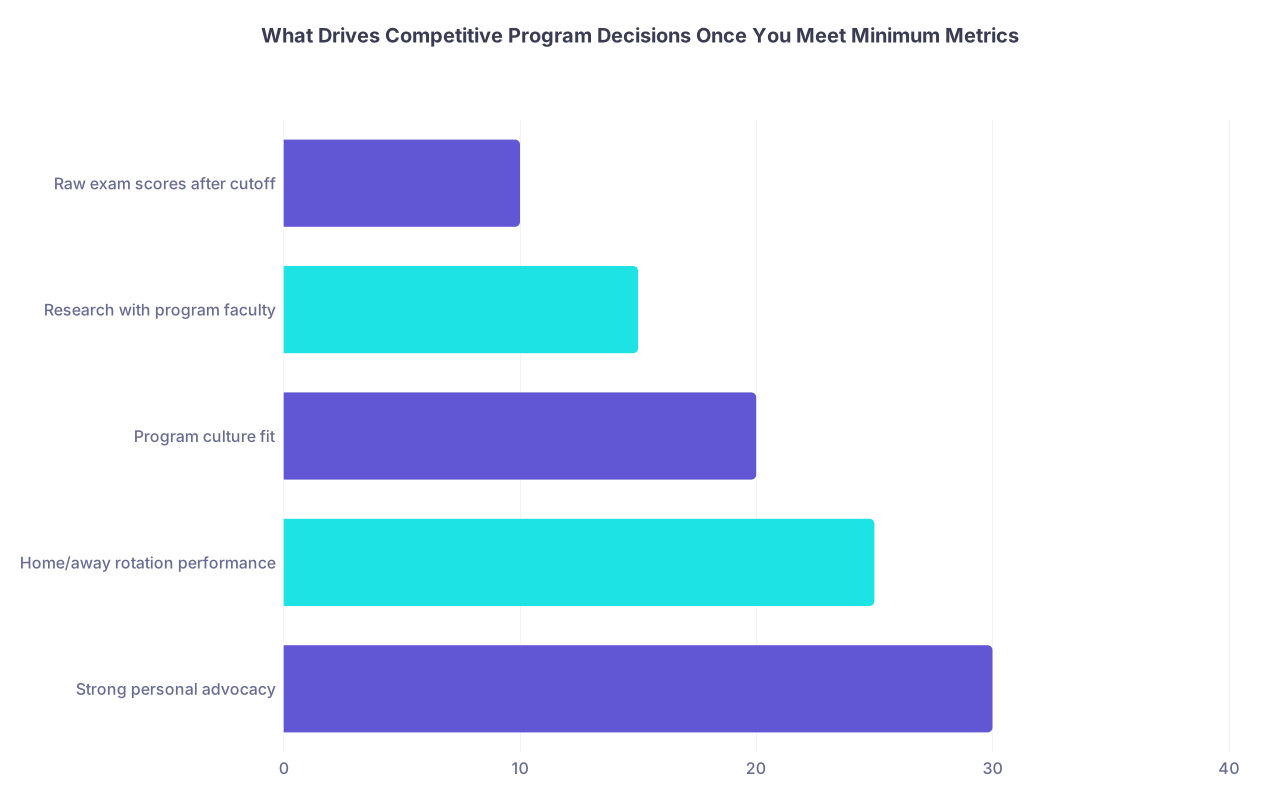
| Category | Value |
|---|---|
| Strong personal advocacy | 30 |
| Home/away rotation performance | 25 |
| Program culture fit | 20 |
| Research with program faculty | 15 |
| Raw exam scores after cutoff | 10 |
Here is the dirty ranking system nobody advertises:
- A real human advocate in the room
- How you performed on their turf (home or away rotation)
- Whether you “feel” like one of their people
- Whether you’re tied to their research machine
- Your numbers – only if you’re borderline or unknown
You are obsessing over #5. Faculty are primarily acting on #1–3.
Let’s walk through them.
1. The Single Most Powerful Weapon: An Advocate In The Room
In every rank meeting, there’s a moment where the spreadsheet goes quiet and the room looks at one person.
“Is this your guy?”
“Is this the student you told us about?”
“What do you think?”
If a powerful voice in that room answers “Yes, take them,” you’re done. You win. I’ve seen it over and over.
This is how an average-stat applicant beats the golden unicorn 270/AOA/15-pub applicant:
Picture a derm meeting at a big-name place:
- Applicant A: 257, AOA, 10 pubs, no one at the program knows them personally.
- Applicant B: 236, decent research, rotated there, scrubbed in on weekends, went to every journal club, faculty actually like them.
The PD turns to the derm research director:
“Between these two, who are you willing to vouch for?”
Director: “I know B. She’ll show up. She worked her ass off on service. Residents liked her. I’d rather have her.”
Applicant B wins every time.
Now the part students hate: “advocate” is not the same as “good letter.”
A boilerplate letter from a famous name is not an advocate.
An advocate is someone who will:
- Email the PD and say, “You need to look at this application.”
- Speak up in the actual rank meeting and push your name over others.
- Put their own reputation on the line by saying, “If they fail, that’s on me.”
You cannot see that on ERAS. But that’s what moves needles.
2. Away Rotations: The Real Auditions (And How Average Wins)
You already suspect this, but you underestimate how brutally binary away rotations are.
On paper, programs screen you with scores and CVs.
On rotations, they screen you with one main question:
“Would I be okay getting 3 AM consults with this person for 3 years?”
If the answer is yes, your 230-something suddenly becomes “completely acceptable.”

| Step | Description |
|---|---|
| Step 1 | Apply to Competitive Program |
| Step 2 | Screened mostly by scores |
| Step 3 | Screened by real performance |
| Step 4 | Rank list boost |
| Step 5 | No major boost |
| Step 6 | Effectively blacklisted |
| Step 7 | Away rotation? |
| Step 8 | Team reaction |
On a high-stakes away:
- A “star” is remembered
- A “disaster” is remembered and sometimes communicated quietly to other programs
- An “average but good to work with” is very often ranked to match
The secret: for many top programs, their away rotators dominate the top of their rank list. Because these are known quantities.
So that “average” student? What did they often do right?
- Showed up early, stayed a bit late, but didn’t act like a martyr
- Took ownership of basic tasks — notes, calls, following up
- Asked smart questions, not constant questions
- Was normal to talk to in the OR, on rounds, in the workroom
- Didn’t throw anyone under the bus, ever
They didn’t need a 270. They just had to be undeniably safe and not annoying.
I watched an ortho faculty member say about a borderline-stat away rotator:
“Look, are they the smartest? Maybe not. But I trust them on call and they’ll work. I don’t want to train the guy with the 260 who acts like he’s doing us a favor by being here.”
Guess who got ranked higher.
3. “Fit”: The Most Abused But Real Concept
You’re right to roll your eyes at “fit.” It’s been used as a fig leaf for bias and laziness. But there’s a real version of it that matters.
Residency is basically a forced family. Programs know this. They’re guarded.
Behind the scenes, attendings ask residents:
- “Do you want to take call with this person?”
- “Could you see them in the workroom at 2 AM without wanting to kill them?”
- “Would they survive here without being miserable?”
If the resident room says no, I’ve seen candidates with glowing CVs fall straight down the list.

Here’s where “average” applicants often quietly crush it:
The hyper-competitive superstar who treats every interaction like a networking opportunity feels fake. Transactional. Residents smell that. So do attendings.
The solid, grounded, down-to-earth student who:
- Admits what they don’t know
- Doesn’t brag about every line on their CV
- Laughs at themselves
- Treats nurses, techs, and janitorial staff well
…often ends up with much stronger resident support.
During one ENT rank meeting, I remember a senior resident saying:
“Their application is not as impressive, but if I had to show up for 14 days of nights with one of these two, I’d pick this one, no question.”
That statement alone bumped an “average” applicant several spots.
4. The Quiet Power of Being “One of Ours”
There’s another layer: internal and quasi-internal candidates.
If you are:
- A home student who has been known for years
- A research fellow with the department
- A chronic visitor at their lab meetings, conferences, tumor boards
You are not evaluated like a random ERAS file.
Programs are terrified of catastrophic mis-hires. Someone who looks amazing on paper but is a nightmare in person. Internal candidates dramatically lower that risk. They already know your work habits, your attitude, your baseline reliability.
So when they’re comparing:
- Unknown but “amazing” on paper from another med school
- Known, steady, reliable “average” from their own shop
The safe, known option wins more than you expect.
| Candidate Type | Hidden Advantage Level |
|---|---|
| Home student, well liked | Very High |
| Research fellow with department | Very High |
| Strong away rotator | High |
| Completely unknown on paper | Low |
| Known problem from away/home | Toxic (hurt everywhere) |
I’ve seen programs basically decide: “We’d be okay matching all our spots with our aways and home students this year.” And then external “perfect” applications just become lottery tickets for leftover spots.
5. How “Connections” Actually Work (Not What Reddit Thinks)
Everyone loves to scream “nepotism” and “it’s all who you know.”
Yes and no.
Yes: the PD’s former co-resident texting, “Can you take a look at this student?” absolutely pushes your file to the top of the review stack. I’ve seen that email turn a maybe into an interview in under 10 minutes.
But here’s what’s also true: if you are bad, that same connection will not save you. No one’s risking their reputation for someone who can’t function.
The more common scenario is this:
- You worked with a well-respected attending at an away
- They liked you, legitimately
- They quietly email 3–4 PDs they know and say, “This one is good. Worth your time.”
Those are the whispers that open doors at “impossible” programs for very average-looking applicants. There is a back-channel referral system you never see.
That’s why you occasionally see a mid-tier student with unimpressive Step scores land 5 interviews at elite programs where “no one from our school ever goes.” Someone they impressed picked up the phone.
6. Research: Less About Volume Than Alignment
In competitive specialties, you’ve been told research is mandatory. Fine. But you’re thinking about it wrong.
Selection committees do not sit there and manually add points for each abstract. They barely skim your PubMed list unless something stands out or you are applying to a research-heavy place.
What does catch their attention:
- You worked with their faculty
- You published in their area of interest
- Their friend in another department emails: “This is my student; she crushed it in our lab.”
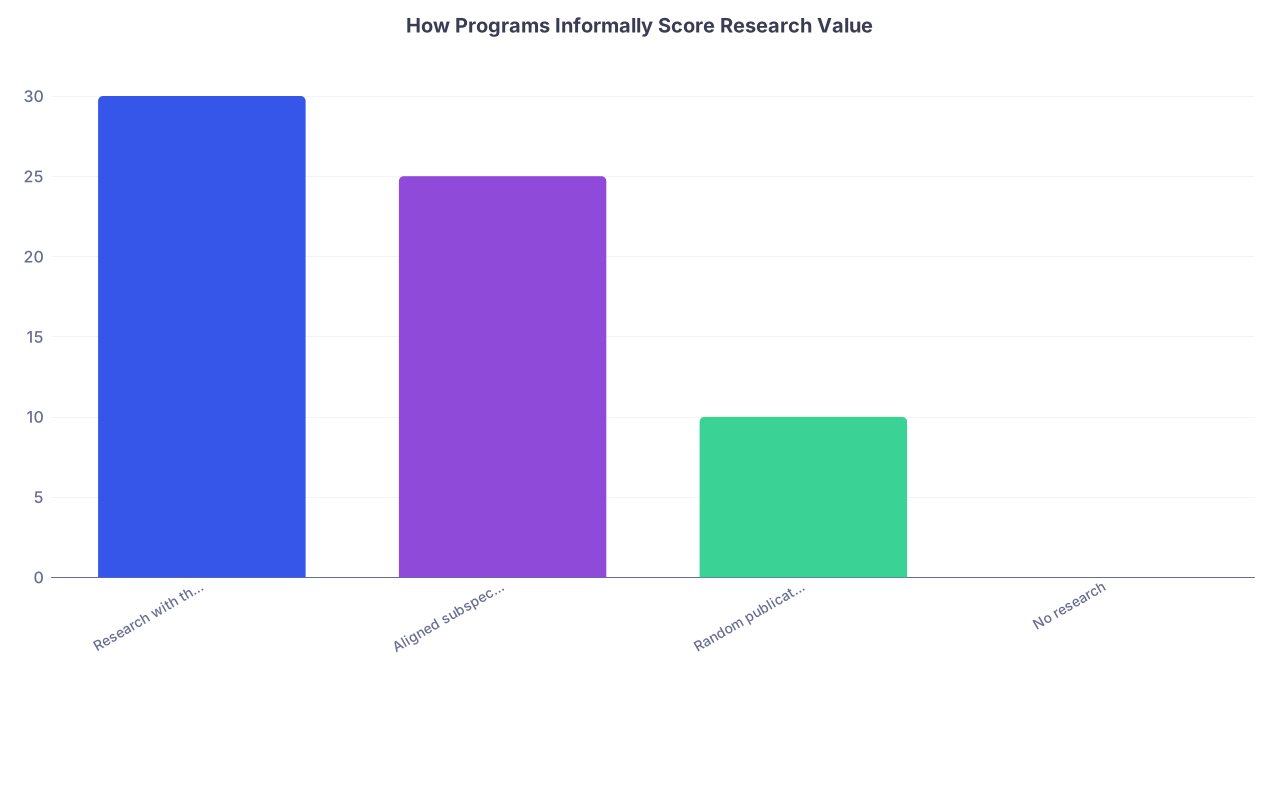
| Category | Value |
|---|---|
| Research with their faculty | 30 |
| Aligned subspecialty work | 25 |
| Random publications volume | 10 |
| No research | 0 |
So your “mediocre” set of 2–3 meaningful projects with the right people can be far more powerful than someone else’s 15 low-impact posters with no recognizable names.
This is how an average-stat applicant with targeted, aligned research gets a serious look from a big-name academic program while a high-stat applicant with scattered research doesn’t stand out.
7. The Other Hidden Filters: Red Flags And Risk Aversion
Another truth no one advertises: top programs are often more conservative, not less.
They will absolutely pass on a brilliant, high-stat applicant if they smell:
- Attitude problems
- Blame-shifting in the MSPE
- Shaky professionalism on rotations
- Even a whiff of dishonesty
Because they know that once you’re in, getting you out is painful and public.
So imagine two files:
- Applicant Fabulous: 260+, huge research, but one shelf failure, vague “concerns” in an eval, not great word-of-mouth from residents.
- Applicant Solid: 235–240, good letters, clean professionalism record, away rotation where everyone said “nice to work with.”
The committee will say:
“We don’t need another paper machine. We need someone who will not be a nightmare.”
And the average applicant walks into a top 10 spot while the superstar lands at a less conservative program willing to gamble.
8. What The “Average Who Matched Big” Usually Did Differently
Let me pull all this into something concrete, because patterns repeat.
The average-stat applicant who matches a top competitive program usually has some combination of:
- Early alignment with a specialty and a department, so they became a known entity over time
- A killer away rotation where residents genuinely liked working with them
- One or two influential advocates who were willing to go on record and push for them
- No professionalism issues whatsoever – they’re boring on that front, in the best way
- Real-person presence on interview day – not robotic, not rehearsed to death, not arrogant
They invested less in being perfect on paper. More in being undeniable in person to a small number of people who actually have power.

Meanwhile, the purely stats-focused applicant spread themselves across 25 projects, 40 programs, 70 applications, 5 half-hearted aways. They touched a lot of places and impressed almost no one deeply.
Guess which strategy the insiders respect more?
9. How To Use This If You’re “Average” On Paper
I’ll be blunt.
If you’re chasing derm, ortho, plastics, ENT, neurosurgery, urology, or integrated anything with just a “spray and pray” high-volume application strategy and nothing else, you are playing the wrong game.
You need to think like this:
- Where can I become a known quantity?
- Who can actually speak for me in a room?
- Which away rotation(s) could realistically lead to, “We want this person here”?
That may mean:
- Doubling down on your home department
- Doing one or two very intentional away rotations instead of four random ones
- Getting into a real working relationship with a faculty member who has national friends
And during those experiences, acting like the person residents want at 3 AM:
- Competent
- Honest
- Low-drama
- Curious but not needy
- Respectful to everyone
That’s the stuff that makes attendings say, “We should take them. I know they’ll be fine.”
FAQ (3 Questions)
1. Do I actually have a shot at a top competitive program if my Step scores are below the “average” for that specialty?
If your scores clear the basic competence bar (varies by specialty and program, but think roughly: you’re not in obvious danger of failing boards), then yes, you still have a real shot if you compensate with strong in-person performance and advocacy. Below that threshold, some programs will auto-screen you out. Above it, your numbers quickly become secondary to who knows you, what they say about you, and how you performed on their service.
2. Is it better to do more away rotations to increase my odds, or just one or two key ones?
More is not always better. Each away is an audition that can either help you or quietly blacklist you. One outstanding away where you crush it and gain a real advocate is worth more than three where you’re forgettable or misaligned. Most insiders I know favor 1–2 well-chosen aways that match your realistic target tier and culture.
3. How do I actually get a faculty member to become an advocate instead of just a lukewarm letter writer?
You earn it over time. Work closely with them on a project, be present on their service, show up prepared, follow through without being chased. Explicitly ask for feedback early and respond to it. Then, when the time comes, you ask directly: “Do you feel you know me well enough to strongly support my application, and would you be comfortable reaching out to a few programs on my behalf?” If they hesitate, they are not your advocate. If they say yes and mean it, that’s the person who might get you into a program your stats alone never would.
Key points, so you leave with something sharp:
- Top competitive programs pick people they trust, not spreadsheets they admire.
- Average numbers plus strong advocacy and trusted in-person performance will beat elite numbers with no real relationships more often than you think.
- Your real job is not to look perfect to everyone. It’s to be unforgettable to a few people who can actually speak for you in the room where the rank list is written.