
Clinical grades are overrated. Program directors care a lot more about the story behind them than the letter printed on your transcript.
If you want a competitive specialty and your third‑year evals are mediocre or worse, you are not done. You just lost your “easy mode.” You can still win the game.
Here is how.
Step 1: Get Ruthlessly Clear on How Bad the Damage Is
You cannot solve a vague problem. “My clinical grades are weak” is meaningless. Quantify it.
Pull up:
- Full transcript
- Dean’s letter draft (if available)
- Rotation eval narratives
- Any professionalism notes or remediation letters
Now classify:
| Category | Description | Risk for Competitive Fields |
|---|---|---|
| Cosmetic | One or two Passes, no remediation, decent comments | Low–moderate |
| Structural | Several Passes, few Honors, vague/negative comments | Moderate–high |
| Red Flag | Failed/remediated rotation or professionalism concern | Very high but not impossible |
You are likely in one of these scenarios:
- Mostly Pass, 1–2 Honors, maybe one High Pass
- All Pass with neutral comments
- One failed or remediated clerkship
- Mixed: early weak performance, clear upward trend
Do not sugarcoat it. Write a one‑sentence diagnosis for yourself:
- “Average across the board, no Honors, no fails.”
- “Failed surgery, remediated, rest solid.”
- “Early Passes, later Honors in IM and Neuro.”
That sentence will drive your strategy.
Step 2: Understand What Competitive Programs Actually Care About
You are not applying to community FM. You are looking at Derm, Ortho, Plastics, ENT, Urology, Neurosurgery, Rad Onc, competitive IM (Cards/Onc track), EM at top places, etc.
Across these, the hierarchy usually looks like this:
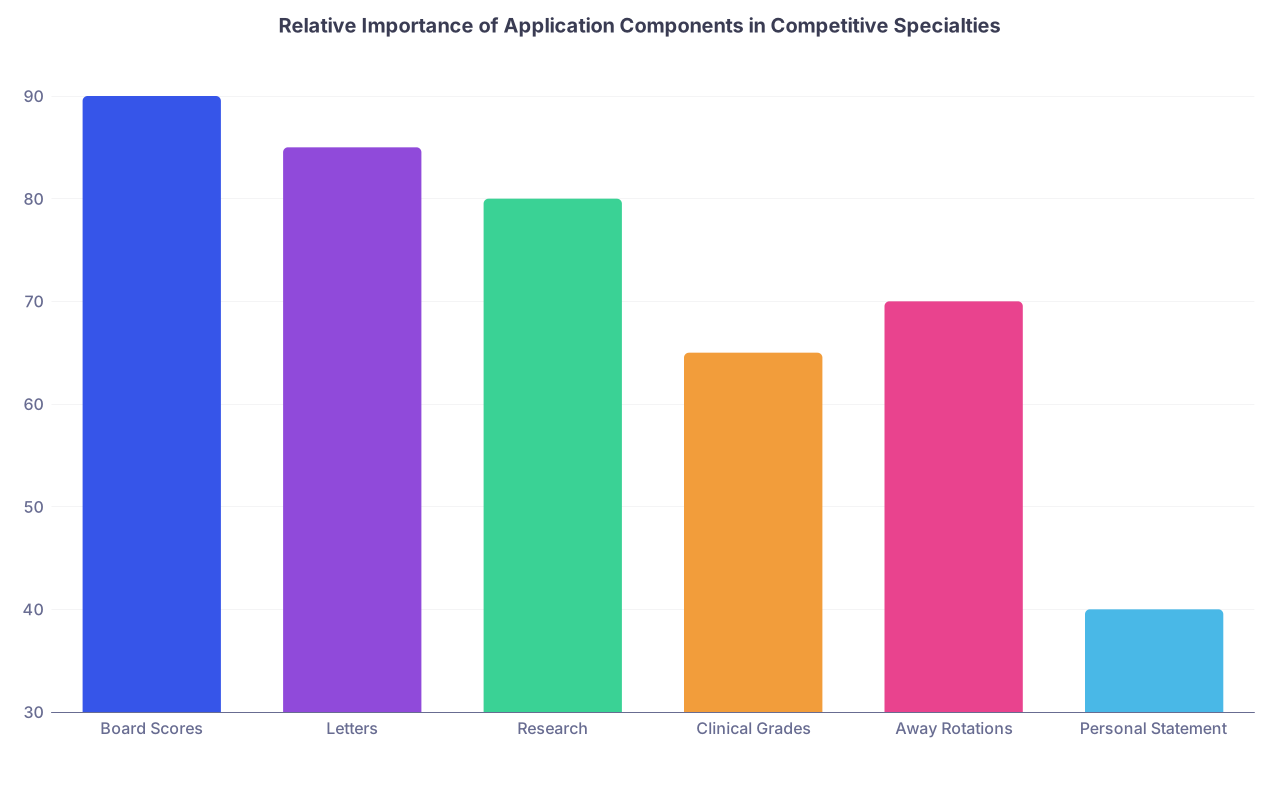
| Category | Value |
|---|---|
| Board Scores | 90 |
| Letters | 85 |
| Research | 80 |
| Clinical Grades | 65 |
| Away Rotations | 70 |
| Personal Statement | 40 |
Typical order of importance:
- Board scores (especially Step 2 now that Step 1 is pass/fail)
- Specialty‑specific letters from known faculty
- Research productivity and depth
- Clinical performance in that specialty (sub‑I, away rotations)
- Overall clinical grades and narrative comments
- Fit, maturity, and trajectory
Notice what is not #1: your third‑year Pediatrics grade. Or that Pass in OB at a school that barely gives Honors anyway.
You are going to:
- Neutralize / contextualize your weaker grades.
- Overpower them with:
- A strong Step 2 CK
- Dominant performance on sub‑Is and aways
- Excellent, specific letters
- A coherent upward story
Step 3: Diagnose Why Your Clinical Grades Were Weak
The solution depends heavily on the cause. Be brutally honest.
Common patterns I keep seeing:
Slow starter / timid on the wards
- Comments like “quiet,” “needs to speak up,” “hesitant with plans.”
- You knew the medicine but never drove the team.
Poor documentation / efficiency
- Notes late.
- Orders lagging.
- Intern re‑doing everything.
Knowledge gaps
- Missed basic questions.
- Shelf scores below class average.
- Comments: “needs to improve fund of knowledge.”
Professionalism or reliability
- Late.
- Missed pages.
- Poor communication.
- Actual write‑ups.
Personality clash / unlucky rotation mix
- One or two attendings with a reputation for killing evals.
- Everyone that month got crushed.
Your fix must match the diagnosis. Generic “work harder” does not change evals. Changing behaviors does.
Write down for each weak rotation:
- 1–2 sentences on what faculty actually criticized.
- 1 specific behavior you need to repair.
If you cannot see patterns, ask:
- A trusted resident
- Clerkship director
- Specialty mentor
Sit down and ask directly: “What pattern do you see in my evals, and what would you fix first?”
If they hesitate, that is your clue. They are choosing words to avoid hurting you. Push: “I want the version you would tell your own kid.”
Step 4: Build the Counter‑Narrative: Upward Trajectory
Competitive programs dislike stagnation more than imperfection. A student who bombed early but clearly fixed it is more attractive than someone steady‑mediocre all the way through.
Your goal: create a visible, provable trajectory.
A. Use time to your advantage
If you are:
- M2/M3 early: You have runway. You must change how you function now so later rotations are clearly better.
- Late M3 starting M4: You have limited levers: sub‑Is, aways, Step 2 CK, and research.
- Already in the application year: You must lean hard on existing strengths and away performance.
B. Pick rotations strategically before you apply
You want:
- Your best, most motivated performance on:
- At least one home sub‑I in your specialty
- One or two away rotations (for competitive fields)
- Solid to strong performance in:
- Medicine or surgery (depending on your target field)
- Any preliminary or transitional year core rotation
Do not “save” your interest specialty sub‑I until after you apply. That is malpractice. You need those fresh strong evaluations in your application.
Step 5: Turn Your Next Rotations into Redemption Rotations
Now we get concrete. Here is the playbook you use starting tomorrow.
1. Pre‑rotation meeting with your attending or clerkship director
You do this in week 1, ideally day 1.
Script (adapt it, but keep the bones):
“Dr X, I want to be transparent. Earlier in third year I struggled with [being too quiet / organization / documentation], and it shows in my evaluations. I have been working on [specific changes]. My goal on this rotation is to demonstrate that I heard that feedback and have improved. I am very open to real‑time correction, even if it is blunt.”
Why this works:
- Signals maturity.
- Lowers their defensiveness.
- Invites them to notice improvement (which they can then write about).
2. Over‑communicate and take ownership of small things
On a competitive service, the bar is different. The learners who stand out:
- Volunteer for scut but do it fast and well.
- Own their patients’ stories.
- Anticipate needs rather than waiting for direction.
Concrete behaviors:
- Pre‑round prepared: vitals trends, labs, overnight events, key imaging, any pending studies.
- Always know “next step”: what is needed to get this patient home or to the OR?
- When given feedback, repeat back: “Got it, I will [do X differently] starting this afternoon.”
3. Fix the specific behaviors that tanked you
Examples:
If you were “too quiet”:
- Force yourself to present first at least once a day.
- Speak up on rounds with 1–2 concise plan suggestions per patient.
- Ask the resident beforehand, “Today I want to try leading the plan for Ms Y—will you backstop me if I miss something?”
If documentation was weak:
- Ask a resident to review one note early in the rotation and mark it up ruthlessly.
- Build that template and reuse it.
- Set alarms so notes are in early, not at 4 p.m.
If knowledge gaps:
- Daily: pick 1–2 patients → read 20 minutes from a real resource (UpToDate, guidelines), then tell the team, “I read about X last night; one relevant point is Y.”
- Study for shelves weekly, not cramming last 72 hours.
If professionalism / reliability:
- Target perfect attendance and punctuality.
- Over‑confirm tasks: “I will call the family and document in the chart—will update you when it is done.”
- Zero excuses. If you are late once, you own it: “I misjudged timing. It will not happen again.”
4. Ask for mid‑rotation feedback. Relentlessly.
Not the useless, “You are doing fine.”
You ask:
“Specifically, what is one thing that would take me from ‘solid’ to ‘top student on this rotation’ in your eyes?”
Then you:
- Implement it that day.
- Circle back in 3–4 days: “You suggested I [X]. Have you noticed any improvement? Anything still off?”
This gives attendings permission—and content—for a narrative like:
“Early in the rotation, Alex struggled with speaking up. After feedback, he became one of the most engaged students I have worked with and drove patient care discussions by the end.”
Programs love that sentence.
Step 6: Engineer Killer Letters to Outweigh Weak Grades
Average grades with great letters beat strong grades with generic letters. That is not theory; that is how ranking meetings actually sound.
Your targets:
- 2–3 specialty‑specific letters from people who:
- Saw you work directly.
- Know the program director world.
- Are willing to comment on growth and comparative strength.
How to set up a strong letter
Choose letter writers strategically
- Prioritize: division chiefs, program directors, well‑known faculty in your field.
- But only if they actually know you. A detailed letter from the associate PD beats a vague one from the department chair.
Have the “growth” conversation before they write
After a strong rotation, say:
“I am applying to [specialty]. Earlier in third year I had some weaker evals, but I have been very deliberate about improving. You have seen me at that later stage. Would you feel comfortable writing a strong, supportive letter that comments on my current level and growth?”
If they hesitate, do not use them. You cannot afford a lukewarm LOR.
Give them ammunition
- A short CV.
- Your personal statement draft (if decent).
- A 1‑page “letter aid” with:
- 3 patients or cases where you took ownership.
- 2–3 specific behaviors you improved during their rotation.
- Any specific feedback they gave you and how you acted on it.
Step 7: Use Step 2 CK and Exams as Your “Proof of Potential”
If clinical grades are suspect, boards become your credibility.
You want Step 2 CK to:
- Sit at or above the average of matched applicants in your field.
- Or at least be clearly stronger than what your transcript might suggest.
Rough guidance (not hard cutoffs, but reality):
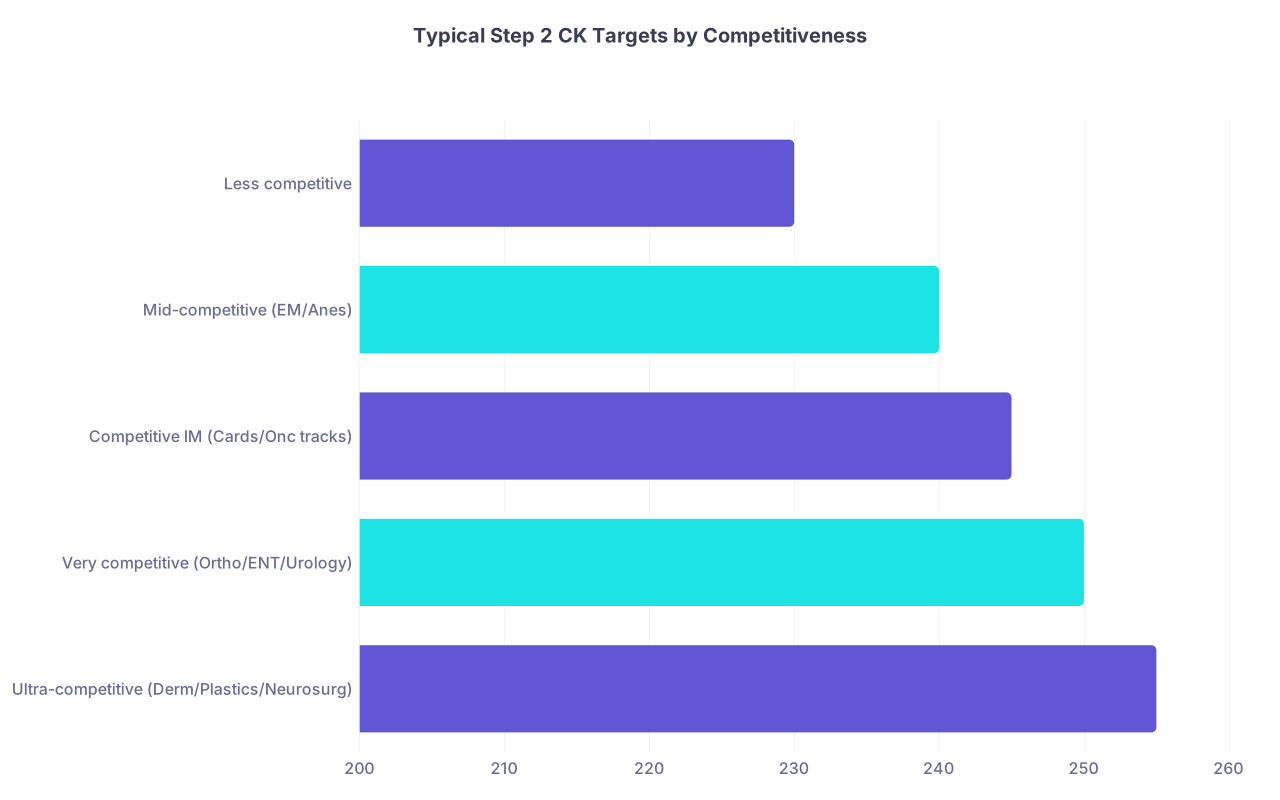
| Category | Value |
|---|---|
| Ultra-competitive (Derm/Plastics/Neurosurg) | 255 |
| Very competitive (Ortho/ENT/Urology) | 250 |
| Competitive IM (Cards/Onc tracks) | 245 |
| Mid-competitive (EM/Anes) | 240 |
| Less competitive | 230 |
You are not doomed if you are below those, but you will need:
- Stronger letters
- Stronger research
- Stronger away rotation performance
If your Step 1 is weak (barely passed, or low if from numeric era), Step 2 must look like a correction, not confirmation.
Study like it is your only shot because for competitive fields, it may be.
Step 8: Deploy Research as Signal, Not Decoration
For competitive specialties, research is not just about productivity. It is a credibility marker: “I live in this specialty’s world.”
If your clinical grades are not impressive, you must show:
- Depth of engagement: one lab or mentor over time.
- Real work: abstracts, posters, manuscripts, even QI projects.
- That someone in the field is willing to vouch for you as a worker.
Focus areas by field:
- Derm: chart reviews, case series, clinical trials, dermpath projects.
- Ortho: retrospective surgical outcomes, biomechanics projects.
- ENT/Plastics: outcomes, recon techniques, craniofacial, head and neck.
- Rad Onc: outcomes, dosimetry, clinical trials.
- Competitive IM: cards / onc / pulm‑crit outcomes, retrospective cohorts.
You do not need 10 pubs. You need 1–3 solid projects with:
- Your name not buried at the bottom every time.
- A mentor who will call a PD and say: “This student is serious and works hard.”
Timing:
- If early M3: find a mentor now; you can have a poster by ERAS.
- If late: at least get involved enough to talk about a project in your personal statement and interviews.
Step 9: Crush Your Away Rotations (Where It Actually Counts)
For many competitive specialties, the away rotation is the real audition. Your third‑year family med grade? Background noise.
Plan your aways like a military operation.
Where to go
Balance:
- 1–2 realistic “reach” programs.
- 1–2 realistic “target” programs where:
- You have geographic ties.
- Your school has sent graduates before.
- Your mentor has contacts.
Ask your mentor frankly:
“Based on my record and current work, which programs might realistically rank me if I perform very well on an away?”
How to behave on an away
Baseline rules:
- First in, last out. Without being annoying about it.
- Learn the culture: who presents, how formal rounds are, how consults are handled.
- Mirror the residents who are well liked.
You must:
- Ask for feedback early (week 1–2) not week 4.
- Tell at least one faculty member you trust:
“This is a top‑choice program for me. If by the end of the month you feel you can support my application, your feedback or advocacy would mean a lot.”
If your clinical grades are weak, but:
- You are the student residents fight to work with.
- You make intern life easier, not harder.
- You show obvious growth and self‑awareness.
You will get:
- Strong away letters.
- Verbal advocacy in their selection meeting.
That can absolutely override a string of earlier Passes.
Step 10: Address the Elephant in the Room—Strategically, Not Desperately
You do not ignore a failed rotation or a string of Passes if they are obvious. But you also do not lead your entire application with an apology tour.
Where to address it:
- Briefly in your personal statement (only if central).
- In your MSPE / dean’s letter (they will anyway).
- In interviews, when asked.
Personal statement approach
Two rules:
- No excuses.
- Clear cause → action → result.
Example structure:
- One sentence: “Early in third year, my performance on [X rotations] was inconsistent with the standards I set for myself.”
- Brief cause: “I was slow to adapt to the demands of inpatient care and hesitant to take ownership.”
- Action: “With direct feedback from my clerkship director, I changed how I prepared for rounds, sought real‑time correction, and deliberately put myself in the position of driving patient care on later rotations.”
- Result: “That shift is reflected in my subsequent performance on [IM sub‑I, away in X], where I [specific outcomes/feedback].”
You are not asking for sympathy. You are showing adult behavior.
Interview approach
When asked about grades:
- Acknowledge.
- Own your part.
- Demonstrate concrete change.
“Yes. Early on, my evals were honestly pretty average. I was too passive, especially on busy inpatient services. The turning point was [specific feedback]. Since then, I have focused on [specific behaviors]. On my [sub‑I/away] you can see the difference in [comments/letters]. I am grateful I had that wake‑up call before residency.”
Then stop. Do not over‑defend. Let them move on.
Step 11: Be Brutally Smart About Your Application List
Weak clinical grades narrow your margin. You need to play the numbers and the tiers intelligently.
For highly competitive specialties, a reasonable distribution for a weaker‑grades applicant might look like:
| Program Tier | % of Applications | Notes |
|---|---|---|
| Reach | 20–30% | Top academic, heavy research, big names |
| Target | 40–50% | Solid academics, mid‑upper programs |
| Safety-ish | 20–30% | Smaller or less known, but still solid training |
And yes, in some fields “safety” is relative. There are no true safety programs in Derm or Plastics. But there are:
- Less research‑obsessed programs.
- More community‑oriented programs.
- Places that historically like your med school.
You must:
- Use NRMP Charting Outcomes and specialty‑specific data (last few cycles) to see where your board scores and background fit.
- Talk to your dean’s office and specialty advisor for real odds, not your fantasy.
If you are coupling a highly competitive specialty with a preliminary year (e.g., Ortho + prelim surgery):
- Over‑apply to prelims.
- Make sure at least a handful are places that know you or your school.
Step 12: Decide When to Pivot—and When Not To
I am not going to tell you everyone can match Derm with a 225 Step 2 and a failed rotation. That is delusional.
You need a clear‑eyed view:
- Some combinations of:
- Weak boards
- Weak clinical grades
- No research Will close off the ultra‑competitive stuff for now.
Options if you are in that territory:
Extra research year
- Only useful if:
- You get with a productive mentor.
- You can realistically change your board / eval trajectory.
- You are okay delaying graduation.
- Only useful if:
Apply to a different field now, then consider fellowship later
- Example: strong IM with later Cards vs chasing Derm with no portfolio.
- For many people, this yields a better career than banging on a locked door for years.
Dual apply
- Competitive + a more forgiving but still solid field.
- Only do this with very careful advising; some combos are toxic (they read as indecision).
Your decision point:
- Talk to:
- Your specialty mentor.
- Your dean or advising dean.
- A resident in your target field who will be blunt.
Ask them:
“If I were your sibling with this record, would you tell me to go all in on [specialty], do a research year, dual apply, or pivot?”
Then listen. Even if you do not like the answer.
Quick Reality Check: What Actually Changes PD Minds
What I have seen move someone from “risky” to “we should rank this person”:
- A very strong Step 2 CK relative to their transcript.
- An away rotation letter that says:
“One of the top students I have worked with in the last few years. Excellent growth and work ethic.”
- A clear upward trend in narrative comments:
“Initially quiet…” → “More engaged…” → “Functioned at intern level by end of rotation.”
- A mentor at that institution calling the PD and saying, “You should take this one seriously.”
You are building a portfolio that forces them to say:
“Yes, the early grades are underwhelming, but everything else says they figured it out and will be a strong resident.”
That is the goal.
Final Takeaways
- Weak clinical grades are not a death sentence for competitive specialties, but they remove your margin for laziness or magical thinking. You must be deliberate and aggressive about fixing specific behaviors and building an upward story.
- Your leverage comes from what you do after those weak grades: dominant sub‑Is and aways, strong Step 2 CK, targeted research, and powerful letters that explicitly describe your growth and current level.
- You need honest external eyes—mentors, deans, residents—to tell you whether to double down, add a research year, dual apply, or pivot. Pride is expensive. A clear, realistic strategy is not.