Silent Killers: Small Application Mistakes That Doom Competitive Specialty Hopes
What do you tell yourself the night before ERAS locks… when you think everything is fine, but have no idea which tiny mistake just took derm, ortho, or plastics off the table?
Let me be direct: for competitive specialties, people rarely get destroyed by one huge, obvious blunder. They get cut by a dozen tiny, “that probably doesn’t matter” errors that absolutely do.
I’ve watched strong applicants—250+ scores, AOA, solid research—end up with 2 interviews in their chosen field because of “small” things they thought were harmless.
You are not competing against average. You are competing against applicants who triple‑check everything and treat each line as a data point in a ruthless screening process.
Let’s go through the silent killers.
1. Applying Like It’s Internal Medicine When It’s Actually Ortho, Derm, or ENT
Competitive specialties are different ecosystems. If you apply like you are doing IM or FM, you are already behind.
Mistake: Under‑applying or mis‑targeting programs
People think:
- “My Step is good; I don’t need to apply that broadly.”
- “I’ll just apply to the big names I know.”
Then they end up with five total interview invites.
For competitive specialties, the “sane” range is often:
- 60–100+ programs for most US MD applicants
- 80–120+ for DO or IMG applicants, or anyone with a red flag
| Specialty | Low Risk US MD | Mod Risk / DO | IMG / Red Flag |
|---|---|---|---|
| Dermatology | 60–80 | 80–100 | 100+ |
| Orthopedics | 60–90 | 80–110 | 110+ |
| Plastics | 50–70 | 70–100 | 100+ |
| ENT | 50–80 | 70–100 | 100+ |
| Neurosurg | 40–60 | 60–80 | 80+ |
If your list is 25 derm programs because “they’re the ones I’ve heard of,” that is not confidence. That is delusion.
Mistake: Ignoring program behavior from past cycles
Every specialty has:
- Programs that reliably interview home students only
- Programs that heavily favor couples, MD/PhD, or top‑5 med schools
- Programs that almost never interview DOs or IMGs
You ignore this at your own risk. You do not have infinite ERAS slots, money, or time.
You should:
- Talk to recent grads from your school in your specialty
- Cross‑check with specialty‑specific Discords/Forums (filtered through sanity)
- Identify:
- “Reach but realistic”
- “Realistic, mission‑fit”
- “Probably wasting money”
The mistake is applying blind and pretending all programs are equally likely. They are not.
2. Letters of Recommendation: Great Names, Wrong Content
This one hurts because it feels like you did it right.
You got:
- A letter from the department chair
- A letter from a “big name” researcher
- A letter from your sub‑I attending
You feel safe.
You are not.
Silent killer: Generic letters that say nothing specific
Programs in competitive fields have a sixth sense for “polite but empty” letters:
- “Pleasure to work with”
- “Will make an excellent resident”
- “Hard‑working and compassionate”
If that is the strongest line in the letter, you are dead at screening.
You need:
- Concrete statements: “Top 5% of students I have worked with in the last 10 years.”
- Specific examples: “Took independent responsibility for managing complex flap patients by week 2 of the rotation.”
- Specialty‑specific praise: “Excellent dexterity and spatial reasoning; picked up arthroscopy basics faster than most interns.”
Silent killer: The wrong mix of letters
Each specialty has expectations. For example (common patterns, not universal):
| Specialty | Core Letters Expected |
|---|---|
| Ortho | 2–3 ortho faculty, often including chair |
| Derm | 2 derm, 1 medicine or research |
| ENT | 2 ENT, 1 surgery / research |
| Plastics | 2 plastics, 1 surgery or research |
| Neurosurg | 2 neurosurg, 1 neurology/surgery/research |
The mistake: submitting, say, 1 ENT, 1 internal medicine, 1 pediatrics because “they know me best.” That might work for peds. For ENT? Not so much.
You should:
- Prioritize specialty‑specific letters even if they know you for a shorter period, provided they can write something strong and specific.
- Make sure at least one letter writer can actually comment on:
- Technical skills
- Fit for the specialty
- Performance compared to other students.
If you are not sitting down with each writer to discuss what you are aiming for and what programs care about, you are leaving way too much to chance.
3. The Personal Statement That Could Be Used for Any Specialty
I have read “competitive specialty” personal statements that never mention a single patient, procedure, or concrete story from that actual field.
That is an instant “no” at many programs.
Red flags that your PS is generic fluff
If your personal statement contains mostly:
- “I have always been fascinated by the human body…”
- “I love both surgery and continuity of care…”
- “I want to make a difference in patients’ lives…”
- “Ultimately, I realized I wanted a specialty that combines research, patient care, and teamwork…”
You have written a statement that applies equally to:
- Anesthesiology
- Cardiology
- Pediatrics
- Literally anything
That is a problem.
Competitive specialties want:
- Clear, specific evidence that you actually understand their field’s:
- Lifestyle realities
- Case types
- Personality fit
- A narrative that explains:
- Why this specialty over any other
- How your experiences map onto the demands of this specialty
You do not need to be dramatic. But you do need to be specific.
Silent killer: Subtle tone mismatches
Common misfires:
- Sounding entitled: “Given my scores and research output, I believe I will be an asset to any program.”
- Sounding obsessed with prestige: heavy namedropping of institutions, “top tier,” “elite training.”
- Sounding naive about workload: “I value work‑life balance above all else” in neurosurgery or ortho.
You want tone that says:
- Hard‑working but not martyr
- Curious but not arrogant
- Competitive but not toxic
If 2–3 people in the field have not read your statement and given blunt feedback, you are guessing.
4. Sub‑I and Away Rotation Landmines
Competitive specialties treat away rotations like month‑long interviews. Small mistakes here are not small.
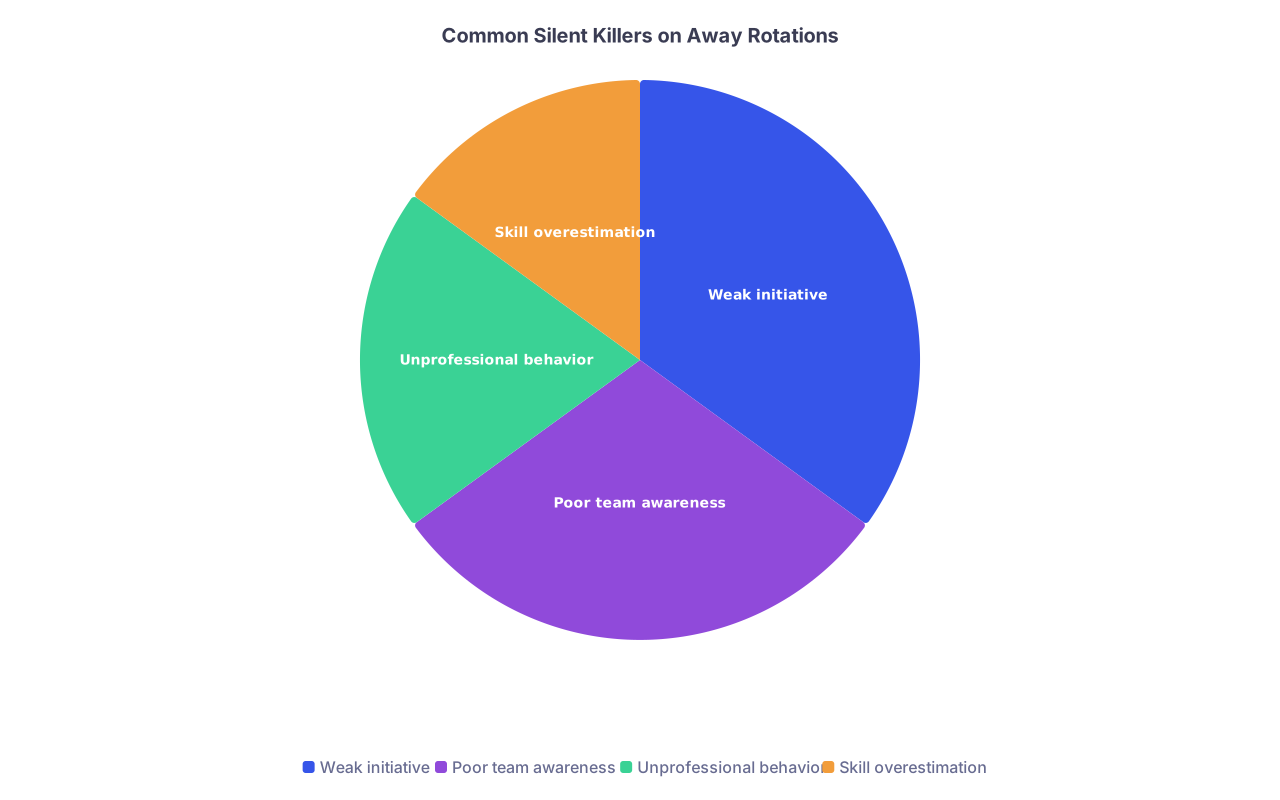
| Category | Value |
|---|---|
| Weak initiative | 35 |
| Poor team awareness | 30 |
| Unprofessional behavior | 20 |
| Skill overestimation | 15 |
Silent killer: Being “fine” instead of “clearly strong”
Programs do not want to rank “fine.” They want:
- Clearly above‑average students
- People who made the team’s life easier
Behaviors that quietly kill your evaluation:
- Needing to be told everything instead of anticipating:
- “Can you have the consent filled out by the time I get there?”
- “Please have the post‑op note drafted.”
- Standing back in the OR waiting for permission to do the next step, every time, even after repetition.
- Checking your phone in the OR or while pre‑rounding “just quickly.”
You do not need to be perfect. But if multiple residents say, “Yeah, they were fine,” that is usually not enough to trigger an interview.
Silent killer: Sloppy professionalism
Things I have actually heard about rotators:
- “Always five minutes late but acted like it was nothing.”
- “Asked to leave early constantly for nonessential stuff.”
- “Talked badly about other students on the team.”
These people often still think they did well because no one confronted them directly.
You need someone you trust at each rotation (resident or fellow) to tell you the truth:
- “What would you write about me in an evaluation right now?”
- “What’s one thing that might make people hesitate to recommend me?”
If you are afraid to ask, that tells you something.
5. Sloppy ERAS Details That Signal “Not Actually Competitive”
Programs look for reasons to say no quickly. Many of those reasons are avoidable.
Silent killer: Inconsistent or vague experiences
Problem patterns:
- Huge number of research entries with no clear outcomes (no abstracts, no posters, no publications, no real description)
- “Assisted with…” repeated endlessly without specifying actual responsibilities
- Typos, capitalization errors, random tense shifts
This makes you look padded. Or careless. Or both.
You should:
- Only list research that:
- You actually contributed to in a clear way
- You can discuss fluently at interview
- Be concrete in descriptions:
- “Collected data for 50+ patients”
- “Performed statistical analysis using R”
- “Co‑authored abstract accepted to ACS regional meeting”
Silent killer: Misaligned “most meaningful” experiences
I see applicants to:
- Ortho listing purely global health or palliative care as all three “most meaningful”
- Derm listing nothing even remotely related to outpatient or skin or chronic disease
- ENT listing only non‑clinical volunteer experiences
Does that always kill you? No. But it creates doubt:
- Do you actually want this specialty?
- Did you not have any meaningful experiences in it?
At least one “most meaningful” should connect clearly to:
- The specialty itself
- Personality traits that fit it (precision, team‑based care, operative thinking, etc.)
6. Poor Program Signaling and Preference Signaling Strategy
If your specialty uses signaling (derm, ENT, ortho, others are joining), you can absolutely sabotage yourself with a lazy strategy.
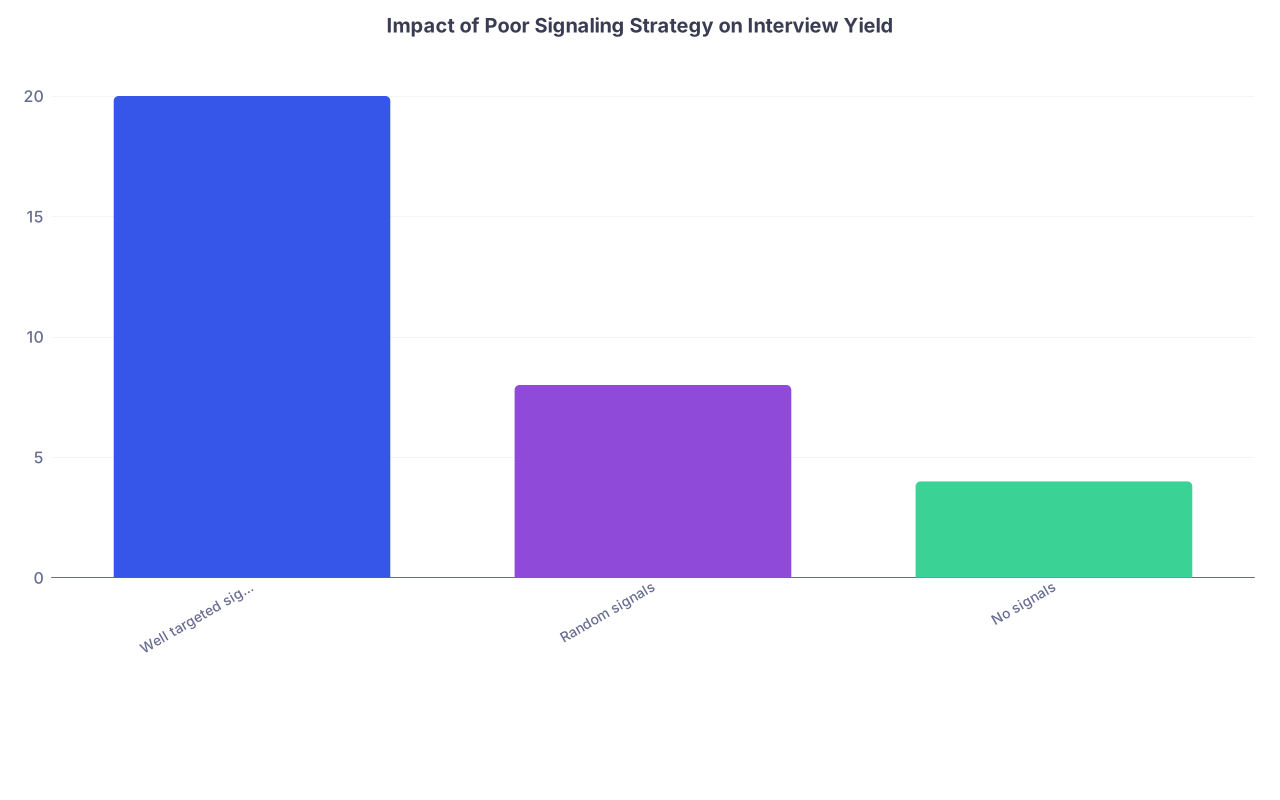
| Category | Value |
|---|---|
| Well targeted signals | 20 |
| Random signals | 8 |
| No signals | 4 |
Numbers above are illustrative, but the pattern is real: sloppy signaling cuts your chances.
Silent killer: “I’ll just signal all the top‑tier places”
This is how strong mid‑tier applicants end up with:
- No interviews from mid‑tier programs
- Weak overall yield
Common dumb strategy:
- Signal all the “famous” programs (MGH, UCSF, Penn, Mayo, etc.)
- Skip the realistic regional programs that might actually rank you to match
Better approach:
- 1–2 true dream reaches (that still interview students like you)
- Majority to realistic‑to‑reach programs where:
- Your school sends residents
- Your mentors have connections
- You have geographic ties
Using signals just to flex is how you end up unmatched.
7. Tone‑Deaf Communication and Post‑Submission Behavior
You can build a great application and then start slowly killing your chances with how you communicate.
Silent killer: Over‑emailing programs
Patterns that scream “high maintenance”:
- Emailing coordinators or PDs “just checking in” because you have not heard anything for 2 weeks
- Sending “update letters” with no real update—just restating interest
- Asking questions that are clearly answered on the website
A coordinator once showed me a thread:
- 9 emails in 3 weeks from one applicant, all variants of:
- “Just wanted to reiterate my interest.”
- “Checking if my application is complete.”
- “Any update on interview decisions?”
They did not invite that person. Not because they were malicious. Because no one wants to add a headache to their resident pool.
Silent killer: Sloppy or desperate interview thank‑you emails
Harmless? Sometimes. But they can hurt you when:
- They are obviously copy‑pasted and addressed to the wrong program
- They include weird flattery, like:
- “Your program is my dream and I will rank you highly,” sent to 7 programs
- They contain mistakes like wrong names, wrong details
If you cannot send a calm, accurate, professional note, skip the note.
8. Underestimating How Red Flags Are Interpreted in Competitive Fields
You might have:
- One low Step score
- A leave of absence
- A course failure
- Limited research in a research‑heavy specialty
The mistake is not always the red flag itself. It is pretending it does not exist or failing to frame it correctly.
Silent killer: No coherent narrative for a problem
Competitive programs think like this:
- “Everyone has issues. Do they own it? Did they learn? Is it likely to repeat?”
If you:
- Never mention a major issue in your personal statement
- Have no brief, clear explanation ready for interviews
- Act defensive or evasive when asked
You look risky.
A better approach:
- 2–3 sentences in the application (if there is a designated section) that:
- State the issue plainly
- Provide context without excuse‑making
- Show the concrete change since then
Example:
- “I failed my second‑year renal course after attempting to balance a full‑time caregiving role with my normal study methods. Since then, with support and a new study structure, I have passed all subsequent courses and scored [Step score]. I now build margin into my schedule instead of overcommitting.”
If multiple people have not pressure‑tested your explanation, you are likely underselling or oversharing.
9. Forgetting That Fit Is Local, Not Universal
The quiet mistake many strong applicants make: assuming that strong + generic = safe everywhere.
Programs are looking for:
- People who understand their case mix and identity
- People with some plausible reason to thrive in their environment

Small but deadly errors:
- Saying you want “high volume trauma” to a program that does mostly elective bread‑and‑butter cases
- Claiming deep interest in academic research at a purely community program
- Never mentioning any geographic or personal tie when applying far from anywhere you have ever lived
You do not need to fabricate some grand tie. But you should:
- Have a believable reason for being in that city/region
- Understand whether the program is:
- Research‑heavy
- Clinically focused
- Niche (peds heavy, onc heavy, etc.)
Generic “I will be honored to train at your excellent program” language is invisible. And useless.
10. How to Audit Your Application for Silent Killers
You cannot fix what you do not systematically look for.
Here is the process I wish more people actually followed:

| Step | Description |
|---|---|
| Step 1 | Draft complete application |
| Step 2 | Self audit with checklist |
| Step 3 | Peer review by co-applicant |
| Step 4 | Review by specialty mentor |
| Step 5 | Revise content and strategy |
| Step 6 | Finalize and submit |
| Step 7 | Major gaps? |
Your personal “silent killer” checklist
Ask yourself bluntly:
Application Strategy
- Did I apply to enough programs for my risk profile?
- Did I waste signals on dream‑only places?
Letters
- Do I have at least 2 specialty‑specific letters with concrete praise?
- Has at least one trusted faculty member told me they can write a strong letter, not just a letter?
Personal Statement
- Could this statement be used for a different specialty with only minor edits?
- Would someone outside medicine understand why I chose this field from reading it?
Experiences
- Do my “most meaningful” entries clearly support my specialty choice?
- Are there any research/leadership entries I cannot discuss fluently?
Professionalism / Communication
- Am I tempted to email programs “just to see” what is happening?
- Do my emails have any emotional leakage (defensiveness, desperation, flattery)?
If you are honest with yourself, you will catch a few of these. Better now than after interview season.

FAQ (Exactly 4 Questions)
1. My stats are strong (AOA, 250+ Step 2). Can small mistakes really sink my chances in a competitive specialty?
Yes. High scores and honors get you past many filters, but they do not immunize you against:
- Weak specialty letters
- Bad away rotation impressions
- Tone‑deaf personal statement or signals
I have seen “perfect” applicants with:
- Only 3–4 interviews in derm or ortho
- No home interview because of a mediocre sub‑I impression
Strong numbers move you from “automatic no” to “maybe.” The rest of your file—and how clean it is—decides whether you get the invite.
2. How many away rotations should I do for a competitive specialty without hurting myself?
For most fields:
- 1–2 aways is typical
- 3 can be reasonable for some (ortho, ENT, plastics) if you have the stamina and no significant red flags
More than that:
- Increases your exposure risk (one bad month can poison things)
- Makes it harder to maintain energy and performance
The mistake is not the number alone. It is doing so many that:
- You show up exhausted
- Your performance varies wildly between sites
I would rather see 2 excellent aways than 4 mediocre ones.
3. If I realize my personal statement or ERAS has issues after I submit, is there anything I can do?
You cannot rewrite ERAS or your PS after submission, but you can:
- Adjust your communication and interview behavior:
- Be extra clear and specific about why the specialty is right for you
- Address any misaligned signals (e.g., research vs clinical) verbally
- Use interviews to:
- Clarify any red flags that were not well framed on paper
- Highlight parts of your story that your PS underplayed
What you should not do:
- Email programs asking to replace your personal statement
- Send long “clarification letters” that call attention to the mistakes
Focus forward: fix what you can control next, not what is already locked.
4. How do I know if my letter writers are actually writing strong letters, not just polite ones?
You cannot read the letters, but you can:
- Ask directly: “Do you feel comfortable writing me a strong letter for [specialty]?”
- If they hesitate or downgrade to “I can write you a letter,” choose someone else.
- Look at:
- How well they know your work
- Whether they have written strong letters for matched students in your field before
- Ask your advisor or PD:
- “Who in the department tends to write the strongest letters for applicants?”
The silent killer is assuming that prestige = strong letter. A world‑famous surgeon who barely knows you will often write a weaker letter than a mid‑career faculty member who watched you work hard for four weeks.
Key points to walk away with:
- Competitive specialties are won or lost on details—small “probably fine” choices can quietly pull you below the interview line.
- Letters, aways, signaling, and tone all send signals about how serious and self‑aware you are; treat each one like a high‑value move, not a formality.
- Do a ruthless audit of your application with people in the field; fix the quiet errors now, or you will pay for them in a silent interview season.