
The obsession with “260 or bust” is lazy thinking—and the data proves it.
If you’re aiming for derm, ortho, plastics, ENT, neurosurgery, or any other oxygen‑thin specialty, you’ve probably heard some version of: “If you don’t have a 260+, you’re done.” Attendings say it. Residents repeat it. Group chats live on it.
It’s also wrong. Not a little wrong. Fundamentally wrong about how competitive matches actually work in 2026.
Let me be clear: high Step scores help. A lot. But the religion around 260+—as if that number magically separates “matchable” from “unmatchable”—is myth, not medicine.
Here is what the data and real match behavior actually show.
The 260+ Myth: What People Think vs What Really Happens
The usual story goes like this:
- Competitive specialty = you must be 260+
- No 260 → no interview invites
- No interview invites → no match
- Therefore, your life depends on that three-digit number
This is based on two half‑truths:
- Programs use Step scores as an early screen. True.
- Higher scores give you more interviews. Also true.
Then people do a lazy mental shortcut: “more = enough” and “less = doomed.” That’s not how probability, or residency selection, actually works.
Let’s ground this in reality.
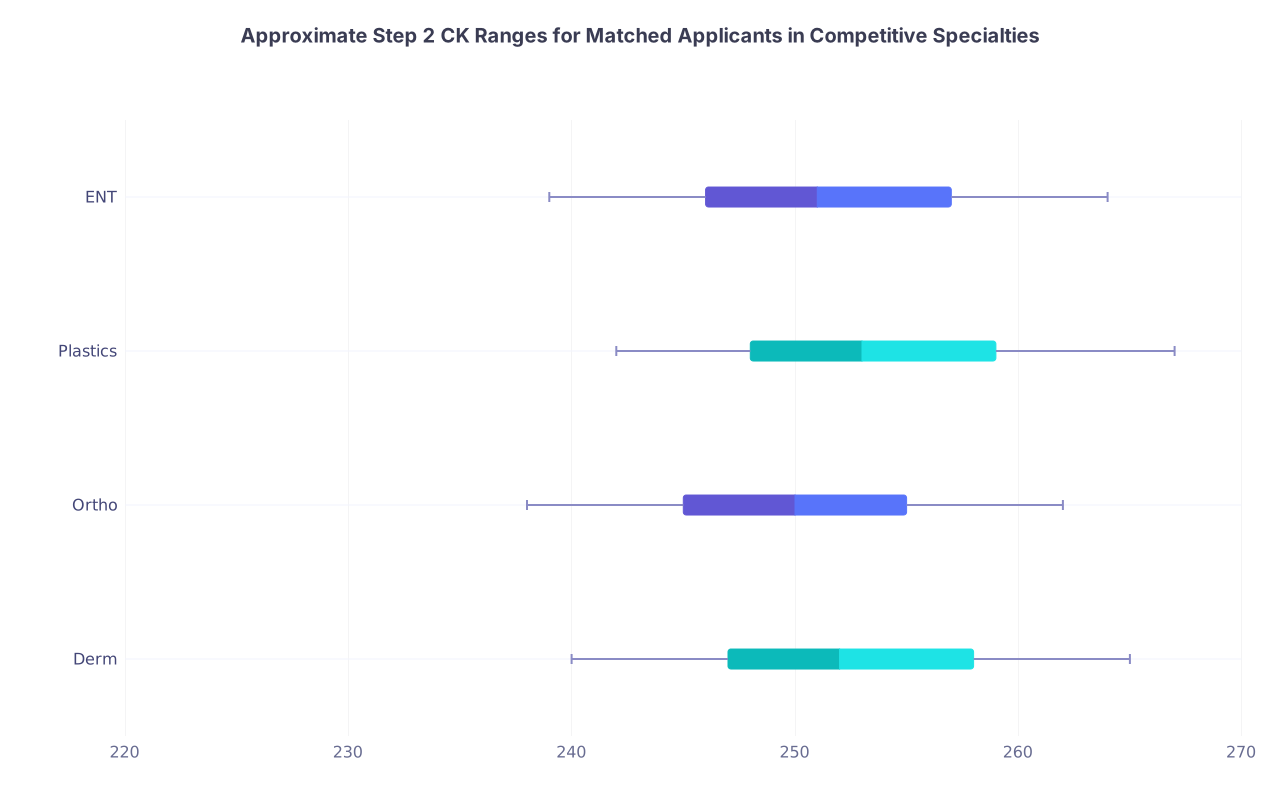
| Category | Min | Q1 | Median | Q3 | Max |
|---|---|---|---|---|---|
| Derm | 240 | 247 | 252 | 258 | 265 |
| Ortho | 238 | 245 | 250 | 255 | 262 |
| Plastics | 242 | 248 | 253 | 259 | 267 |
| ENT | 239 | 246 | 251 | 257 | 264 |
Look at that carefully. Distributions, not cutoffs.
A few key points from NRMP and specialty‑specific data over the last several cycles:
- Median matched Step 2 CK for these specialties often sits in the mid‑240s to low‑250s, not 260+
- A non‑trivial slice of matched applicants are in the 230s—yes, even in derm and ortho
- A 260+ tends to be top‑quartile, not basic entry
“Must be 260+” is like saying “you must run a sub‑3:00 marathon to finish a marathon.” Sub‑3:00 makes you competitive. Impressive. Rare. It does not define viability.
The more accurate statement is:
For competitive specialties, a high Step score is a powerful multiplier on an already strong application. It’s not a magic key.
And that word—multiplier—is where people get lost.
What Scores Actually Do for You (And What They Don’t)
Scores are not a personality trait. They’re a filter and an anchor.
They mainly do three things in competitive specialties:
Get you past automated or lazy screens
Some programs slap a filter at 240 or 245 for Step 2. A few might push to 250. They do this because they’re drowning in 800+ applications for 5 spots and they do not want to read.Shape first impressions at file review
Two derm applicants: 252 vs 238. Identical research and letters. The 252 file gets a little more cognitive “halo” in that first 90‑second scan. Human, predictable, not mysterious.Protect you from getting cut in committee when someone wants an excuse
When faculty are on the fence about you, a high Step makes it harder for someone to say, “We can do better; pass.” A mediocre Step gives lazy reviewers cover to drop you.
Notice what’s missing from that list:
- “Guarantees you interviews” – it does not
- “Guarantees a match” – absolutely not
- “Makes up for a weak CV, poor letters, or zero fit” – never
I’ve watched an ortho PD scroll through an applicant list during a meeting: “260, 262, 259, 264… who is this person? Any letters from people we know? Any research?” The scores didn’t make him stop. The story and the connections did.
The Score Plateau: Diminishing Returns Above ~250
Here’s where the 260 cult really collapses.
Above a certain number, more points add almost no practical value. They’re ego fuel, not match fuel.
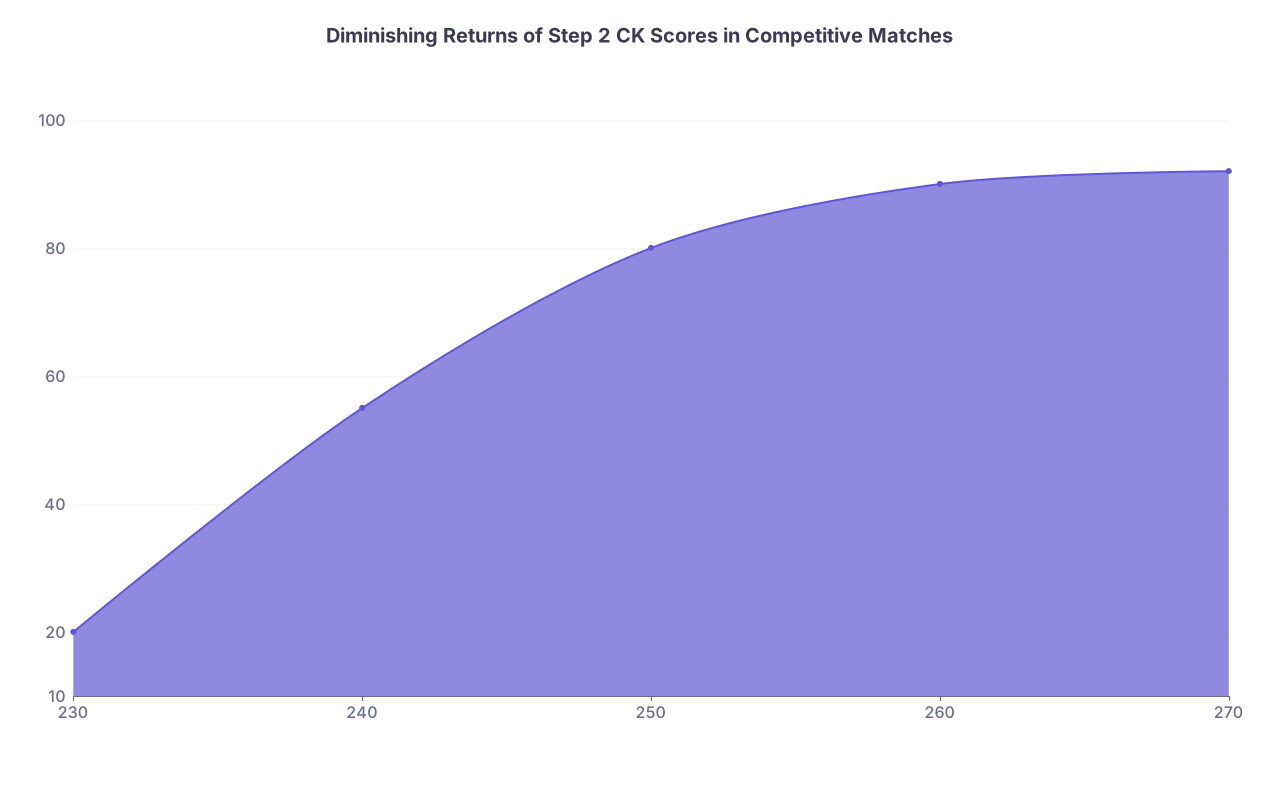
| Category | Value |
|---|---|
| 230 | 20 |
| 240 | 55 |
| 250 | 80 |
| 260 | 90 |
| 270 | 92 |
Interpretation (rough, but aligned with how PDs talk):
- Going from 230 → 240: massive jump in interview viability
- 240 → 250: still big, you move closer to “in the conversation” for most top programs
- 250 → 260: modest improvement, but not transformative
- 260 → 270: bragging rights, not a different life
Programs do not sit around saying: “We only want 260+.” They say:
- “Below 240, it’s a hard sell unless they have something special”
- “Around 250+ with solid research and letters? We’re interested”
- “We’re not rejecting a 245 with a KOL letter for a 262 rando from nowhere”
Once you are safely above whatever internal comfort zone a program has (usually mid‑240s to low‑250s for very competitive ones), the conversation shifts:
- Who wrote the letters?
- Are they normal human beings on interview day?
- Do we trust them in the OR/clinic?
- Any red flags?
- Do they want us, or are we clearly a backup?
The Step number stops being the star of the show. It becomes background noise.
Why Some 260+ Applicants Still Don’t Match
If 260+ were a golden ticket, this wouldn’t happen. But it happens every year.
You can find unmatched spreadsheets where people list stats. The depressing entries:
- “Step 2 263, AOA, 3 pubs, applied ortho, unmatched”
- “Step 2 261, 2 derm pubs, 1 away, no derm match”
How does that happen? Quite easily.
Common patterns I’ve seen:
Score‑rich, everything‑else poor
- Generic letters (“hard‑working, pleasant to work with”) from unknown faculty
- No real mentorship in the specialty
- Weak or superficial research
- No clear narrative of “this person loves X and has invested in it”
Toxic or awkward on interview
Programs absolutely tank high‑scoring applicants who are weird, arrogant, or cannot hold a normal conversation. A 265 does not override “massive interpersonal red flag” or “clearly hates patients.”Rank list strategy failure
Some people chase prestige, rank 10 hyper‑competitive programs only, pair it with one or two safety-ish places, and act shocked when probability behaves like probability.Letters that quietly kill them
The nastiest part: applicants never see the death sentence letter.- “Technically strong but needs a lot of direction”
- “Will do fine in a program with close supervision”
In a competitive specialty, that’s code for “do not touch.”
Meanwhile, applicants with 240s and 250s match into the same fields with:
- Strong, specific letters from well‑known faculty
- Consistent involvement over 1–2 years in that specialty
- Normal, likable behavior on interviews
- Realistic rank lists
260 is not insurance against being forgettable, disorganized, or badly advised.
The Other Side: Matching Competitive with “Only” a 240–250
You probably know at least one story like this:
- Step 2 242, matched ENT
- Step 2 247, matched derm
- Step 2 238, matched ortho after a research year
Those aren’t unicorns. They are exactly what happens when the rest of the application compensates.
Let’s make this concrete.
| Feature | Applicant A (262) | Applicant B (245) |
|---|---|---|
| Step 2 CK | 262 | 245 |
| Research | 1 case report, unrelated | 2 first-author plastics papers |
| Letters | Generic from medicine | Enthusiastic from plastics PD |
| Away Rotations | None | 2 strong rotations |
| Networking | Minimal | Known by multiple attendings |
Who gets more interviews in plastics? It’s not even close. Applicant B.
Why? Because beyond being above the floor, score is a supporting actor. Not the protagonist.
Every year I see:
- “Low 240s but did a derm research year, got a paper in JAAD, PD called for them—matched derm”
- “High 230s, ortho, but crushed away rotations and had two heavy‑hitter letters—matched solid program”
Were they playing on “easy mode”? No. But they weren’t dead on arrival either. The Step obsession crowd acts like those matches are miracles. They’re not. They’re what you get when people play the whole game instead of just the test score mini‑game.
How Programs Actually Sort a Competitive Pile
Let’s walk through what really happens when a PD or selection committee faces a mountain of applications.
First pass: brutal filters
- Red flags out (fails, professionalism issues, giant gaps with no explanation)
- Step filter (depends on program): “Below X? Only keep if home student or special circumstance”
- Obvious “not serious” applications (no related experiences, no research, weak home evals)
Second pass: signal and name recognition
- Do we know their school? Their mentors?
- Any of our faculty mentioned in their letters or experiences?
- Have they been on our service (away or home rotations)?
Third pass: story and consistency
- Have they actually done work in this specialty?
- Do letters say anything specific and credible? (“Did a great job” means nothing.)
- Are there concrete achievements in the field: posters, papers, QI projects, leadership?
Only after that does Step score matter in a nuanced way.
Score usually plays three roles here:
- If slightly low (e.g., 238 in derm) but everything else is strong, they say, “Okay, but look at these letters and research, we should still interview.”
- If average in pile (245–250), the rest of the app decides. It doesn’t disqualify or elevate much.
- If very high (260+), it may push someone borderline (in other domains) into the interview pile but only if nothing else is obviously weak.
Programs are trying to find people they can trust at 3 a.m. with real patients, not just people who can crush multiple‑choice exams. They use scores mostly as risk control, not as the singular marker of excellence.
Where the Score Does Matter a Lot
Now, let’s not swing to the opposite lie: “Scores don’t matter, holistic review for everyone.” That’s also nonsense in competitive specialties.
Score obsession is wrong; score denial is just as dumb.
When are scores legitimately high‑stakes?
If you are clearly below typical matched ranges
Want derm with a 225? Now you do live in miracle‑land. You’ll need:- Research year or two
- Mentors making personal calls
- Stellar clinical performance and letters
And still, odds are rough.
If you are an IMG or from a lower‑reputation school
Some programs won’t say it out loud, but they use Step as a crude equalizer. IMGs often need higher scores to get the same look a US MD gets with a 10–15‑point lower score.If you have no other standout features
No research, generic letters, average school, nothing unique. In that situation, yes, a very high score might be the only reason someone pauses on your file instead of scrolling past.
You should absolutely take Step 2 seriously. It can rescue you from a weak school brand. It can compensate partly for thin research. It can open doors that would otherwise stay shut.
But it’s one leg of the stool. Not the whole chair.
The Real Strategy: Optimize Score, Then Stop Worshiping It
Here’s the part no one wants to hear: the problem is not that people care about scores. It’s that they keep caring about them after the point where more points don’t change their odds much.
You want to be smart?
- Prepare hard for Step 2 CK; aim for your maximum realistic score, not some internet‑mandated 260+
- If you land in the mid‑240s or higher, especially as a US MD, treat that as “doors are open” for most competitive fields with the right supporting application
- Then dump 90% of your mental energy into:
- Getting real mentorship in the field
- Doing meaningful, visible research or projects
- Securing letters from people whose names actually matter
- Performing like your life depends on it on relevant rotations
- Not being a robot on interview day
Because once you clear the score bar, those things are what move the needle.
Final Takeaways
I’ll leave you with three blunt truths:
- You do not “need a 260+” to match a competitive specialty. You need to be above the floor, then strong everywhere else.
- Above roughly the mid‑240s to low‑250s, extra points yield sharply diminishing returns; they help, but they don’t transform your odds the way people pretend.
- Applicants who treat the match like a single‑metric contest get burned. Applicants who treat Step as one tool among many—and then aggressively build the rest of their portfolio—are the ones who quietly sign contracts in April while everyone else argues about percentiles on Reddit.