
What actually happens when two applicants with the same Step score and similar grades apply to dermatology—one with 25 “pubs” and one with 4 high‑quality projects?
Let’s kill the fantasy version first: no, programs are not sitting around carefully reading every line of your CV, thoughtfully weighing the impact factor of each journal, tracing author order, and then doing a nuanced Bayesian analysis of your “scholarly potential.”
They are skimming. Under time pressure. With noise, bias, and shortcuts.
But that does not mean research is random or that “more is always better.” The data—and what PDs actually say when they think they’re off the record—tell a more uncomfortable story.
What the Data Actually Show About Research and Matching
You’ve probably heard the “you need 20+ pubs for derm / plastics / ortho” line from a gunner classmate who loves PubMed screenshots more than actual patients. Let’s look at real numbers.
The NRMP’s Charting Outcomes and Program Director surveys (especially 2018, 2020, 2022) consistently show the same pattern across competitive specialties:
- Applicants who match in competitive specialties have more “research items” than those who don’t.
- But the numbers are inflated and misleading. Why? Because:
- “Research items” = publications + presentations + abstracts + posters + book chapters.
- A single small project can generate 3–5 “items” if you milk it.
Here’s how it breaks down in simplified form.
| Specialty | Mean Research Items* | Typical Step 2 CK Range |
|---|---|---|
| Dermatology | ~18–20 | 250–260+ |
| Plastic Surgery | ~18–20 | 250–260+ |
| Orthopedic Surg | ~12–15 | 245–255 |
| Radiation Onc | ~15–18 | 245–255 |
| Neurosurgery | ~25+ | 250–260+ |
*“Research items” = publications + oral/poster presentations + abstracts + book chapters (NRMP definition, not yours).
Key point: You’re not looking at “20 first‑author PubMed indexed original research papers.” You’re looking at a mess of posters, local presentations, and maybe a couple of real papers.
So the first myth:
Myth #1: You need double‑digit publications to match a competitive specialty.
Wrong. You need evidence you can start, follow through, and finish projects in that world. That does not always mean 15 papers.
Programs care less about raw count than about two questions:
- Did you actually do something, or were you just name‑dropped on 12 case reports?
- Does your research story make sense with your specialty interest and the rest of your application?
And here’s the part nobody likes hearing: research output correlates with match outcomes mostly because of who has time, mentorship, and access to produce that output. Not because every extra case report changes PDs’ minds.
Quantity: When “More” Helps You (and When It Backfires)
Let me be blunt: quantity does matter in specific situations. Program directors are busy; they use crude filters. I’ve sat with faculty scrolling ERAS and heard things like:
- “Zero research and wants derm? Pass.”
- “Wow, 30 items… let’s at least look.”
- “Tons of research but all in global health for someone saying ortho? Something’s off.”
They’re not proud of this process. But it happens.
Where quantity actually helps
Quantity is a decent proxy for:
- You can start and finish projects.
- You’ve been in a research‑heavy environment.
- You probably had mentorship and showed up enough to get included repeatedly.
It can save you from getting screened out if:
- Your Step 2 is borderline for the specialty.
- You’re coming from a lower‑tier or newer med school.
- You’re an IMG or DO trying to break into derm/plastics/rads.
And in some subspecialty‑obsessed programs (think high‑powered academic neurosurgery, top‑tier radiation oncology), massive numbers do signal something: that you’ve practically lived in the lab or at a computer terminal for years. Those program cultures often reward that.
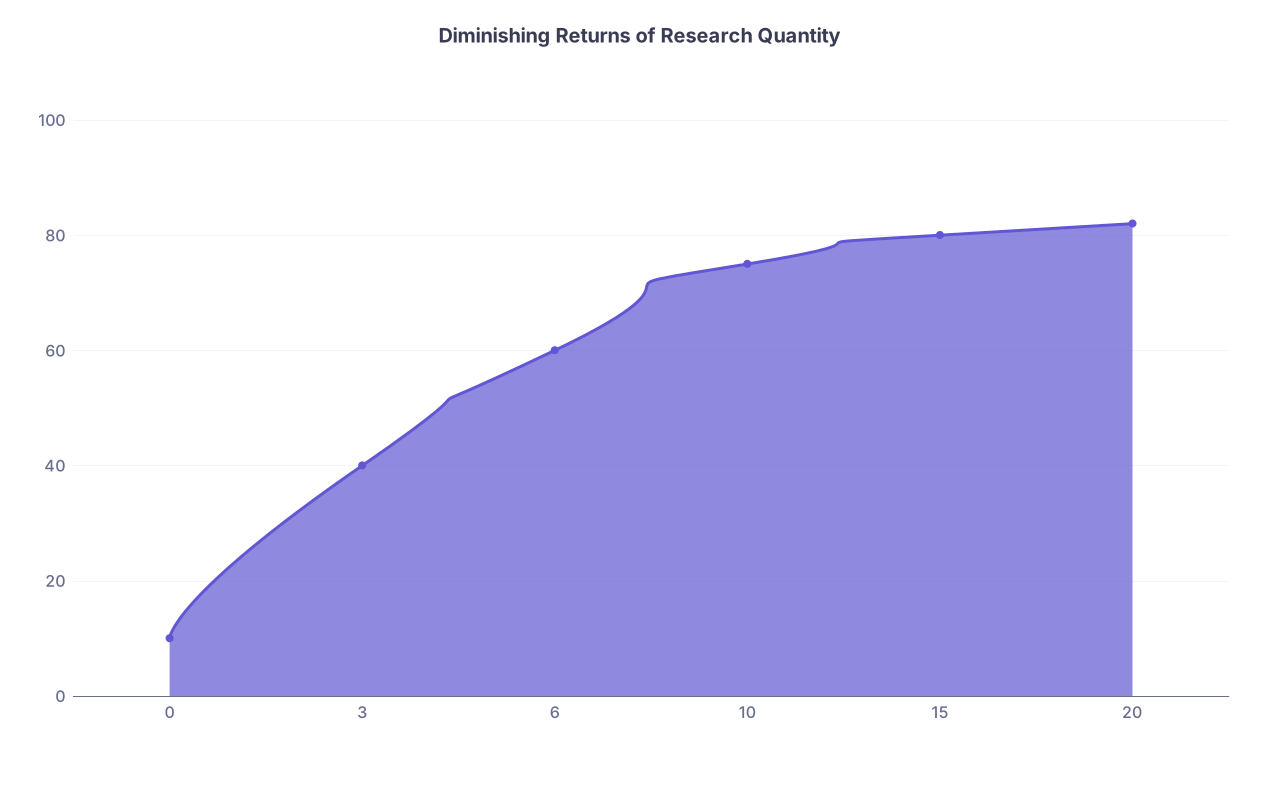
But here’s the part most students miss: after a certain point, quantity has diminishing returns. 2 vs 0 research items matters. 8 vs 2 might matter. 28 vs 18? Almost no one has the time or energy to care.
| Category | Value |
|---|---|
| 0 | 10 |
| 3 | 40 |
| 6 | 60 |
| 10 | 75 |
| 15 | 80 |
| 20 | 82 |
Interpretation: once you clear the “this person does research” threshold, each additional chunk of output adds less and less to perceived competitiveness.
Where quantity hurts you
I’ve watched PDs roll their eyes at CVs loaded with nonsense:
- 18 case reports from the same attending, all variations of “rare presentation of common thing.”
- 12 posters at small institutional research days, all with copy‑paste methodology.
- Abstracts that were never followed by actual manuscripts. Ever.
This triggers a different filter: “CV padding” and “this person optimizes checkboxes instead of depth.”
Red flags programs notice:
- Long list of items with you always at the very end of the author line.
- Projects in 5 completely unrelated fields without any coherent theme.
- Nothing that shows ownership—no first‑author anything, no continuity.
Quantity without clear involvement makes you look like someone’s research ornament, not a future colleague.
Quality: What Actually Counts as “Good” Research for Matching?
“Quality” is another abused word. Students equate quality with impact factor. Faculty occasionally do the same. PDs? They mostly care about signal, not the statistical purity of your methods.
Quality research, from a residency selection standpoint, tends to have:
- Clear ownership – first‑author or second‑author where you can credibly explain your role.
- Coherence – a pattern that lines up with your stated interest.
- Completion – not just “in progress,” but submitted, accepted, or at least presented.
Let’s make it concrete.
Example: Two derm applicants
Applicant A:
- 18 “research items”
- 0 first‑author papers
- 12 case reports, 4 posters, 2 local oral presentations
- Research mostly in miscellaneous internal medicine oddities
Applicant B:
- 4 “research items”
- 2 first‑author derm review articles in mid‑tier journals
- 1 poster at AAD (American Academy of Dermatology)
- 1 retrospective study in progress, with clear role in data collection and analysis
Applicant A looks “bigger” on paper. Applicant B looks like someone genuinely entering the dermatology ecosystem. At most serious academic derm programs, B is more interesting in the interview room.
Because here’s the hidden priority: PDs are not just judging past productivity. They’re predicting future behavior.
– Who is going to get involved in departmental projects?
– Who can write a decent IRB or abstract without hand‑holding?
– Who might become faculty one day?
That’s why:
- A well‑done single retrospective study with you as first author often carries more weight than nine meaningless case reports where you barely know what happened.
- A strong poster at a relevant national meeting beats 5 local “Student Research Day” posters.
Quality also shows in how you talk about it
I’ve seen this exact interview exchange:
Attending: “So tell me about this study you were involved with on melanoma outcomes.”
Applicant: “Sure, I primarily helped with data collection.”
Attending (after a few follow‑up questions): realizes the applicant cannot explain:
- why certain variables were chosen
- what the main statistical test was
- what the primary outcome actually meant clinically
That destroys perceived “quality” instantly—even if the paper is in a high‑impact journal. You look like a passenger.
Compare with:
“I designed the chart abstraction form with my mentor, we had to negotiate what was feasible to collect reliably across 300 charts. We used logistic regression to look at which factors predicted sentinel lymph node positivity, and the big surprise was that X wasn’t significant when adjusted for Y.”
Even if the paper ended up in a modest journal, that is quality. You’re doing the thinking.
Specialty Differences: Where Research Truly Matters vs Where It’s Overhyped
Not every competitive specialty treats research the same way, and acting like they do is how you waste years on the wrong projects.
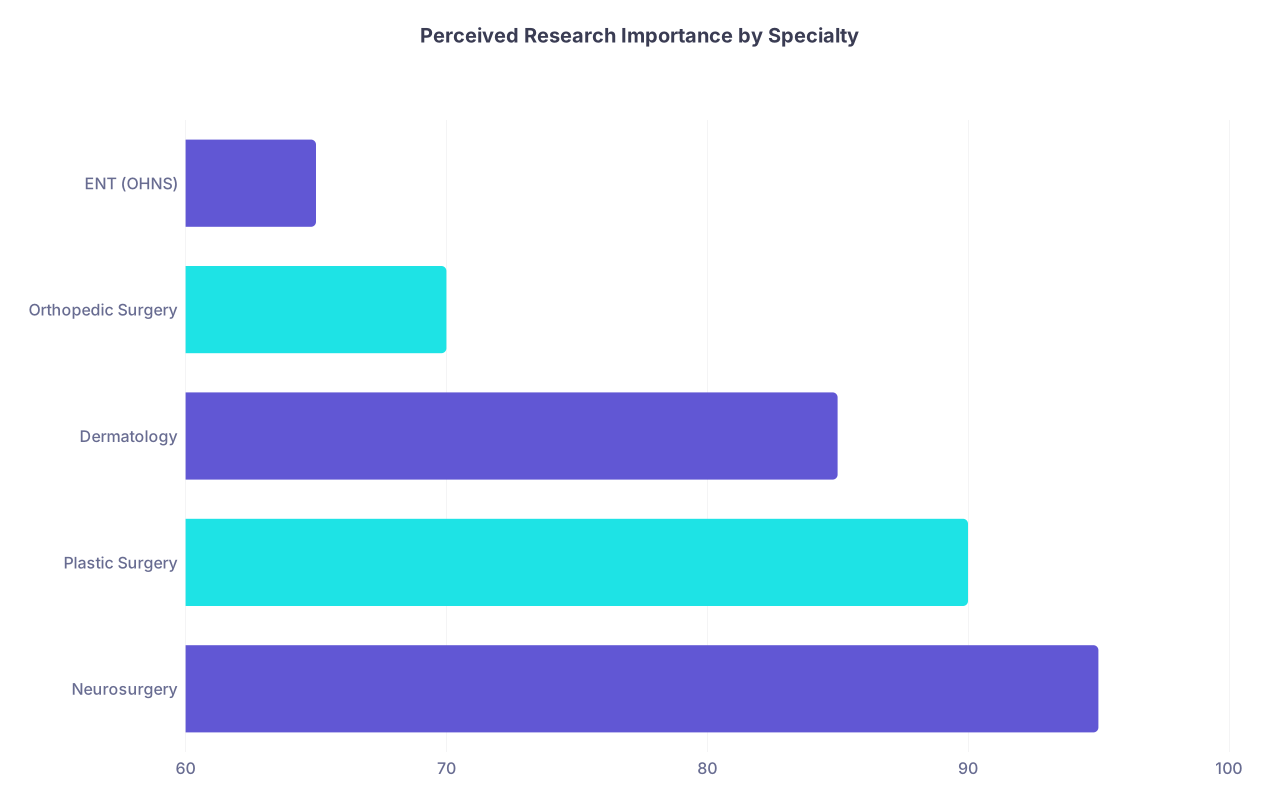
| Specialty | Research Weight | What PDs Really Look For |
|---|---|---|
| Dermatology | Very High | Specialty‑aligned, continuity, ownership |
| Plastic Surgery | Very High | Lab or outcomes work, mentorship lineage |
| Neurosurgery | Extremely High | Volume + serious projects, often basic science |
| Ortho Surgery | High | Clinical projects, biomechanics, sports, outcomes |
| ENT (OHNS) | Moderate–High | Some ENT‑related work, can be a differentiator |
Neurosurgery & plastics: where big quantity and quality matter
These are the few fields where double‑digit real publications can actually shift your odds. Not because PDs love PubMed screenshots, but because the culture still worships academic output.
In top neurosurgery programs, a candidate with:
- 15+ neurosurgery‑related papers
- A known mentor in the field calling on their behalf
- Time spent in a dedicated research year
…is playing a different game than someone with 3 unrelated abstracts.
But even here, the type of work matters. A long author list basic science paper where you did bench work and can explain the pathway beats 7 random case reports in low‑tier journals.
Dermatology: coherence and connections over raw count
Derm is weird. There are people matching with what look like “mediocre” numbers on paper and others failing with insane research output. The difference:
- Some applicants have a narrative that makes sense.
- Others are just hoarding items.
Strong derm match profiles typically show:
- At least one sustained derm research relationship over a year or more
- Something that reached the derm world: AAD, JAAD, JAMA Derm, Cutis, etc.
- A mentor in derm willing to advocate for you
A random pile of hospitalist case reports doesn’t do that.
Ortho, ENT, others: “just enough to not look unserious”
For mid‑to‑high competitive surgical fields, you don’t always need a research year. What you do need is:
- A couple of solid ortho / ENT / specialty‑relevant projects
- Enough items to not look like you ignored scholarship entirely
- Letters from people who actually worked with you on those projects
PDs in these fields are quite open about it: they’d often prefer a resident who can operate, work hard, and be reliable over a pseudo‑postdoc who hates the OR but loves R.
| Category | Value |
|---|---|
| Neurosurgery | 95 |
| Plastic Surgery | 90 |
| Dermatology | 85 |
| Orthopedic Surgery | 70 |
| ENT (OHNS) | 65 |
How Programs Actually Read Your Research Section
Here’s roughly what happens when a faculty member or PD scans your ERAS research in a competitive field:
Quick glance at total number of items.
- “Zero?” Problem.
- “Some?” Ok.
- “A lot?” Mildly intrigued, mildly suspicious.
Scan journals and conference names.
- Real specialty‑relevant venues? Good.
- Predatory or obviously shady journals? Very bad.
- Only institutional stuff? Neutral, slightly weak.
Look for your role.
- First author anywhere? Nice.
- Always buried? Questions.
- Mix? Normal.
Check for theme and continuity.
- Do they look like a future [specialty] person or just a tourist?
- Any mentor they recognize?
Optional: Ask you about it in the interview to see if you actually understand it.
That’s it. No one is building an impact‑factor weighted, h‑index equivalent ERAS scoring algorithm for you.

| Step | Description |
|---|---|
| Step 1 | Open ERAS Application |
| Step 2 | Scan total research items |
| Step 3 | Negative impression |
| Step 4 | Scan journals and venues |
| Step 5 | Check author roles |
| Step 6 | Look for specialty theme |
| Step 7 | Flag for possible interview questions |
| Step 8 | Any research? |
How You Should Actually Approach Research (If You Want to Match Big)
There’s a smarter way to play this than “collect as many case reports as possible.”
1. Anchor yourself to a specialty early enough
You do not need to know PGY‑1 of med school that you’re a future plastics attending. But by early MS3, if you’re gunning for derm/plastics/neurosurg, you should have:
- Picked a specialty direction
- Found at least one mentor in that field
- Attached yourself to 1–2 ongoing projects with a clear path to completion
Waiting until late MS4 and then panic‑cranking research is how you end up with a padded but hollow CV.
2. Favor depth over scatter
It is almost always better to:
- Have 2–3 projects in the same specialty, some of which actually finish
than - 9 micro‑projects in 7 fields, none of which you can explain.
Depth also impresses letters writers—they’ve seen you show up repeatedly.
3. Push for completion, not perfection
A first‑author poster at a national meeting is far more valuable for your application than a hypothetical future “perfect” paper that never leaves your hard drive.
I’ve seen students sit on data for a year chasing some fantasy of a big‑name journal and end up with:
- “Manuscript in preparation” on ERAS (translation for PDs: will never happen)
- Zero actual citable output at interview time
Get things over the finish line:
- Write the abstract and get it submitted.
- Turn the poster into a modest paper if the data support it.
- Accept that a smaller real publication beats a big imaginary one.
4. Avoid obvious CV padding
PDs can smell desperation. Patterns that scream “I’m gaming this”:
- 10 case reports all submitted within 2 months, all with nearly identical author lists.
- Projects where your described role is “helped with literature review” on 8 different papers.
- Predatory journals with suspicious names and ultra‑fast acceptance.
If you’re not sure if a journal is questionable, look it up. Or ask a real research mentor, not a classmate who brags about “acceptances in 7 days.”

5. Learn one real skill
Want to stand out? Instead of chasing raw item count, become the person who can actually do something concrete:
- Clean and manage a dataset in R or Python.
- Run and interpret basic statistics beyond t‑tests.
- Design a REDCap database.
- Systematically screen and extract data for a meta‑analysis.
Then you’re not just a warm body; you’re a useful collaborator. That leads to more and better projects, without you begging for scraps.
The Real Myth: That Research Alone Will Save a Weak Application
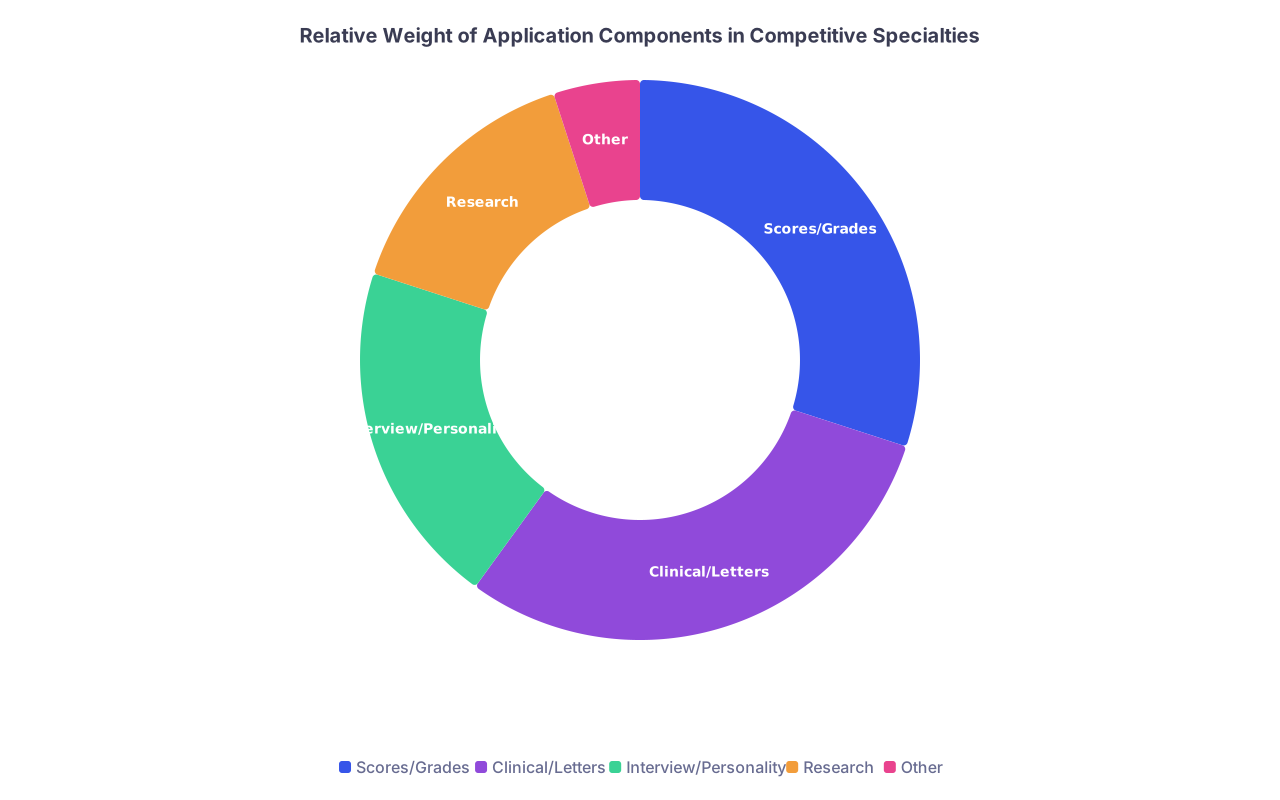
One last hard truth: research is not a magic eraser for poor clinical performance or terrible letters. In most competitive specialties, the hierarchy still looks something like this:
- Step 2 CK / overall academic performance
- Clinical evaluations and narrative letters
- Program “fit” and interview performance
- Research (type, quality, and relevance)
- Everything else (leadership, volunteering, hobbies)
| Category | Value |
|---|---|
| Scores/Grades | 30 |
| Clinical/Letters | 30 |
| Interview/Personality | 20 |
| Research | 15 |
| Other | 5 |
So no, 25 publications are not going to rescue:
- Mediocre clerkship comments that hint you’re unreliable.
- A lukewarm or generic letter from the chair.
- A Step 2 score far below the program’s historical range.
Research is a lever. Not a parachute.
Key Takeaways
- Raw research quantity helps you avoid being filtered out, but has steep diminishing returns and can backfire if it looks like padding.
- Quality, from a PD’s perspective, means ownership, completion, and specialty‑aligned coherence—not just journals with big names.
- The best strategy for competitive specialties is targeted, sustained research in your field of interest, with real involvement and at least a few projects actually finished and visible, not a bloated list of filler.