The way most students “take a gap year” almost guarantees it will not move the needle for a competitive match.
You cannot wander for 12 months and expect to land dermatology, plastics, ortho, neurosurgery, ENT, or IR just because you “did some research.” This year has to look like a project plan, not a sabbatical.
Below is your playbook: a month‑by‑month, then week‑by‑week structure for a 12‑month gap year specifically designed to boost your odds in competitive specialties.
Assume you are:
- Applying to a competitive specialty (derm, ortho, ENT, plastics, neurosurg, urology, IR, rad onc, etc.)
- Already have or will have Step 2 CK by early in this year
- Planning to submit ERAS at the end of this 12‑month window
If your timeline is slightly shifted (e.g., you start in March instead of July), keep the sequence of tasks; just slide the months.
Big Picture: How Your 12 Months Should Look
At this point you need a clear structure. Here’s the skeleton:
| Quarter (3 mo blocks) | Primary Focus | Secondary Focus |
|---|---|---|
| Months 1–3 | Secure position + ramp | Build relationships |
| Months 4–6 | Heavy productivity | Early outputs + networking |
| Months 7–9 | Finish products | ERAS + letters |
| Months 10–12 | Interview prep | Last‑minute products |
And visually:
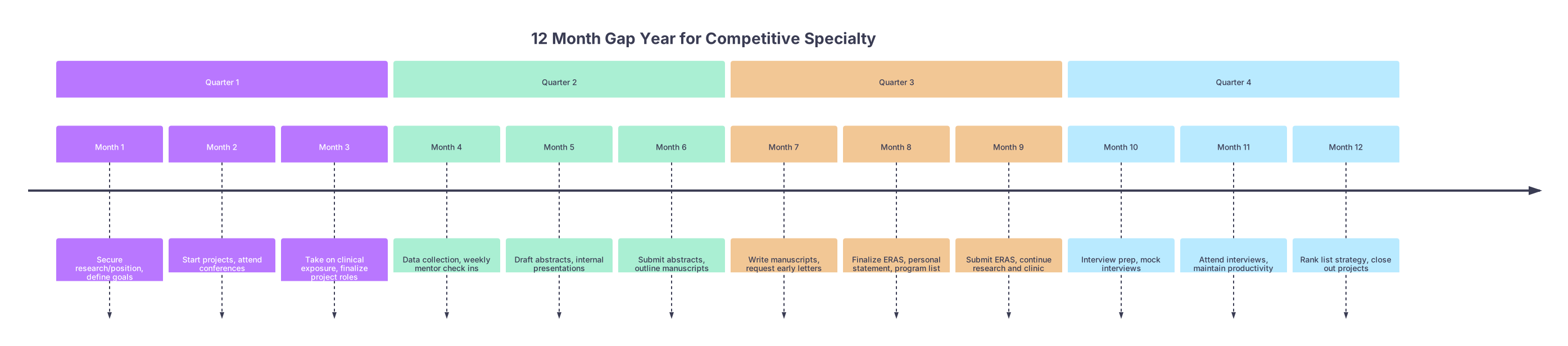
| Period | Event |
|---|---|
| Quarter 1 - Month 1 | Secure research/position, define goals |
| Quarter 1 - Month 2 | Start projects, attend conferences |
| Quarter 1 - Month 3 | Take on clinical exposure, finalize project roles |
| Quarter 2 - Month 4 | Data collection, weekly mentor check ins |
| Quarter 2 - Month 5 | Draft abstracts, internal presentations |
| Quarter 2 - Month 6 | Submit abstracts, outline manuscripts |
| Quarter 3 - Month 7 | Write manuscripts, request early letters |
| Quarter 3 - Month 8 | Finalize ERAS, personal statement, program list |
| Quarter 3 - Month 9 | Submit ERAS, continue research and clinic |
| Quarter 4 - Month 10 | Interview prep, mock interviews |
| Quarter 4 - Month 11 | Attend interviews, maintain productivity |
| Quarter 4 - Month 12 | Rank list strategy, close out projects |
You’re going to live inside that structure. Let’s break it down.
Before Month 1: 8–12 Weeks Before the Gap Year Starts
If you are not doing this pre‑work, your “12‑month” gap year is actually a 6–8 month gap year. You lose the ramp‑up.
8–12 weeks before start (while you’re still in school or on rotations):
Identify your home department or target institution(s) in your specialty.
Email 10–20 faculty with:
- 3‑4 line intro (school, year, Step 2, interest in X specialty).
- 1 short paragraph about wanting a dedicated research year / scholarly year.
- Attached CV and USMLE score report.
- Clear ask: “Do you have ongoing projects I could work on full‑time for a research year starting [month/year]?”
Ask about:
- Funded research fellow positions
- “Scholarly year” research tracks
- Dedicated research coordinators with MD/PhD faculty
Your goal before Month 1:
- Signed on to:
- A full‑time research fellowship, or
- A structured combination: 60–80% research + 20–40% clinical exposure (sub‑I style, clinic, call shadowing).
If you start Month 1 still “looking around,” you’re already behind.
Months 1–3: Lock Position, Build Trust, Claim Projects
This is the “prove you’re not a flake” phase. Everyone is sizing you up.
Month 1: Onboarding and Positioning
At this point you should:
- Be physically present at your primary institution.
- Have:
- Hospital badge
- EMR access (if relevant)
- IRB training modules done
- A primary mentor assigned
Week 1–2:
- Sit down with your mentor and ask directly:
- “What would success look like for you at the end of this year?”
- “Which projects need a workhorse right now?”
- Get assigned to:
- 2–3 active projects (not hypothetical future ideas)
- Ideally:
- 1 retrospective chart review or database project
- 1 case series / case report pipeline
- 1 multicenter or prospective project (even if long‑shot for publication this year)
Week 3–4:
- Push for clarity:
- Who’s first author? (Do not be coy here.)
- What’s the realistic timeline for each project?
- Where are the data located? Who else is on the team?
You want at least one project where you are first or second author and timeline to submission is ≤ 9 months.
- “We’ll think about projects later.”
- “Just read these 30 papers for now.”
- Mentor who cancels 3+ meetings in a row.
If this is happening, start quietly networking with other faculty in the same department by the end of Month 1.
Month 2: Become Indispensable
Now you prove speed and reliability.
At this point you should:
- Be touching your projects every workday.
- Have at least:
- 1 data collection form or REDCap instrument drafted
- 1 IRB amendment or protocol you’re helping with
- 1 early outline for a potential abstract or manuscript
Weekly rhythm in Month 2:
- 4 days: hands‑on work (data pulling, chart review, coding, literature search).
- 1 day: meetings, clinic, case discussions, specialty conference.
If you’re in something like ortho, ENT, or neurosurg, try to:
- Attend every M&M conference.
- Go to OR cases for patients on your research list.
- You want attendings to say “Oh, you’re the one working on the [X] outcomes project.”

End of Month 2 checklist:
- You know:
- Exact N targets for your projects
- Which journals or conferences your mentor prefers
- Who writes strong letters in the department
- You’ve sent at least:
- One short “methods” draft or data dictionary for feedback
- One email volunteering for an additional small project if bandwidth allows
Month 3: Convert Work into Concrete Outputs
By now, people have decided if you’re serious. This is where most gap‑year students stall. Do not.
At this point you should:
- Have at least one project where:
40–50% of data are collected, or
- A case series is fully identified and data extraction started.
- Be on track for:
- 1 abstract submission within the next 2–3 months
Weeks 9–12 focus:
- Push to:
- Clean data sets
- Finalize variables
- Start analytics conversations (even if you’re not the stats expert)
Ask for:
- Internal department presentation opportunities:
- Journal club lead
- Research-in-progress talk
- This builds a track record and gives faculty material to reference in your letters.
Months 4–6: Heavy Productivity and Early Wins
This is the “build your CV” quarter. These 3 months often determine how your ERAS looks.
Month 4: Data and Drafts
At this point you should:
- Have daily or near‑daily progress on your main project.
- Be meeting with your mentor every 1–2 weeks.
Week‑by‑week in Month 4:
- Week 13–14:
- Lock dataset for at least one project.
- Sit with a biostatistician or senior resident to plan the analysis.
- Week 15–16:
- Run first pass of analysis.
- Start writing:
- Introduction and Methods sections (you can do this before results are final).
Parallel: Start 1–2 “quick win” projects if you don’t have any (case reports, technical notes, letters to editor).
Month 5: Abstracts and Meetings
This month can produce the first line items on ERAS.
- Specialty‑specific national meetings:
- AAD (derm), AAOS (ortho), CNS/AANS (neurosurg), AAO‑HNS (ENT), AUA (urology), etc.
- Subspecialty or regional meetings in your field.
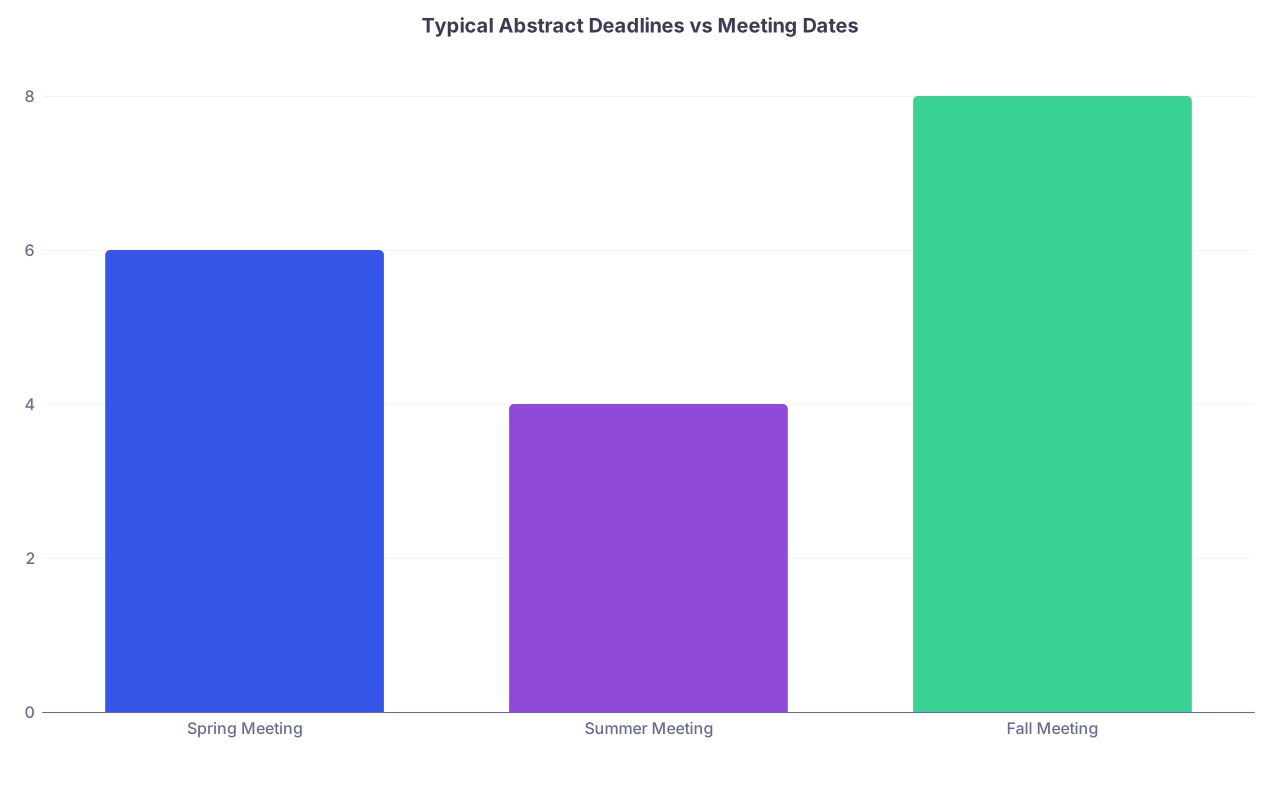
| Category | Value |
|---|---|
| Spring Meeting | 6 |
| Summer Meeting | 4 |
| Fall Meeting | 8 |
(Values represent months between abstract deadline and actual meeting date. Translation: you submit way before you present.)
At this point you should:
- Have 1–3 abstracts ready to submit or under serious draft.
- Be emailing your mentor with:
- Draft abstracts attached
- Proposed meeting targets
- Explicit author order list for confirmation
Week 17–20:
- Finalize and submit abstracts.
- Ask mentors:
- “If accepted, would you support me traveling and presenting?”
- “Are there faculty you’d want me to meet at that meeting?”
Month 6: Manuscript Push and Relationship Building
Now you start turning those projects into papers.
At this point you should:
- Have at least one manuscript draft in progress.
- Have met or meaningfully worked with 2–3 potential letter writers.
Practical moves this month:
- Schedule 1‑on‑1 feedback meetings with:
- Division chief or program director if they know you.
- Senior residents going into your specialty.
- Ask directly:
- “If I keep this pace, does my profile look competitive for [derm/ortho/etc.] here?”
- “What gaps do you see that I can address in the next 6 months?”
If they say:
- “You need more clinical exposure” → add consistent clinic or call shadowing.
- “You need stronger Step 2 or more publications” → adjust expectations or consider dual‑apply planning now, not in panic mode later.
Months 7–9: Finish Products and Build Your ERAS
This quarter overlaps heavily with ERAS prep. You’re now running two tracks: productivity and application.
Month 7: Manuscripts and Early Letters
At this point you should:
- Have:
- 1–2 manuscripts with full drafts
- 1–3 abstracts submitted
- Some presentations lined up or pending review
Week 25–28:
- Push to:
- Incorporate co‑author edits.
- Decide target journal for each paper.
- Start thinking about:
- Personal statement themes (tie your gap year work into it).
Letters of recommendation:
- If you’ve worked closely with a faculty member for ≥4–5 months, ask:
- “Would you feel comfortable writing me a strong letter of recommendation for [specialty]?”
Do not wait until the last second. You want:
- 1–2 home institution letters from your gap‑year mentors.
- At least 1 strong clinical letter from a sub‑I or rotation.
Month 8: ERAS Build and Program List
At this point you should be structuring your application, not just your CV.
Application work this month:
Draft personal statement:
- Emphasize:
- Why this specialty.
- What your gap year showed about your fit (ownership, persistence, seeing patient outcomes over time).
- Emphasize:
Build a realistic program list:
- Mix of:
- Home program and affiliates
- Regionally diverse academic centers
- A few “reach” and plenty of “solid target” programs
- Mix of:
Confirm:
- All test scores uploaded.
- All transcripts and MSPE timing.
Research and clinical work:
- Continue as normal, but:
- Reserve 1–2 evenings per week for ERAS (do not let this drift to last minute).
Month 9: Submit ERAS and Keep Producing
This is the execution month.
At this point you should:
- Submit ERAS early (first few days of opening if possible).
- Have:
- 2–4 submitted manuscripts (could be under review).
- 3–8 abstracts/presentations (submitted, accepted, or presented).
- 2–3 strong letters from your specialty.
Do not stop showing up after ERAS submission. Faculty notice.
Your weeks now:
- 3–4 days:
- Research, clinic, serious work.
- 1–2 days:
- Interview prep (see next section).
- Cleaning up lingering projects (revisions, resubmissions).
Months 10–12: Interview Season, Rank Strategy, and Final Push
These months are where your professional behavior matters as much as your CV.
Month 10: Interview Prep and Visibility
At this point you should:
- Have some interview invites starting to appear (depending on specialty and year).
- Be ready to talk coherently about every line on your CV.
Week‑by‑week:
- Week 37–40:
- Do mock interviews with:
- A faculty mentor
- A senior resident in your specialty
- Practice:
- “Tell me about your research.”
- “Why this specialty?”
- “Why did you take a gap year?”
- Do mock interviews with:
Answers should sound like:
- Intentional plan
- Measurable output
- Growth, not damage control
Meanwhile, at work:
- Keep:
- Attending conferences.
- Showing up on time.
- Closing the loop on projects you promised.
No checking out mentally because you’re “on interview trail.”
Month 11: Interviews and Professional Follow‑Through
This month is chaotic. Travel (or virtual marathons), still working, still writing.
At this point you should:
- Have a system:
- Calendar with:
- Interview dates
- Pre‑interview dinners/socials
- Thank‑you email reminders
- Calendar with:
During interviews:
- Be prepared to:
- Name specific faculty or projects at that institution that align with your gap year work.
- Explain what you’d want to work on if you matched there.
This is where your structured year helps:
- You can say:
- “This year I led a retrospective outcomes study on [X]. At your institution, I’d be excited to join the [Y] outcomes group and build on that.”
Programs want to picture you as a productive resident from day 1.
Month 12: Rank List and Closing the Loop
Final month of the gap year.
At this point you should:
- Have:
- Interview season mostly behind you.
- A draft rank list.
Debrief with:
- At least one trusted mentor in your specialty.
- Ask candidly:
- “Given what you know about me and this year, what range of programs do you think is realistic?”
Use your notes:
- Culture vibes
- Resident happiness
- Case volume
- Research support (if you care about academic careers)
Closing out projects:
- Send:
- Status update emails to all mentors you worked with.
- Clear bullets:
- Submitted manuscripts (where, when).
- Accepted presentations.
- In‑progress work and who will own it after you.
- Offer to:
- Help with revisions even after you start residency (within reason).
This is how you protect your reputation and keep long‑term relationships, which matter for fellowships later (peds ortho, spine, micro, Mohs, etc.).
How to Adjust by Specialty (Quick Notes)
Some specialties have quirks. Here’s the condensed version.
| Specialty | Extra Emphasis | Must-Have Exposure |
|---|---|---|
| Dermatology | Publications volume | Derm clinic, biopsy exposure |
| Ortho | Big datasets, outcomes | OR time, fracture call |
| Neurosurg | Longitudinal projects | OR and ICU, conferences |
| ENT | Case series, QI | Clinic and OR, airway cases |
| Plastics | Technical case reports | OR, micro or hand exposure |
You don’t need to reinvent your year. You just bias it:
- Derm → more papers, case reports, derm‑specific meetings.
- Ortho → registries, multicenter collaborations, AO/AAOS presence.
- Plastics → visually clear before‑after cases, strong portfolio of case reports and technique articles.
Non‑Negotiables For This 12‑Month Gap Year
Let me be blunt. If you ignore these, the year will look soft:
Structure the year like a job, not an extended rotation.
40+ productive hours per week, every week. Show up. Be accountable.Aim for submitted products, not just “working on” things.
Abstracts, manuscripts, presentations in the pipeline by Month 6–9.Use the year to earn advocates, not just lines on a CV.
You want 2–3 faculty who can say, with a straight face:
“This student works at the level of an intern already, and I’d want them in my program.”
If you anchor your 12 months on those three points—and follow the timeline above—you’re not just “taking a gap year.” You’re running a focused, year‑long campaign to make yourself very hard to ignore on Match lists.