
You are here
It’s late January. Your last big-name interview just wrapped. Your suit is finally back in the closet. Your inbox is quieter—but your brain is not.
You’re aiming for a competitive match: derm, ortho, plastics, ENT, urology, neurosurgery, integrated vascular, rad onc, IR. Everyone tells you “just rank in your true order.” That’s cute. You’re staring at 14 amazing programs that all start blending together. One of them will be your life for the next 5–7 years. Maybe more.
This is where people make real mistakes. Rushed rank lists. Overweighting prestige. Ignoring red flags they felt but never wrote down. Or worse—missing deadlines because they thought NRMP/ERAS reminders would “be enough.”
Let’s walk it week by week from final interview → submitted rank list, with competitive-specialty specifics baked in.
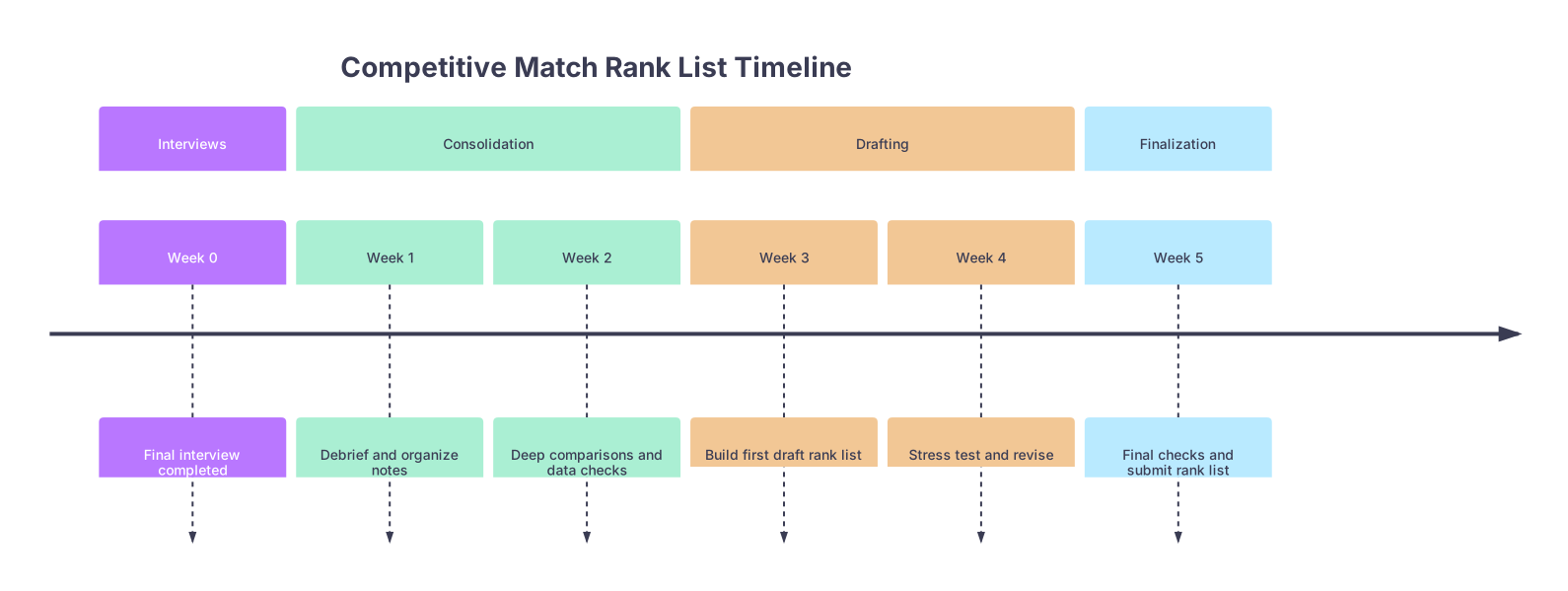
| Period | Event |
|---|---|
| Interviews - Week 0 | Final interview completed |
| Consolidation - Week 1 | Debrief and organize notes |
| Consolidation - Week 2 | Deep comparisons and data checks |
| Drafting - Week 3 | Build first draft rank list |
| Drafting - Week 4 | Stress test and revise |
| Finalization - Week 5 | Final checks and submit rank list |
Week 0–1: Right after your last interview – capture everything
You just finished your final interview (or you know you’re at the end of the realistic invite window). At this point you should lock down your impressions while they’re still vivid.
Within 24–48 hours of each remaining interview
If you still have 1–2 interviews left, start this now for those, and retroactively for earlier ones.
At this point you should:
Do a 10–15 minute brain dump per program
Write exactly what you remember, unfiltered:- Best moment of the day
- Worst moment (awkward comment, hostile vibe, chaos)
- Resident mood: tired-but-fine vs checked-out-miserable
- Any “I could absolutely see myself here” feeling
- Any “I would be embarrassed to tell people I matched here” thought (yes, write that too)
Score programs on the things that actually matter in competitive fields
Keep it simple. Use a 1–5 or 1–10 scale, but stay consistent.Consider categories like:
- Training rigor / operative volume / case variety
- Ortho: joints, trauma, spine exposure
- ENT: skull base, otology vs head & neck balance
- Derm: complex med derm vs pure cosmetics vs Mohs
- IR: independent procedures vs diagnostic-heavy
- Fellowship / job outcomes
- Resident happiness and cohesion
- Location + cost of living
- Support for early subspecialty interests
- Training rigor / operative volume / case variety
Capture numbers while you still remember them
Things like:- Number of faculty in your niche (e.g., “3 spine attendings,” “1 Mohs surgeon, 0 peds derm”)
- Average operative cases cited by residents (not glossy brochure numbers)
- Board pass rates, fellowship match slides shown on interview day
You are not trying to build a rank list yet. You’re building the dataset your future self will need.
Build a quick comparison sheet
At this point you should put everything into something structured you can actually look at:
| Factor | Program A | Program B | Program C |
|---|---|---|---|
| Training rigor (1–5) | |||
| Operative volume (1–5) | |||
| Resident happiness | |||
| Location fit | |||
| Prestige / reputation |
Do this now, not two days before the rank deadline when everything has blurred.
Week 1–2: Decompress, then start serious comparisons
You’ve survived the tour season. At this point you should give yourself 48–72 hours off. No spreadsheets. No stalking SDN or Reddit. Just let the adrenaline drop.
Then get systematic.
Step 1: Hard criteria vs nice-to-haves
Open your notes. At this point you should clearly separate:
Non-negotiables
Examples I’ve seen students define:- “I must train somewhere with strong complex spine.”
- “I must be in a city where my partner can work in finance.”
- “I will not do 120+ hour weeks for 6 years. Period.”
- “I need a program where at least half the residents have kids / families.”
Strong preferences
- “I prefer academic over community.”
- “I’d like a path to a competitive fellowship but not at any human cost.”
Truly minor stuff
- Beautiful brand-new hospital
- Free food
- On-call room quality
(These feel big on interview day. They’re not.)
Write these categories down. Seeing them in front of you exposes how often people reverse them (choosing aesthetics and “prestige” over all else).
Step 2: Reality-check competitiveness vs list length
If you’re in a competitive match, at this point you should make sure your rank list will be long enough.
Use this rough sanity check (assuming you applied broadly, not just 10 reach programs):
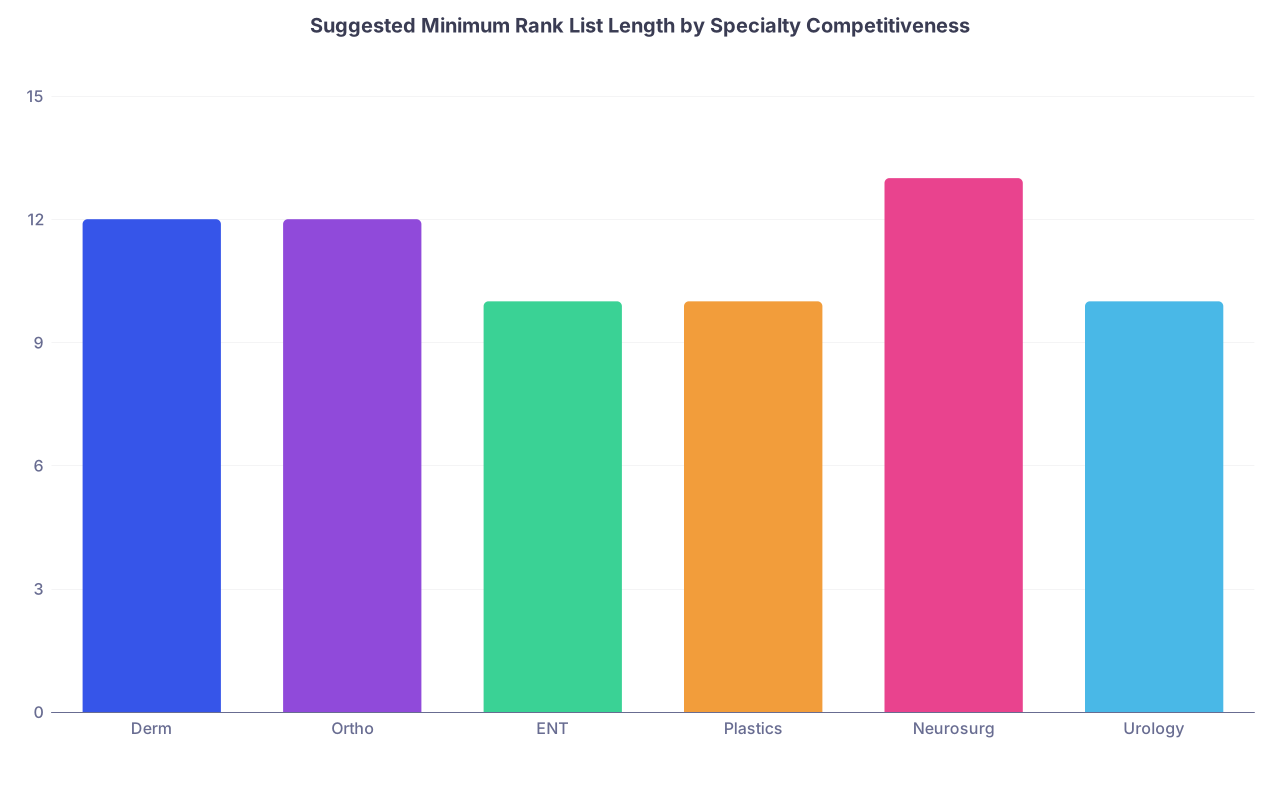
| Category | Value |
|---|---|
| Derm | 12 |
| Ortho | 12 |
| ENT | 10 |
| Plastics | 10 |
| Neurosurg | 13 |
| Urology | 10 |
These are not magic numbers, but if you’re ranking way under them and you’re not a top 1–2% applicant (think 270s + big-name research + home program love), you’re playing risky games.
If you have fewer than ~10 realistic programs for the ultra-competitive fields, you should:
- Re-check for prelim / categorical backup plans where appropriate
- Talk frankly with a trusted mentor this week, not after the rank deadline
Week 2–3: Building your first real draft rank list
Now you have data. At this point you should build a draft rank list and accept that it will change.
Step 1: Group programs into tiers
Do not start with 1–14. Your brain will freeze.
Instead, at this point you should:
Make three buckets on paper or a whiteboard:
- Tier 1: “I’d be thrilled here”
- Tier 2: “I’d be fine here”
- Tier 3: “I’d tolerate this if it meant matching”
Put programs into tiers based on gut + hard criteria, not prestige alone
- If you can’t imagine being happy living there → Tier 3 or off the list
- If you loved the residents but training seemed weak in your area → probably Tier 2
Only after that, sort within each tier.
Step 2: Forced-choice matchups
Where people stall: “I like A and B both, no idea which to put first.” Fine. At this point you should run program vs program face-offs.
Take your top 6–8 and do pairwise comparisons:
- A vs B: If you could only match at one, which would you pick, and why?
- B vs C
- A vs C
- Repeat until you’re sick of it
Write short reasons: “A over B because better operative autonomy + closer to family.” When you see those reasons written three times, a hierarchy emerges.
Step 3: Adjust for specialty-specific traps
This is where competitive specialties differ. A few harsh truths:
Derm
- Purely “chill” programs with almost no complex med derm or inpatient consults can burn you when you want academic or subspecialty fellowships.
- Overweight: breadth of pathology, fellowship match data, research support.
Ortho / Neurosurg / ENT / Plastics
- Lifestyle at top programs may be bad on paper but produce confident, independent surgeons. Some “chiller” programs quietly graduate residents who scramble for fellowship spots.
- Overweight: operative autonomy by PGY level, scope of index cases, how often fellows “take” cases.
Urology / IR / Rad Onc
- Small fields. Reputation within the field and alumni network matter more than Doximity scores.
- Overweight: where recent grads went, who writes your LORs at the next stage, how often residents are pushed into careers they did not want.
Start moving programs up or down based on training quality in your intended career path, not generic brand name.
Week 3–4: Stress-test your list and sanity-check with mentors
By now you should have a draft rank list that feels 70–80% right. Good. At this point you should try your hardest to break it.
Step 1: Run “forced futures”
For each top 5–7 program, imagine:
It’s July 15. You matched there.
- What’s your commute like?
- Who are the co-interns you met on interview day?
- Are you excited to learn from those faculty?
It’s 5 years from now. You finished there.
- Can you get the fellowship or job you want from that program?
- Do alumni actually do that?
Write fast responses underneath each program name. If there’s a program where your “July 15” or “Year 5” mental picture feels empty, that’s a red flag.
Step 2: Check mentor and insider opinions – selectively
At this point you should talk to:
- 1–2 faculty in your specialty who:
- Know your file
- Know your goals
- Have actual national-level insight (serve on committees, review applications, attend national meetings regularly)
Do not crowdsource your rank list to 10 people. That just gives you 10 conflicting biases.
Ask specific questions like:
- “Between [Program X] and [Program Y], which do you think better positions me for [peds ENT fellowship / academic spine / Mohs, etc.] and why?”
- “Have you seen any recent concerning patterns from [Program Z] graduates?”
Then decide how much weight to give their take. They are not living your life. You are.
Step 3: Filter the noise
Competitive fields are full of prestige-drunk commentary. At this point you should consciously discount:
- The classmate who says, “I’d never go to [solid regional program], it’s not top 10.”
- Residents on social media who only show the happy parts.
- Anonymous forum rankings that treat all “lower-tier” programs as identical.
If your gut and your data say Program #4 is where you’d be happiest and still well-trained, you put it #1. The algorithm rewards honest preference.
Week 4–5: Final checks, logistics, and last-minute scenarios
Rank list certification week. This is where people get sloppy. At this point you should switch to detail-obsessed mode.
Step 1: NRMP / specialty-specific match deadlines
Some competitive specialties (urology, ophtho) use separate match systems with different calendars. If you are in one of those, you should already know this—but verify again.
Create a tiny one-look reference:
| Match System | Specialty Example | Rank List Deadline (Approx) |
|---|---|---|
| NRMP | Derm, Ortho | Late Feb / Early Mar |
| AUA Match | Urology | Early Jan |
| SF Match | Ophtho, Plastics | Early Jan / Mid Jan |
Do not trust your memory. Put the exact dates and times (with time zone) in your calendar with alerts.
Step 2: Final program-by-program safety check
At this point you should go down your draft list, one program at a time, and ask:
Would I rather scramble / SOAP than match here?
- If yes → remove it.
- If no → it can stay, even if it’s last.
Is this program truly rankable for me and my life?
- Location your partner absolutely refuses?
- Program with glaring resident mistreatment you tried to ignore?
- Gut says “no” every time?
Drop it.
Remember: You are not required to rank everywhere you interviewed. That myth pushes people into miserable matches.
Step 3: Backup planning for ultra-competitive paths
If your application was mid-range or below in a hyper-competitive field (e.g., new Step 2 pass, limited research, weak letters), at this point you should have:
Clear backup lanes:
- Prelim surgery and re-apply (for some surgical subspecialties)
- Transitional year + research
- Willingness to switch specialties if needed
Mentors who know your risk profile and have agreed to help you post-Match if things go badly
You do not need to broadcast this. But be honest with yourself.
Final 72 hours: Clean decisions, no wishy-washy edits
The panic window. At this point you should avoid making big changes based on last-minute emotion.
3 days out
- Log in to NRMP (or your match system) and enter your full list, in order, calmly.
- Step away for at least half a day.
- Come back and read it top to bottom and ask:
- “If I matched at my #1, would I be happy?”
- “If I slid to #4, could I still see myself thriving?”
- “Is there anywhere on here that would feel like a real mistake?”
Fix any obvious order errors. But do not keep shuffling slots because of anxiety alone.
24 hours out
At this point you should:
Confirm:
- All program codes are correct
- Categorical vs prelim status matches your intent
- Any couples match linking is set and verified
Print or save a PDF of your final list for your own records.
Do not crowdsource changes now. I’ve watched people ruin a good list because a classmate said, “Wait, you put [X] over [Y]? Bold.” Ignore that.
Day of the deadline
You know what you’re doing:
- Log in early in the day, not 10 minutes before the cutoff.
- Confirm:
- Certification checkbox is checked.
- System shows “Rank List Certified” with the correct timestamp.
Then log out. Do not log back in and fiddle unless you spot an actual, factual error.
Competitive-specialty nuances you should factor anywhere in the process
These apply across the weeks. If you missed them earlier, revisit your list once with each lens.
Autonomy and case ownership
In competitive surgical specialties, at this point you should ask:
- Who actually operates?
- You heard residents say “fellows take everything”? Believe them.
- Are there multiple hospitals where residents get jerked around with no continuity?
- Do seniors sound confident or vague about their “numbers”?
If a program’s prestige is high but real autonomy is low, think hard before ranking it over a slightly “less fancy” program that lets you actually cut.
Mentorship and subspecialty alignment
You’re not just matching to a hospital. You’re matching to future letter writers and sponsors.
At this point you should know:
- Are there 2–3 people in your desired niche who:
- Showed up and seemed invested in residents
- Have active projects / trials / grants
- Have graduates who look like who you want to be
One superstar faculty who’s barely around is not a “program strength.”
Resident culture honesty check
You saw the best version of them on interview day. Even so, leaks show.
Look back and ask:
- Did any resident accidentally hint at:
- Massive attrition
- Toxic attendings everyone “knows” about
- Constant schedule changes without notice
- Were answers about wellness cartoonishly scripted?
If multiple programs had red flags, move them down as a group. Misery in a competitive field spreads fast.
Your next step today
Do not “think about this later.” You’re already in the post-interview fog.
Today, before you close this tab, do one concrete task:
Open a blank document and list every program you interviewed at, in any order. Next to each, write a single sentence starting with “My gut reaction:” and finish it without overthinking.
That 15-minute exercise will anchor everything else you build in the next few weeks.