
The myth that “school name is everything” in competitive matches is lazy, half-true advice that hurts smart applicants.
Let me tell you what really happens in program rooms when it comes to prestige, performance, and those ultra-competitive specialties.
How Program Directors Actually Think About Prestige
Here’s the unfiltered truth: name brand absolutely matters in competitive specialties—but not the way students think, and not nearly as much as raw performance once you clear a very real threshold.
For something like derm, plastics, ortho, neurosurgery, ENT, or high-end academic radiology, there are three mental “buckets” most faculty use when they first scan your application:
- Known powerhouse schools
- “Solid but not famous” schools
- Schools they do not recognize at all
That’s it. No nuanced algorithm. Just: do I know this place, do I trust its grading and letters, and have we taken their grads before.
At a selection meeting, I’ve heard exactly this:
“He’s AOA from Hopkins, 260+ Step 2, research in our field. That’s easy – interview.”
“She’s from a mid-tier Midwest school, but she rotated with us and crushed it. Strong letters. Also an easy yes.”
“I don’t know this Caribbean school. Step is good, but I have 70 other applicants with similar numbers from places I know. Pass.”
Notice what happened there:
- Prestige opened the door quickly for one person.
- Performance and direct observation opened the same door for another.
- Unknown school with no other hook? Dead in the water, even with a good score.
Prestige is a multiplier, not a replacement for performance. It makes strong performance look even stronger. It does not rescue mediocre performance in competitive fields. And once you hit the top performance tier, the prestige advantage shrinks faster than people admit.
What “Prestige” Actually Buys You
Let’s stop talking about prestige like it’s a religious concept and talk about what it really changes, day to day, in the match process.
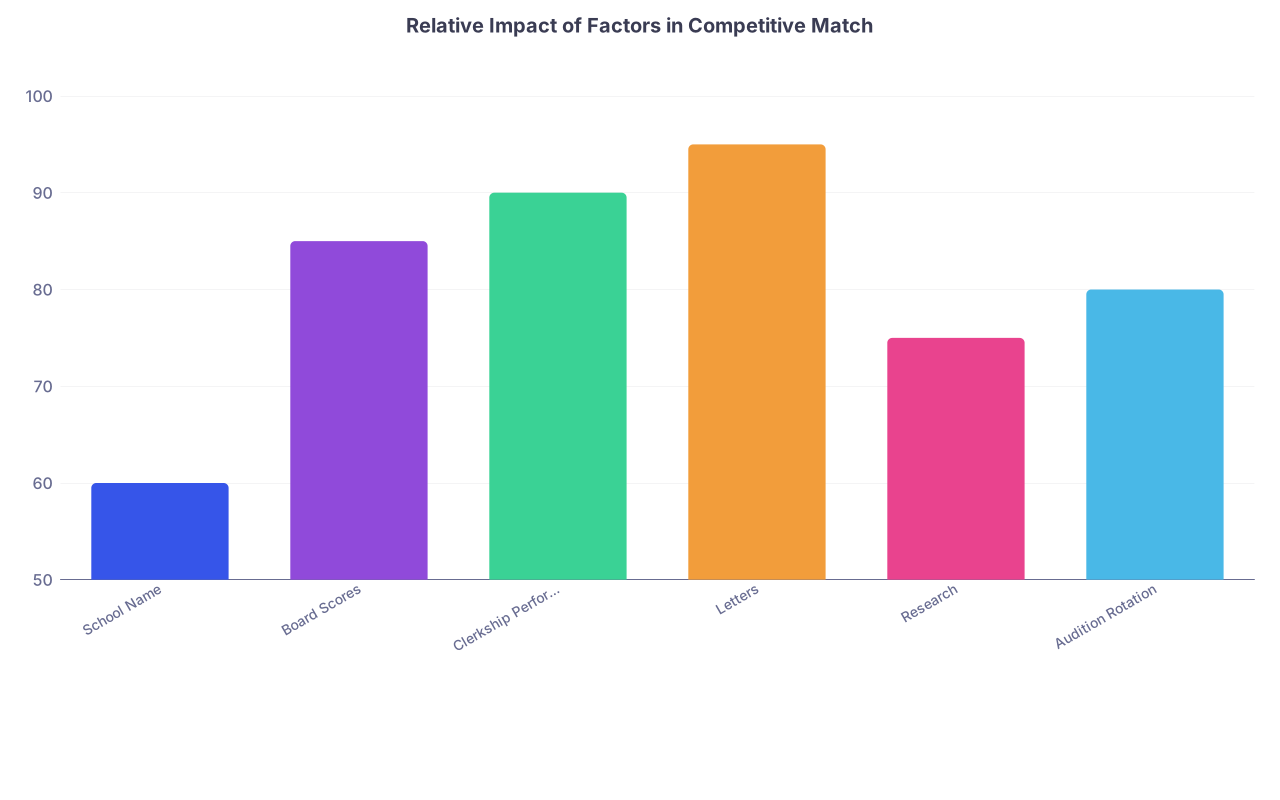
| Category | Value |
|---|---|
| School Name | 60 |
| Board Scores | 85 |
| Clerkship Performance | 90 |
| Letters | 95 |
| Research | 75 |
| Audition Rotation | 80 |
This is roughly how competitive specialty program directors perceive the impact, not what students are told.
School name buys you:
Default trust in evaluation systems
If you’re from UCSF, Penn, Duke, Michigan, Harvard, etc., faculty feel they “know” what Honors means there, what AOA means there, what a department chair letter means. They have context.
From a school they barely recognize? They do not know if your “Honors” equals their “High Pass,” and many will subconsciously downshift your performance.Shortcut credibility in borderline cases
Two applicants. Both 250 Step 2, similar research, similar number of honors. One from Stanford, one from an unranked newer school. On a busy ranking night when people are tired, someone will say, “The Stanford kid is probably safer.” There’s your edge.A stronger peer comparison pool
This is cruel but real. If you are top 10% at a place that sends multiple people into derm/ortho every year, that “top 10%” label hits harder than being top 10% at a school that rarely matches into those fields. PDs know the ecosystems.Networked letter writers
This is the big unspoken one. A bland letter from a nationally known name is sometimes more powerful than a glowing letter from someone nobody in that room has heard of. When a PD sees a letter writer who’s on conference panels with them every year, it automatically carries more weight.
But here’s what prestige doesn’t do as much as people think: it doesn’t rescue you if the numbers, the clinical comments, and the narrative are mediocre. In competitive fields, big-name programs are drowning in “good, not great” applicants from those same big-name schools. They do not need you just because of your crest.
Performance: The Currency That Actually Moves Needles
If you want competitive, here’s the harsh reality: you cannot be “fine.” You must be undeniably good for your environment.
And this part is key: program directors mentally normalize you to your environment. Which is where the prestige obsession gets stupid.
I’ve seen this argument on student forums: “I’d rather be average at a top-10 than top of my class at a mid-tier because prestige wins.” That’s how you lose derm and ortho offers.
Because in that selection room, the conversation actually sounds like this:
“He’s from Columbia but mostly High Passes, no AOA, no clear department support.”
“She’s from Iowa, but she’s AOA, all Honors in cores, department letter says ‘top student in five years.’ Put her higher.”
Let’s break down the performance pieces that actually matter.
1. Board Scores (yes, still)
Step 1 going pass/fail did not kill score screening. It just moved the choke point to Step 2 CK, especially in competitive specialties.
Uncomfortable truth:
- 250+ Step 2 CK from a mid-tier or newer MD school puts you in play at places that would not read you at 235.
- 260+ from a DO school suddenly gets you treated like a serious candidate at historically MD-heavy programs.
- 245 from Harvard is not “the same” as 245 from a school no one knows. But 260 from a state school absolutely erases a lot of the Harvard glow.
People love pretending holistic review is dominant. It is not. Not in the first pass for competitive specialties. Your performance on standardized exams is still often the first hard filter, then they look at context.
2. Clerkship performance and narrative comments
Clerkship grades are not just grades. They’re your early reputation.
What PDs care about in your MSPE and clerkship evaluations:
- How many honors in core rotations, especially surgery, IM, and any field adjacent to your specialty
- Patterns of “almost-honors” vs consistent honors
- The language in the comments: “top 5% of students,” “one of the best I’ve worked with,” “we tried to recruit him/her to our specialty”
I’ve seen PDs ignore slightly lower Step scores when the MSPE narrative is glowing and consistent. I’ve also seen 260 get tossed aside when repeated comments say “sometimes late,” “requires supervision for basic tasks,” or “needs to improve communication.”
And yes, some schools have grade inflation and some are stingy. PDs know some of that. But they are too busy to recalibrate all of it. So high performance from any reasonably known US MD school will still play very well.
The Real Gap: Unknown vs Known, Not Top-10 vs Top-30
Students obsess over whether a USNWR #18 vs #42 med school will “kill” their shot at ortho or derm. That is not the real chasm.
The actual cliffs are:
- US MD vs offshore Caribbean
- US MD vs very new/unestablished schools no one is familiar with
- US MD vs DO for certain historically MD-dominated fields and institutions
Let’s be blunt: a solid US MD from a non-elite state school beats a Caribbean grad with the same Step score 99% of the time for a competitive specialty. You can find exceptions, but they are unicorn-level outliers with insane research or deep personal connections.
| Training Background | Baseline Credibility Tier |
|---|---|
| Top 20 Research MD | Very High |
| Established State MD | High |
| Newer / Regional MD | Moderate |
| DO (for competitive fields) | Variable |
| Caribbean / Offshore | Low |
Inside the “US MD” bucket, the difference between school #8 and school #45 shrinks dramatically. Once you’re in that “we know this place” category, performance and specialty-specific work dominate.
I’ve watched PDs stack their rank list with:
- AOA from Ohio State
- Research-heavy from UAB
- All-honors from Utah
- A couple from Penn or UCSF
- A DO from a place they know, with a 260 and stellar home program letter
The real disadvantage? Being the name no one at the table has ever seen before—and not giving them a reason to care.
Where Prestige Quietly Helps the Most: Letters and Research
The dirtiest secret in this whole game: prestige doesn’t just live in your med school name. It lives in who writes about you and what projects they pull you into.
Letters of recommendation
A mediocre letter from a nationally known department chair or program director is often weighted more than a glowing letter from someone unknown. It shouldn’t be, but it is.
Here’s how it sounds in the room:
“Letter from Dr. X? I know him from AAOS. If he says this student is good, that means something.”
“Who is this writer? Community program? Harder to interpret.”
At elite med schools, you’re surrounded by “Dr. X” types. National speakers, guideline authors, study PIs. Getting face time with those people is easier, and when they like you, your application walks into rooms with them.
At a mid-tier or newer school, you can still win on letters. I’ve seen this:
“This is a community ortho surgeon, but this letter is insanely strong. ‘Best in a decade, I would hire them tomorrow.’ That stands out.”
The difference? You had to be so good that someone with no name recognition still managed to pierce the noise through sheer enthusiasm and specificity.
Research opportunities
At a big-name research school, there’s an assembly line: high-impact labs, established projects, residents and fellows funneling students into papers. People underestimate how much this machinery pushes your CV forward without you reinventing the wheel.
From the inside, I’ve watched this play out:
- A student from a top-5 research place attaches themself to a big outcomes project, gets a middle-author pub in a top journal almost by default, plus three posters at specialty meetings.
- A student from a smaller school is cold-emailing random attendings, begging to help with a retrospective chart review that never gets past IRB.
You can compensate. You just have to be much more intentional and persistent.
If you are at a non-big-name school and want derm, ortho, ENT, neurosurg, plastics, rads, etc., you cannot be casual about research. You may need:
- A dedicated research year at a big-name institution
- Remote collaborations leveraging national societies or mentors outside your institution
- Strong, completed projects that lead to actual publications, not “in progress” fluff lines
Prestige greases these wheels. Performance and hustle can still get you on the train—but you’re pushing uphill.
Away Rotations: The Great Equalizer (and Filter)
For competitive specialties, away rotations are where prestige from your med school drops and your personal prestige gets built in real time.
This is the part most students underestimate.

| Step | Description |
|---|---|
| Step 1 | Apply for Away Rotation |
| Step 2 | Get Accepted |
| Step 3 | Work with Residents and Faculty |
| Step 4 | Home Program Advocates for You |
| Step 5 | Neutral or Negative Feedback |
| Step 6 | Stronger Rank at That Program |
| Step 7 | Better Letters for Other Programs |
| Step 8 | Lower Chance at Program |
| Step 9 | Performance Strong? |
I’ve sat in conferences where someone said:
“I do not care that his med school is small. He rotated here, he was the best student we had all year, residents loved him, and he stayed late every single day. Rank him high.”
And the opposite:
“Harvard student. Came here on an away, acted entitled, disappeared early, did not read. Hard pass.”
On away rotations, your school name gets you in the door (they’re more likely to take rotators from schools they know or that match to them regularly), but once you’re there, nobody cares about your crest. They care what you know, how hard you work, and how you fit their culture.
For applicants from non-elite schools, aways are your biggest weapon:
- They see you, not your school
- They can anchor your letters to statements like “we would rank this student to match”
- They give you advocates in that ranking room who actually know your work
You can absolutely out-compete “prestige” students on aways. I’ve watched it happen every year.
So Which Matters More—School or Performance?
If you want the honest hierarchy, especially for competitive specialties, it looks more like this:
- Baseline training category (US MD vs others) – this is the ugly gatekeeper
- Your measurable performance within that category – boards, clerkships, evaluations
- Your specialty-specific work – research, exposure, aways, letters
- School name and reputation – as a tiebreaker, confidence signal, and booster
Or said differently:
- A top performer at a “mid-tier” US MD will beat a mediocre performer at a top-10 for competitive specialties more often than not.
- A top performer at a top-10 gets extra wind at their back. That combo is lethal.
- Prestige without performance is just noise on paper.
The bravest and most accurate statement I can make:
Once you’re in a reasonably well-known US MD school, how you perform matters more than which school is printed on your ID—especially if you aggressively build specialty-specific capital.
How To Play The Hand You Already Have
You cannot go back and re-choose your med school. So let’s talk about how to leverage where you are.
If you’re at a top-name school:
- Don’t coast on the logo. Half your classmates are also chasing competitive fields. You are now being compared to them, not to the average med student.
- Exploit the machinery fully: big labs, national name mentors, connections to high-tier residencies in your specialty. Mediocre performance from your school will be exposed very quickly in these fields.
If you’re at a solid but not famous MD school:
- Double down on objective excellence: crush Step 2, stack core clerkship honors, cultivate department-level support.
- Get smart on research early. Find out which attendings are plugged in nationally and attach yourself to them.
- Be strategic with aways—target programs that already take your grads or are at least familiar with your school. Then overperform there.
If you’re DO or from a newer/unfamiliar school and chasing a very competitive specialty:
- You must be exceptional. Not “good for your class.” Objectively exceptional: test scores, research output, and real advocacy letters.
- Strongly consider a research year at a big academic center in your specialty. That’s one of the few levers that genuinely changes how your application is perceived.
- Recognize program tier reality. You may match your desired specialty but not at the sexiest coastal name. Decide if that trade-off is acceptable early.
The Part Nobody Says Out Loud
Behind closed doors, faculty say things you will never see written in any official advice:
- “I do not believe this Step score from a school I do not know as much as I believe the same score from a place I know is rigorous.”
- “We’ve had weak residents from that school before; I’m cautious about taking more.”
- “Our last three residents from that mid-tier school were phenomenal. I trust their training now.”
Your prestige is not just the name on your degree. It’s:
- The reputation of your school’s grads with that particular program
- The personal prestige of whoever is willing to go to bat for you
- The story your record tells about how you performed relative to your environment
And that, more than the global USNWR ranking of your med school, is what moves your file up or down a rank list.
FAQs
1. Does going to a top-10 med school guarantee an easier path to derm/ortho/ENT/neurosurgery?
No. What it guarantees is access: more research pipelines, more nationally known letter writers, and more classmates going into the same specialties so programs know what to expect from your institution. But if you are middle of the pack at a top-10 with average Step 2 and mediocre narratives, you can absolutely get outcompeted by a top-of-class student at a so-called “mid-tier” school who has stellar letters and clear specialty commitment.
2. I’m at a non-top-20 US MD school and want a very competitive specialty. Is it realistic?
Yes, if your performance is top-tier for your environment and you play the strategy correctly. That usually means high Step 2 (think 250+), strong clerkship performance (especially in adjacent fields), serious research or at least tangible scholarly output in the specialty, and one or two aways where you absolutely shine. Your school name won’t carry you, but it also won’t sink you if everything else is excellent.
3. How much does being DO or Caribbean hurt for competitive specialties?
For DO, it depends on the specialty and the program culture. Some ortho, ENT, and rads programs are openly DO-friendly and have a track record to prove it. Others simply never interview DOs. Board scores, specialty-specific research, and strong letters can open doors, but you will be shut out of a chunk of programs regardless. For Caribbean, matching into competitive specialties is extremely rare and usually requires a combination of exceptional scores, very strong US connections, and often multiple years of research or networking. It is fighting uphill the entire way.
4. If I’m already locked into a less-known school, what single move changes my competitive specialty chances the most?
A high-impact combination: a strong Step 2 score plus a dedicated, well-executed research experience at a respected academic center in your chosen specialty. That might mean a research year or a heavy longitudinal project. When that leads to publications and puts you under the wing of someone with national standing who then writes a detailed, unequivocal letter calling you a top-tier future resident, it changes how program directors read everything else about you. With those foundations in place, you’re not just the name of your school anymore—you’re a known quantity in their world. And once you are in that club, you’re ready to face the interview trail. But that’s a story for another day.