
The most dangerous mistakes in residency ranking are not the obvious ones. They are the quiet, “this feels fine” decisions that sink competitive specialty matches every year.
If you are applying to a competitive specialty and you do not treat your rank list as a strategic document, you are gambling with years of your life. Not exaggerating. I have watched phenomenal applicants miss out on Dermatology, Ortho, ENT, Plastics, Urology, Optho, and fail to re-enter those fields again because they made avoidable ranking errors.
Let us walk through the traps that nail strong applicants over and over again—and how you avoid becoming another “great candidate who somehow did not match.”
Mistake #1: Treating Your Rank List Like a Courtesy List, Not a Strategy Document
The rank list is not a thank-you note to programs that were “nice to you.” It is a legally binding preference order that the algorithm takes absolutely literally.
The number one, unforgivable mistake: ranking programs for reasons that have nothing to do with where you actually want to train.
Common versions of this:
- Ranking a home program higher because “I feel bad, they supported me.”
- Ranking the PD who promised you “we will take care of you” even though the residents all told you they are miserable.
- Pushing a mid-tier program high because “they loved me; I am basically a lock.”
The Match algorithm does not reward loyalty. It does not care who “loved you.” It only cares about mutual ranking positions.
Here is the rule you do not violate:
You must rank programs in your true order of preference, assuming they all wanted you equally.
If you would be devastated to match at Program X over Program Y, Program X does not belong above Program Y. Sentiment cannot overrule this.
I have heard versions of this confession too many times in March:
“I ranked my home ENT program first because the PD wrote my letter and I knew they would be hurt if I did not. They matched someone else high on their list and I ended up in a backup specialty. I cannot fix this now.”
You avoid this mistake by doing the uncomfortable thing: ignore feelings, ignore politics, and ask yourself one brutal question after every comparison:
“If these two programs called me right now and gave me an offer, which one do I sign with, immediately, without consulting anyone?”
That is your ranking order. Anything else is self-sabotage.
Mistake #2: Misunderstanding the Match Algorithm (And Overestimating “Strategy”)
You are not playing poker against programs. You are not “gaming” the system by anticipating where they will rank you.
The NRMP algorithm is applicant-proposing. That means it is designed to favor your preferences, not theirs.
Where people go wrong:
- Dropping a dream program lower because “I am sure they will rank me low.”
- Moving “safer” programs higher because “I just want to make sure I match.”
- Leaving programs off entirely because “they are a reach; I do not want a rejection showing on my record” (this is not a thing).
If a program ranks you, and you rank them higher than where you match elsewhere, the algorithm will place you there—regardless of how “low” you imagine you are on their list.
You know who loses? The applicant who decides they should be “realistic” and ranks reach programs artificially low. I have seen people move a top-10 Derm program from #1 to #4 to “protect themselves” with “safer” mid-tier places. They matched at #2, mid-tier. Later found out the top-10 program had ranked them high enough that, had they been #1, they would have matched there.
They outsmarted themselves. Do not copy that.
You do not rank based on your guess at where programs will put you. You rank based on where you want to be if they will have you.
That is it.
Mistake #3: Failing to Respect Competitive Risk – The “Too Short” List
This one is brutal in competitive specialties.
Derm. Ortho. ENT. Plastics. Neurosurg. Urology. Ophthalmology. Rad Onc.
Every year I see the same pattern:
- Applicant: High Step scores, strong letters, solid research. Confident.
- Rank list: 6–8 programs in a hyper-competitive field, often all in high-cost coastal cities or “big-name” regions.
- Outcome: No match.
They had friends who matched Derm with 8 programs. They had a mentor who said, “You are a great candidate, you will be fine.” They believed it.
Here is the uncomfortable truth: in competitive specialties, “great candidate” does not guarantee anything. There are too many great candidates.
Under-ranking is particularly deadly if:
- You are a reapplicant.
- You did not rotate at many programs in that specialty.
- You do not have a strongly connected home department.
- Your interview season was light (e.g., < 8–10 interviews in hyper-competitive specialties).
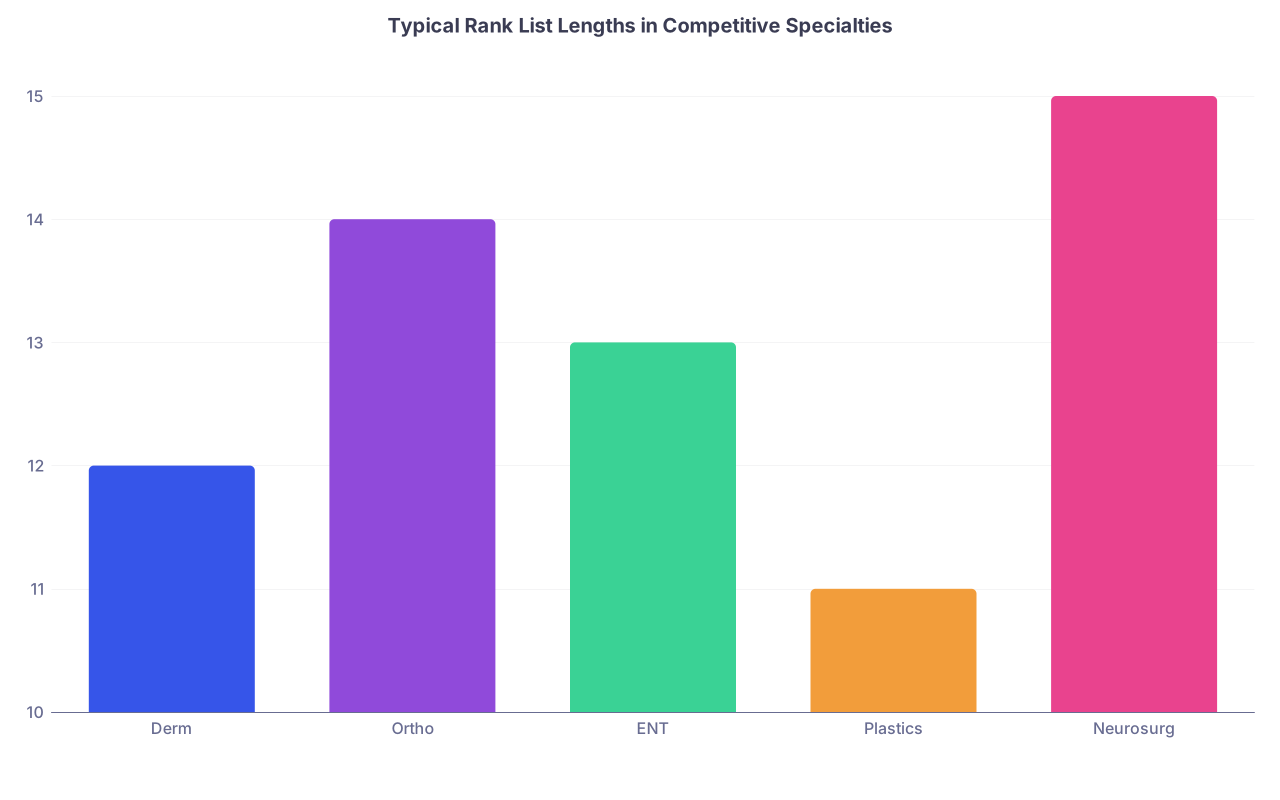
To make this concrete:
| Category | Value |
|---|---|
| Derm | 12 |
| Ortho | 14 |
| ENT | 13 |
| Plastics | 11 |
| Neurosurg | 15 |
Those are hypothetical typical numbers for successful applicants, not a hard rule, but you get the point: 6–8 interviews in these fields is not abundance. It is borderline.
Yet applicants routinely convince themselves: “I want quality over quantity. I only want to go somewhere I really love.” Translation: “I will risk not matching rather than rank some places that are not perfect.”
That attitude is a luxury you do not have when the supply–demand curve is this skewed.
You avoid this mistake by:
- Ranking every program where you would be willing to train. Maybe not thrilled. But willing.
- Being honest about whether no-match would be catastrophic for your specialty hopes.
- Expanding your geographic and prestige comfort zone more than your ego likes.
Do not sacrifice entry into a competitive specialty because a solid, less “shiny” program felt beneath you on interview day.
Mistake #4: Ignoring the Joint Risk of Advanced + Preliminary / TY Positions
This mistake destroys Anesthesia, Radiology, Derm, PM&R, Neuro, and some Ophtho applicants every year.
You apply to an advanced program (PGY-2 start) and forget—or grossly underestimate—the importance of ranking enough, and realistic, prelim/TY positions.
Classic disaster scenario:
- You matched an advanced Anesthesia program.
- You “should” be thrilled.
- Except you did not match a prelim/TY.
- Now you are scrambling in SOAP for one year of something, anywhere, often in a field and city you never wanted.
Why does this happen?
Because applicants:
- Rank prelims as an afterthought, at the last minute.
- Only rank “desirable” prelims (e.g., all medicine prelims in top cities).
- Assume “if I am good enough for a big-name advanced program, I will easily grab a prelim” (wrong; prelim lists are often cutthroat).
You do not want to be the person matched to an elite advanced Radiology program but stuck without a PGY-1 slot on Monday. That is a real, miserable outcome.
Here is how to avoid this:
- Treat your prelim/TY list as strategically essential, not optional.
- Rank more prelim/TY programs than advanced programs, if necessary.
- Include a mix: categorical backups, community TYs, medicine prelims, surgery prelims if you are truly willing.
And, crucially, understand how your lists interact. If there is a prelim program you would never accept under any circumstance, do not rank it. But if you “do not love it” yet would rather do that year and keep your advanced match than blow up the entire trajectory, it belongs on your list.
Mistake #5: Using Geographic Fantasy as Your Main Filter
Competitive specialty applicants are especially guilty of this one.
They decide ahead of time:
- “I am only willing to live on the West Coast.”
- “I refuse to be in the Midwest.”
- “If I’m going to work this hard, I want a big-name coastal city.”
Then they get 10–12 interviews. 7–8 of them are in the Midwest or South, 2–3 in high-demand cities. Their rank list? Packed at the top with 2–3 coastal programs and a few local favorites. They bump down (or leave off) the “flyover” or smaller city options.
Result: they either match somewhere fine but risky-low on their list, or worse, they do not match at all in their chosen specialty.
Harsh but true: in competitive fields, insisting on ideal geography is one of the fastest ways to sabotage your career.
You can fix location later. Changing specialties is far harder.
You avoid this trap by asking: “Would I rather be in my dream city but a backup specialty, or in a less ideal city doing the specialty I actually want for the next 30 years?” Most people, when honest and not daydreaming, know the answer.
Make ranking decisions accordingly.
Mistake #6: Overweighting 8 Hours of Interview Vibes Over Serious Data
You met the residents once. They were funny. The dinner was great. Someone said, “We are like a family.”
Dangerous words. I have lost count of how many residents later told me:
“The interview day did not match reality. They trotted out the happy people. We never saw the ones burned out or looking to transfer.”
Do not misunderstand: interview impressions matter. Severe red flags should tank a program. But for competitive specialties especially, applicants make two huge errors:
Ranking high based only on one glossy day, ignoring:
- Case volume
- Fellowship match
- Operative autonomy
- Board pass rates
- Reputation among attendings in that field
Ranking low because of minor or petty reasons:
- One awkward resident you did not click with.
- A slightly boring pre-interview social.
- The hotel was bad.
Programs know exactly how to package the day. You saw the nice conference room, not the 2 a.m. trauma case where the senior yelled at the intern for missing a lab.
You protect yourself by forcing your ranking process to include real data:
| Factor | Why It Matters |
|---|---|
| Case Volume | Skills and confidence by graduation |
| Fellowship Match | Doors opened for subspecialty |
| Board Pass Rates | Training quality and exam support |
| Resident Attrition | Hidden culture or workload problems |
| Autonomy Level | Readiness for independent practice |
Collect this from FREIDA, program websites, current residents not chosen by the PD, and your mentors in the specialty. Then force yourself to weigh it at least as heavily as interview-day vibes.
Mistake #7: Ranking Programs to Impress Other People
Nobody will live your residency except you. But you would not know that from overhearing MS4 conversations in October.
“I am shooting for MGH, UCSF, or bust.”
“I do not want to explain why I went to a ‘no-name’ program.”
“I would rather scramble than end up at [community place].”
This is ego talking. And ego is expensive.
In competitive specialties, prestige-chasing on the rank list is one of the most common ways smart people wreck their own long-term happiness. They chase the name, not the fit.
What this looks like:
- Ranking an elite but malignant program above a solid, supportive mid-tier one.
- Dismissing excellent community programs that quietly place residents into top fellowships.
- Treating “lower-tier” as synonymous with “terrible training.”
It is not.
I know residents from anonymous community Ortho programs doing phenomenal cases and matching into competitive fellowships. I also know folks from big-name academic centers who were glorified note-writers, left undertrained, and had to claw their way into decent jobs.
- Your learning.
- Your day-to-day survival.
- Your long-term career goals.
Not your classmates’ opinions or your parents’ bragging rights.
Mistake #8: Not Stress-Testing the Worst-Case Scenarios
Too many applicants rank like optimists. They imagine matching somewhere in their top 3 and never really ask, “What if I end up at #10?”
You need to sit with that possibility.
Take a hard look down your list and, for every rank number, ask:
- “If I match here, can I realistically live this life for 3–7 years?”
- “Is this program still acceptable if my relationship ends, my support system shifts, or the PD who recruited me leaves?”
- “If this were my only option in this specialty, would I take it over not matching?”
If the honest answer is no, that program does not belong on your rank list. You are better off not ranking a truly unacceptable program than ending up stuck there.
Where applicants screw this up is they treat the lower half of their list as “this will never happen.” Then March hits, they fall further down than expected, and now they are trapped in a place they never actually wanted and mentally checked out of before Day 1.
Better to have a shorter, fully acceptable list than a long one padded with places you would hate.
Just be honest with yourself about what “acceptable” really means. Not “perfect.” Not “exciting.” Acceptable.
Mistake #9: Last-Minute Ranking, Zero Structured Process
Another avoidable but common error: treating the entire ranking exercise as a 2-hour task the night before the deadline, scrolling through emails and going by gut.
That is how emotional noise, recency bias, and random memories dominate the process.
What I have seen work far better (and block bad decisions):

| Step | Description |
|---|---|
| Step 1 | List All Interviewed Programs |
| Step 2 | Collect Hard Data |
| Step 3 | Write Pros and Cons |
| Step 4 | Initial Rank Order |
| Step 5 | Mentor Review |
| Step 6 | Stress Test Worst Case |
| Step 7 | Finalize True Preference Order |
You do not need a 20-tab spreadsheet. But you do need:
- A written list of all programs.
- Notes from right after each interview (not 3 weeks later).
- A simple rating for training, culture, location, and career outcomes.
- A draft rank list done early enough to sit with for at least a week.
Last-minute ranking leads to:
- Overweighting the most recent interview.
- Forgetting specific red flags (“which program had the exhausted residents again?”).
- Knee-jerk changes based on one text from a friend.
Treat your list like a major contract. Because that is exactly what it becomes on Match Day.
Mistake #10: Not Asking for Specialty-Specific, Brutally Honest Input
Competitive specialties are insular. Connections matter. Perceptions of programs inside a field are often very different from how they market to you.
Yet I watch applicants make rank lists in isolation or with generic advisors who do not know the specialty landscape well.
You are making a mistake if you:
- Do not sit down with at least one trusted faculty member in your specialty and review your list.
- Rely solely on anonymous message boards (which are a mix of truth, myth, and insecurity).
- Assume “top 20 hospital in US News” automatically means “great residency in your specific field.”
The PD in your competitive specialty knows things you do not:
- Programs in turmoil.
- Places with quietly horrible cultures or terrible operative autonomy.
- “Underrated” programs with strong fellowships and supportive leadership.
Grab that information. Ask directly, “Given my goals, does this order make sense? Are there any programs here you would move significantly up or down?”
You are not outsourcing your decision. You are updating your map with real terrain data.
Visualizing the Risk You Are Actually Managing
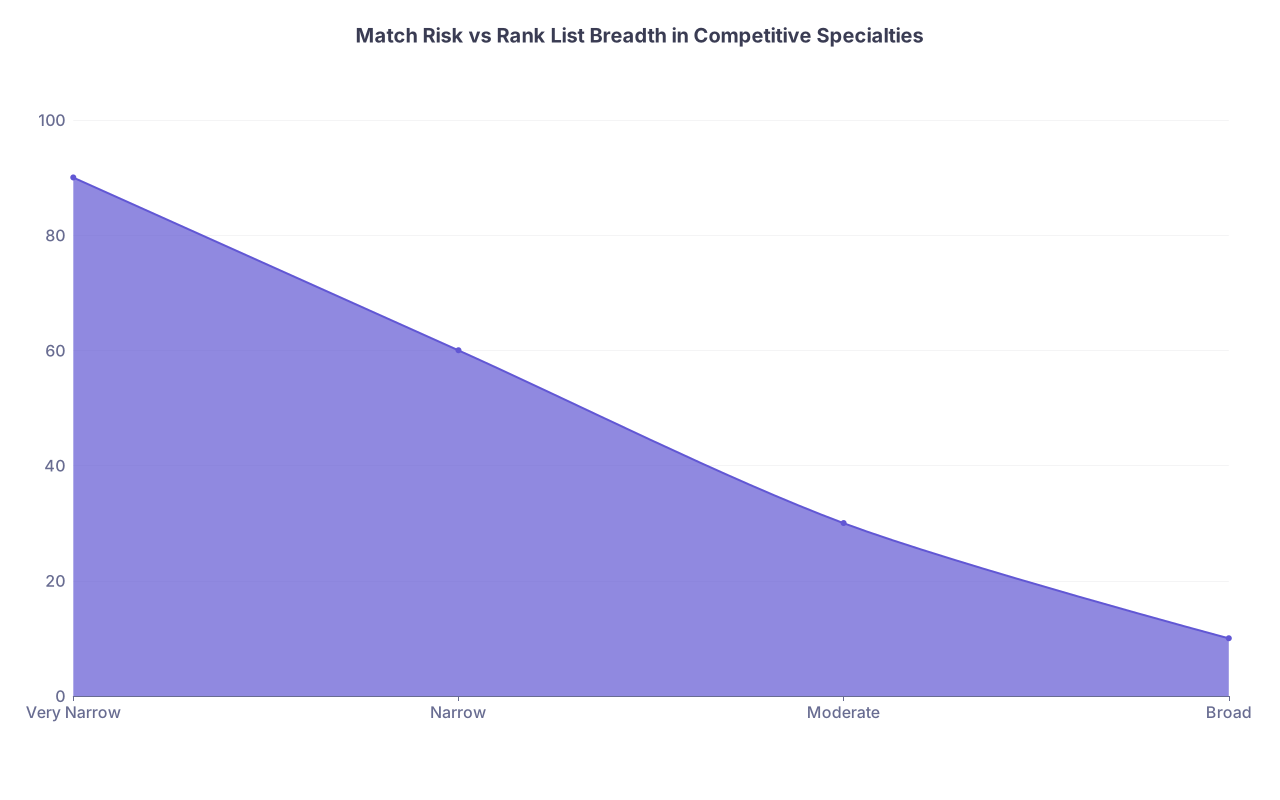
Think about your match risk as a simple tradeoff between “competitiveness of your field + selectivity of your list” and “breadth/realism of the programs you rank.”
| Category | Value |
|---|---|
| Very Narrow | 90 |
| Narrow | 60 |
| Moderate | 30 |
| Broad | 10 |
That is the basic shape: very narrow, prestige-heavy lists in highly competitive specialties carry very high non-match risk. Broad, realistic lists lower it. There is no magic.
The One Principle That Saves Careers
If you remember nothing else, remember this:
In a competitive specialty, your rank list must protect two things above all:
- Your ability to enter and stay in the specialty.
- Your ability to survive training without burning out or breaking down.
That means:
- You do not sacrifice the specialty just to cling to a specific city or tier.
- You do not rank programs that would be psychologically or ethically intolerable just to avoid the fear of not matching.
- You do not under-rank or under-apply and then act surprised when statistics behave like statistics.
Your rank list is where you stop fantasizing and start playing the long game.

Practical Step-By-Step: How To Build A Safe, Smart List
Here is the stripped-down version of how to not sabotage yourself:
- Make a master list of every program you interviewed at. No sorting yet.
- For each, write:
- 3 honest pros.
- 3 honest cons.
- Your gut 1–10 for:
- Training quality.
- Culture.
- Location tolerance (not love; tolerance).
- Draft an initial rank list based purely on, “Where would I sign tomorrow if they all offered me a spot?”
- Identify:
- Programs that are truly unacceptable → delete them.
- Programs you do not love but would accept to secure the specialty → keep them.
- Cross-check with:
- A mentor in your specialty.
- A co-applicant you trust, just to verbalize your reasoning.
- Sit on the list for several days. Do not keep shuffling it daily.
- Before certifying, do one final pass: for every pair, ask, “If I match at the lower one instead of the higher, will I feel regret?” If yes, your order is wrong.
This takes work. It is supposed to.

FAQs
1. How many programs should I rank for a competitive specialty?
There is no single magic number, but under about 10 in hyper-competitive fields (Derm, Plastics, ENT, Neurosurg, Ortho at the top tier) is often thin ice unless you are an absolute outlier with strong home support and multiple aways. If you have 12–15 interviews, you should be ranking almost all of them, except truly unacceptable ones. The worse your objective metrics or the lighter your interview count, the broader your rank list should be.
2. Should I ever rank a solid backup specialty on the same list?
If you are doing a true dual-application (for example, applying both IM and Derm), you need to be very clear with mentors about the implications. Ranking a backup categorical spot below your competitive specialty programs means that if you do not match the competitive ones, you may end up “locked” into the backup specialty. That can be better than going unmatched, but it might also permanently close the door on your first-choice specialty. You should only do this after a hard, specific conversation with advisors who know your file.
3. Is it safe to rank a “malignant but prestigious” program high if I think I can handle it?
“Handle it” is a phrase people use when they are 24 and not sleep-deprived. Prestige rarely compensates for chronic cruelty, unsafe workloads, or a culture that eats its own. In competitive specialties especially, there are enough good, rigorous programs that you do not have to sell your mental and physical health to get strong training. If multiple independent sources call a place malignant, I advise dropping it unless your situation is extremely unusual and you know exactly what you are walking into.
4. What is one concrete thing I should do this week about my rank list?
Open a document and write down every program where you interviewed, then force yourself to write three pros and three cons for each, from memory. Where you struggle to list pros, pause. Where you struggle to list cons, also pause. Those extremes tell you something. Then draft your “if they all offered me a spot tomorrow” order. That is your starting rank list. Bring that version to a trusted specialty mentor for a brutally honest review.
Open your draft rank list today and go line by line asking: “If these two programs both called me with an offer right now, which do I sign with instantly?” If your list does not match those answers, you are risking your match on a lie. Fix it before the algorithm locks it in.