
You are three days out from your first interview at a top dermatology program. Your ERAS is spotless. Step scores above the 90th percentile. Glowing letters. Research stacked. You are reviewing your interview answers when a co‑resident casually says over lunch, “Hey, your Instagram is wild, man. You are going to lock that down before interviews… right?”
You shrug it off.
Two weeks later, that same program never sends a second look, never follows up, and quietly drops you from serious consideration. No violation email. No warning. Just a silent “no.”
You will never see the email chain where a faculty member forwarded a screenshot of one of your posts with the subject line: “Professionalism concern?”
This is how social media actually kills competitive applications. Quietly. Off the record. And usually preventable.
For competitive specialties—derm, ortho, ENT, plastics, neurosurgery, ophtho, urology, radiation oncology—your online footprint can and does become part of your file, whether or not anyone tells you so.
Let me walk through the specific social media red flags that quietly get people eliminated, especially in competitive fields. You do not need to be perfect. But you absolutely cannot be careless.
The Naïve Assumption That “They Don’t Look”
The biggest mistake: believing programs are too busy or too professional to care about your Twitter, Instagram, or TikTok.
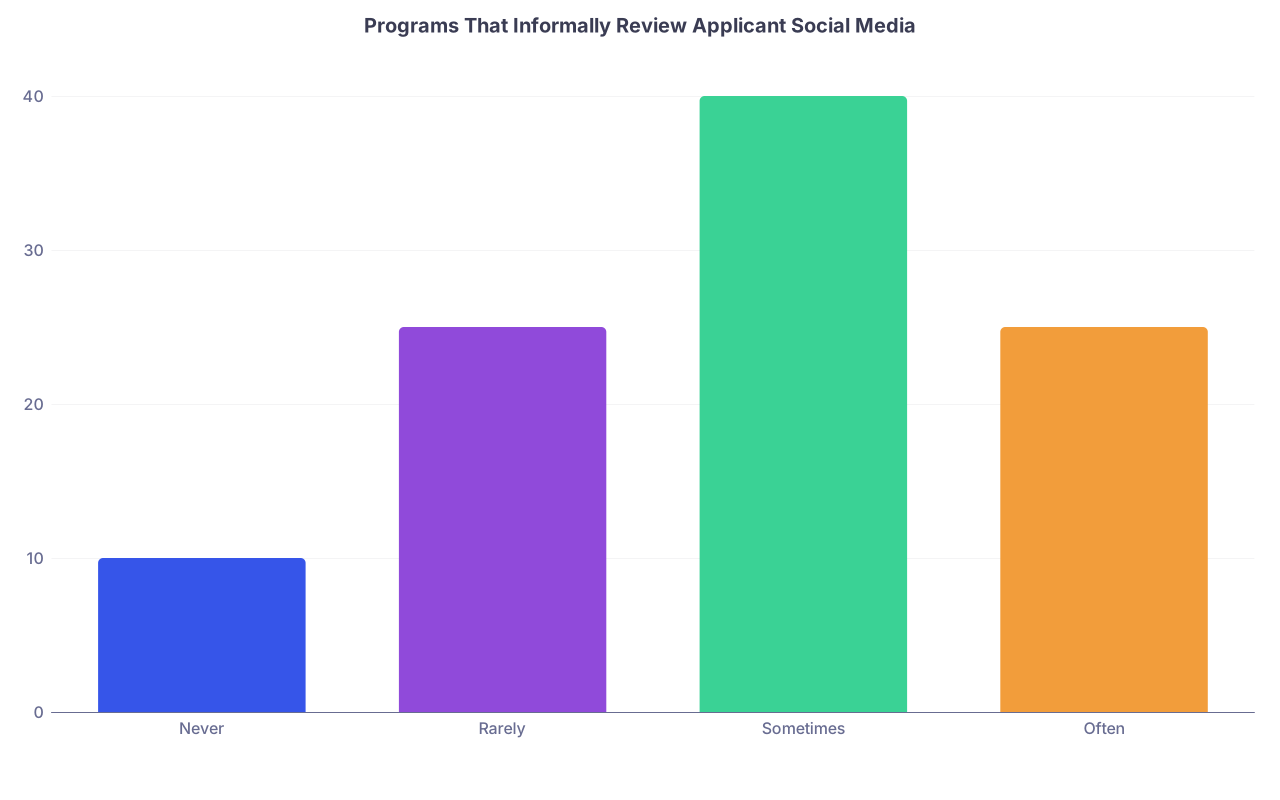
They look. Not always. Not systematically. But often enough that gambling on invisibility is stupid.
Here is what actually happens:
- One resident on the selection committee recognizes your name from Twitter and looks you up “just out of curiosity.”
- A program coordinator quickly searches your Instagram because your email handle matches your username.
- A faculty member hears you have a “big TikTok” and checks it during a boring Zoom meeting.
- A single concerning screenshot gets dropped into a group chat: “This the same applicant from last week?”
No formal policy. No documentation. Just, “Why invite drama when we have 400 other applicants who look just as strong on paper?”
| Category | Value |
|---|---|
| Never | 10 |
| Rarely | 25 |
| Sometimes | 40 |
| Often | 25 |
Do not make the mistake of treating social media like a separate life. In competitive specialties, you have no separate life. You have one reputation. And it leaks.
Red Flag #1: Anything That Looks Like HIPAA — Even If It Isn’t
This is the fastest way to get quietly blacklisted: posting anything that even smells like a patient.
You think you are being vague:
“No identifying info,” you tell yourself. “Everyone does this.”
You post:
- A “funny” story from OB about a patient yelling during labor.
- A picture in the trauma bay with a blurred face but a visible tattoo.
- A “case of the day” from derm with a very distinctive lesion and your hospital logo in the background.
- An ICU selfie with monitors visible behind you.
I have seen applicants crushed for far less.
In competitive specialties, programs are hypersensitive to liability and reputation. They do not care if your post technically meets HIPAA de‑identification standards. If it makes them think you are loose with boundaries, you are done.
Watch for:
- Photos in clinical spaces where anything medical is visible: charts, monitors, boards, ID bands, room numbers, even partial faces.
- Stories or tweets about “crazy patients,” “drug seekers,” “noncompliant diabetics,” or “ridiculous families.”
- Anything bragging about procedures, cases, or surgeries done during rotations with even hints of timeline or location.
If someone on a committee says, “We had a HIPAA scare last year,” your borderline post is now a hard no.
Do not argue technical legality. Programs are selecting judgment, not just knowledge.
Red Flag #2: Alcohol, Drugs, and “Party Persona” Content
This is the content that applicants love to rationalize.
“I am just being human.”
“Everyone drinks.”
“It is my private account.”
Here is how programs actually react:
- One resident sees your public profile picture: you holding two massive drinks, clearly wasted, in a crop top, tagged at a national conference. They mention it in a ranking meeting with a half‑joke: “This one knows how to party.”
- A faculty member clicks through your TikTok and sees multiple videos with alcohol chugging, black‑out jokes, or weed references. Subconsciously, they now group you with “higher risk for professionalism issues.”
- You applied to neurosurgery, but your Twitter is filled with memes about “showing up hungover to rounds” and “post‑call drinking to forget the trauma.” You may intend humor; they see liability.
The competitive specialties are already typecast as intense, “serious,” and high‑risk. They are not going to take a chance on someone who broadcasts out‑of‑control behavior.
Especially toxic combinations:
- Alcohol + scrubs or white coat.
- Alcohol + conferences, away rotations, or hospital tags.
- Substance jokes + mental health struggles framed as “coping by using.”
You do not have to erase all evidence that you are a human being. A wine glass at dinner or a birthday toast is not going to sink you. The pattern is what matters.
If a stranger looked at your last 12 photos and thought “this person’s life is mostly partying,” you have a branding problem.
Red Flag #3: Aggressive, Hostile, or Unprofessional Commentary
Plenty of applicants destroy themselves with their own words, not their pictures.
I have seen:
- Applicants subtweet attendings by name or easily identifiable descriptors.
- Long threads complaining about “toxic programs,” specific hospitals, or staff.
- Screenshots of email exchanges with faculty or coordinators posted for “tea.”
- Rants about “lazy nurses,” “useless consultants,” or “out‑of‑touch attendings.”
Even if you think you are anonymous, you are not. Medicine is a small world. Competitive specialties are even smaller. Two hops on a group chat and that tweet is in front of your future program director.
Programs imagine you doing that to them in two years. They do not knowingly invite that risk.
Watch for:
- Public fights in comment sections with other med students or physicians.
- Repeated swearing out of patients, nurses, or anyone you work with.
- “Call‑out” posts of people in your institution, even without names.
- Extreme political rants that cross from opinion into personal attacks or dehumanization, especially about groups you will be treating.
You can have opinions. You should have a spine. But once your tone becomes consistently hostile or contemptuous, people assume you will bring that same energy into their OR, clinic, and call room.
And no, “it is just my personal Twitter” will not save you. Screenshots do not care about your privacy settings.
Red Flag #4: Sexually Explicit or Objectifying Content
This is the one applicants like to pretend is generational. “Old attendings just don’t get it. It is empowerment.”
Here is what actually happens in rank meetings:
Nobody wants to say it out loud, but someone eventually does: “Are we comfortable backing someone whose public persona is… this?”
I have seen impressive applicants quietly tank because:
- Their Instagram is essentially a thirst‑trap portfolio: underwear shots, provocative poses, OnlyFans style content (even if not explicit nudity).
- Their TikTok dances in scrubs cross into sexualized content clearly using the “doctor aesthetic” as bait.
- Their captions are explicit sexual jokes linked to being a “future surgeon,” “future derm queen,” etc.
Right or wrong, competitive programs are conservative about what they attach their name to. They worry about future patient complaints, media screenshots, and HR nightmares.
If you want that kind of presence, that is your choice. But do not be naive about the trade‑off: visibility now vs. doors later.
At minimum, if any content would make you physically uncomfortable being shown on a projector in front of your entire department—including the chair—you should not have it easily traceable to your real name during application season.
Red Flag #5: “Edgy” Humor That Punches Down
You think you are being funny. Your friends think you are hilarious. The committee sees risk.
Risk of:
- Discrimination complaints.
- Hostile work environment claims.
- A viral tweet of “Racist resident at [Program Name].”
Examples that get people quietly blacklisted:
- Jokes about gender, race, religion, or sexuality that are even slightly off‑color.
- Memes stereotyping patient populations (“you know it is Medicaid day when…”).
- “Dark humor” about suicide, self‑harm, or psychiatric patients posted under your real name.
- Disability jokes, IQ jokes, or “boomer”/“Karen” jokes that read as contempt for older patients.
In a competitive field, programs have plenty of applicants who are just as qualified and less likely to cause HR problems. Guess who they pick.
Humor is not neutral when you are asking a group of strangers to trust you with patients, staff, and the program’s reputation.
Ask yourself a brutal question:
If someone took your last 50 memes and showed them to a random HR lawyer, how nervous would they look?
If the answer is “very,” delete them.
Red Flag #6: Chronic Negativity About Medicine
There is a difference between honest commentary about systemic problems and relentless bitterness.
Applicants love posting:
- “Medicine is a scam, do not do it.”
- “If you are a premed, run.”
- “All attendings are abusive.”
- “Residency is just legalized hazing.”
- “Patients are the worst part of this job.”
Do programs know medicine is broken in many ways? Of course. Many faculty have said worse things privately than you have ever tweeted.
But they are not hiring you for your ability to rage‑tweet. They are trying to predict whether you will:
- Burn out so hard you become nonfunctional.
- Poison the residency culture with constant cynicism.
- Publicly trash the program when you are unhappy.
Competitive specialties depend heavily on teamwork, long hours, and tight call groups. They are wary of anyone who reads like a walking morale hazard.
If your online persona is 80% complaining, 20% memes, and 0% constructive anything, you look like bad news.
You do not need to become fake‑positive. But you do need to stop doing public self‑sabotage.
Red Flag #7: “Medfluencer” Behavior Without Professional Boundaries
There is a specific danger zone for people who want a “brand” while still in training.
Common self‑inflicted wounds:
- Giving detailed medical advice to strangers in comments or DMs (“you probably have X, ask your doc for Y”).
- Selling supplements, skincare regimens, diet plans, or “hormone optimization” as a student or early resident.
- Portraying yourself as an “expert” in a subspecialty where you have zero independent credential.
- Using your white coat or hospital setting as a prop for monetized content.
Competitive specialties are already wary of the social media doctor phenomenon. They see lawsuits, board complaints, and news headlines.
This is especially brutal in derm, plastics, and aesthetics, where the online space is crawling with questionable content. Programs are watching who is drifting toward that edge while still in training.
A high‑quality, professional presence can help you. A clout‑chasing, advice‑giving, monetized persona can sink you.
If you are making money or gaining followers using your status as a doctor‑in‑training, assume someone will bring it up behind closed doors.
Red Flag #8: Discrepancies Between Your Application and Your Online Life
Programs hate one thing more than risk: inconsistency.
You present yourself in your personal statement as:
- Deeply committed to underserved care, but your TikTok is endless luxury unboxings, “rich doctor” aspirational content, and you joking about not wanting to see “complicated patients.”
- Passionate about professionalism and communication, but your Twitter is full of threads dragging co‑residents, nurses, and faculty.
- Humble, team‑oriented, and low‑ego, but your Instagram captions are “I am built different,” “future derm god,” or “too smart for this.”
They see that misalignment and assume one of two things:
- You are performing for the application.
- You lack insight into how you come across.
Both are disqualifiers in highly competitive spaces.
You do not need a sterile, perfectly branded presence. But your public persona should not directly contradict the core values you claim in your ERAS. That looks like dishonesty, not personality.
What Programs Actually Care About: Quiet Risk Assessment
Let me be blunt. Most faculty do not care about your weekend brunch. They barely understand TikTok.
What they do care about:
- Will this person embarrass the program online?
- Will this person violate patient privacy?
- Will this person create HR complaints?
- Will this person poison the culture?
- Will this person end up in the news with our institution’s name in the headline?
Your social media is not scored with a rubric. It is scanned for red flags.
You are not being judged on aesthetics. You are being screened for potential regret.
Once you understand that, your decisions online become much clearer.
A Ruthless Social Media Audit: How Not To Blow This
This is the part most people skip. Do not.
Do a structured audit before your application season, especially if you are going after a competitive specialty.
| Area | Action |
|---|---|
| Old platforms | Search and delete or lock down |
| Photos | Remove clinical/party risks |
| Captions/comments | Delete hostile or edgy posts |
| Handles/usernames | Make them neutral or generic |
| Privacy settings | Tighten across all platforms |
Then go deeper:
- Google yourself in an incognito window. Check:
- Images.
- Old blog posts.
- Comment threads with your full name.
- Search your name + “med,” “MD,” your school, and your city.
- On every platform (Instagram, Twitter/X, TikTok, Facebook, Reddit if linked):
- Scroll back years. Yes, years.
- Assume nothing is “too old” to resurface via screenshot.
Concrete delete candidates:
- Any clinical selfie in scrubs where hospital details are visible.
- Any “crazy patient” story, even de‑identified.
- Any heavily intoxicated, half‑clothed, or sexually suggestive photo tied to your real name.
- Any post attacking groups of people, coworkers, or your current institution.
- Any meme that could be read as racist, sexist, homophobic, transphobic, or demeaning to disabled or mentally ill people.
- Any screen‑shotted or shared internal communications.
If you have doubts, run a brutal test:
Would you be comfortable with this post on a slide in your rank meeting, projected in front of the PD, APD, program coordinator, and residents?
If not, delete it. No explanation. No sentimentality.
“Private” Is Not Safe
The other lazy mistake: thinking private accounts solve everything.
Here is reality:
- People screenshot. Always.
- Follow requests get accepted too freely.
- You will never know which co‑student, ex, or mildly annoyed acquaintance is willing to share your content later.
Yes, use privacy settings. Absolutely restrict who can see your stories and posts.
But never post anything under your real name, face, or easily connected username that would be catastrophic if it went public.
Private slows the spread. It does not erase the risk.
Specialty‑Specific Sensitivities You Are Underestimating
Competitive specialties have different triggers.
Dermatology:
- Hyper‑sensitive to aesthetics content, skincare “advice,” and questionable product pushing.
- Risk: Looking like a future Instagram dermatologist before you have credentials.
Orthopedics:
- Watchful for hyper‑masculine, bro‑culture posts that hint at sexism or bullying.
- Risk: Group shots with demeaning jokes about women, non‑athletes, or “weak” colleagues.
Plastic Surgery:
- Extra wary of sexually explicit content, body‑shaming jokes, and “before/after” aesthetic commentary as a student.
- Risk: Appearing to commodify bodies or see patients as marketing material.
ENT / Neurosurgery:
- Focused on judgment and stability; anything suggesting chaos, heavy substance use, or emotional volatility is a problem.
- Risk: Lots of unfiltered rants, vague suicidal jokes, or extreme burnout posts.
Radiation Oncology:
- Sensitive to pseudoscience, “alternative” medicine endorsement, and anti‑evidence rhetoric.
- Risk: Sharing or liking “anti‑chemo,” “natural cancer cures,” or anti‑vax content.
If you are aiming high, stop pretending your online life is invisible. It is not.
Do Not Overcorrect Into Robotic Nothingness
There is a final mistake I see: applicants panic, delete everything, and become bizarrely blank online.
Programs mostly do not require you to have a social media presence. So your absence will not kill you.
But if you choose to stay online, you do not need to scrub your personality away. You just need to strip out the self‑sabotage.
You can still:
- Post about hobbies: hiking, cooking, running, music.
- Share neutral or constructive commentary about medicine.
- Celebrate milestones: white coat, Match Day, publications.
- Show normal human relationships, friends, pets, travel.
The goal is not to become generic. The goal is to remove obvious landmines.

| Step | Description |
|---|---|
| Step 1 | Think of Post |
| Step 2 | Do not post |
| Step 3 | Reconsider or edit |
| Step 4 | Skip |
| Step 5 | Post |
| Step 6 | Shows patient or hospital? |
| Step 7 | Contains alcohol, sex, or hostility? |
| Step 8 | Aligns with professional image? |
You are allowed to be a person. You are not allowed to be reckless and then act surprised when it costs you.
The Quiet Reality: You Rarely Hear When Social Media Hurt You
This is the part people hate hearing.
You will almost never know when your online presence damaged your application. Committees do not send feedback saying, “You were ranked lower because your TikTok gave us pause.”
What actually happens:
- Someone sees something concerning.
- They casually mention it: “Did anyone else see their Instagram?”
- The room gets quiet.
- You drop a few spots. Or off the list entirely.
- Nobody tells you. You blame “bad luck” or “too competitive this year.”
Stop attributing everything to chance.
You cannot control lot of this process. You can control what you put on the public internet with your real name attached while you are asking strangers to trust you with a scalpel, a laser, or a delicate cranial nerve.
What You Should Do Today
Do not bookmark this and move on.
Right now, while this is fresh:
- Open Instagram, TikTok, Twitter/X, and Facebook.
- Scroll back 2–3 years on each.
- Delete at least three posts that make you even slightly uneasy through the lens of a residency selection committee.
If you cannot bring yourself to delete them, you are not taking this process seriously enough for a competitive specialty.