
The mythology around competitive residencies is wrong. Applicants obsess over total interview numbers, but the data show that where you interview and how those programs rank you matter far more than raw counts. Ten interviews can be a near lock in one specialty and a coin flip in another.
If you are applying to dermatology, plastic surgery, ortho, ENT, neurosurgery, or integrated IR, you are not playing the same game as internal medicine. The yield curve is steeper, more volatile, and far less forgiving of weak interviewing or misaligned rank lists.
Let me walk through this the way a numbers-obsessed program director or data analyst would: by treating each interview invite as a probabilistic asset and each rank list as a portfolio.
1. The Yield Concept: From Invite to Match Probability
Yield is simple on paper: number of matches divided by number of interviews. But for a single applicant, that is too crude. You care about:
- Probability of getting at least one offer (i.e., matching somewhere)
- Probability of matching at a “target tier” (top-10, academic, geographic, etc.)
- Marginal benefit of interview #5 vs #10 vs #15
You are operating under the NRMP matching algorithm. Two key facts drive the math:
- The match favors applicant preferences, not program preferences, conditional on appearing on each other’s rank lists.
- Your chance of matching rises sharply with each additional interview early on, then plateaus.
People throw around rules of thumb (“10–12 interviews is safe”) with no context. That is lazy. The real picture depends heavily on specialty competitiveness and how many programs you realistically rank.
To anchor this, look at approximate “safe-ish” ranges from recent NRMP Charting Outcomes and Program Director Surveys. These are rounded, but directionally accurate from the post–Step 1 numeric score era.
| Specialty (US MD) | Match ~50% Odds | Match ~80–90% Odds | Near-Guarantee Range* |
|---|---|---|---|
| Dermatology | 6–7 interviews | 9–11 interviews | 12–14+ interviews |
| Plastic Surgery (Int) | 5–6 | 8–10 | 11–13+ |
| Orthopedic Surgery | 6–8 | 10–12 | 13–15+ |
| ENT (Otolaryngology) | 5–7 | 8–10 | 11–13+ |
| Neurosurgery | 5–6 | 8–9 | 10–12+ |
| Integrated IR | 5–6 | 8–10 | 11–13+ |
*“Near-guarantee” is never 100%. It means historically around ≥95% match rates for applicants with those numbers of interviews and average or better applications.
Those curves are not linear. The first few interviews are dramatically more valuable than the later ones. Think diminishing returns.
2. Visualizing the Curve: Interviews vs Match Probability
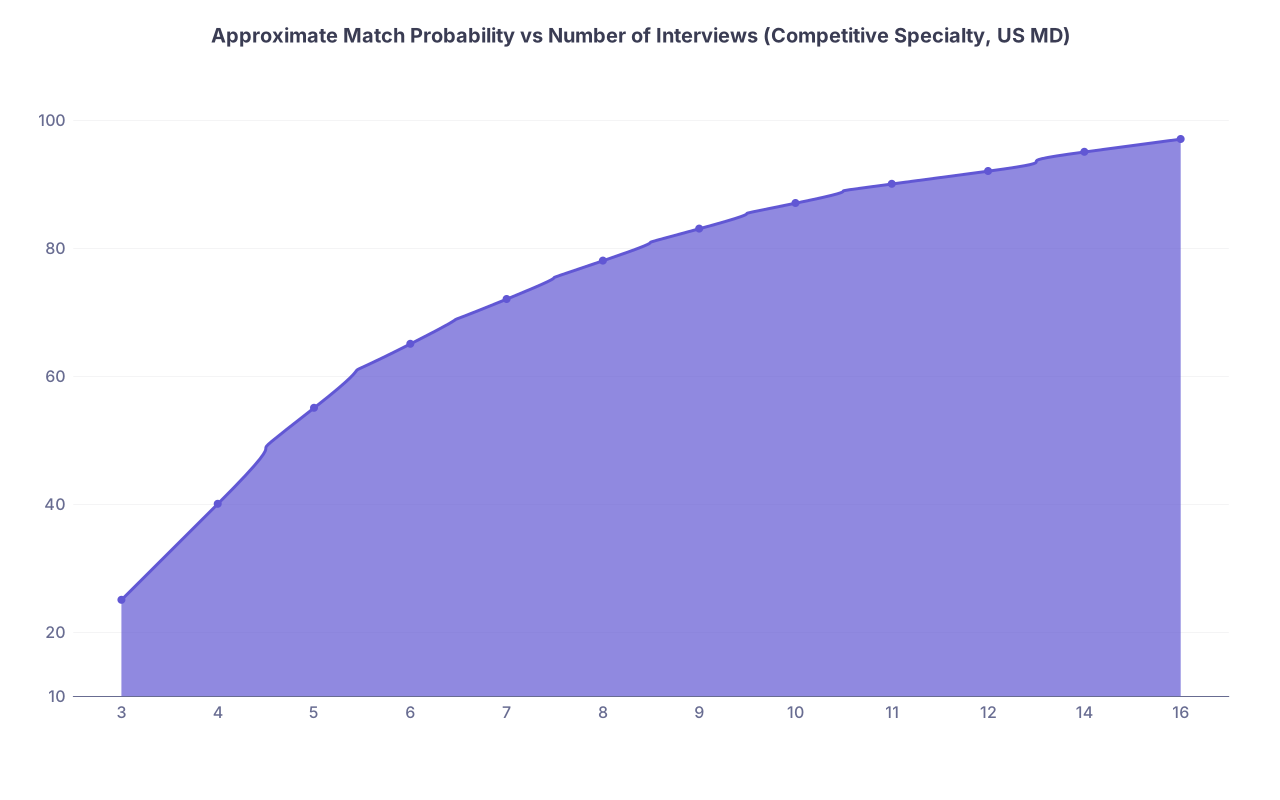
Let’s quantify this. Based on NRMP-style data and simulation studies, the shape for competitive specialties looks roughly like this for a solid US MD applicant.
| Category | Value |
|---|---|
| 3 | 25 |
| 4 | 40 |
| 5 | 55 |
| 6 | 65 |
| 7 | 72 |
| 8 | 78 |
| 9 | 83 |
| 10 | 87 |
| 11 | 90 |
| 12 | 92 |
| 14 | 95 |
| 16 | 97 |
Interpretation:
- Going from 3 to 6 interviews more than doubles your match probability.
- Going from 8 to 12 interviews gives you maybe a ~14 percentage point gain.
- Going from 12 to 16 interviews? Marginal.
For very competitive specialties, there is a persistent group every year with 2–4 interviews and a non-trivial chance of going unmatched. The “danger zone” is not zero interviews; it is low single digits.
Here is the part applicants do not like hearing: if you have 3–4 interviews in derm or plastics, you are statistically in trouble, regardless of how “good” those individual programs are.
3. Interview Yield by Specialty: Competitive vs Non-Competitive
You cannot interpret interview counts in a vacuum. Ten interviews in ophthalmology is not the same as ten in family medicine.
Programs in more competitive specialties simply rank more applicants per position and take longer rank lists to fill. That means:
- Each interview has lower per-program probability of converting into a match.
- You need more interviews to reach the same overall match probability.
On the program side, think of “interview yield” as:
Match yield per interviewed applicant = (Positions filled) / (Number of interviewed applicants)
Typical approximate ranges (per NRMP Program Director Surveys, condensed and rounded):
| Specialty | Approx. Interviewed per Position | Match Yield per Interview (%) |
|---|---|---|
| Dermatology | 14–18 | 5–7 |
| Plastic Surgery (Int) | 14–16 | 6–7 |
| Orthopedic Surgery | 13–15 | 6–8 |
| ENT | 12–15 | 6–8 |
| Neurosurgery | 10–12 | 8–10 |
| IM (Categorical) | 8–10 | 10–12 |
| Family Medicine | 6–8 | 13–17 |
Read that carefully.
If a derm program interviews ~16 applicants per position, on average about 1 out of 16 interviewed people will fill that position. Yes, the numbers bounce around by region and prestige, but the order of magnitude is correct.
From your side, that means:
- Each interview in derm carries maybe 6–7% “per-program” match odds, on average.
- Ten such interviews might naïvely look like 10 × 6–7% = 60–70%, but those probabilities are not independent because of how rank lists and overlapping applicants work.
You can still reason directionally: more interviews at competitive programs create better odds, but no single interview is likely to be “the one” statistically.
4. Applicant-Level Yield: Converting Invites into Rank Positions
Programs do not rank everyone they interview at the same height. Some will rank you near the top of their list, some in the middle, some not at all. The distribution is not uniform.
There are three key probabilities per interview:
- Probability of making the rank list at all
- Probability of being ranked in the top N positions where N ≈ positions × oversubscription factor
- Probability that this program ends up being the highest program on your list that ranks you high enough to match
It sounds abstract, but in practice, the data and experience say this:
- In competitive specialties, a meaningful fraction of interviewees either are not ranked or are ranked so low that the effective probability of matching there is near zero.
- Your personal “interview-to-rank” yield depends heavily on fit, communication skills, and how your file looks compared to the room.
- One poor interview day can easily cut your program-level probability from 7–8% to ~0%.
This is why two applicants with the same number of interviews can have radically different match outcomes.
I have seen:
- A US MD ortho applicant with 7 interviews, solid but not charismatic, match at their #7.
- Another with 6 interviews, phenomenal interpersonal skills, match their #1 and later be told they were near the top of multiple lists.
- A derm applicant with 10 interviews who overreached on rank list geography and prestige and went unmatched, then easily matched the next year with 7 interviews but more realistic rankings.
The data explain these stories. The variance in per-program yield is high.
5. Competitive Specialties vs Internal Medicine: Different Games
Let me put this into a concrete comparison. Assume two US MD applicants with “typical” competitive profiles for their field:
- Applicant A: Dermatology, 9 interviews
- Applicant B: Internal Medicine categorical, 9 interviews
The typical probability of matching with 9 interviews:
- Derm (US MD): roughly 80–85%
- IM categorical (US MD): ~98–99%
Same raw count. Wildly different yield.
That gap is not arbitrary. Internal medicine programs:
- Have more positions per program.
- Interview fewer applicants per position.
- Have a larger fraction of applicants who do not rank them very highly, so they must rank deeper to fill.
- Historically report much lower unmatched rates among applicants with ≥8–10 interviews.
Competitive specialties:
- Fewer positions per program.
- Higher interviews-per-spot.
- Applicants are more uniformly “all in” on the specialty and rank lists cluster at the top few programs, leading to more compression at the top of each rank list.
So when you hear, “My friend matched IM with 6 interviews, so you are fine for ENT,” ignore that advice. Those distributions are not comparable.
6. Marginal Value of Each Additional Interview
Think of each interview as buying an additional lottery ticket, but the ticket quality is not constant. Early tickets are much higher EV (expected value) than later ones.
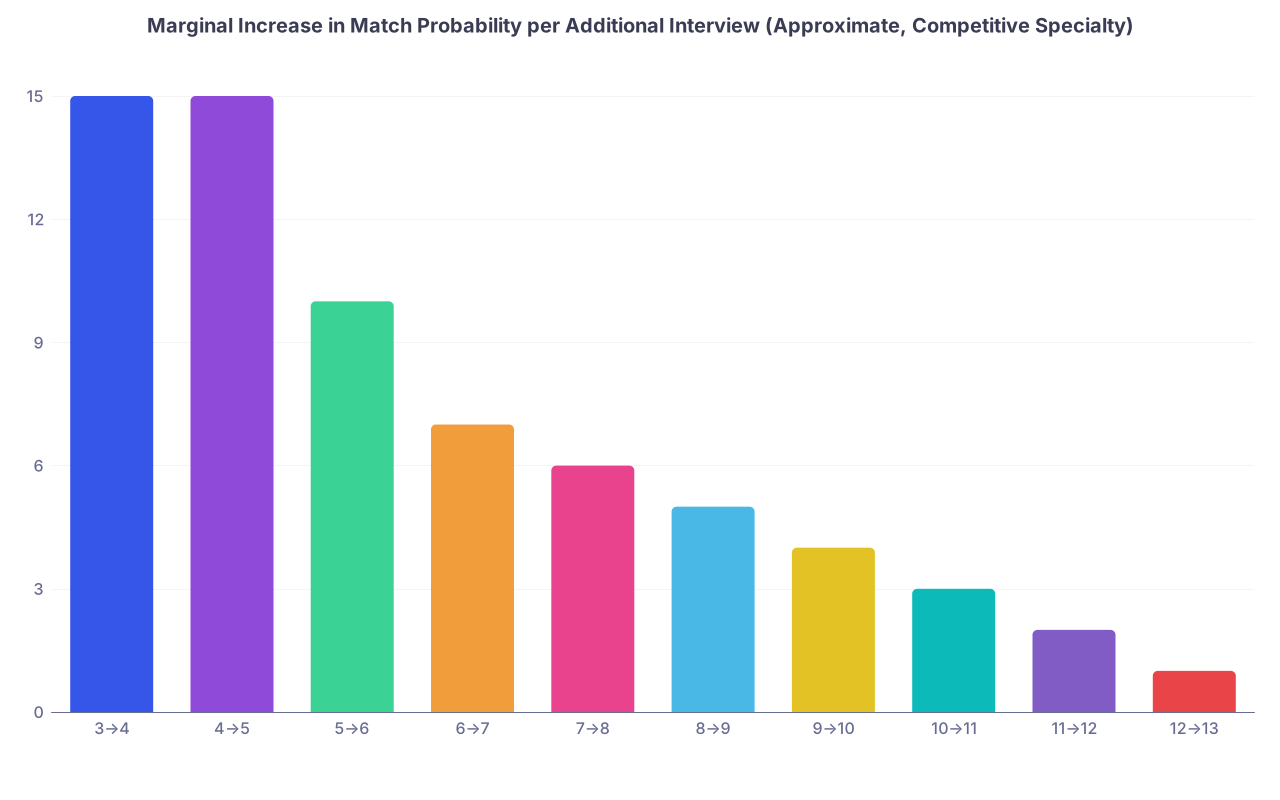
The rough marginal gain in match probability for a competitive specialty (US MD level applicant) looks like this:
| Category | Value |
|---|---|
| 3→4 | 15 |
| 4→5 | 15 |
| 5→6 | 10 |
| 6→7 | 7 |
| 7→8 | 6 |
| 8→9 | 5 |
| 9→10 | 4 |
| 10→11 | 3 |
| 11→12 | 2 |
| 12→13 | 1 |
Translation:
- Going from 3 to 4 interviews could add ~15 percentage points.
- Going from 8 to 9 interviews might add ~5 points.
- Going from 12 to 13 interviews? Maybe 1 point, sometimes less.
This is why your focus early in the season should be on:
- Maximizing the number of interviews up to that ~8–10 range.
- Protecting time and money to attend almost any reasonable interview opportunity in your target specialty until you are safely above that range.
Once you are into low double-digit interview counts in a competitive field and your application is not obviously flawed, the incremental value of squeezing out one more mid-tier program is low.
7. Strategic Ranking: Where Yield Gets Destroyed
The biggest way applicants sabotage interview yield is not on interview day. It is on rank list day.
Data from the NRMP show a brutally simple trend: among applicants who go unmatched in competitive specialties, a high fraction rank surprisingly few programs despite having enough interviews to be relatively safe.
Common self-inflicted errors I have seen:
- Ranking only 5–6 programs after having 9–10 interviews because “I only want to be in these cities.”
- Dropping mid-tier or community programs entirely to “send a signal” of academic focus.
- Over-weighting prestige while ignoring personal performance on interview day (they ranked the fancy program that seemed lukewarm to them over the mid-tier that clearly loved them).
Mathematically, if you have 9 interviews and rank all 9 programs, your chance of matching is substantially higher than if you rank only your top 5. Many applicants do not fully internalize that the match algorithm is not a negotiation; there is no “signal” benefit in under-ranking.
A simplified way to think about probability of matching somewhere:
P(match) = 1 − Π (over each ranked program i) [1 − pᵢ],
where pᵢ is your probability of matching at that specific program, conditional on being ranked there.
If you cut four “long shot” programs from your list because you did not like the city, you are literally multiplying more (1 − pᵢ) terms together and shrinking your overall P(match). Arguing with the math does not help.
8. Specialty-Specific Nuances in Interview Yield
Not all competitive specialties behave identically. Some details:
Dermatology
- Extremely high density of top applicants, large research variance.
- Programs often over-interview PhD-level or highly productive research applicants, so clinical-heavy but less-research-heavy applicants might be lower on rank lists.
- Yield tends to favor applicants who can show long-term interest in derm + strong professional polish. One awkward interview can meaningfully shift rank position.
Orthopedic Surgery
- Historically strong Step 1 filter; now more weight on Step 2, away rotators, and letters.
- Away rotations create “home-court” effect. A single home/away program that loves you can be a disproportionately high-yield interview.
- Interview performances are scrutinized for “team fit” more than polished academic speech.
ENT / Neurosurgery / Plastics
- Small communities. Signals (formal or informal) and away rotations drastically shape how many interviews convert to realistic rank positions.
- Networking and pre-interview contact often influence how high you land on lists. That is not always fair, but it shows up in match patterns.
Bottom line: yield is not uniform even within the “competitive” bucket. The same 8 interviews can translate into very different probabilities depending on where they are (home vs away vs random, research-heavy vs clinically focused) and how your profile matches what those programs value.
9. Using Data to Make Decisions During Interview Season
You cannot change the macro statistics, but you can use them intelligently.
Here is a practical framework I would use with any applicant in a competitive specialty:
Track your interview count against historical benchmarks.
Before interview season, know the typical number of interviews associated with ~80–90% match for your specialty and applicant type (US MD vs DO vs IMG). Use NRMP data, not Reddit.Classify each program by “realistic yield.”
Not all interviews are equal. Having 8 interviews where you feel you clicked and have realistic fit may be better than 10 where 4 are obvious long shots.Protect your low-number range at all costs.
If you are at 3–5 interviews in a very competitive field by mid-season, you are in a risk bracket. Declining invitations to less desirable locations is almost always a mistake at that stage.Once in the 8–10 range, shift to quality control.
Start making more selective decisions about overlapping dates, red-flag cultures, and travel fatigue. The incremental probability boost of each additional interview is smaller; burnout costs are higher.Rank deeply and rationally.
Your rank order list is where you convert interview counts into actual match probability. Cutting programs that would be “fine but not ideal” is mathematically expensive.
10. A Quick Reality Check for Different Applicant Types
Numbers from Charting Outcomes and program surveys consistently show stratification:
- US MD > US DO > US IMG in average yield for the same raw number of interviews in competitive specialties.
- That is not merit-based; it is baked into program preferences and historical bias.
So adjust expectations:
- A US MD derm applicant with 8 interviews is probably in a high-odds bracket.
- A US DO derm applicant with 8 interviews is still in a good bracket, but not the same curve. Similar story for ortho, ENT, plastics at many academic programs.
- An IMG in these specialties can have double-digit interviews and still face non-trivial unmatched risk if many programs rank IMGs lower or not at all.
If you are not a US MD, you cannot simply copy US MD “safe” interview counts. You need to:
- Aim higher on interview numbers.
- Be brutally realistic about which programs have a track record of ranking and matching applicants like you.
- Treat each interview at an IMG/DO-friendly site as higher-yield than one where you are historically an outlier.
11. What Actually Maximizes Interview Yield
The data tell a fairly blunt story about what moves the needle after you have enough invites:
Adding interviews from 0 → 6 is the single biggest determinant of whether you match at all.
After ~8–10 interviews, the variable that moves yield most is how programs place you on their rank lists, which is driven by:
- Perceived fit and communication skills on interview day.
- Alignment between your CV and the program’s identity (research vs community, academic vs private, subspecialty strengths).
- Subtle but real: letters of recommendation strength and away rotation performance.
Purely academic metrics (Step scores, publications) are what got you the interview. They are not what convert invitations to matches at the margin.
From a numbers perspective: once you are past the threshold where interview count is no longer your bottleneck, your effective “program-level pᵢ” becomes the main lever. That is entirely about how you perform and how much the program actually wants you.
12. Key Takeaways
Boil all this down, and the data-driven story is short:
Interview count is a non-linear asset.
For competitive specialties, the first 6–8 interviews dramatically change your match probability. Beyond 10–12, the returns flatten.Specialty context matters more than raw numbers.
Ten interviews in derm, ortho, ENT, plastics, neurosurgery, or IR do not mean what ten interviews mean in internal medicine or family medicine.You control conversion more than you think.
Once you cross the “enough interviews” threshold, your interview performance, realistic ranking strategy, and specialty-specific targeting have more impact on match probability than squeezing out one extra mid-tier invite.
Treat each interview as a probabilistic asset, not a trophy. Manage the portfolio accordingly.