Most ortho applicants overestimate their scores and underestimate how much a single subinternship can make or break their match.
You are not “auditioning.” You are being stress‑tested. Every minute on that ortho sub‑I is a data point: hire or hard pass.
Let me deconstruct this properly.
The Real Role of the Ortho Subinternship in the Match
The orthopaedic surgery match is brutally simple behind the curtain: programs rank the people they trust to not collapse when things get ugly at 2 a.m. Subinternships (aways) are the primary tool to test that.
At most ortho programs, the sub‑I functions as:
- A 4‑week live interview
- A compatibility and work ethic assay
- A cheap, high‑yield background check on how you behave under fatigue and pressure
Scores open the door. The sub‑I determines if they keep it open.
Programs heavily weight:
- How residents talk about you at the end of the month
- Whether attendings can picture you as their intern
- Whether the chief resident says, “We want this one back” or “Hard no”
Here is how programs usually combine these variables.
| Component | Rough Weight in Final Impression |
|---|---|
| USMLE (Step 2) | 20–25% |
| Subinternship performance | 35–45% |
| Letters of recommendation | 20–25% |
| Research & CV | 10–15% |
| Personal statement | 5% |
Note: that “subinternship performance” weight includes the quality of the letters they write for you. It is all one narrative.
If you think you can “just be yourself” and hope for the best, you are misunderstanding the game. You need a deliberate tactic for each dimension they are judging.
How You Are Actually Evaluated On Ortho Sub‑Is
Programs are not using a formal rubric like a clerkship shelf. They use patterns. The same six axes come up in every resident room when they discuss students:
- Work ethic and initiative
- Situational awareness and team fit
- Technical potential
- Clinical thinking and teachability
- Ownership and reliability
- Professionalism under pressure
Let me break those down with what they look like on the ground.
1. Work Ethic: The Non‑Negotiable
Residents will forgive average hands. They will not forgive laziness.
High‑signal behaviors:
- You are in the workroom before the junior. Consistently.
- The list is updated, printed, and organized without being asked.
- You pre‑write notes, admit H&Ps, and start discharge summaries.
- You restock the cast room / suture cart when it is empty, without broadcasting it.
Low‑signal (and career‑limiting) behaviors:
- “What time are we done today?” by 10 a.m.
- Leaving the hospital before the intern on a regular basis.
- Vanishing between cases “to read” but never being around when needed.
Residents will literally say, “That student grinds,” or “That student disappears.” One of those gets you an interview.
2. Situational Awareness: Knowing Where To Stand, Literally
Ortho is crowded. Rooms are tight. Workrooms are chaotic. The best students have radar.
Strong situational awareness looks like:
- You know the OR schedule, clinic schedule, and consult list cold.
- You predict bottlenecks: x‑rays before rounds, braces ordered, splints fixed.
- You sense when residents are in a time crunch and adapt: fewer questions, more doing.
- In the OR, you anticipate retractors, suction, and when to get the heck out of the way.
Weak situational awareness:
- Standing exactly where anesthesia needs to be.
- Asking long conceptual questions when the chief is 90 minutes behind.
- Needing to be told three times where post‑op notes go.
This is why some average‑knowledge students outperform genius‑level test takers. They read the room better.
3. Technical Potential: Not Being a Liability
No one expects you to nail a distal radius ORIF. But they do expect a trajectory.
You are being quietly judged on:
- How you handle basic instruments: knife, pickups, needle driver, drill.
- Whether you learn from repetition or repeat the same hand positions wrong all week.
- How you handle sterile field: hands off table, not leaning, not contaminating yourself five times per case.
If a PGY‑2 has to say, “Grab the needle like this” three days in a row, your technical eval drops. Not because of skill alone, but because it signals poor motor learning and/or low focus.
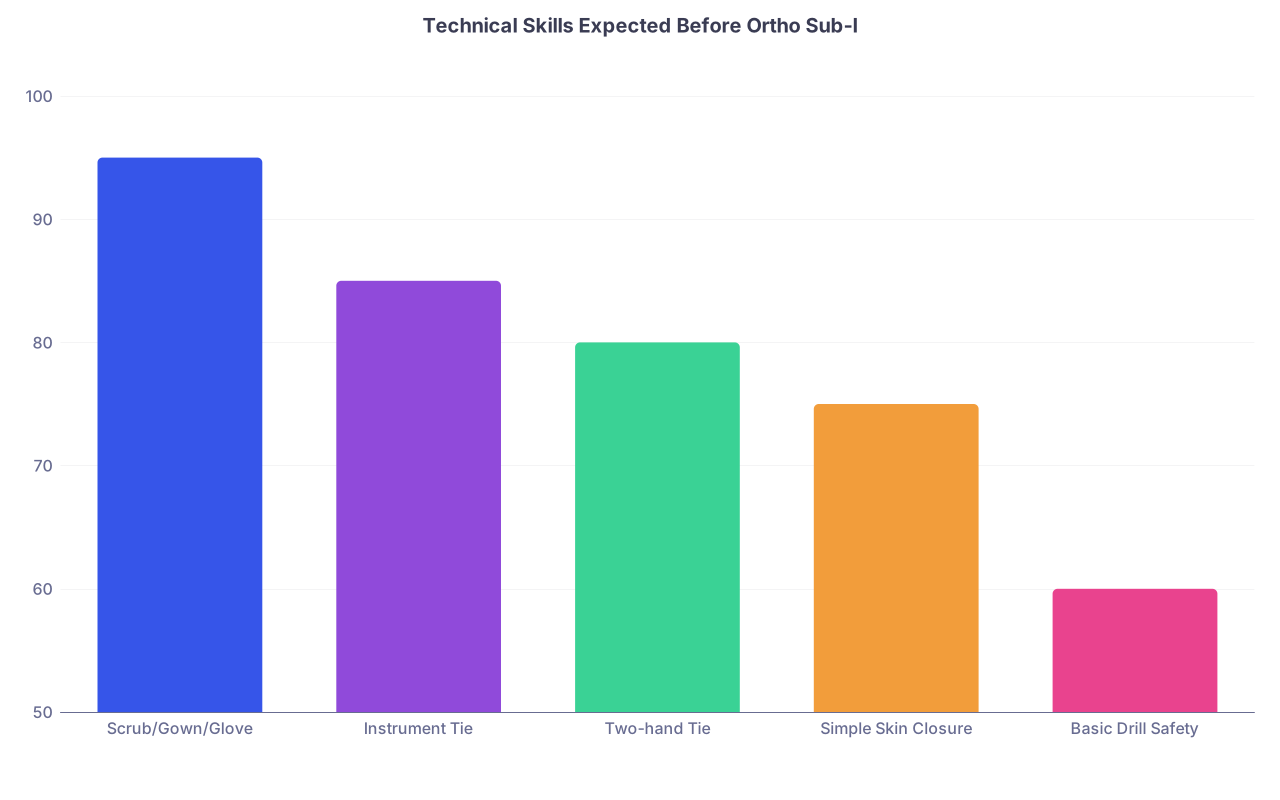
You should go into your first ortho sub‑I already competent at:
- Proper scrubbing, gowning, gloving
- Basic knot tying (instrument and two‑hand)
- Simple skin closure with nylon
- Loading a needle correctly and following angles
This is pre‑work, not optional enrichment.
| Category | Value |
|---|---|
| Scrub/Gown/Glove | 95 |
| Instrument Tie | 85 |
| Two-hand Tie | 80 |
| Simple Skin Closure | 75 |
| Basic Drill Safety | 60 |
(Those percentages are the rough proportion of programs where I would expect you to have at least baseline proficiency from day one.)
4. Clinical Thinking and Teachability
No one is grading you on boards‑style MSK minutiae. They want to know:
- Can you present a consult coherently and concisely?
- Do you understand basic fracture patterns and urgency?
- When corrected, do you improve or argue / blame “how I was taught at home”?
A strong student on consults:
- Gets mechanism, neurovascular status, open vs closed, and imaging before calling.
- Has a one‑liner ready: “This is a 65‑year‑old with a closed intertrochanteric fracture after a mechanical fall, neurovascularly intact.”
- Asks targeted questions: “Is your threshold for calling plastics lower for these hand injuries?”
A weak student:
- Calls ortho without checking pulses or compartments.
- Presents a rambling story without a clear problem.
- Doesn’t adjust after feedback (“We do it this way here”).
Teachability is binary for many residents. If they label you “rigid” or “doesn’t listen,” you are done at that program.
5. Ownership and Reliability
The highest compliment: “That student functioned like an intern.”
Ownership looks like:
- You know every detail about the 3–5 patients you are following. Labs, imaging, plans, PT notes.
- When someone says, “Who knows 412B?” your hand goes up.
- You chase down loose ends without being micromanaged: consults, family updates, DME.
Red flags:
- Rounds: “I am not sure about their vitals today” on your own patient.
- Missing a post‑op check because you “thought someone else was doing it.”
- Forgetting to check a critical post‑reduction film.
No resident wants an intern who drops the ball on a compartment syndrome. They start screening for that level of accountability now.
6. Professionalism Under Ortho‑Level Stress
Ortho runs late. It is physical. People snap. The volume is relentless at some sites.
Programs watch:
- How you behave on day 24 when you are exhausted and annoyed.
- Whether you complain about call, long cases, or specific residents.
- Whether you are respectful to scrub techs, nurses, radiology, and PT.
One sharp comment to a scrub tech can tank your eval. Conversely, when scrub techs and nurses say, “We like that student,” people listen.
Pre‑Sub‑I Prep: You Cannot “Wing” Ortho Aways
If you walk into your first away rotation unprepared, you will spend the first 10 days learning basics while your competition is already ahead.
You need three types of prep: cognitive, technical, and logistical.
Cognitive: Know the Canonical Ortho Student Knowledge
You do not need to be a mini‑fellow, but you should have a strong handle on:
- Hip fractures: basic classification, who goes to OR urgently vs emergently vs tomorrow morning.
- Ankle fractures: Weber types, gravity stress vs weight‑bearing films.
- Open fractures: Gustilo classification, antibiotic timing, need for I&D.
- Compartment syndrome: classic findings, why pain with passive stretch matters.
- Pediatric basics: supracondylar fractures, SCFE, septic hip vs transient synovitis.
You should read before the rotation:
- One concise ortho student book (e.g., “Netter’s Concise Orthopaedic Anatomy” + a brief fracture manual).
- Your home institution’s ortho student guide if available.
- Any orientation packet from the away site. Many students bizarrely ignore these; programs notice.
Technical: Practice Until It Is Boring
You want muscle memory for:
- Instrument tie with your non‑dominant hand starting.
- Two‑hand ties in a deep “wound” (box, towel roll, etc.).
- Running subcuticular closure on a practice pad.
- Handling a drill: finger position, trigger control, not “diving” the drill.
If you struggle with basic sterile technique during your sub‑I, they mentally downgrade you to “pre‑clerkship level.” Hard to come back from that reputation in 4 weeks.
Logistical: Stack the Deck Before You Arrive
Concrete steps:
- Email the program coordinator 2 weeks before: confirm start time, where to report, dress code, call expectations.
- Ask (once, not three times) for a sample schedule or block plan.
- Review the call schedule and OR times so you are not clueless on day 1.
- Have a dedicated “ortho bag”: trauma shears, penlight, small notebook, belt loop for lead badge, a watch with seconds.
You want to look like you have been in an OR before. Because you should have.
Daily Tactics: How To Run a High‑Level Ortho Sub‑I Day
Here is what a strong day looks like, step by step. This is where most students fall apart—they improvise instead of systematizing.

| Step | Description |
|---|---|
| Step 1 | Arrive Early |
| Step 2 | Pre-round on Patients |
| Step 3 | Update List and Notes |
| Step 4 | Formal Rounds |
| Step 5 | OR or Clinic |
| Step 6 | Afternoon Tasks and Consults |
| Step 7 | Evening Check and Sign-out |
| Step 8 | Quick Reading and Prep |
Early Morning: Pre‑Round Like You Mean It
Target: Arrive 30–45 minutes before the intern.
Your job:
- Check vitals, labs, overnight events for “your” patients.
- See them briefly: pain, exam, drains, dressings, ambulation.
- Update the list: new labs, imaging, plan adjustments.
- Pre‑write your notes (if EMR allows) so rounds are smoother.
When rounds start, you should be ready to present quickly:
- “Mr. X is POD2 from R THA, walked 40 feet with PT, pain 4/10, vitals stable, Hgb 9.8, plan for discharge tomorrow.”
If you are guessing on basic data, you look like you do not own your patients.
Rounds: Concise, Reliable, Zero Drama
During rounds:
- Walk at the front or middle, not trailing like an undergrad.
- Carry pens, tape, and a list. Offer to write orders if allowed.
- Listen for action items: imaging, consults, dressing changes. Write them down.
If the chief or attending asks, “Who talked to family for 512A?” you should answer without looking at the intern. That is ownership.
OR Time: How To Be the Student Residents Fight For, Not Against
There is an unpleasant truth here: not everyone can be in the best cases every day. Residents quietly decide who to “bring in.”
Make yourself the obvious choice:
Before the case:
- Know the indication and rough steps. You should be able to say, “We are doing an IM nail for an intertrochanteric fracture, starting with positioning, incision, guidewire, reaming, then nail, screws.”
- Help move the patient, put on the tourniquet, mark the side if appropriate.
- Volunteer to help with positioning and prepping. Scrub when the intern or junior scrubs.
During the case:
- Eyes on the field, not the monitor when you are retracting.
- Keep tension steady; do not “chase” tissue with wild movements.
- If you get to close: small bites, perpendicular needle angles, gentle tissue handling.
After the case:
- Help transport, write quick post‑op note (with supervision), update the list.
- Ask one focused, case‑related question after the room is closed.
Bad behaviors that kill OR invites:
- Asking, “Can I scrub this?” repeatedly. They know you want to scrub.
- Complaining about long cases, standing, or lead.
- Looking bored or scrolling your phone in the corner.
Clinic: The Underrated Evaluation Zone
A lot of students assume clinic does not “count.” That is wrong. Staff see your patterns there without the OR adrenaline.
In clinic:
- Take ownership of seeing and presenting new patients when appropriate.
- Learn to perform and present a targeted MSK exam.
- Keep flow moving: remove dressings, get braces ready, help with documentation.
If an attending sees you take initiative in clinic, they often become your strongest letter writer.
Evening: Do Not Sprint To Your Car
Before leaving:
- Check with the junior: “Anything else I can help with? Any patients you want me to see?”
- Confirm if there are late add‑on cases or ED consults.
- If on call, know exactly how they want consults paged and presented.
Then leave. You do not need to fake staying until midnight. Orthopedic people know when someone is “lingering” for show versus actually working.
Rotations Across Multiple Programs: Strategy, Not Tourism
Most serious ortho applicants do 2–3 away rotations. Doing four usually adds fatigue more than advantage.
You need to think about:
- Where you are realistically competitive—based on Step 2, research, and letters.
- Where your home program connections can vouch for you.
- How programs historically treat away rotators (some take most of their class from away students, others barely interview them).
| Program Type | % of Class from Aways (Typical) |
|---|---|
| Big-name academic (Top 10) | 40–70% |
| Mid-tier academic | 30–50% |
| Strong community with fellowships | 20–40% |
| Pure community, no fellows | 10–30% |
You want at least one rotation where you are solidly competitive and one aspirational. Do not fill your calendar only with prestige names where you are an outlier on Step and research.
Letters of Recommendation: Converting Performance into Paper
Your sub‑I performance is only as valuable as the letter that comes out of it.
The best ortho letters say, implicitly: “We would trust this person as our intern.”
To get that level of letter:
- Identify early (week 2) which attending / faculty you are consistently working with and who seems supportive.
- Ask directly and professionally in week 3: “I have really enjoyed working with you. If you feel you know my work well enough, would you be willing to write a strong letter of recommendation for my ortho applications?”
- Make it easy: send your CV, personal statement draft, and bullet points of what you did on that rotation.
Weak ask: “Can you write me a letter?” Strong ask includes the phrase “strong letter” and comes after you have actually proven something.
Also: resident input matters. Many attendings will ask, “What did you think of this student?” If the senior says, “Top student this year,” the letter changes tone.
Common Failure Modes That Sink Ortho Sub‑Is
Here are the patterns I see repeatedly that crash otherwise decent applications.
1. Acting Like You Are Still in Third Year
- Leaving before residents.
- Treating the rotation like an observation.
- Not learning names of nurses, techs, or PT.
You are auditioning for a job, not collecting H&Ps for your log.
2. Overcompensating and Turning Into a Try‑Hard
Other extreme:
- Answering every pimp question before anyone else can.
- Talking over the intern to show what you know.
- Constantly telling people how much you “love ortho” instead of showing it.
Residents will label you “gunner.” That label sticks.
3. Poor Energy Management
You cannot grind 16‑hour days for 4 weeks on caffeine and vibes. At week 3 you will crack, and everyone will see it.
Simple but non‑negotiable:
- Sleep. Non‑negotiable 6 hours minimum.
- 10–15 minute walk or light movement once a day.
- Hydrate; bring a water bottle under your white coat or leave one in the workroom.
This is not wellness fluff. It is how you avoid snapping at a scrub tech on day 20 and ending up with a professionalism comment in your eval.
4. No Self‑Correction
The worst pattern: getting the same feedback twice.
If a resident tells you, “Your presentations are too long, focus on the problem,” you have exactly one more day to still be long‑winded before they decide you do not listen.
Ask once per rotation: “Is there anything I can adjust to be more helpful to the team?” Then actually change.
Post‑Rotation: Cementing the Impression
When the month ends, most students vanish. The smart few close the loop.
Do this:
- Thank the coordinator, residents, and attendings you worked closely with. In person if possible, short email is fine as backup.
- Send a brief thank‑you email to your letter writer once they agree: include your ERAS ID and timeline.
- If the program is one of your top choices, a later targeted email in interview season that references your rotation and continued interest is reasonable (not weekly, not desperate).
You want them to remember your name when they open ERAS and see 70 ortho applications that all blur together.
Frequently Asked Questions
1. How many ortho subinternships should I do to be competitive?
For most applicants, two away rotations plus one home ortho rotation is the sweet spot. One away is risky if it goes poorly. Three is fine if you have the stamina, but four usually adds fatigue and diminishing returns. Prioritize quality over quantity: two stellar rotations beat four mediocre performances.
2. What if I feel lost technically on my first sub‑I—am I doomed?
Not automatically. Programs care more about your trajectory than your starting point. If your first week is rough but your improvement is obvious by week 3—steadier hands, better knot tying, fewer sterility errors—you can still finish strong. The problem is stagnant performance. If you are not better in week 4 than week 1, that is when evaluations turn negative.
3. How much does research matter compared to sub‑I performance?
Research gets you into the conversation. Sub‑I performance decides your rank. A heavy research background might help you land interviews at academic programs, but no amount of PubMed entries will rescue a poor away rotation. Conversely, a slightly lighter research CV with an outstanding sub‑I and powerful letters can absolutely match at strong academic programs.
4. Should I ever leave early to study during an ortho sub‑I?
Very rarely, and only with explicit buy‑in from your team. On a light clinic afternoon when the junior says, “We are good, go home and rest,” you can leave. Choosing to leave early on your own because you want to “read” while the team is still grinding is a bad look. Reading is for nights and weekends. During the day, be present and useful.
5. How do I recover if I think one away rotation went badly?
You cannot fix that specific eval after the fact, but you can protect your overall application. First, perform at an exceptionally high level on your remaining rotations and secure strong letters there. Second, make sure your home program faculty really understands your strengths and can advocate for you during interview season. One “off” sub‑I will not automatically sink your match if the rest of your application and rotations tell a different, stronger story.
With these tactics, your subinternship stops being a mysterious audition and becomes something you can control—deliberately, step by step. Master this phase, and you are not just “going for ortho.” You are building the reputation that will follow you into residency. The next move after that is using interview season to reinforce that same narrative. But that is a strategy for another day.