
Only 41% of neurosurgery interns nationwide feel physically and emotionally prepared for the stamina demands of their first year. The rest learn the hard way.
Most applicants think selection committees care mainly about board scores, publications, and letters. They do. But for neurosurgery, that is just step one. Once you cross the academic threshold, the conversation in the rank meeting shifts fast:
“Can this person take a 28‑hour call without disintegrating?” “Are they going to shut down on night 4 in the ICU?” “Will they be the one we find crying in the stairwell at 3 a.m., again?”
This article is about that hidden layer: how neurosurgery residency selection committees actually evaluate grit and stamina, and the very specific signals—good and bad—you send without realizing it.
1. Why Neurosurgery Cares About Grit More Than Almost Any Other Field
Neurosurgery is not just competitive. It is physically and psychologically punishing in a way most other specialties simply are not.
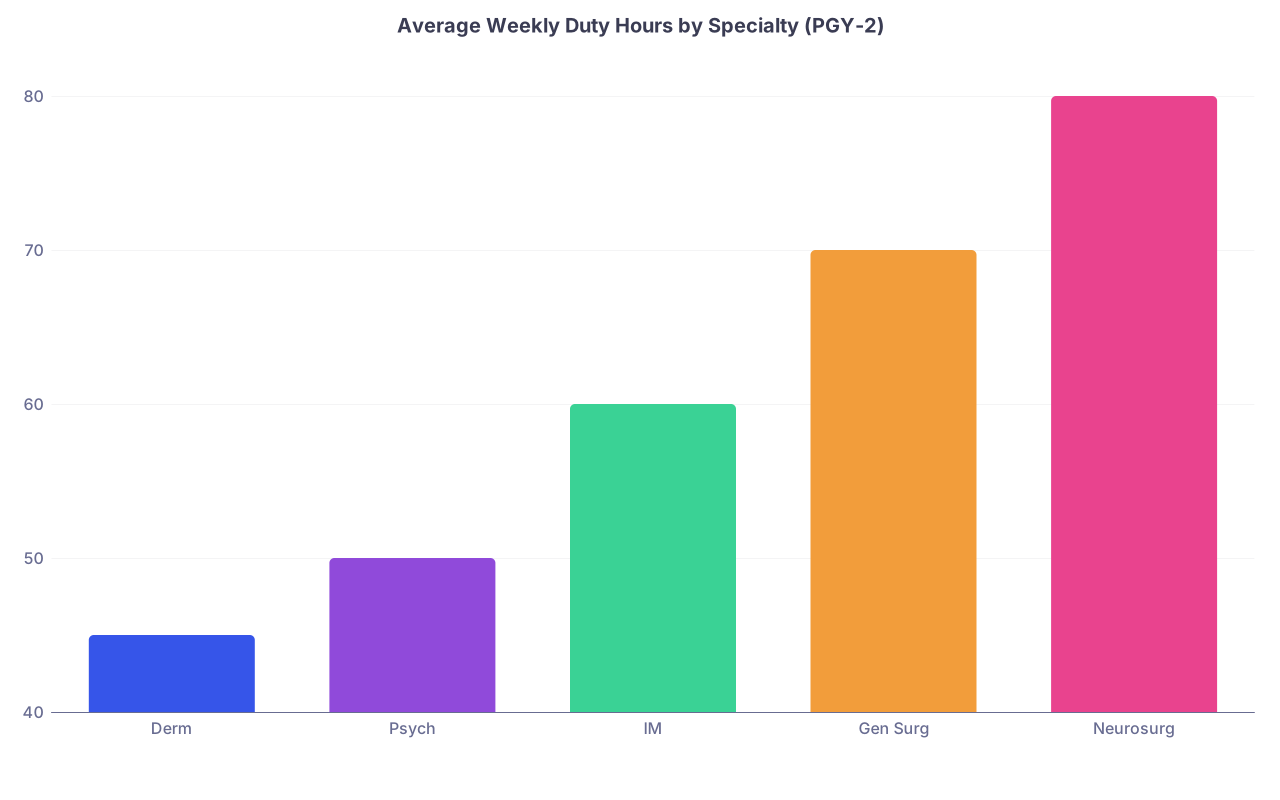
| Category | Value |
|---|---|
| Derm | 45 |
| Psych | 50 |
| IM | 60 |
| Gen Surg | 70 |
| Neurosurg | 80 |
That bar chart is the whole story in one picture.
If you sit in a neurosurgery CCC (Clinical Competency Committee) or program evaluation meeting, you hear the same refrains over and over:
- “This job selects for people who can suffer productively.”
- “I can train someone slower. I can’t train someone to not fall apart at 2 a.m.”
- “The work never stops. If they need a perfect wellness bubble, they will not survive here.”
The job demands:
- 70–90 hour weeks for years.
- 24–28 hour calls with real decisions at hour 26.
- Prolonged cognitive load: 8–14 hour cases where one lapse can be catastrophic.
- Living with bad outcomes that are no one’s fault and still showing up the next morning.
That is why committees obsess over “grit” and “stamina.” Not because it sounds nice in a PowerPoint. Because if they get it wrong, it costs patient safety, team function, and often that resident’s career.
2. The Real Gating: Academic Screen, Then Grit Screen
Let me be brutally clear. No program is ranking you high for “grit” with a 215 Step 2 and zero meaningful neurosurgery exposure. Baseline academic filter comes first.
But once you are in the realistic interview tier, committees start rating something much squishier: will you actually endure this?
Here is how many programs mentally structure it (they rarely write this down, but the conversations are almost identical):
| Stage | What They Ask | Typical Tools |
|---|---|---|
| 1. Academic Threshold | Can they pass the boards? | Step 2, clerkship grades, class rank, publications |
| 2. Grit/Stamina Assessment | Can they survive and function here? | Sub-I behavior, letters, interview demeanor, life history, red flags |
Once you are above their Step 2 and transcript threshold, the “who ranks top 5 vs. #23” is dominated by perceived grit and fit. I have literally heard a PD say, “We have enough smart. I want durable.”
3. Where Committees Actually Get Grit and Stamina Data
They do not ask, “Do you have grit?” in an interview and then believe your answer. They infer it from very specific sources.
3.1 Away Rotations and Sub‑Internships: Exhibit A
This is the primary grit test. Everyone on the selection side knows it.
Sub‑I performance is not just “are they smart and pleasant.” People on service are quietly logging:
- What happens to you at 5 p.m. after a brutal day.
- How you act when you get demolished at the board.
- Whether you keep showing up early the week after a complication.
- How much you complain (or do not) when the work is soul‑crushing.
On neurosurgery sub‑Is, there are a few classic “stress exposures” that people watch very closely:
First night on home call or in-house call
Everyone listens afterward to how you describe it on rounds. Do you say, “It was insane, I was destroyed, I barely survived” — or do you matter‑of‑factly summarize issues and move on? Committees are not looking for macho posturing, but they are filtering out dramatizers.String of long days
After 5–7 consecutive 12–14 hour days, does your performance slip? Are you still prepared on rounds, or suddenly “forgot to check” half your patients? Residents notice. They talk.The first big embarrassment
For example: faculty asks you a basic question (“What’s the GCS again?”) and you blank in front of the team. Grit is: do you recover, read about it that night, and answer better the next time? Or do you withdraw, participate less, and start saying “I don’t know” reflexively?
The bottom line: sub‑Is are less “auditions” and more “stress tests.” That is what people in rank meetings reference: “I saw him post‑call twice. Still on.”
3.2 Letters of Recommendation: The Coded Language of Grit
Letters are not just about “brilliant” and “hard‑working.” Neurosurgeons use very specific phrases when they are signaling stamina and durability to each other.
Classic green‑flag phrases:
- “Functions at the level of an R2.”
- “Never once complained despite one of the heaviest months of the year.”
- “Stayed late after every case to see the patient out of the OR.”
- “Was consistently the last student to leave the hospital.”
- “Actively sought more responsibility even when exhausted.”
These are not filler lines. These are deliberate.
On the flip side, there are phrases that look neutral to laypeople but are nails in the coffin for a high‑intensity field:
- “Will thrive in a supportive environment.” ⇒ Translation: needs hand‑holding. Might not handle neurosurgery.
- “A pleasure to work with, always polite.” (And then nothing about work ethic or hours.) ⇒ Translation: nice, but soft.
- “Best when well rested and prepared.” ⇒ Translation: not robust when stressed or sleep‑deprived.
If your strongest neurosurgery letter does not have some explicit nod to work ethic, persistence, or stamina, many committees will quietly slide you down to the “backup pick” region.
3.3 Interview Day: Micro‑Stamina in Real Time
Interview days themselves are setup as mini endurance tests, especially at bigger programs:
- Multiple back‑to‑back 20–30 minute interviews.
- Early‑morning pre‑interview talks plus resident mixers the night before.
- Long tours, standing, small talk, then formal sessions.
No, this is not equivalent to call. But faculty and residents are absolutely watching what you are like at 3 p.m. compared with 8 a.m.
Behaviors that signal strong stamina and grit:
- Consistent energy and engagement across the day.
- Asking thoughtful questions in the last session, not just the first.
- Same posture, same eye contact, same attentiveness at the end.
- Not constantly checking your watch/phone the moment there is a break.
Red‑flag interview behaviors:
- Noticeable sagging or “I’m over it” vibe by mid‑day.
- Comments about being “so tired” from travel or previous interview days.
- Seeming easily overwhelmed by a dense schedule (“This is a lot, wow”).
You do not have to be manic or hyper. Calm, steady, still engaged after several hours — that is what many surgeons read as high bandwidth.
3.4 Life Story and Application Pattern
Committees also scan your life trajectory for evidence that you have already done hard things for a long time. Not 2‑week sprints. Multi‑year grinds.
Things that carry weight:
- High‑level athletics with demanding training schedules (especially endurance, but any serious sport helps).
- Military service, especially with deployment or leadership responsibility.
- Meaningful work during college (night shifts, 30–40 hour work weeks while full‑time student).
- Longstanding responsibilities (caring for family, financially supporting others, etc.).
- Multi‑year research with setbacks and eventual output, rather than 4 scattered poster abstracts.
They are not looking for trauma stories. They are looking for repeated exposure to effort over time without quitting.
If your whole application looks like: high GPA, very curated experiences, no signs of ever being chronically tired or stretched — some programs will wonder about your stress baseline.
4. The Situational Questions: Where They Probe Grit
Committees rarely ask, “Are you gritty?” They ask about situations that force you to reveal your default response to adversity.
Here are some common patterns and what they are really testing.
4.1 “Tell me about a time you were overwhelmed or overextended.”
Bad answer pattern:
- Long description of how unfair the situation was.
- Focus on what others did wrong.
- Ending with “but I survived” without specific actions.
What they infer: blames externally, not solution‑oriented, fragile under pressure.
Strong answer pattern:
- Brief setup of the situation (heavy clinical load, research deadline, family illness).
- Specific actions you took to adapt: re‑prioritized, asked for help, built a system.
- One or two concrete behavioral changes you made that persisted.
- Brief reflection that is not melodramatic: “It was rough, but it reset my ceiling for what I can handle.”
They are trying to see: do you respond to overwhelm with organization and action, or emotional flooding?
4.2 “Tell me about a failure or setback.”
Many applicants think they need some cute “I studied hard and then I got an A” story. That is garbage in neurosurgery interviews.
They want:
- A real failure. Bad exam. Lost season. Failed grant. Getting cut from something.
- No excuses. Own the failure outright.
- Evidence that you stayed engaged instead of pulling back.
- Tangible behavioral change afterward. Not just “I learned resilience.”
Red flags are easy to spot: evasiveness, blaming, or choosing a “failure” that is not actually a failure.
5. What Grit Looks Like on a Sub‑I (Down to the Level of Daily Behavior)
Let me break this down very specifically, because this is where most neurosurgery hopefuls either separate themselves or quietly sink.
You are on a neurosurgery sub‑I. The day is objectively miserable: three add‑on cases, two new consults in the ED, a crashing ICU patient.
Here is how a gritty, high‑stamina applicant behaves vs. the one who gets quietly down‑ranked.
Morning Rounds
High‑grit version:
- Shows up earlier after a bad day, not later.
- Still has a running list of overnight events. Not perfect, but complete enough.
- Asks one or two high‑yield questions, not 15.
- Does not lead with how tired they are.
Low‑grit version:
- Late, blames it on sign‑out or traffic.
- “I didn’t get to see all the patients” becomes standard, not exception.
- Brings up their exhaustion frequently (“I was here so late yesterday…”).
In the OR
High‑grit:
- Still paying attention on case #3 of the day.
- Still asks thoughtful questions, but knows when to be silent if the room is tense.
- Volunteers to help turnover, get consent for the next patient, check on post‑ops.
Low‑grit:
- Zoning out at the field or staring at the clock.
- Takes “breaks” that stretch and seems in no rush to get back.
- Disappears post‑case instead of following patient to PACU or ICU.
End of the Day
High‑grit:
- “What else needs to be done before I leave?”
- Double‑checks their notes or to‑do list for the night team.
- You can see they are tired, but they are still present. Not whining.
Low‑grit:
- Hovers near the door at 5 p.m. waiting for permission to leave.
- Frequently asks, “So… can I go soon?” when the team is obviously still buried.
- Leaves loose ends for residents to clean up.
Residents write comments like “never once asked to leave early” or “stayed until team finished” in their program’s internal evaluation systems. Those phrases end up in selection meetings.
6. How Programs Misjudge Grit (And Where You Can Capitalize)
Selection committees are not perfect. Certain traits get mistaken for grit, and true stamina sometimes gets overlooked. You can exploit that if you understand the bias.
6.1 Overvalued: Loud Confidence
The loud, charismatic student who loves to say things like “Oh yeah, I love long hours, I live for this stuff” often gets early positive attention. Early. Until you see them on a bad call night.
If you are quieter, you can still project grit by:
- Speaking concretely about prior long‑hour experiences, not generically.
- Describing specific sacrifices you have already made for a goal.
- Using precise language: “I ran 70 miles a week for three years.” “I worked 36 hours a week overnight through junior year.”
Specifics trump bravado. Honest, detailed examples of sustained effort often flip faculty opinions after the third or fourth interview.
6.2 Undervalued: Low‑Drama Consistency
A lot of true grinders are almost boring. They do not sell themselves; they just keep showing up. Committees sometimes miss them if the letters and interview do not amplify that quality.
If this is you, you need your advocates to be explicit. Ask letter writers to comment directly on:
- Number of hours you spent on the service or project.
- Your reliability post‑call or under pressure.
- Times you went beyond what was required without being asked.
Vague “hard worker” lines will not capture your actual resilience. You need hard edges to the story.
7. Signals That You Do Not Have the Stamina for Neurosurgery
Let me be blunt. There are specific patterns that repeatedly correlate with residents who later burn out or leave. Committees have seen them enough that these are near automatic down‑shifts.
7.1 Chronic Wellness Fragility
I am not talking about having a therapist or taking care of your mental health. Many programs actually see that as a positive.
I am talking about:
- Long, detailed discussions of how you need strict sleep schedules.
- Emphasis on “work‑life balance” as a core requirement in neurosurgery interviews.
- Framing prior stressors as almost traumatic when they were standard for most applicants.
Neurosurgery is moving toward better wellness, but it is not a 9–5 field. Saying you “need” guaranteed sleep or protected evenings as a non‑negotiable is a mismatch. Committees hear that very clearly.
7.2 Repeated Pattern of Quitting When Things Get Hard
On paper this looks like:
- Multiple short‑lived activities: 6 months of this, 1 year of that, no long arcs.
- Dropping sports, instruments, leadership roles right when they became demanding.
- Stepping back from research or long projects once initial enthusiasm fades.
During interviews, this surfaces when you cannot tell a story that spans multiple years of sustained effort.
Programs are not offended by quitting one thing. They are worried when they see a lifestyle pattern of chasing what feels good and leaving what is heavy.
8. Concrete Ways You Can Demonstrate Grit and Stamina (Without Being Fake)
You cannot reinvent your life history in a year. But you can do a lot to highlight the durable parts of your story and to behave in a way that clearly shows you know what neurosurgery costs.
8.1 Before You Apply
- Commit to at least one multi‑year activity that demands consistent effort: research, athletics, work, or major longitudinal volunteering.
- Seek out genuinely demanding clinical experiences: SICU, trauma, busy ED shifts. Then reflect specifically on what you learned about your limits.
- Build physical conditioning. You do not need to be an ultra‑marathoner, but poor baseline fitness shows itself brutally on long calls and in the OR. Programs notice.
8.2 On Sub‑Is
- Show up 15–30 minutes earlier than you “need to” every day. Consistently.
- When you are exhausted, focus on completeness and reliability rather than speed.
- Never complain up the hierarchy. If you need to vent, do it to someone completely outside the system, not to interns or chiefs.
- Volunteer for unpleasant tasks occasionally: late‑night consent, extra ED consult, following up a lab at midnight. Do not martyr yourself, but take on some extra weight with good humor.
8.3 In Your Personal Statement
Do not say, “I have grit.” Prove it with one or two specific stories that show:
- Extended effort over time.
- Sacrifices you consciously chose to make.
- Learning from failure without melodrama.
- Ability to function when tired or stretched.
One solid, concrete narrative beats ten abstract paragraphs about “resilience.”
9. How Grit and Stamina Actually Show Up During Residency
Committees are not guessing in the dark. They have watched residents for decades. They know what early green flags look like.
Typical comments in CCC meetings about a strong PGY‑1 / PGY‑2:
- “Never says no to work.”
- “Rock solid on post‑call rounds.”
- “Had a complication but came in even sharper the next week.”
- “Residents trust them with sick patients at 3 a.m.”
And about the ones who are struggling:
- “Unreliable when tired.”
- “Needs constant reassurance.”
- “Mood shifts dramatically with workload.”
- “Talks often about quitting or switching fields.”
When they are ranking applicants, they are projecting you into one of those columns. Every data point you give them is used to guess: which sentence will we be saying about this person in two years?
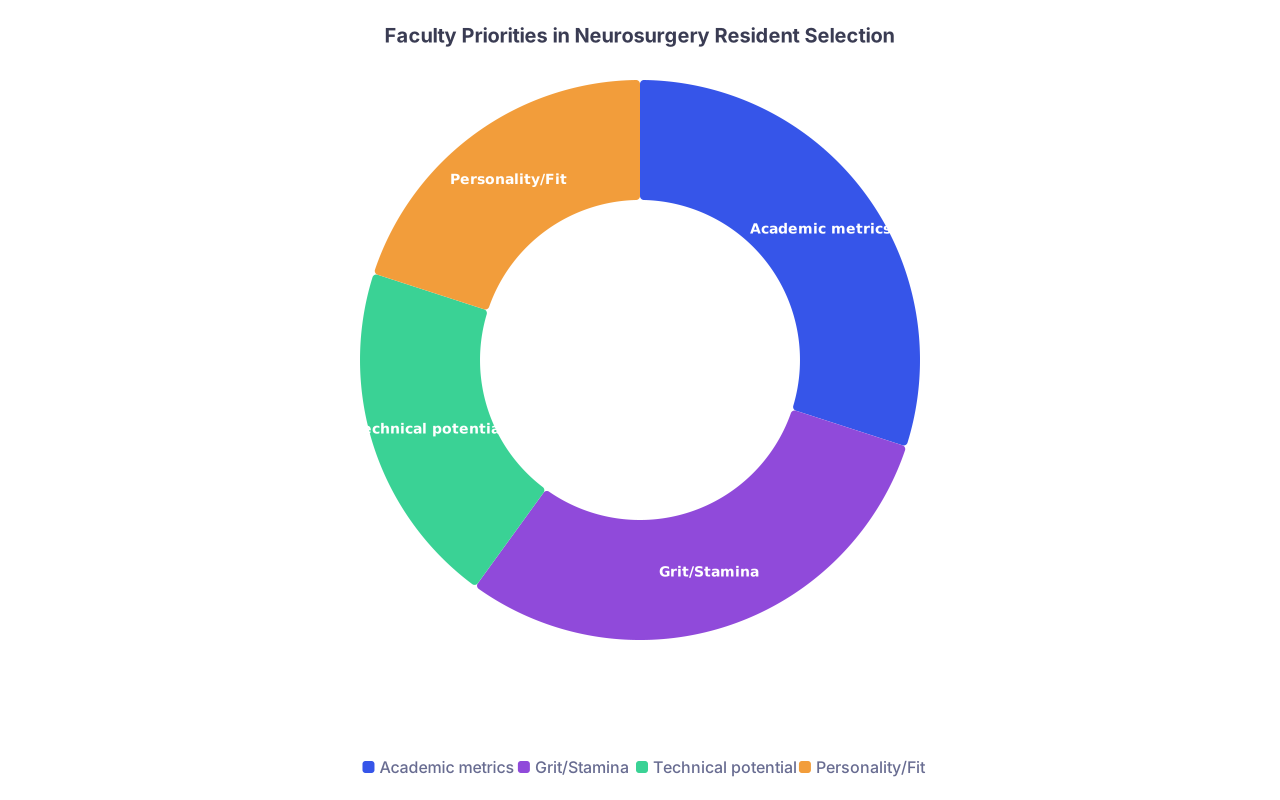
| Category | Value |
|---|---|
| Academic metrics | 30 |
| Grit/Stamina | 30 |
| Technical potential | 20 |
| Personality/Fit | 20 |
Those numbers will vary by program, but this split is not far off at many places once you are in the serious applicant pool. Grit and stamina are not a tiebreaker. They are central.

| Step | Description |
|---|---|
| Step 1 | Application Received |
| Step 2 | Reject |
| Step 3 | Neurosurg Letters Reviewed |
| Step 4 | Low Priority |
| Step 5 | Sub-I Performance |
| Step 6 | Interview Invite |
| Step 7 | Rank List Upper Tier |
| Step 8 | Rank List Lower Tier |
| Step 9 | Meets Academic Cutoff |
| Step 10 | Strong Work Ethic Signals |
| Step 11 | High Stamina on Service |
| Step 12 | Interview Grit Signals |
That is more honest than what you will see on any public‑facing program website.

10. Quick Reality Check: Should You Even Be Selling Grit for Neurosurgery?
A harsh but necessary question: do you actually want this life, or are you trying to contort yourself to match an image?
Here is a simple internal screen I recommend:
- Have you already experienced sustained 70–80 hour work weeks (clinical, research plus work, athletics plus school) for at least a few months?
- When you think about operating at hour 24 of call, does part of you feel drawn to that challenge, not just terrified?
- Do you recover from stress with anger and focus, or with withdrawal and avoidance?
If you cannot honestly say you have at least some history of long‑term, high‑demand effort, you should slow down and push‑test yourself before committing to neurosurgery. Not to “toughen up,” but to see your own default settings.
Grit is not just a checkbox for match. It is the thing that keeps you functioning safely when it is year 5, 2 a.m., and you are deciding whether to take a second look at that slightly blown pupil.
FAQ (5 Questions)
1. I have average Step scores but very strong work ethic and stamina. Can grit compensate enough to match neurosurgery?
Sometimes, but only partially. Programs still need to trust that you will pass boards and handle in‑service exams. If your scores are just below the usual neurosurgery range, unusually strong letters emphasizing stamina, reliability, and performance on sub‑Is can get you serious looks, especially at mid‑tier or smaller programs. If your scores are very low for the field, grit alone will not save the application.
2. Do programs actually care about athletic or military backgrounds, or is that just a myth?
They care. Not because they like uniforms or sports, but because those experiences are clean demonstrations of long‑term discipline and functioning under stress and fatigue. A former college wrestler or Marine does not get a free pass, but many faculty assume a higher baseline of grit until proven otherwise. The key is connecting those experiences to how you handle hard clinical situations now.
3. How much does one “bad” sub‑I (where I was clearly overwhelmed) hurt me?
A truly bad sub‑I at a program that writes you up as struggling can be damaging, especially if that program was one of your main neurosurgery homes. That said, a strong performance on other sub‑Is with letters emphasizing resilience and improvement can counterbalance a weaker early month. What worries committees is not “rough start” but “unchanged under stress.” If you learned and clearly functioned better on later rotations, that narrative can be salvaged.
4. Is openly discussing past mental health struggles a negative for neurosurgery selection?
Handled well, it does not have to be. Many PDs respect applicants who have engaged with their mental health in a mature, proactive way. The danger is when the story emphasizes fragility, ongoing instability, or very narrow conditions required to function. If you choose to share, the emphasis must be on what you built—coping skills, insight, durable routines—rather than the depth of the crisis. Committees are asking: “Can this person hold up under our workload now?” not “Have they ever struggled?”
5. What is the single most convincing way to show grit to a neurosurgery program?
Sustained, high‑level performance on a demanding neurosurgery sub‑I, backed by a detailed, enthusiastic letter from someone the program trusts. Nothing else comes close. If that letter clearly describes your behavior on long days, your reliability when tired, and your willingness to shoulder unglamorous work without complaint, most committees will put more weight on that than any polished interview answer about “resilience.”
Key points: neurosurgery committees do not guess about grit; they read it from your behavior on service, your history of sustained effort, and the language in your letters. Once your academic metrics clear the bar, perceived stamina and durability are often what separate “maybe” from “must‑have” on the rank list.