
The mythology around matching into competitive specialties is more powerful than the actual numbers. And it hurts applicants more than the specialties do.
I’ve watched smart, capable students quietly kill their own chances in derm, ortho, plastics, ENT, urology, optho, neurosurgery—not because the field was “too competitive,” but because they believed bad advice repeated enough times that it sounded like truth.
Let’s dismantle the big ones.
Myth #1: “If You Don’t Have a 260+ (Or Top X% Step Score), You Have No Shot”
This is the loudest myth. Also the laziest.
Programs like simple screens. Applicants like simple narratives. “Score above this line, you’re safe. Below this line, you’re dead.” Convenient. Also false once you zoom out from the top 5-10 programs.
Here’s what the actual data and patterns show.
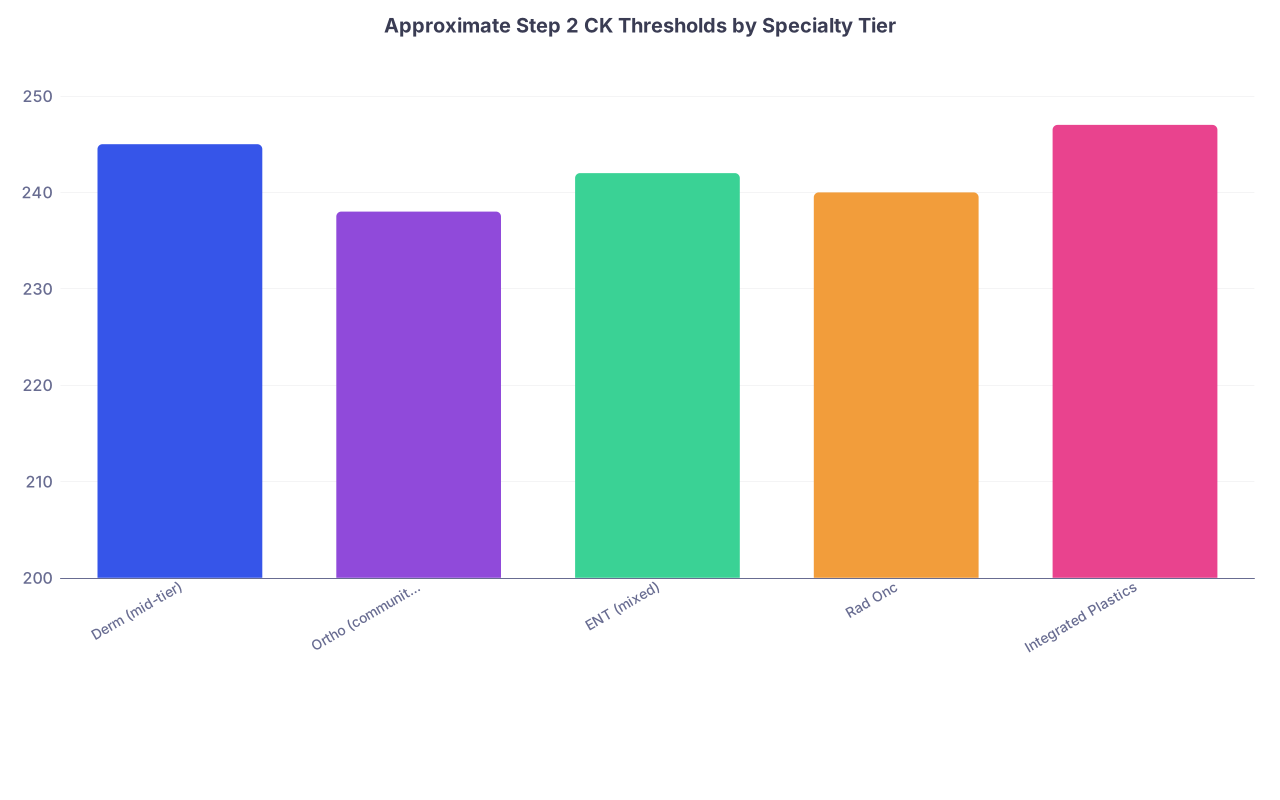
| Category | Value |
|---|---|
| Derm (mid-tier) | 245 |
| Ortho (community-heavy) | 238 |
| ENT (mixed) | 242 |
| Rad Onc | 240 |
| Integrated Plastics | 247 |
Those are ballpark “comfortable” Step 2 ranges where lots of successful applicants land for non-elite programs. Notice what’s missing? The number 260.
If you pull NRMP Charting Outcomes and filter for matched vs unmatched in competitive specialties, a few consistent truths appear:
- There’s a zone of futility: extremely low scores where odds are truly bad.
- There’s a zone of probability: decent but not top scores where you’re in the running if the rest of your application is coherent.
- There’s a zone of luxury: the 260+ crowd. They get more interview offers, but they don’t magically bypass poor fit, no letters, or weird red flags.
I’ve seen:
- A 255 derm applicant with zero derm research and generic IM letters get fewer interviews than a 238 applicant with 3 derm pubs and a glowing PD letter.
- An ortho applicant with a 242, a home rotation, and legit advocacy from faculty match at a solid university program while a 252 applicant with weak ortho ties slid into a preliminary spot only.
Programs are optimizing for outcomes, not just test scores: people who will pass boards, operate safely, publish a bit, not quit, not make their lives miserable. Scores are one proxy. Not the only one.
The nuance people ignore:
- A 248 with strong specialty-specific signals is dramatically more competitive than a 260 who looks undecided or generic.
- Once you’re above a program’s soft floor (often ~235–240 for many non-top-10 competitive programs), the slope of benefit from each extra point flattens.
The dangerous part of this myth is what it does to behavior:
- Students with 238 decide they’re “dead” for ortho and never build the rest of the portfolio that would actually get them in the door.
- Others chase a “save me” 260 on Step 2 instead of shoring up research, letters, and networking—then end up with a 250 and no plan.
Let me be blunt: for competitive specialties, scores are necessary but not sufficient. And unless you’re aiming exclusively at top-5 ivory tower programs, they don’t need to be god-tier. They need to clear the filter and then get out of the way of the real differentiators.
Myth #2: “No Research = No Chance”
This one survives because program websites overcorrect. Everyone now lists “demonstrated scholarly activity” like they’re all running R01 labs. They’re not.
Yes, for derm, plastics, neurosurgery, rad onc, ophtho, ENT—research helps. But there’s a very specific pattern programs actually care about, and it’s not the celebrity number of PubMed hits you see on Reddit.
What they want to know:
- Can you commit long enough to finish something?
- Can you function in that specialty’s academic ecosystem?
- Do you have real relationships with the people signing your letters?
Here’s the mismatch between perception and reality.
| Specialty | Reddit Myth (PubMed #) | Common Matched Range | What Actually Matters Most |
|---|---|---|---|
| Dermatology | 15–30+ | 3–8 | Derm-specific work + letters |
| Plastic Surgery | 20+ | 4–10 | Longitudinal projects + faculty support |
| ENT | 10+ | 2–6 | ENT projects + strong rotation evals |
| Orthopedics | 10+ | 1–5 | Ortho exposure + home advocacy |
| Neurosurgery | 15+ | 5–12 | Serious commitment + neurosurg mentors |
Those “3–8” numbers aren’t theoretical. They’re what you actually see across many mid- and even some high-tier programs when you look past the exceptional CVs used in marketing slides.
Crucial distinction: research volume vs research signal.
- Five first- or middle-author derm papers with the same attending over two years? That screams “future academic colleague.”
- Ten scattershot QI abstracts in random fields with no clear theme? That screams “checklist.”
The applicant with one solid specialty-specific project that led to a podium presentation, a paper in process, and a strong letter from the PI is more compelling than the applicant with “13 posters” who cannot explain what any of them actually changed in patient care.
I’ve seen competitive matches with:
- Zero formal publications, but a legitimate, well-run derm project with a detailed letter from the PI describing originality, grit, and follow-through.
- One or two case reports plus a strong Step score and outstanding rotation evals.
Does no research hurt? Yes, especially in fields like derm, plastics, neurosurg, ENT. But “hurt” is not the same as “impossible.” The real death sentence is:
- No research
- No specialty mentor
- No away rotation at all
- Generic letters from unrelated fields
If you’re late to the game, your goal isn’t to cram 10 superficial projects into 6 months. It’s to build one or two high-yield, specialty-linked projects that generate mentorship, a letter, and proof that you can finish what you start.
Myth #3: “Without a Home Program, You’re Screwed”
Another favorite. Often repeated by students at big-name schools… who, incidentally, have home programs.
Yes, having a home department in ortho, derm, ENT, plastics, etc. is an advantage. You get built-in mentors, research infrastructure, and guaranteed audition time. But saying “no home program = no chance” simply ignores the entire existence of:
- Osteopathic schools
- Newer MD schools
- International grads who matched competitive spots
They did not magically conjure “home programs.”
Here’s the actual dynamic: if you do not have a home program, your visiting rotations and networking become your “home.” Programs know this. Many are explicitly looking to pick up strong students from schools without that specialty.

| Step | Description |
|---|---|
| Step 1 | No Home Program |
| Step 2 | Pick 2 to 3 target regions |
| Step 3 | Arrange visiting rotations early |
| Step 4 | Do strong rotation work |
| Step 5 | Secure specialty letters |
| Step 6 | Apply broadly in those regions |
Patterns I’ve watched play out:
- DO student with no home derm program, 2 away rotations, 3 derm projects with one strong mentor, matched at a mid-tier academic derm program that historically likes DOs.
- MD student from a new school without ortho, who did 3 away rotations, got two ortho-specific letters, and matched at a community-heavy ortho program where they had rotated.
Programs are not blind. They adjust expectations:
- If you have a famous home program and still do three away rotations in the same specialty, they’ll ask why your own PD isn’t loudly backing you.
- If you have no home program, they don’t expect a home PD letter—but they do expect you to have found some form of specialty surrogate home via aways and mentorship.
The real problem isn’t “no home program.” The real problems are:
- Weak planning: realizing in July of MS4 that you want neurosurgery and you have no neurosurgery anything.
- Poor rotation choices: doing aways at only ultra-elite programs, getting lukewarm evals, and walking away with no letters.
- No regional strategy: spraying applications nationally with no demonstrated ties to anywhere.
If you lack a home program, you cannot afford to be casual. But you’re not doomed. You just need a deliberate map: target regions, 2–3 well-chosen aways, early communication with coordinators, and mentors who will actually pick up the phone.
Myth #4: “You Must Do 3–4 Away Rotations To Have a Shot”
This one is half-true, half-insanity.
Away rotations are important in competitive fields. But there’s a point of diminishing—and then negative—returns. I’ve watched students burn themselves out doing 4–5 back-to-back aways, chasing some mythical “more is better” rule, only to end up with mediocre evals and generic letters.
Programs care about quality and fit far more than raw count.
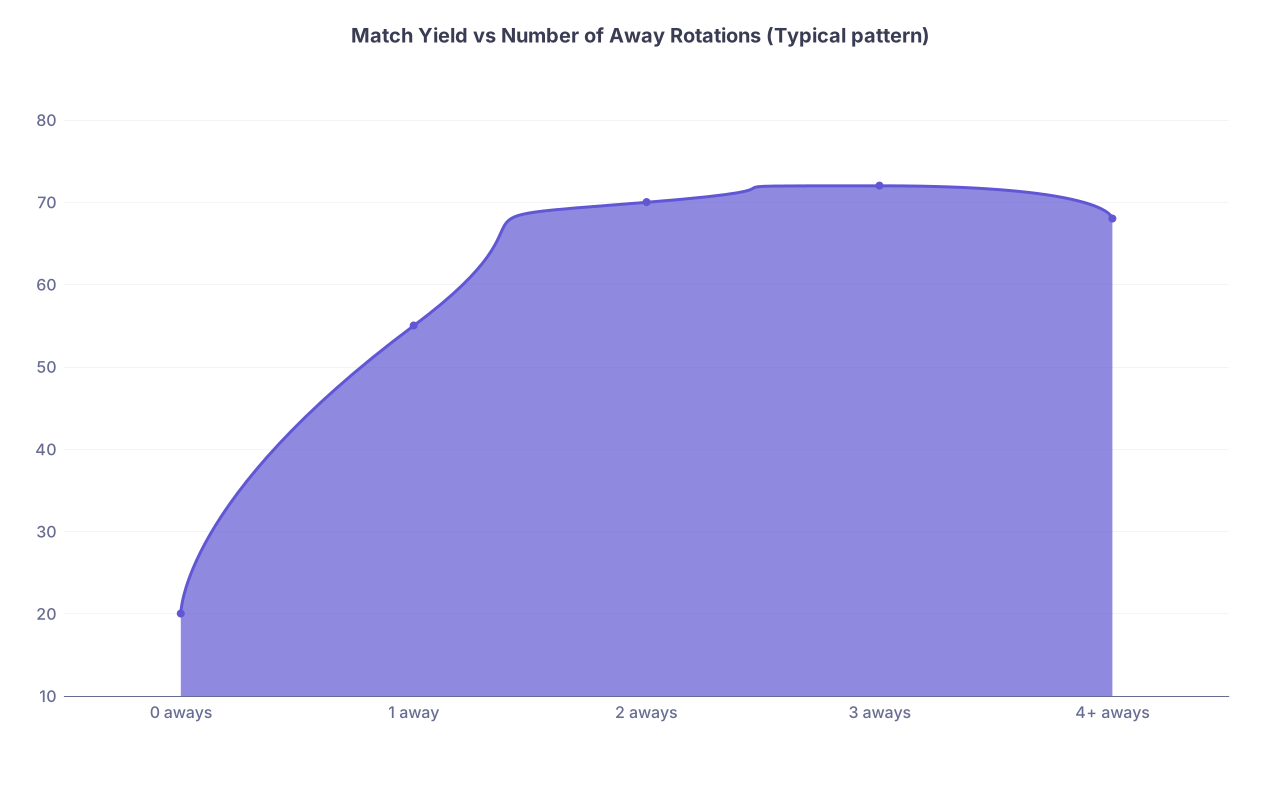
| Category | Value |
|---|---|
| 0 aways | 20 |
| 1 away | 55 |
| 2 aways | 70 |
| 3 aways | 72 |
| 4+ aways | 68 |
That shape is very real anecdotally:
- Zero aways in a competitive specialty? Tough. You’re an unknown quantity.
- One or two strategic aways? High yield—programs know you, you show your best self while not being clinically exhausted.
- Three? Sometimes helpful if you’re late, changing fields, or have big red flags to overcome.
- Four or more? Fatigue sets in. Your performance plateaus or drops. Letters start to sound recycled.
I’ve heard faculty say quietly in workrooms:
- “By the third away in a row, they just look tired.”
- “Their clinical skill is fine, but they’re obviously burned out, not the energetic intern we want.”
Better pattern: two aways you’re genuinely interested in, plus your home program if you have one. Pick them intelligently:
- At least one where you’re realistically competitive (not just top-10 name-chasing).
- Ideally one where you have some regional or personal tie.
- Places that historically take outside rotators into their rank list.
More is not always more. At some point, you’re just generating more evaluations that say “hard-working, pleasant, solid knowledge” instead of one or two that say “this person is exceptional; we want them.”
If you have limited time or budget, I’d rather see:
- Two aways
- One strong research project with a big-name letter writer
- Solid Step 2
- Better personal statement and program list
…than five aways and nothing else substantial.
Myth #5: “If You Don’t Match First Try, You’re Done For That Specialty”
This one is especially cruel. It preys on fear and shame.
Yes, not matching in a competitive specialty hurts. It’s public. It’s demoralizing. But the idea that you are permanently banished from derm, ortho, ENT, plastics, etc. after one failed attempt? Not supported by reality.
What programs actually care about after a non-match is:
- What did you do about it?
- Did you meaningfully improve the specific weaknesses in your application?
- Do you still clearly want this field, or are you bouncing around?
I’ve seen second-time matches in competitive specialties with trajectories like:
- An initial unmatched derm applicant who did a derm research fellowship for a year, picked up 4 publications and a department-chair letter, then matched derm.
- An ortho applicant who matched a surgical prelim year, impressed the ortho team, picked up new letters, and re-applied successfully in ortho.
- An ENT applicant who pivoted to a dedicated ENT research year and came back with a completely transformed application and strong advocacy.
The key is that you cannot simply reapply with the same file plus “really wants it” added. That almost never works.

| Step | Description |
|---|---|
| Step 1 | Unmatched Competitive Specialty |
| Step 2 | Dedicated study + strong Step 2/3 |
| Step 3 | Research year in specialty |
| Step 4 | Prelim or TY year with strong performance |
| Step 5 | New letters + updated CV |
| Step 6 | Reapply with clear improvement |
| Step 7 | Identify main weakness |
Patterns that succeed:
- A focused improvement plan tied to what programs actually value in that specialty.
- Honest ownership of the previous outcome in your personal statement and interviews without self-pity.
- Real progress: not just a few extra abstracts, but substantial new mentorship, publications, or clinical excellence.
Patterns that fail:
- Reapplying with almost the same stats and no new specialty-specific work.
- Spray-applying to a mishmash of less-competitive specialties “just in case” without demonstrating interest in any of them.
- Hiding from mentors and trying to DIY the second application in isolation.
Yes, some people decide during that gap year that they prefer a different field—and that’s totally valid. But if you truly want to re-attack derm, ortho, ENT, plastics, neurosurg, etc., your odds the second time around depend far more on what you build between cycles than the mere fact you did not match once.
So What Actually Matters?
Strip away the myths and the Reddit noise, and competitive specialties are not mysterious. They are cautious. They want future colleagues they can trust with sharp instruments, fragile patients, and the department’s reputation.
Three things consistently move the needle:
A coherent specialty-specific story
Not “I’m competitive, therefore I want derm.” Instead, “Here’s my concrete derm work, my mentors, my projects, my rotations, and the kind of derm practice I’m aiming for.” Programs can smell performative interest from a mile away.Execution over optics
They care less that you have “15 pubs” and more that one or two show real effort, follow-through, and impact. They care less that you did “4 aways” and more that you absolutely crushed one. Depth beats scatter.Advocacy from the right people
A strong, specific letter from a well-regarded specialist in the field who has seen you at your best is worth more than another generic “hard-working and pleasant” letter from a random attending. Faculty making phone calls for you still matters—some programs outright count that as a major plus.
If your plan for a competitive specialty starts and ends with “get a sky-high score and hope,” you’re playing a caricature of the process, not the real game.
The real game is subtler: build a story, build relationships, and build proof that you’ll show up the same way for 5–7 years as you do on your best day of an away rotation.
Everything else—the myths about magic numbers, mandatory 4 aways, research quotas, or one-and-done failure—is just noise.