The prestige myth about competitive specialties is killing strong applicants from community colleges and state schools.
If you believe “no one from my background gets derm/ortho/ENT,” you will subconsciously build a weak application that proves yourself right.
You are not disqualified. But you also do not get any freebies. You have to build a profile so strong that program directors stop caring where you started and pay attention to what you have done.
Here is how to do that, step by step, from exactly your situation.
1. Know the Game You’re Actually Playing
You’re not competing with “all med students.” You’re competing with a small, self-selected group gunning for derm, ortho, ENT, plastics, urology, neurosurgery, maybe radiation oncology or integrated vascular.
Those applicants from T10 med schools with Ivy undergrads? They’re real. But they’re not your measuring stick.
Your measuring stick is this:
“Would a rational PD look at my file and say: this person will make my program look good and cause me zero headaches?”
That’s it.
Competitive specialties care about:
- Can you pass boards first try and score well?
- Will you grind in the OR/lab/clinic without drama?
- Do you raise the academic profile of the program?
- Are you teachable and not weird?
Where you went to community college or state school becomes background noise if you crush:
- Standardized metrics
- Specialty‑specific research
- Specialty‑specific mentorship and letters
- Visible commitment to the field
But you’re starting with a perception handicap. So you must overshoot, not “meet minimums.”
2. Fix the “Pedigree Gap” With Data, Not Vibes
Your undergraduate path is already written: community college → state school. Fine. You cannot change that. You can absolutely change what PDs think when they see it.
You do that with performance that leaves them no room to doubt.
Step 1: Own your academic narrative
If you had:
- A rough start at community college
- Upward trend at state school
- Family/financial/work issues
You don’t whine about it. You weaponize it.
Your AMCAS/ERAS experiences and personal statement should frame it like this:
- I started here.
- Here’s how I improved.
- Here’s how I perform when the playing field levels.
Example:
“Worked 25–30 hours weekly during community college to support family, resulting in early academic inconsistency. After transferring to State University, with decreased work hours, I maintained a 3.85 GPA in upper-division science courses and honors thesis work.”
You’re saying: once the noise decreased, I performed like a top student.
Step 2: MCAT and USMLE/COMLEX must be weapons
From a state school / community college background, “average” scores are not enough for derm, ortho, ENT, etc.
You want to be clearly in the competitive range:
| Exam | Minimum Competitive | Safely Competitive |
|---|---|---|
| MCAT | 515 | 518+ |
| Step 1* | Pass on first try | Strong pass + high Step 2 |
| Step 2 CK | 245–250 | 255+ |
*Yes, Step 1 is pass/fail now. PDs still care that you passed first attempt and then validated yourself on Step 2.
If you’re not at or above those “Safely Competitive” zones, you are not dead. But you have to compensate harder with:
- More research
- Stronger letters
- More away rotations
- Sharper networking and fit
3. Start Early: The Community College and State School Years
If you’re still in community college or early at your state school, you have leverage most people waste: time.
At community college
Here’s what you do now, not “later”:
- Destroy your basic science courses. You want As, not “solid Bs.”
- Treat every science prof like a future letter writer:
- Go to office hours
- Ask for extra problems
- Talk about transfer and med school plans
- Start clinical exposure:
- CNA/EMT
- Scribe
- Hospital volunteer (in a real clinical area, not gift shop)
Your goal at this phase isn’t to impress derm programs. It’s to build the habits you’ll need when you do.
At the state school
This is where you start differentiating yourself.
Priority stack:
- Join an honors program or thesis track if available. Shows rigor.
- Get into a research lab and stay there long-term (not 3 months before graduation).
- Lock in leadership that actually involves responsibility (not “Member, Pre-Med Club”).
You want a trajectory that looks like:
- Junior year: taking 300/400-level sciences, doing research 10–15 hrs/week, maybe presenting at a campus symposium.
- Senior year: poster at a regional or national conference, solid letters from PI and science faculty, GPA trend going up or staying high.
4. Medical School: Where You Either Level the Field or Lose the Game
By M1 day one, nobody cares that you went to community college. They care what you do now.
You must treat your state med school (or newer DO program, or lower-ranked MD) as a launch pad, not a limitation.
M1–M2: Make yourself a low-risk, high-upside bet
Non-negotiables:
- Top quartile of your class. At worst, solidly above average.
- Pass everything the first time. No remediation. No professionalism flags.
- Clinically relevant research started by end of M1, especially if it’s in or near your target specialty.
Don’t wait for things to come to you. Go to the department:
“Hi Dr. X, I’m an M1 interested in [derm/ortho/ENT]. I know I’m early and have a lot to learn, but I’m hoping to start getting involved in research and learning about the field. Is there anyone you’d recommend I talk to?”
It sounds simple. Most students never do it.
M2: Build the testing muscle
You need to take Step 2 CK seriously from the start of M2 because:
- Step 1 is now pass/fail, and
- PDs are leaning heavily on Step 2 CK to stratify applicants.
M2 plan:
- UWorld systematically, not casually.
- Regular NBME practice.
- Address weak systems aggressively instead of ego-protecting.
Remember: you’re trying to erase pedigree concerns with performance. This is where you do it.
5. Specialty-Specific Positioning From a “Non-Name” Background
Here’s the hard truth: MD from Harvard with 250 Step 2 and 1 derm paper looks more “auto-safe” than MD from State U with the same score and paper count.
Is that fair? No. Is it reality? Yes.
So your strategy is not “match them.” It’s “surpass them enough that it doesn’t matter.”
Core pillars you must build for competitive specialties
I don’t care if it’s ortho, derm, plastics, ENT, neurosurgery—same skeleton:
- Consistently strong clinical performance (especially on related rotations)
- Meaningful, specialty-related research with your name on it
- Strong letters from well-known people in the specialty
- Visible, documented commitment to the field
- Good performance on away rotations, if applicable
Let’s break that down.
6. Research: From State School to PubMed in a Competitive Field
You’re up against applicants with year-long research fellowships and name-brand mentors. You do not need to match their CV line for line, but you do need legitimacy.
How to get specialty research when you have no connections
Step 1: Start at home institution first
Go to the specialty department webpage. Make a list of attendings with:
- Publications in the last 3–5 years
- Titles like “Director,” “Vice Chair,” “Program Director,” “Clinical Research Director”
Email 3–5 of them (short, respectful, to the point):
“Dear Dr. X,
My name is [Name], and I’m a first-year medical student at [State University]. I’m very interested in [specialty] and would love to get involved with ongoing research. I’ve completed coursework in [relevant background] and can commit [X] hours per week.
If you or anyone in your group has a project where an extra pair of hands would be useful—for data collection, chart review, or manuscript preparation—I would be grateful for the opportunity.
Thank you for your time,
[Name]”
You’ll get some no’s and a lot of nothing. You only need one yes.
Step 2: Be the reliable workhorse
You want your name to come up in department meetings as, “That student from State who actually gets things done.”
That means:
- You answer emails quickly
- You hit deadlines
- You do the boring parts (chart review, data cleaning) without complaining
Step 3: Build to abstracts and papers
Your realistic target by application season:
- 1–3 specialty-related abstracts/posters
- 1+ specialty-related publication (even middle author is fine, but try to get at least one first- or second-author anything)
Is that “required”? No. Does it move you from “random applicant” to “legit contender” from a non-prestige school? Yes.
7. Letters of Recommendation: Your Real Pedigree
Your community college and state school background get overwritten in PDs’ minds by one thing: who is willing to put their name behind you.
You want your letters to say, implicitly:
“I would hire this person as my partner.”
Whose letters actually move the needle?
- Chair or vice chair of the specialty, especially if they know people nationally
- Program director or associate PD of that specialty at your institution
- A research mentor who has seen you grind and can speak to your work ethic and curiosity
A bland letter from “Associate Professor of Orthopaedic Surgery, State U” beats a generic letter from some private practice hotshot in another city every time.
To get strong letters:
- Show up consistently over time (clinics, OR, research meetings)
- Ask for feedback before you ask for letters
- Ask directly: “Do you feel you can write me a strong letter for [specialty] residency?”
If they hesitate, do not use that letter. Ever.
8. Away Rotations: Where You Can Overturn First Impressions
For ortho, derm, ENT, plastics, neurosurgery, urology—aways are often king.
This is where your community college / state school background can actually turn into a story instead of a liability.
Your job on an away rotation
You’re not trying to be the smartest person. You’re trying to be the resident they wish they had.
That looks like:
- Showing up early, leaving late
- Learning names (nurses, techs, front desk)
- Doing the scut work without rolling your eyes
- Reading about cases the night before and asking 1–2 good questions, not 20
You want people to say in the debrief: “That student from [State]—they were solid. Zero drama. I’d take them here.”
Performance on aways can absolutely overpower your undergrad pedigree and even a slightly less famous med school.
9. Strategic School and Program Targeting
You can’t out‑apply reality. You need a smart list.
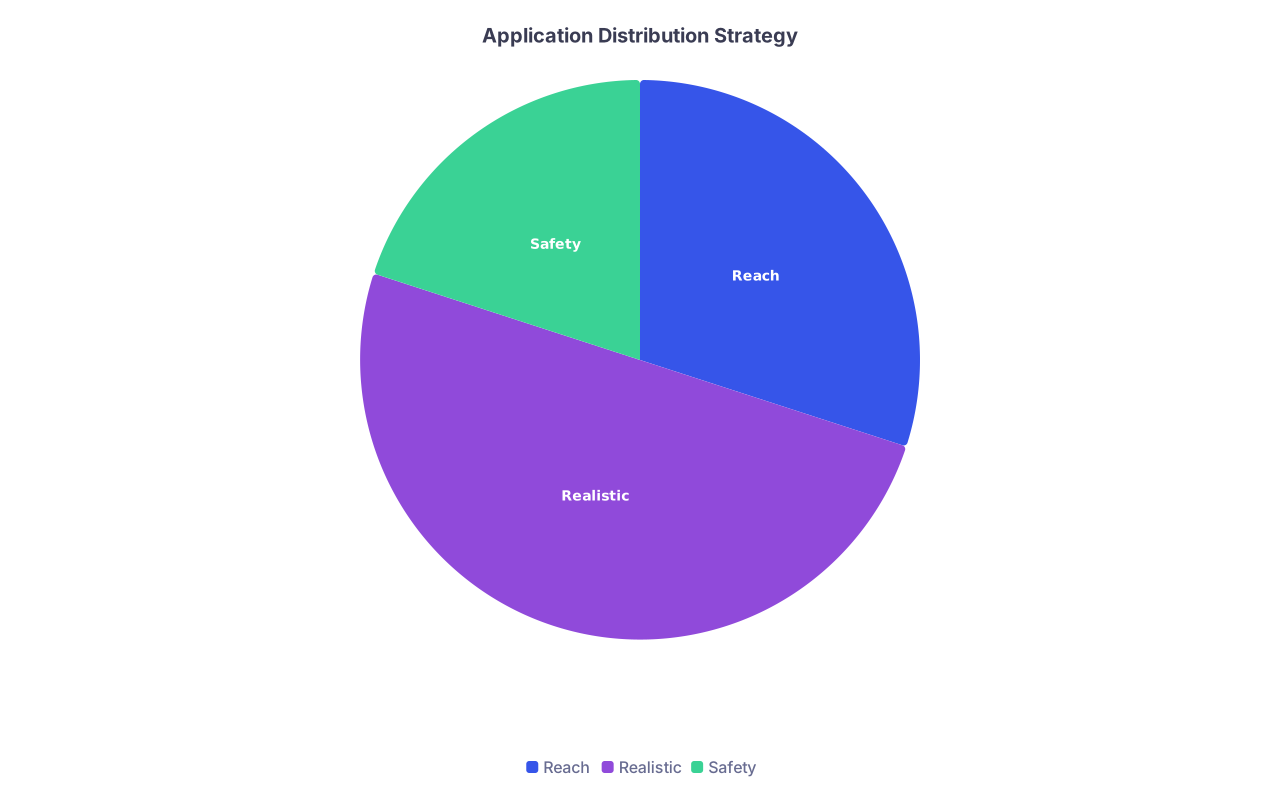
| Category | Value |
|---|---|
| Reach | 30 |
| Realistic | 50 |
| Safety | 20 |
For a competitive specialty from a state school, a reasonable strategy might be:
- 30% reach programs (big-name, high research places)
- 50% realistic fits (strong training, mid‑tier academic, some name recognition)
- 20% safer options (community or hybrid programs that match non‑traditional backgrounds)
Pay special attention to:
- Programs that routinely take applicants from “non-elite” med schools
- Places where your home institution faculty have connections
- Cities where you’d genuinely be willing to live (if you rank them, be ready to go)
10. How to Talk About Your Path Without Sounding Defensive
You will get questions like:
- “So you started at a community college—tell me about that.”
- “Why State University instead of [Local Private]?”
The wrong approach: apologizing or oversharing trauma.
The right approach: calm, matter-of-fact, growth-focused.
Example:
“I started at community college because financially that was what my family could do, and I was working almost full time. By the time I transferred to State, I was more stable and able to lean into academics and research, which is where you see my trajectory really take off.”
You’re turning “I had to go cheap” into “I made a disciplined choice, then leveled up.”
11. A Simple Timeline If You’re Late to the Party
If you’re M3 right now, newly in love with ortho/derm/ENT and you came from a community college + state school + average MCAT, here’s the real play:

| Step | Description |
|---|---|
| Step 1 | M3 Early |
| Step 2 | Pick Specialty by mid M3 |
| Step 3 | Start specialty research now |
| Step 4 | Excel on core rotations |
| Step 5 | Take Step 2 CK early and score high |
| Step 6 | Schedule aways at realistic programs |
| Step 7 | Crush aways and secure strong letters |
| Step 8 | Build realistic rank list |
If Step 2 CK comes back weak or you cannot line up strong letters/aways in time, you have a separate decision tree:
- Push graduation (if allowed) to take a research year
- Pivot to a less competitive but still rewarding field
- Or apply in a dual-application strategy (e.g., ENT + gen surg, derm + IM prelim, etc.) with eyes wide open
That’s a bigger conversation, but the point is: from your background, you cannot afford wishful thinking. You need data-driven decisions.
12. Your Background Is a Multiplier—If You Use It Correctly
Programs aren’t dumb. They know what it means if:
- You started at community college
- Worked through school
- Transferred to a state university
- Ended up in med school
- And now you’re pulling 250+ Step 2 with real research and strong clinical reviews
They see resilience. Grit. Upward trajectory.
The mistake is acting like you’re second-class. The real move is to say, with your record, “I’ve already done more with less. Give me your resources and watch what I do.”
With a profile like that, derm/ortho/ENT/plastics are not off-limits. You just cannot coast.
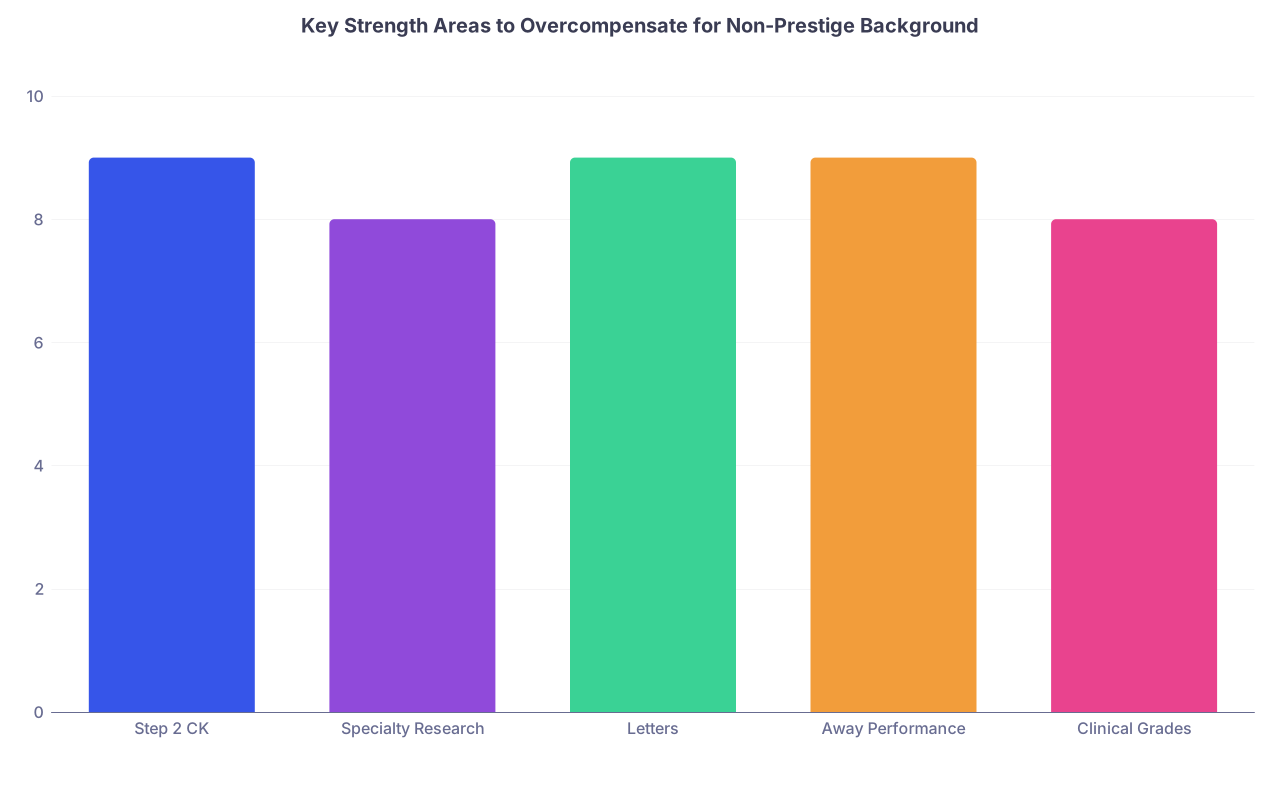
| Category | Value |
|---|---|
| Step 2 CK | 9 |
| Specialty Research | 8 |
| Letters | 9 |
| Away Performance | 9 |
| Clinical Grades | 8 |
FAQ (Exactly 5 Questions)
1. Be honest: can someone from community college + state school really match derm/ortho/ENT?
Yes. I have seen it multiple times. But those people didn’t have “fine” applications. They had:
- Top-tier Step 2 CK scores
- Real specialty research
- Strong letters from known names
- Great performance on away rotations
If you want a chill path, pick a non-competitive field. If you want derm/ortho/ENT from your background, you have to grind harder and earlier than most of your classmates.
2. Does my community college GPA drag me down forever?
Not if you show clear improvement. Med schools and residencies look at:
- Overall trend (upward vs. flat vs. down)
- Performance in advanced, recent coursework
- Standardized test performance (MCAT, Step 2 CK)
If you had mediocre community college semesters but then pulled 3.8+ at the state school and crushed the MCAT and boards, most decision makers will accept that you grew and recalibrated.
3. What if my Step 2 CK is only “okay” (e.g., 240) and I still want a competitive specialty?
Then you need to be brutally strategic. A 240 doesn’t kill you, but it doesn’t carry you either. To stay in the game, you should:
- Turbocharge your research output in the specialty
- Target programs that historically take applicants from schools like yours
- Absolutely dominate aways and get outstanding letters
You should also have a serious backup plan: dual application or being mentally ready to reapply or pivot if the cycle goes poorly.
4. Is it worth doing a research year from a state school to break into a competitive specialty?
Often yes, if:
- Your Step 2 is middling
- You have little or no specialty research
- You can land a research fellowship at a known program or with a well-connected PI
But a “research year” where you sit at home, not publishing, is useless. If you commit to it, you should be aiming for multiple abstracts, posters, and at least one or two papers, preferably with people who can also write strong letters.
5. How many programs should I apply to as a competitive specialty applicant from a state school?
More than your classmates going into IM or peds. For derm/ortho/ENT/plastics from a non-elite background, 60–80 programs is common, and some go higher. The exact number depends on:
- Scores (higher = fewer needed)
- Research strength
- Letters and connections
Smart targeting matters more than raw number. A list of 80 programs that would never interview someone from your school is worse than 50 solid, realistic choices where you have some angle in your favor.
You started from community college and a state school. So what. You’ve already done something statistically rare by getting to this point.
Now the question is whether you build a profile that forces competitive specialties to take you seriously, or you let the prestige story write itself without a fight.
If you follow the path we just laid out—early commitment, real research, strong scores, powerful letters, and ruthless realism about your chances—you’ll give yourself a genuine shot at the fields everyone says are “impossible” from your background.
And once you’re holding a match letter in hand, no one will care where you took Chem 101.
From here, your next move is figuring out which competitive specialty actually fits your day-to-day life, not just your ego. But that’s a different decision, and a different strategy, for another day.