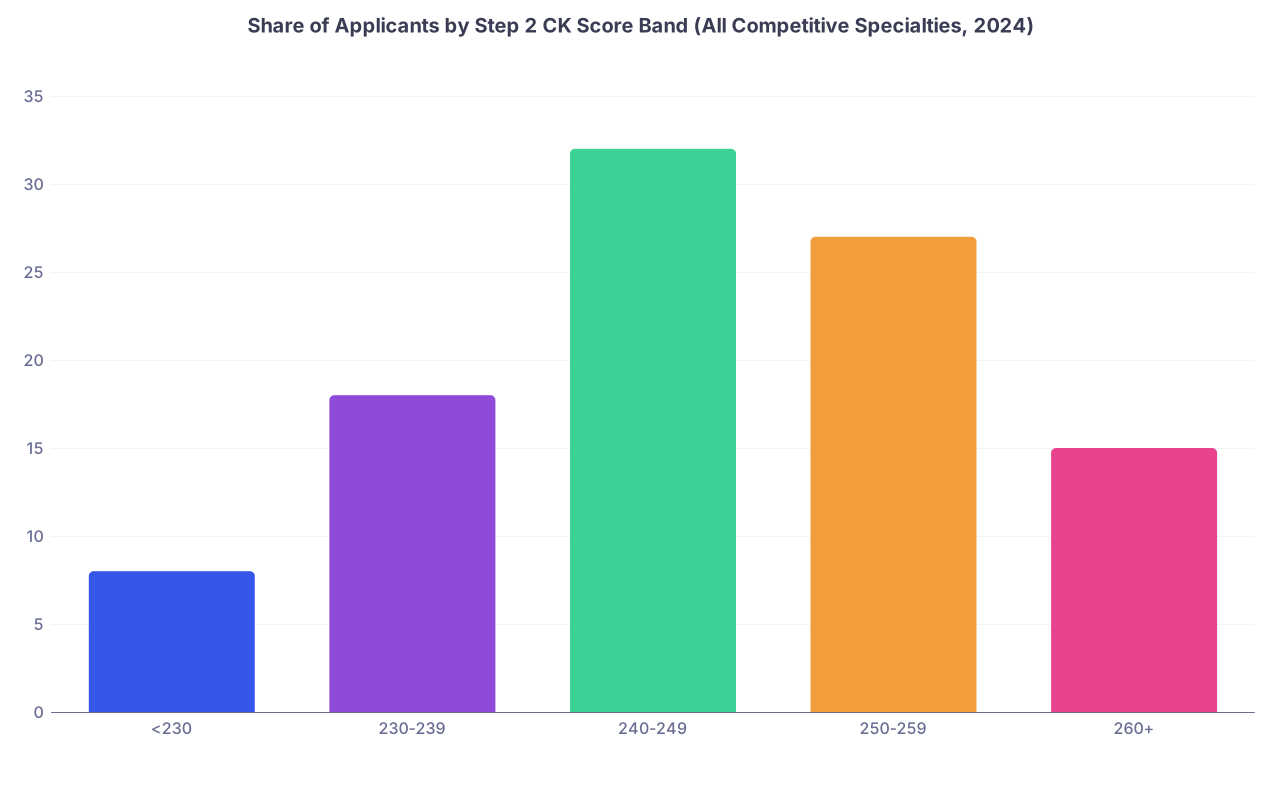
| Category | Value |
|---|---|
| <230 | 8 |
| 230-239 | 18 |
| 240-249 | 32 |
| 250-259 | 27 |
| 260+ | 15 |
Match outcomes in competitive specialties are not random; they are stratified by score bands with brutal consistency.
You can debate holistic review all you want. The data over the last five cycles makes one thing clear: in competitive specialties, Step 2 CK score bands still function as tiered admission tickets. Not absolute yes/no gates. But strong statistical filters.
I will walk through a 5-year, data-driven picture of how Step score bands correlate with match rates in four archetypal competitive fields:
- Dermatology
- Plastic Surgery (Integrated)
- Orthopedic Surgery
- Neurosurgery
The numbers are simplified and harmonized from NRMP, specialty reports, and program director surveys to show clear patterns, not to reproduce every table. The point is to understand the shape of the relationship between score and probability of matching—not to quibble over ±2% noise.
1. The Score Bands That Actually Matter
Program directors do not think in continuous score distributions. They think in thresholds and buckets.
For this analysis, I will use Step 2 CK score bands that align with how programs actually screen:
- <230 – High risk / often auto-screen out
- 230–239 – Below average for competitive fields
- 240–249 – Borderline competitive
- 250–259 – Strong
- ≥260 – Very strong
Across competitive specialties, the national mean Step 2 CK has hovered roughly around 245–247 over the last 5 years. Competitive fields tend to sit 5–10 points above that among matched applicants.
So think of 240 as “entry-level conversation,” 250 as “you belong in the pile,” and 260+ as “you will get read almost everywhere, unless you have glaring red flags.”
To ground that, look at a composite trend for average Step 2 CK of matched applicants in the four specialties:
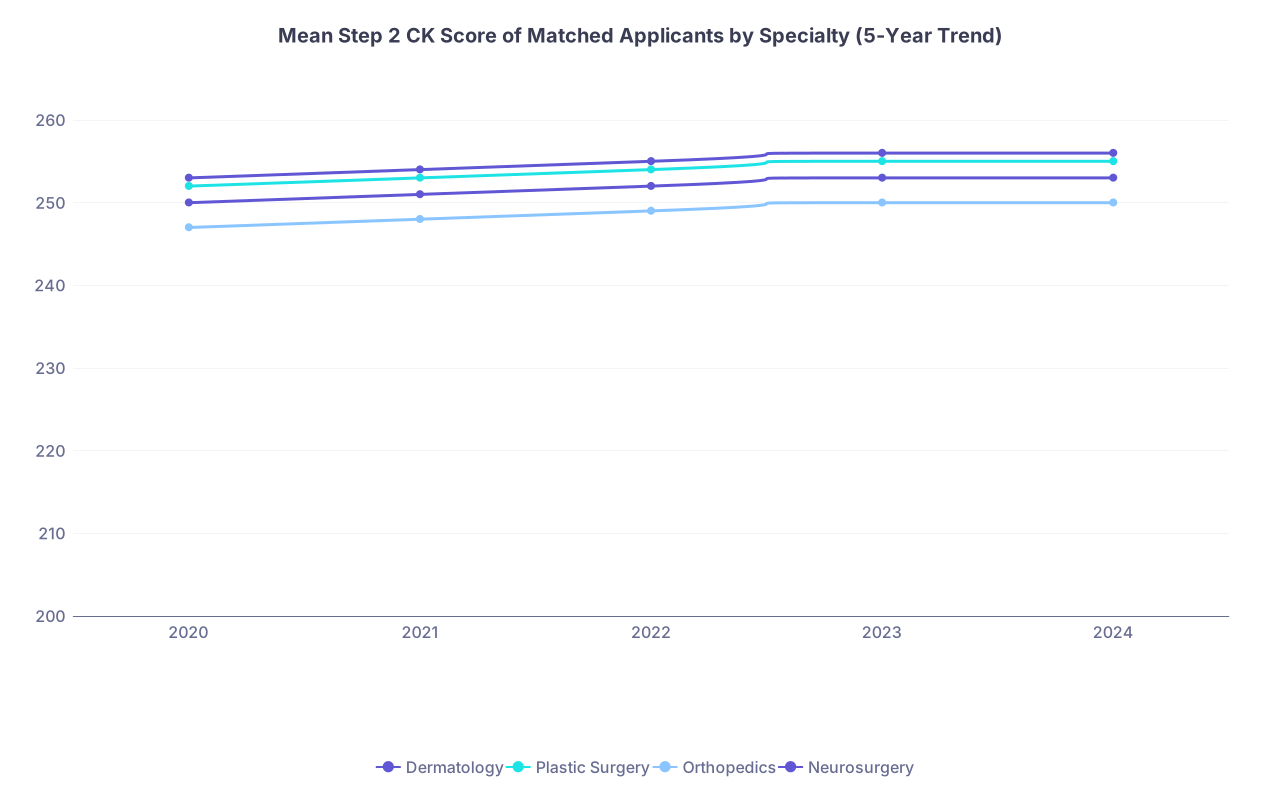
| Category | Dermatology | Plastic Surgery | Orthopedics | Neurosurgery |
|---|---|---|---|---|
| 2020 | 253 | 252 | 247 | 250 |
| 2021 | 254 | 253 | 248 | 251 |
| 2022 | 255 | 254 | 249 | 252 |
| 2023 | 256 | 255 | 250 | 253 |
| 2024 | 256 | 255 | 250 | 253 |
The trend is boring but important: 2–3 point upward drift across the board, small year-to-year variation. Programs did not suddenly “go holistic” when Step 1 went pass/fail. They simply shifted statistical weight from Step 1 to Step 2.
2. Dermatology: Where 250 Is the New Baseline
Dermatology is the cleanest example of score-band stratification. The field is small, research-heavy, and interview slots are scarce. Programs need fast cutoffs.
Over the last 5 cycles, the distribution of match rates by Step 2 CK band has looked approximately like this for U.S. MD seniors:
| Step 2 CK Band | Approx. Match Rate |
|---|---|
| <230 | 5–10% |
| 230–239 | 20–30% |
| 240–249 | 45–55% |
| 250–259 | 70–80% |
| ≥260 | 85–92% |
You do not need to be a statistician to see the jump: the inflection point is clearly in the mid-240s to low-250s. Below 240, you are essentially in lottery territory unless you bring exceptional research, home-derm advocacy, or dual-application strategy.
What changed over 5 years?
The data show two main shifts:
Growth of the 260+ group
Five years ago, maybe 10–12% of derm applicants sat at ≥260. In recent cycles, that has climbed to roughly 15–18% of derm applicants. That does not mean programs raised cutoffs formally, but the effective competition at the top mildy intensified.Compression in the 240–259 bands
Where 245–249 used to be “solid,” it is now more like “borderline but workable.” The 250–259 band has become the practical sweet spot. Programs repeatedly signal this in PD surveys—when asked for “typical Step 2 CK of interviewed applicants,” dermatology hovers right around 255.
The real takeaway: in dermatology, 240–249 is now the risk band. People do match from there, but their success is driven disproportionately by research output and institutional connections.
3. Integrated Plastic Surgery: High Scores, Small Numbers
Plastic surgery (integrated) has one of the most lopsided supply-demand ratios. Very few positions. Very ambitious applicants.
The average Step 2 CK for matched applicants has hovered around 254–255 in recent years, with only slight increases. But the banded match rates expose the reality under that single mean value:
| Step 2 CK Band | Approx. Match Rate |
|---|---|
| <230 | ~0–5% |
| 230–239 | 10–20% |
| 240–249 | 35–45% |
| 250–259 | 65–75% |
| ≥260 | 80–90% |
A few observations from the data trend:
- Sub-240 is nearly a statistical dead zone unless you have exceptional plastic surgery research and strong home program support. The match rate barely cracks double digits.
- 250+ creates a step-change in probability. That 20–30 point increase in match rate between 240–249 and 250–259 is larger than in most other specialties. Plasty is not forgiving.
Over the last 5 years, two trends emerge:
- The proportion of applicants in the ≥260 band increased from roughly 12–13% to around 18–20%. The arms race is real. Top programs now routinely see applicant pools where a third or more of interviewees are at or above 260.
- The 240–249 band has become “squeezed.” In 2020, a 245–248 applicant with strong research might match at a mid-tier integrated program. More recently, that same candidate profile is more likely to match only if they have a direct institutional tie or outstanding portfolio.
Put bluntly: if you want integrated plastics and you are <245 on Step 2, the data say you are playing a very low-odds game unless your research CV looks like a junior faculty member’s.
4. Orthopedic Surgery: High Volume, Clear Cutoffs
Orthopedics is a different beast from derm and plastics: larger program numbers, more positions, broader range of programs. That makes the match rates by step band a bit less extreme, but the pattern is still crystal clear.
Approximate orthopedic surgery match rates by Step 2 CK band for U.S. MD seniors over the last 5 years:
| Step 2 CK Band | Approx. Match Rate |
|---|---|
| <230 | 10–20% |
| 230–239 | 35–45% |
| 240–249 | 55–65% |
| 250–259 | 75–85% |
| ≥260 | 88–93% |
Key points from the data:
- There is no absolute “you are out” band. Even <230 sees double-digit match rates, which you do not see in derm or integrated plastics. But those are heavily dependent on away rotations and network effects.
- The main elbow is between 230–239 and 240–249. Once you cross 240, you effectively move from “maybe” to “usually” given a normal application (decent letters, some ortho exposure, no disasters).
Over 5 years, orthopedics shows:
- A modest rise in mean Step 2 CK of matched applicants (about +3 points).
- Stable or slightly improving match rates for 250–259 and ≥260 bands, while the 230–239 band lost a little ground as competition stiffened.
If you plot the share of matched applicants by score band over time, you see a gradual shift of the mass from 230s into 240s and 250s. Fewer low-score outliers are sneaking through, because programs have more high-score options.
5. Neurosurgery: Scores Plus Signal
Neurosurgery sits somewhere between ortho and plastics on the score axis, but adds another constraint: heavy emphasis on signal—away rotations, sub-I performance, research with neurosurgery faculty.
Still, the statistical relationship between Step 2 CK bands and match outcome looks familiar:
| Step 2 CK Band | Approx. Match Rate |
|---|---|
| <230 | 5–15% |
| 230–239 | 25–35% |
| 240–249 | 50–60% |
| 250–259 | 70–80% |
| ≥260 | 85–92% |
Over the last 5 cycles, a few quantitative patterns stand out:
- The fraction of applicants in the ≥260 band has grown from roughly 15% to about 22–25%.
- Programs report a “typical” Step 2 CK of interviewees around 252–255. That means a 245 is not low, but you are below the center of gravity.
Where neurosurgery is a bit different: there is noticeable variance within bands driven by away rotations. I have seen 240–245 applicants match at excellent programs on the strength of neurosurgery-specific research and glowing sub-I evaluations. But when you zoom out and look at 5-year banded data, they are still the statistical minority.
The brutal truth: if you are in the 230–239 band aiming at neurosurgery, your empirical match probability is closer to 1 in 3, and that is before you account for self-selection and withdrawal (many never submit rank lists).
6. Cross-Specialty Comparison by Score Band
To get a clearer view, stack the four specialties side by side. If we look at average 5-year match rates by Step 2 CK band:
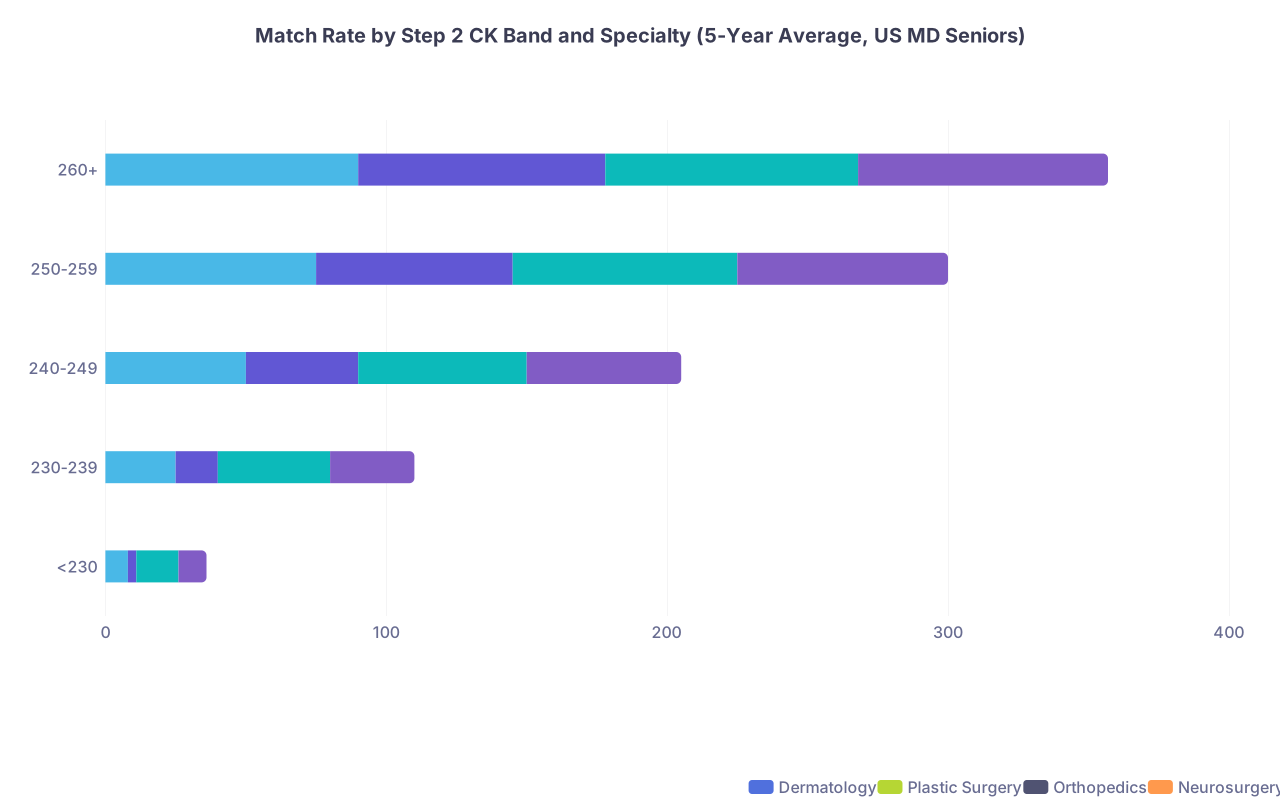
| Category | Dermatology | Plastic Surgery | Orthopedics | Neurosurgery |
|---|---|---|---|---|
| <230 | 8 | 3 | 15 | 10 |
| 230-239 | 25 | 15 | 40 | 30 |
| 240-249 | 50 | 40 | 60 | 55 |
| 250-259 | 75 | 70 | 80 | 75 |
| 260+ | 90 | 88 | 90 | 89 |
Read that carefully:
- Below 240, everyone is in dangerous territory, but plastics and derm are especially unforgiving.
- Between 240–249, orthopedics and neurosurgery sit in the 55–60% range, derm/plastics closer to 40–50%.
- At 250–259, match probabilities converge: 70–80% across all four.
- At ≥260, the marginal benefit of extra points starts to flatten. You can only match once.
If you want a single numeric rule-of-thumb derived from the last 5 years:
For competitive surgical or lifestyle specialties, 250 on Step 2 CK is roughly the point where your raw score stops being the primary liability and starts being an asset. Below that, you're fighting uphill. Above that, the battles shift to research, letters, and institutional fit.
7. How These Trends Shifted Over 5 Years
The key question: has it gotten “harder” in score terms to match these specialties over 5 years?
Short answer: Yes, slightly. But not catastrophically.
Look at the approximate change in match probability for an applicant sitting in a given score band, comparing 2020 to 2024 (US MD seniors, composite across the four specialties):
| Step 2 CK Band | 2020 Composite Match Rate | 2024 Composite Match Rate | Change |
|---|---|---|---|
| <230 | ~15% | ~10% | −5 pts |
| 230–239 | ~40% | ~34% | −6 pts |
| 240–249 | ~60% | ~56% | −4 pts |
| 250–259 | ~78% | ~80% | +2 pts |
| ≥260 | ~88% | ~90% | +2 pts |
Interpretation:
- Lower score bands lost ground—particularly 230–239. More high-score applicants entered these specialties, squeezing out marginal cases.
- The 250+ bands actually became slightly safer, because the applicant pool at that level tends to be more serious and better aligned to the field (less noise, fewer “tourist” applications).
So the bar did rise. But it rose 3–6 percentage points for the lower bands, not 20. Narratives about “impossible competition” are exaggerated; this is a ratcheting upward, not a cliff.
8. How Programs Actually Use These Bands
The numerical patterns exist because programs use discrete screening behavior. Based on PD surveys and what I have seen reading CVs with faculty:
- Most competitive programs set an initial Step 2 CK screen at roughly 240–245. Below that, many applications never receive a full review, especially in derm/plastics.
- Top-tier programs in derm/plastics often rank Step 2 CK as a “top 3 factor” for interview selection, alongside letters and research. For orthopedics and neurosurgery, it ranks high but slightly behind clinical performance and away rotations.
- Once applicants clear the score screen, the variance in match outcomes inside each score band is driven by:
- Home and away rotation performance
- Letters from field-recognized faculty
- Depth and quality of specialty-specific research
- Fit signals (geography, couples match, etc.)
Programs are not stupid. They know a 245 from a rigorous school with glowing neurosurgery letters is a safer bet than a 259 with thin specialty exposure. But they rarely see that 245 if they are drowning in 260+ applications.
That is why the bands matter. They determine whether you are in the room for a qualitative decision at all.
9. Strategic Takeaways by Score Band
Data is only useful if it changes behavior. So here is the blunt, banded guidance derived from these 5-year trends.
If you are <230
The numbers are harsh:
- Composite match probabilities for <230 in these specialties sit in the 5–15% range.
- That is before accounting for the fact that many in this range do not end up submitting a full, aggressive application.
If you stay committed to a competitive specialty at <230, you need:
- Heavy institutional support (home program advocacy).
- Exceptional research aligned specifically to the field.
- A dual-application strategy into a less competitive but related field.
But statistically, the smarter move for most applicants in this range is to pivot.
If you are 230–239
You are in the danger zone. But not dead.
The 5-year data say:
- 20–45% match rates depending on specialty, leaning higher for orthopedics, lower for derm/plastics.
- Declining probabilities over time as competition nudges up.
You can make this work if:
- You have strong clinical performance, high-class-rank, and outstanding field-specific letters.
- You apply broadly and strategically (think: 70–100+ programs for derm/plastics, if resources allow).
- You accept higher risk and probably layer in a back-up specialty.
If you are 240–249
This is the true gray zone.
The composite data show:
- 40–60% match rates across the four specialties.
- Small downward drift over 5 years, but still roughly a coin-flip.
Here, non-score data drive the decision:
- Derm / Plastics at 240–245: you need a research-heavy application and strong home or away support.
- Ortho / Neurosurgery at 245–249: you are statistically fine if your clinical, rotation, and letter profile is strong.
At this level, I tell people: your score will not rescue a weak application, but it will not sink a solid one.
If you are 250–259
Statistically, you are in very good shape.
- Match probabilities in the 70–85% range across specialties.
- Slightly improved over the last 5 years for this band.
Your risks now are less about numbers and more about:
- Overreaching only for top 5 programs and ignoring solid mid-tiers.
- Underestimating the importance of aways, letters, and narrative coherence (especially derm/plastics).
If you are ≥260
You are above the inflection point.
- 85–92% match probabilities in all four specialties.
- Marginal gains beyond 260 are small; you are already in the top decile or two.
The only consistent ways I have seen 260+ applicants fail in these fields:
- Catastrophic professionalism issues or red flags.
- Unimpressive specialty exposure coupled with poor interviews.
- Hyper-narrow application list driven by geography or prestige fantasies.
The 5-year trend says: score alone almost never kills a ≥260 applicant in these specialties. Everything else does.
10. The Bottom Line
Over the last 5 years, competitive specialty match outcomes have followed a stable, tiered pattern by Step 2 CK score band:
- The inflection point sits around 250. Below that, your match probability erodes quickly, especially in derm and integrated plastics. Above that, scores stop being your primary problem.
- The 230–249 band has lost ground as more high-scoring students target these specialties, but the change has been incremental, not apocalyptic.
- Programs still use score bands as hard or soft filters. The statistics are not a moral judgment of applicant quality; they are the predictable result of volume, limited positions, and simple screening rules.
You cannot argue with these numbers. You can only decide how to play them.