
The data shows that most people dramatically overestimate what a single extra publication will do for them.
The Baseline: What Programs Actually See
Let me start with the uncomfortable truth: in the most competitive specialties, you are not competing on “do I have research?” You are competing on how your research stacks up against applicants who already have a lot.
Looking at recent NRMP data (Charting Outcomes in the Match and Program Director Surveys), the trend is blunt:
- Dermatology, Plastic Surgery, Neurosurgery, ENT, Ortho, Radiation Oncology, and Integrated Vascular/CT Surgery applicants now routinely report double‑digit “research products” (abstracts, posters, presentations, publications).
- For matched U.S. MD seniors in these fields, medians often sit around 8–15 total products. For unmatched applicants, the median is lower, but not by “one paper” – more like 4–6 fewer.
So the core question is not “Does one more publication help?” It is: “Where on the curve are you, and does one more move you into a different part of the distribution?”
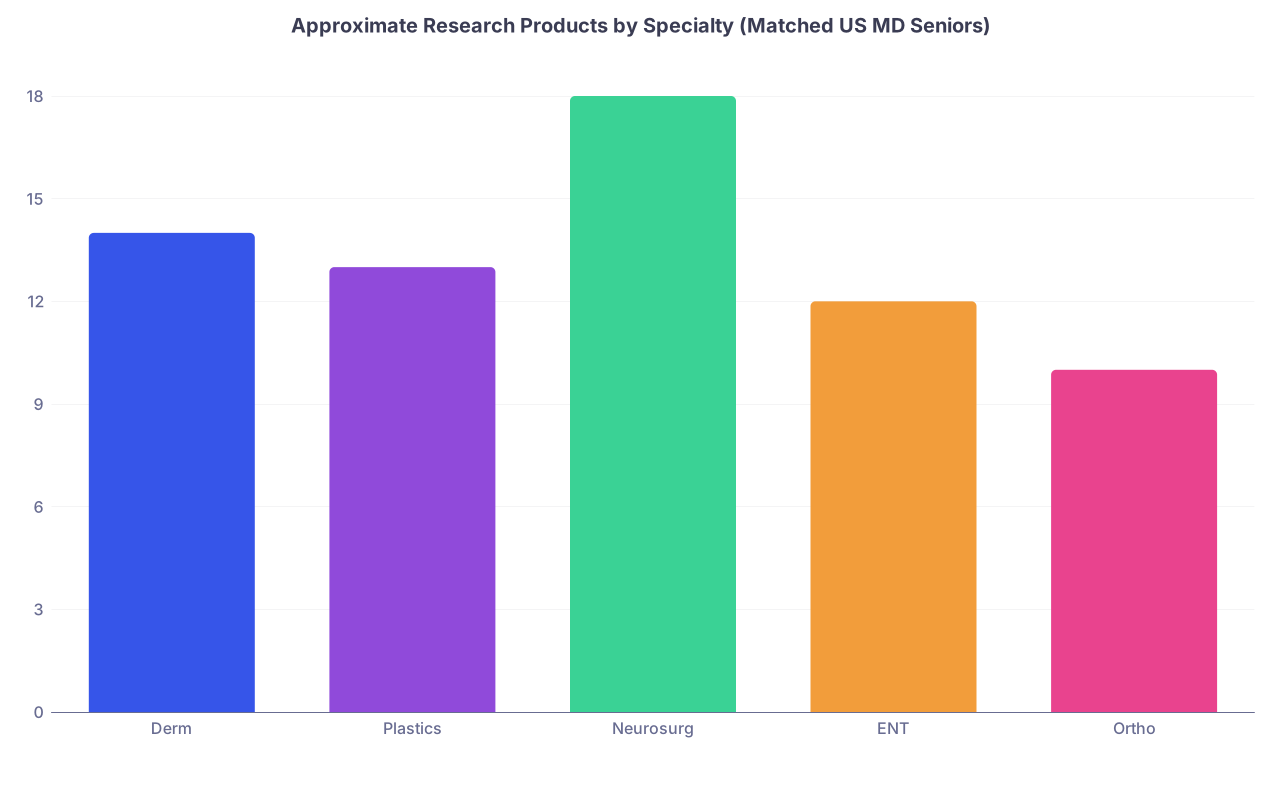
| Category | Value |
|---|---|
| Derm | 14 |
| Plastics | 13 |
| Neurosurg | 18 |
| ENT | 12 |
| Ortho | 10 |
These are ballpark figures from recent cycles, but the pattern is consistent: highly competitive = high research volume.
Now let us break it down by fields and look at where “one more” changes something, and where it is statistical noise.
Understanding Research as a Signal, Not a Score
Programs do not sit in a room and say, “This person has 7 pubs, this one has 8, rank the second higher.” That cartoon view of selection is wrong.
Research functions as a signal along several dimensions:
- Volume – How productive have you been over time? (Consistency, sustained effort)
- Relevance – Is it in the specialty or at least clinically oriented?
- Quality – Peer‑reviewed publication vs poster vs local QI write‑up.
- Role – First author vs middle author vs “fourth author on a giant retrospective.”
- Trajectory – Is there an upward trend? More recent, more independent work?
Think in distributions, not thresholds. Programs have mental buckets like:
- Insufficient research for this field
- Adequate / typical
- Strong
- Exceptional / standout
An extra publication matters only if it moves you between these buckets.

| Step | Description |
|---|---|
| Step 1 | Applicant Research |
| Step 2 | Binary - Any vs None |
| Step 3 | Bucketed by Strength |
| Step 4 | Insufficient |
| Step 5 | Adequate |
| Step 6 | Strong |
| Step 7 | Exceptional |
| Step 8 | Field Competitiveness |
Now let’s go specialty by specialty and quantify what “one more” typically does.
Dermatology: Publications as a Sorting Tool
Dermatology might be the field where people obsess about research the most, sometimes rationally, often irrationally.
The rough pattern from recent cycles for matched U.S. MD seniors:
- Median total research products: around 14–16
- Many strong applicants from top research schools: 20+ products
- Unmatched: often in the 6–10 range with lower Step/COMLEX or weaker letters
In Dermatology, research is heavily used as a tie‑breaker among applicants with already strong scores.
Here is the key: programs are not fooled by raw counts. A single additional case report in an obscure journal when you already have 10+ research items is effectively a rounding error. But an additional first‑author specialty‑relevant paper in a solid journal can function as a quality jump, not just a count increment.
In practice:
- Going from 0 to 1 derm‑related product: huge. You move from “no evidence of interest” to at least “some signal.”
- Going from 1 to 3–4: meaningful. You climb into “this person pursued derm beyond a checkbox.”
- Going from 8 to 9 random small items: minimal marginal gain.
- Going from 8 random to 9 including 1 solid first‑author original study in derm: that can move you from “adequate” to “strong,” especially if it is tied to a well‑known derm mentor.
So, for Derm, the data pattern is: marginal value of one more product declines fast once you are above the median, unless that extra product is qualitatively different.
Plastic Surgery (Integrated): High Volume, High Scrutiny
Integrated Plastics is brutal on research expectations.
Recent NRMP data for matched U.S. MD seniors typically shows:
- Median research products: on the order of 15–20
- Many successful applicants in academic programs: 25–40+ products (multiple gap years, dedicated lab time)
- Unmatched: often significantly lower volume and weaker Step/letters
Programs in Plastics are acutely aware of who did a dedicated research year and with which faculty. They look for multi‑year output from the same group, progression from abstract → podium → manuscript, and senior authors they know.
Concrete impact of “one more” here:
- If you are sitting at 2–3 total items and no plastics‑specific work, one extra general surgery case report is not moving the needle. You are still far from the typical plastics submitter.
- If you have 8 plastics‑relevant products and you add a ninth, which is:
- A middle‑author retrospective: marginal, nearly zero.
- A first‑author multi‑center analysis in a decent journal presented at a major meeting: that could upgrade how programs perceive your seriousness and “academic trajectory.”
The key in Plastics: programs use research to identify future academic surgeons. An extra publication that shows leadership (first author), complexity (original data), or network (big‑name coauthors) carries significantly more weight than three extra case reports.
| Profile | Total Products | Plastics-Focused? | Typical Outcome Signal |
|---|---|---|---|
| Low research | 0–3 | None / 1 | High risk for no interview |
| Moderate | 4–10 | Some | Viable with very strong scores |
| Strong | 11–20 | Mostly plastics | Competitive for many programs |
| Exceptional | 21+ | Heavily plastics | Top programs, academic track |
If “one more” pushes you from 9 to 10 within a category above, nothing changes. If “one more funded, first‑author, multi‑year project” pushes you into the Strong or Exceptional bucket, that is a different story.
Neurosurgery: Depth and Continuity Over Raw Count
Neurosurgery applicants are increasingly research‑heavy, but the culture there values depth and sustained lab work even more than other fields.
Typical patterns for matched U.S. MD seniors:
- Median research products: ~16–20 is common in recent cycles.
- A large subset completes 1–2 dedicated research years, often in neuroscience labs.
- Many have at least 1–2 PubMed‑indexed papers in neurosurgery, neurology, or related basic science.
Here, the “extra publication” question is almost always about trajectory:
- Have you stayed with the same PI or lab for multiple years?
- Do your pubs form a coherent story, or are they random one‑offs?
- Are you showing first‑author leadership by the later parts of med school?
One more cross‑sectional paper that you rush out in MS4, disconnected from your main lab, may not change program perception. On the other hand:
- You have 2 already accepted neurosurgery papers with your department.
- You have 2 more in revision, possibly accepted by interview season.
- That visible progression from “helping” to “leading” is worth more than one isolated extra line on your CV.
Neurosurgery PDs repeatedly emphasize in surveys that mentorship letters that explicitly describe research contributions matter more than the raw list length. Your “extra” paper matters most if it gives a senior neurosurgeon a concrete reason to write, “This student functioned like a junior resident in research.”
ENT, Ortho, and Rad Onc: Thresholds vs Fine Tuning
These three often get lumped together as “competitive but slightly less insane than Derm/Plastics/Neurosurg.” That is not entirely fair, but directionally correct.
Typical matched U.S. MD senior profiles show:
- ENT: research products around 10–14, many ENT‑specific.
- Ortho: around 8–12, with a growing expectation for ortho‑related work.
- Rad Onc: historically extremely research‑heavy, though the job market has changed incentives a bit.
In these fields, the biggest research effects come at two key thresholds:
Zero vs >0 in‑field research.
If you have good scores but no specialty‑specific research while your cohort almost all has some, you are statistically disadvantaged. One ENT paper when you had zero before is massive. It changes your perceived commitment.Minimal vs “within the pack.”
Going from 1 general surgery poster to 4–5 mixed but including at least one ENT/ortho/Rad Onc output moves you from “weak research” to “typical.” That is where you see a tangible shift in interview odds.
Once you are around the field median, each additional small item yields diminishing returns.
To formalize that intuition a bit:
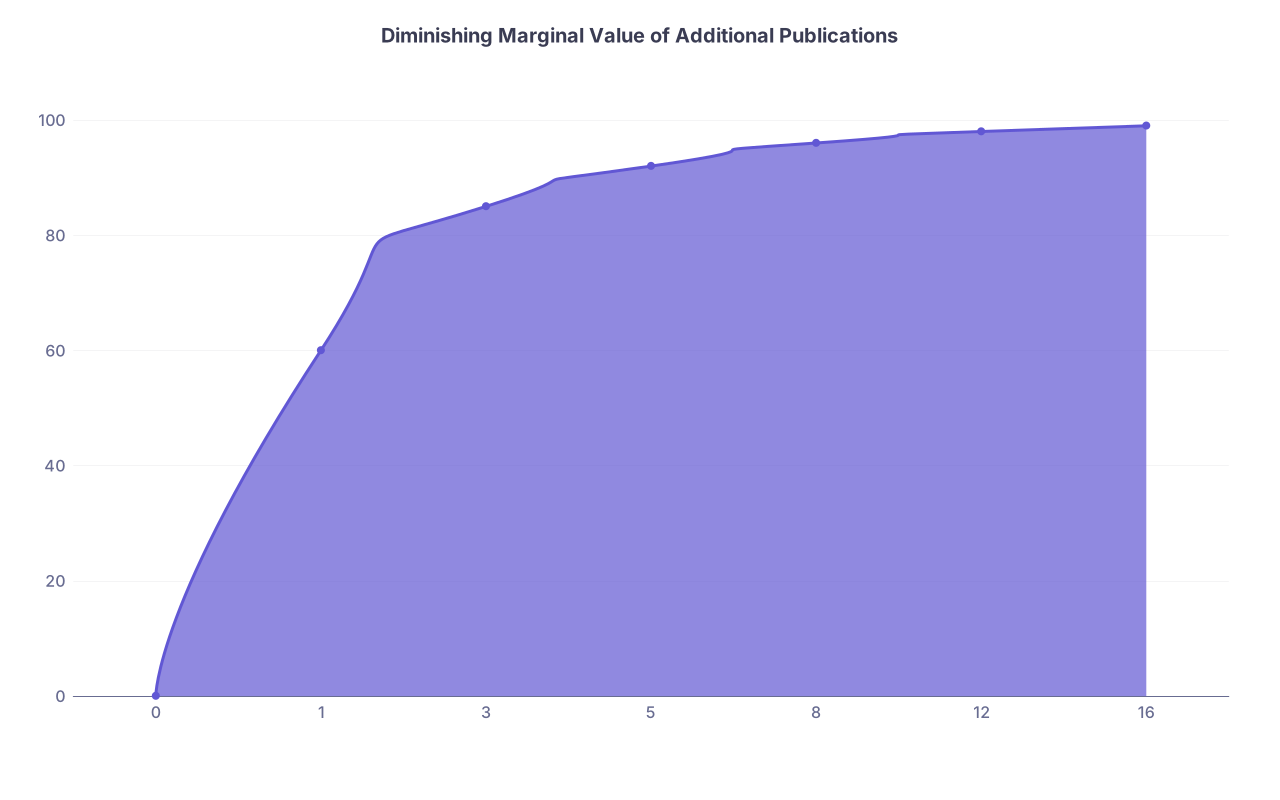
| Category | Value |
|---|---|
| 0 | 0 |
| 1 | 60 |
| 3 | 85 |
| 5 | 92 |
| 8 | 96 |
| 12 | 98 |
| 16 | 99 |
Think of that y‑axis as “relative research competitiveness percentile” within your applicant pool, conceptually:
- Going from 0 to 1: huge jump.
- 1 to 3: still big.
- 3 to 5: moderate.
- 8 to 12: small.
- 12 to 16: almost nothing—unless quality significantly differs.
The data pattern is clear in NRMP outcomes: unmatched applicants in these fields often have some research, but are either far below the specialty’s average or completely off in relevance. One more non‑relevant paper rarely solves that problem.
Quality vs Quantity: When One Publication Really Does Matter
Let me be blunt: most “extra” pubs people chase in MS4 are low‑yield. They burn time and barely move their competitive profile.
An extra publication does matter when it meets at least one of these criteria:
Relevance Shift
You move from no specialty‑relevant work to at least one clear, on‑field paper or major abstract. Example: IM‑only applicant decides late to switch to Dermatology and lands a solid derm case series with a derm mentor. That single item rescues them from the “no evidence of derm interest” pile.Role Shift
You go from being only a middle author on everything to producing a genuine first‑author project. This tells programs you can design, execute, and write, not just “help.”Venue Shift
Your extra project is accepted at a well‑respected specialty journal or at a major national meeting. Not because of the “name” itself, but because it implies your work passed a higher bar.Mentorship Shift
The project cements a relationship with a known faculty member who then writes a strong, specific letter. That letter, tied to your demonstrable research, is more valuable than the line on your CV.Trajectory Shift
Your work shows clear upward movement: poster → oral presentation → manuscript → follow‑up project. A late‑cycle extra piece that completes that arc can matter more than two early, random posters.

In contrast, these “extra” publications are low‑impact:
- Last‑minute case reports with no clear mentor connection.
- Unrelated basic science outside your specialty that you cannot explain well.
- Quantity‑over‑quality outputs in dubious journals no one recognizes.
From a data perspective, when PDs rank factors, “demonstrated interest in the specialty” and “letters of recommendation in the specialty” consistently beat raw publication count.
Your extra publication matters most through its downstream effect on those variables.
Time, Opportunity Cost, and Strategic Choice
You are not allocating infinite hours. So the question shifts logically to: given 100 hours before applications lock, where does each incremental hour produce the biggest probability gain for matching?
If we approximate typical returns in competitive fields:
- 50–100 focused hours can:
- Turn a strong draft into a submitted or revised manuscript.
- Or raise a Step 2 score by several points with targeted studying.
- Or transform your personal statement and program‑specific paragraphs.
- Or build stronger relationships with potential letter writers.
From PD survey data, the factors consistently at or near the top:
- USMLE/COMLEX scores (where still numeric)
- Letters of recommendation in the specialty
- Clerkship grades / class rank
- Interview performance
- Evidence of specialty commitment (which research supports, but is not the sole route)
Research volume sits below these. So if:
- You already have 5–8 reasonably solid, mostly in‑field research products, and
- You can add one more low‑impact item or significantly improve scores/letters…
The rational, data‑driven choice is usually: do not chase that extra trivial publication.
On the other hand, if:
- You currently have zero in‑field research, and
- You can execute one well‑mentored, clearly derm/ortho/etc‑branded project before ERAS…
Then that single publication or high‑quality abstract can shift how you are categorized entirely. That is a good trade.
How Programs Actually Use the CV on Interview Day
When you walk into interviews, your CV is no longer a “filter”; it is a conversation script.
The extra publication matters if:
- Interviewers recognize the journal, topic, or mentor and ask you about it.
- You can speak fluently about hypothesis, methods, limitations, and next steps.
- It gives them data to think, “This person will produce work here too.”
What does not impress them:
- Reading off your CV that you have 12 instead of 11 products if they are all tiny, unfocused, and outside the field.
- Discovering you cannot explain your own “research,” suggesting ghost authorship or superficial involvement.
So when you consider whether to add “one more pub,” ask:
Will this be something I am proud to discuss for 10 minutes under pressure? If not, the marginal value drops sharply.

A Simple Framework: When an Extra Publication Matters
Let me give you a blunt decision framework. You can almost treat this like a triage tool.
Current research bucket (for your field):
- None or almost none
- Some, but below average
- Around average
- Above average
Nature of the potential extra publication:
- Specialty‑relevant vs not
- First author vs middle
- Peer‑reviewed / national vs local / low‑impact
- With a strong mentor vs with no meaningful faculty contact
Competing priorities:
- Need to improve Step 2/COMLEX 2?
- Weak letters that could be improved with more clinical time?
- Application materials that are generic and need serious work?
If you are:
In the “none / almost none” bucket,
and the new project is specialty‑relevant with real mentor involvement,
then one more publication or substantive abstract is often high‑yield.In the “some but below average” bucket,
and the new project moves you closer to your specialty’s typical range and strengthens relationships/letters,
then it is moderately high‑yield.Already around or above average,
and the new project is small, non‑first‑author, tangential, or rushed,
then the marginal value of that extra publication is low relative to other things you could be doing.

| Step | Description |
|---|---|
| Step 1 | Consider Extra Publication |
| Step 2 | Low yield |
| Step 3 | High yield if quality good |
| Step 4 | Moderate yield |
| Step 5 | Low yield |
| Step 6 | Usually low yield |
| Step 7 | In field? |
| Step 8 | Current Research Bucket |
| Step 9 | First Author or High Impact? |
The Bottom Line
The data from highly competitive fields is unambiguous: research matters, but each additional publication has diminishing returns. Programs use research as a categorical and qualitative filter, not as a linear scoring system.
You should treat every potential “extra” publication as a strategic investment, not a collectible. If it does not change your bucket, your trajectory, or your relationships with mentors, the odds that it significantly changes your match probability are small.
Focus on the few outputs that genuinely alter how your application is perceived, not the vanity metric of your PubMed search result length.
FAQ (Exactly 5 Questions)
1. I am applying to Dermatology with 3 derm‑related abstracts and no publications. Is chasing one quick case report worth it?
Probably not, unless that case report deepens a key mentorship relationship or is clearly first‑author and easily finishable. Three derm‑relevant abstracts already shift you out of the “no evidence of interest” bucket. Your time may produce more value improving Step 2, personal statements, or strengthening letters.
2. I have 0 plastics research but good scores. Will one plastics‑related publication actually help?
Yes, because you are moving from zero in‑field research to at least one clear signal of commitment. A solid, mentor‑backed plastics paper can reclassify you from “probably not serious about plastics” to “late but legitimate interest.” That shift can materially affect whether some programs read your file closely.
3. Does it matter if my extra publication is in a low‑impact journal?
It matters less than applicants think. For competitive specialties, the biggest gains come from relevance, role (first author), and the mentor relationship behind the paper. A low‑impact but clearly specialty‑relevant, mentored paper is still more valuable than a higher‑impact, random basic science paper you can barely explain.
4. How many publications do I “need” for Neurosurgery or Plastics to be competitive?
There is no hard cutoff, but recent matched U.S. MD cohorts often cluster around the mid‑teens for total research products, with many applicants in the 20+ range in high‑end academic programs. You do not need to match that exactly, but being far below that range, especially with little specialty‑specific work, is a statistical disadvantage.
5. I can either finish one more first‑author specialty paper or spend that time improving Step 2 by ~5 points. Which is better?
For most applicants, especially those near cutoff ranges, a 5‑point gain on Step 2 produces a larger shift in interview odds than one more paper, even a good one. The exception: if your research is currently very weak for your chosen competitive specialty, and this first‑author paper would be your only major in‑field contribution tied to a strong mentor, then finishing the paper may be the better marginal investment.