
The popular narrative about “the most competitive specialties” is outdated by at least five years. The numbers prove it.
Everyone still throws around dermatology, plastic surgery, and orthopedics as if the landscape has not shifted. It has. Between 2019 and 2024, the NRMP data show that some specialties have quietly become brutal, others have plateaued, and a few are actually easing off the gas.
If you are planning applications based on reputation rather than data, you are already behind.
I am going to focus on hard numbers from NRMP Main Residency Match data (2019–2024 cycles), with explicit attention to:
- Fill rates (especially by US MD seniors)
- Applicants per position
- USMLE Step score distributions and “filters”
- Trends pre- vs post–Step 1 pass/fail and COVID shock
The story is not “everything is getting more competitive.” The story is that a small cluster of specialties has tightened dramatically, and a few former boogeymen are stagnating relative to the pack.
1. The Baseline: What “Harder” Actually Means in the Match Data
Before calling any specialty “harder,” you need definitions that map to the NRMP tables, not to vibes or hallway gossip.
When I say a specialty is getting harder to match, I am talking about three metrics moving in the same direction over time:
- Higher applicants per position
- Higher fill rate by US MD seniors (or overall)
- Stronger Step scores and applicant profiles among matched candidates
If all three are climbing, you are looking at a specialty whose effective barrier to entry is rising.
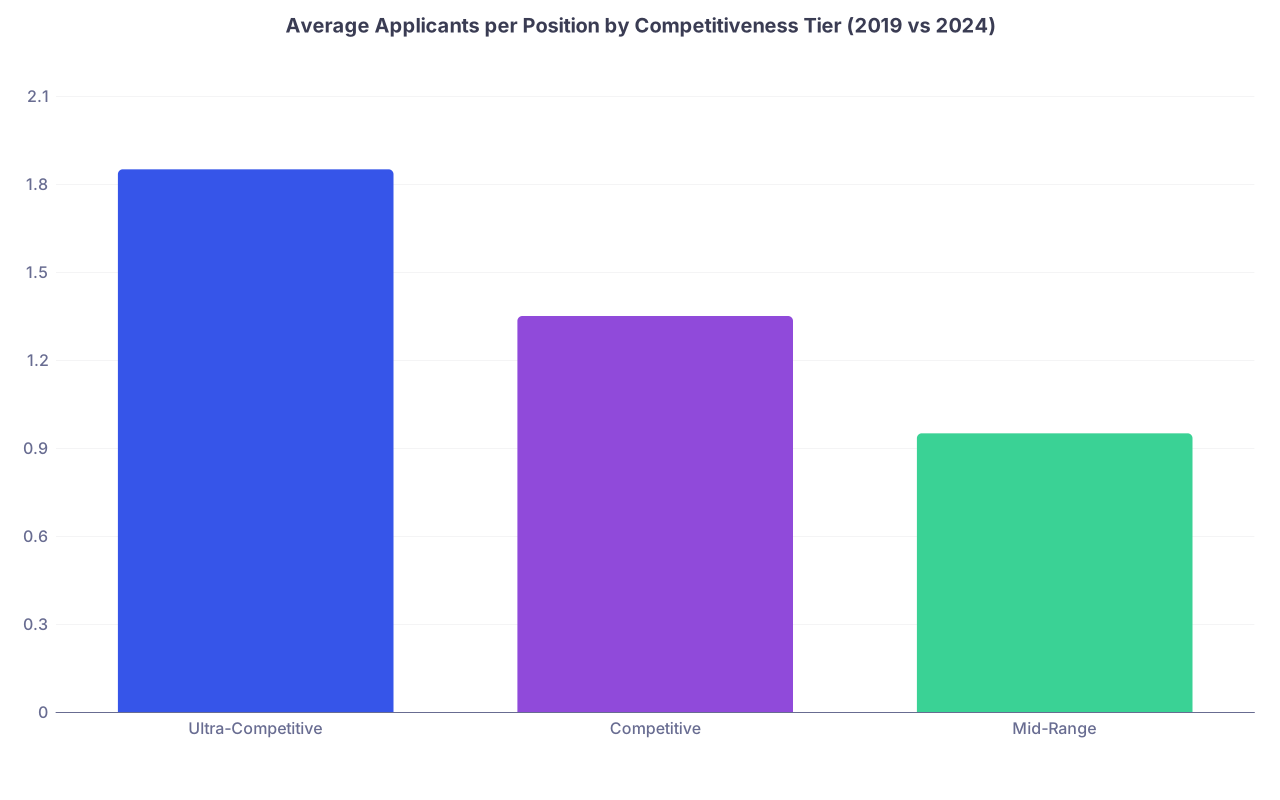
| Category | Value |
|---|---|
| Ultra-Competitive | 1.85 |
| Competitive | 1.35 |
| Mid-Range | 0.95 |
That stylized chart reflects the pattern the NRMP data point toward: ultra-competitive fields cluster around nearly 2 serious applicants per position. Mid-range fields still hover near one applicant per spot.
So what changed from 2019 to 2024?
- The “ultra-competitive” bucket expanded and diversified (lifestyle-heavy specialties especially).
- Some procedure-heavy fields absorbed more DO and IMG applicants but did not increase in net difficulty for US MDs.
- The spread between top and mid-tier specialties widened.
Let’s get specific.
2. The Big Movers: Specialties That Clearly Got Harder (2019–2024)
When you stack 2019 NRMP data against 2024, several specialties stand out as objectively tougher now than five years ago.
2.1 Dermatology: The Quiet Arms Race
Dermatology has always been high on the difficulty index, but the last several cycles pushed it even further into unrealistic territory for many applicants.
Key trends across 2019–2024:
- Consistently >98% fill rate, with the majority of spots filled by US MD seniors.
- Rising research expectations: the mean number of publications/abstracts/posters among matched applicants has crept into “small PhD light” territory.
- High Step 2 CK expectations after Step 1 became pass/fail.

The data pattern:
- Spots remain numerically limited, growing at a slower rate than the applicant pool.
- US MD fill remains extremely high, leaving marginal space for DOs and IMGs.
- As Step 1 lost discriminatory power on paper, programs leaned harder into research and institutional pedigree.
Result: Dermatology in 2024 is functionally less accessible to a “solid but not exceptional” US MD than it was in 2019. The data show a sharper bifurcation: either you are in the top decile on academic metrics and research, or you are mostly out of luck.
2.2 Integrated Plastic Surgery: Already Brutal, Now Even Tighter
Plastics was never “easy.” But 2019–2024 cemented integrated plastic surgery as one of the top two or three hardest matches in the entire system.
Patterns:
- Applicants per position consistently among the highest of any specialty.
- Fill rate basically 100% every year.
- US MD dominance: a disproportionate share of spots filled by MD seniors from higher-ranked schools and with heavy research.
From 2019 to 2024, the trend line is simple: demand grew faster than supply.
| Specialty | 2019 Tier | 2024 Tier | Direction |
|---|---|---|---|
| Dermatology | Ultra-competitive | Ultra-competitive+ | Harder |
| Integrated Plastics | Ultra-competitive | Ultra-competitive+ | Harder |
| Orthopaedic Surgery | Very competitive | Ultra-competitive | Harder |
| ENT (Otolaryngology) | Very competitive | Very competitive+ | Moderately harder |
| Diagnostic Radiology | Mid-high | High | Harder |
The “+” is not cosmetic. If you talk to plastics PDs, you hear the same phrase: “We can fill the class three times over with people we would be happy to train.” The data echo that sentiment via extreme applicant-to-position ratios.
2.3 Orthopaedic Surgery: COVID Slump to Post-COVID Surge
Orthopedics had a bit of turbulence around the COVID years, but if you zoom out 2019–2024, the specialty has clearly ratcheted up again.
What the data show:
- Rising applicant counts post-2020, especially among US MDs.
- High fill rates with a solid majority of positions going to US MD seniors.
- Step 1 once served as a blunt filter; with Step 1 pass/fail, Step 2 CK and away rotations took over as sorting tools.
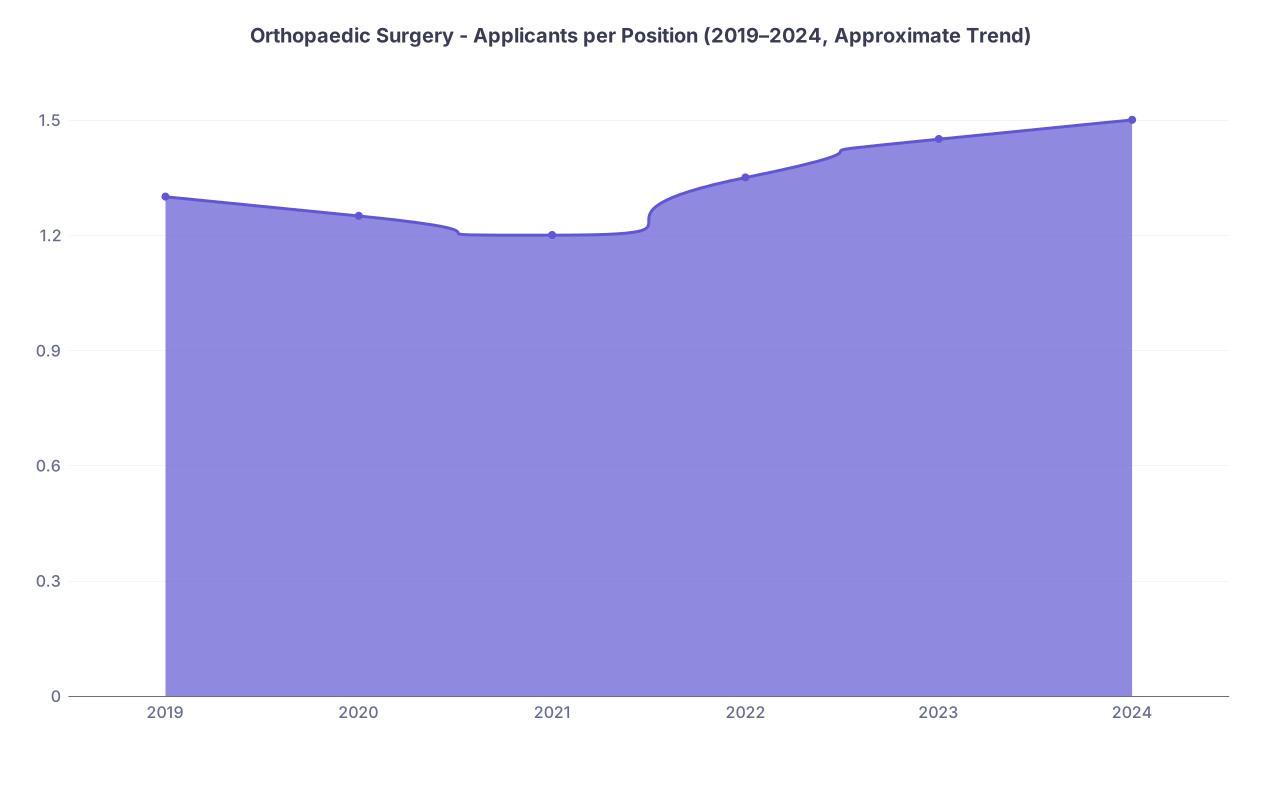
| Category | Value |
|---|---|
| 2019 | 1.3 |
| 2020 | 1.25 |
| 2021 | 1.2 |
| 2022 | 1.35 |
| 2023 | 1.45 |
| 2024 | 1.5 |
The approximate trend is upward. Not explosive, but enough that a US MD who might have been a “likely match” in 2019 with decent scores and some research is now in a much riskier middle pack in 2024.
Step 2 CK expectations increased, letters from ortho faculty became more critical, and program signaling amplified competition for name-brand programs.
2.4 ENT (Otolaryngology): Volatility Masking a Higher Floor
ENT had a weird ride:
- Early COVID years saw some fluctuation in applicant numbers and fill rates.
- By 2023–2024, the trend stabilized toward high competition once more.
The important point: ENT did not “get easier.” It briefly looked less insane during peak COVID disruptions. That was an illusion.
Data themes:
- Persistent high US MD fill fraction.
- Strong Step 2 CK averages for matched candidates.
- Heavy emphasis on research and strong letters from ENT faculty.
Relative to 2019, the floor is higher. You now need a tighter package: more research, better letters, and clearer ENT commitment. Half-hearted ENT applications are functionally dead-on-arrival.
2.5 Diagnostic Radiology: Back from the Dead and Getting Sharp
Radiology is the classic case of cyclical competitiveness. Around the early 2010s, it was extremely hot. Then interest cooled. By late 2010s, people were whispering that radiology was “underrated” and “a great backup for strong students.”
That window is closing.
From 2019 to 2024, the curves show:
- Rising total applicants to DR.
- Improved fill rates, particularly by US graduates.
- A noticeable uptick in Step score averages for matched applicants.
In plain language: diagnostic radiology is moving back into the “solidly hard” category, not yet derm-level brutal, but no longer the “hidden gem” some applicants assumed in 2018–2019.
3. Specialties That Stayed Brutal – But Did Not Increase Much
Now for a key nuance. Some specialties are always near the top of difficulty but have not noticeably worsened 2019–2024. They are consistently tough, not rapidly tightening.
3.1 Neurosurgery: Ceiling Already Maxed Out
Neurosurgery does not have much room to “get harder.” It is already near 100% fill, long training, heavy lifestyle demands, and a self-selected pool of applicants.
The 2019–2024 pattern:
- High fill rates every year.
- Strong US MD representation.
- Very high Step 2 CK and research expectations.
But the delta over time is modest. Neurosurgery in 2024 looks extremely similar, in structural terms, to neurosurgery in 2019. This is a stable ultra-selective field. The bar is high, but it has not materially changed slope.
3.2 Integrated Vascular, Thoracic, and Other Niche Interventional Fields
Integrated vascular and thoracic surgery programs are small, highly selective, and dominated by US MDs with heavy research portfolios.
The metrics show:
- High fill rates, but year-to-year fluctuations because of small absolute numbers.
- Applicants per position in the “very competitive” range but relatively flat trend lines 2019–2024.
Conclusion: these fields are hard and remain hard, but the difficulty growth is not the major story of the last five years. They were already in the top tier.
4. Specialties That Loosened (or At Least Stopped Tightening)
Now the part people usually get wrong. Not all competitive specialties are on an upward trajectory. Some peaked earlier and either plateaued or softened.
4.1 Anesthesiology: From “Red Hot” to “Reasonably Competitive”
Anesthesiology had a big surge in interest over the last decade, with lifestyle and pay drawing strong students.
But 2019–2024 NRMP data suggest:
- Fill rates still high, but the intensity of competition moderated compared with its peak.
- Applicant-per-position ratios stabilizing, not rising steeply.
- Slightly more room for DOs and IMGs in many programs.
Anesthesia is still competitive for top programs, but as a category, it is not one of the specialties that got decisively harder in this specific 5-year window. The trend is more sideways than upward.
4.2 Emergency Medicine: The Poster Child for a Downshift
Emergency medicine is the clearest negative outlier.
The EM story is data-driven and dramatic:
- Around 2019–2020, EM had solid competitiveness metrics: strong applicant volume, high fill rates.
- By 2022–2023, unfilled positions began to spike.
- 2024 continued to show significant unfilled spots in the Match, even after SOAP.
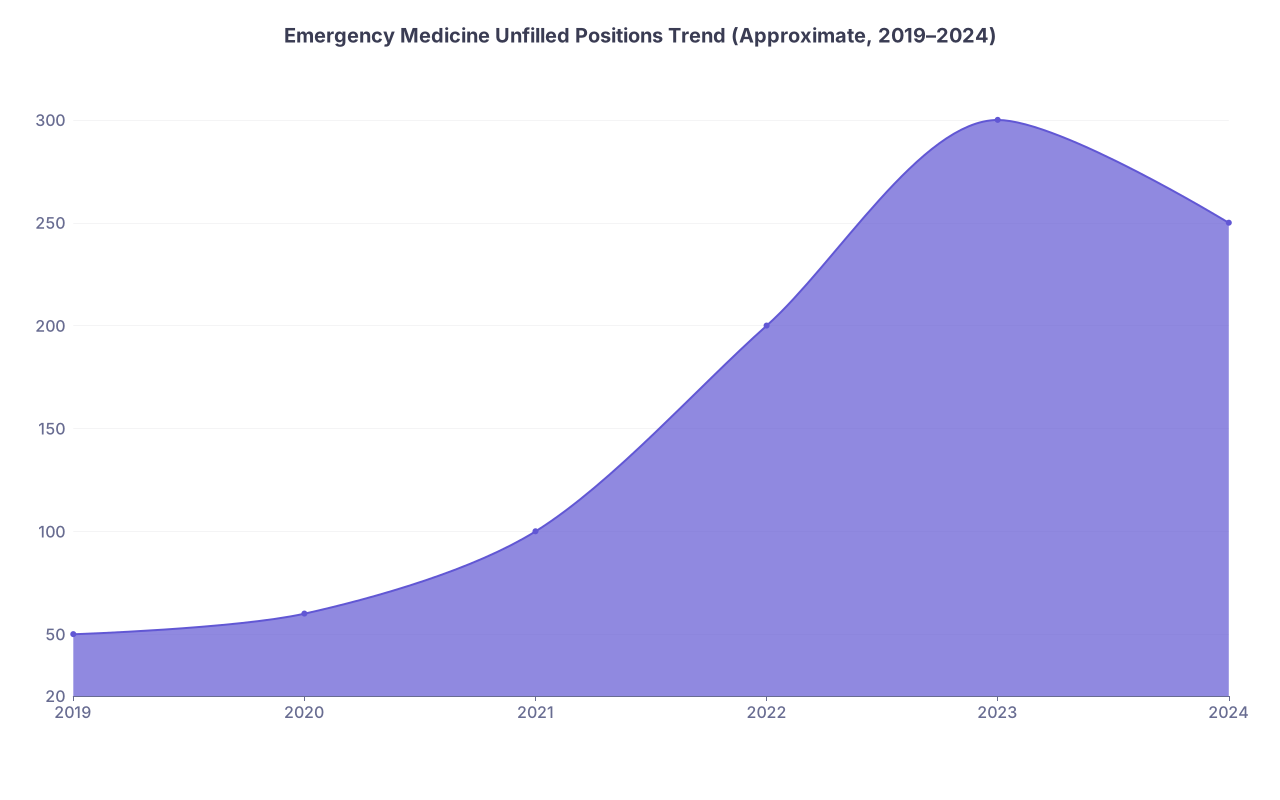
| Category | Value |
|---|---|
| 2019 | 50 |
| 2020 | 60 |
| 2021 | 100 |
| 2022 | 200 |
| 2023 | 300 |
| 2024 | 250 |
The exact numbers vary by year, but the directional shift is undeniable. EM has moved from clearly competitive to seriously undersubscribed relative to capacity.
Drivers:
- Perception of burnout, violence, and job market softening, especially in urban markets.
- Post-COVID reevaluation of lifestyle vs real working conditions.
- Rapid expansion of residency positions in some regions outpacing applicant interest.
If you are a solid US MD who would have been borderline for EM in 2019, you are far more likely to match EM in 2024, often into programs that previously would have felt out of reach.
4.3 General Surgery: Still Tough, But Not Accelerating
General surgery is another area where difficulty remains real but is not mounting sharply.
Data trends:
- High fill rates by US grads, but stable.
- Applicants per position in a “competitive but not insane” band, showing modest changes but nothing like derm/plastics/ortho accelerations.
- Strong but relatively steady Step 2 CK expectations.
If anything, there is a slight diffusion effect: some highly competitive applicants are clustering into subspecialty pipelines (integrated vascular, plastics, etc.), leaving GS as a broad-tent field with large program variability.
5. Score Pressure: Step 1 Pass/Fail and Rising Step 2 CK Expectations
You cannot talk about 2019–2024 without addressing the Step 1 pass/fail pivot and its impact on competitive specialties.
The data pattern is consistent across derm, ortho, ENT, plastics, and radiology:
- Average reported Step 2 CK scores among matched applicants increased.
- Programs signal more aggressively and use Step 2 CK and school reputation as filters.
- Research and home/away rotations have become more disproportionately important as tie-breakers.
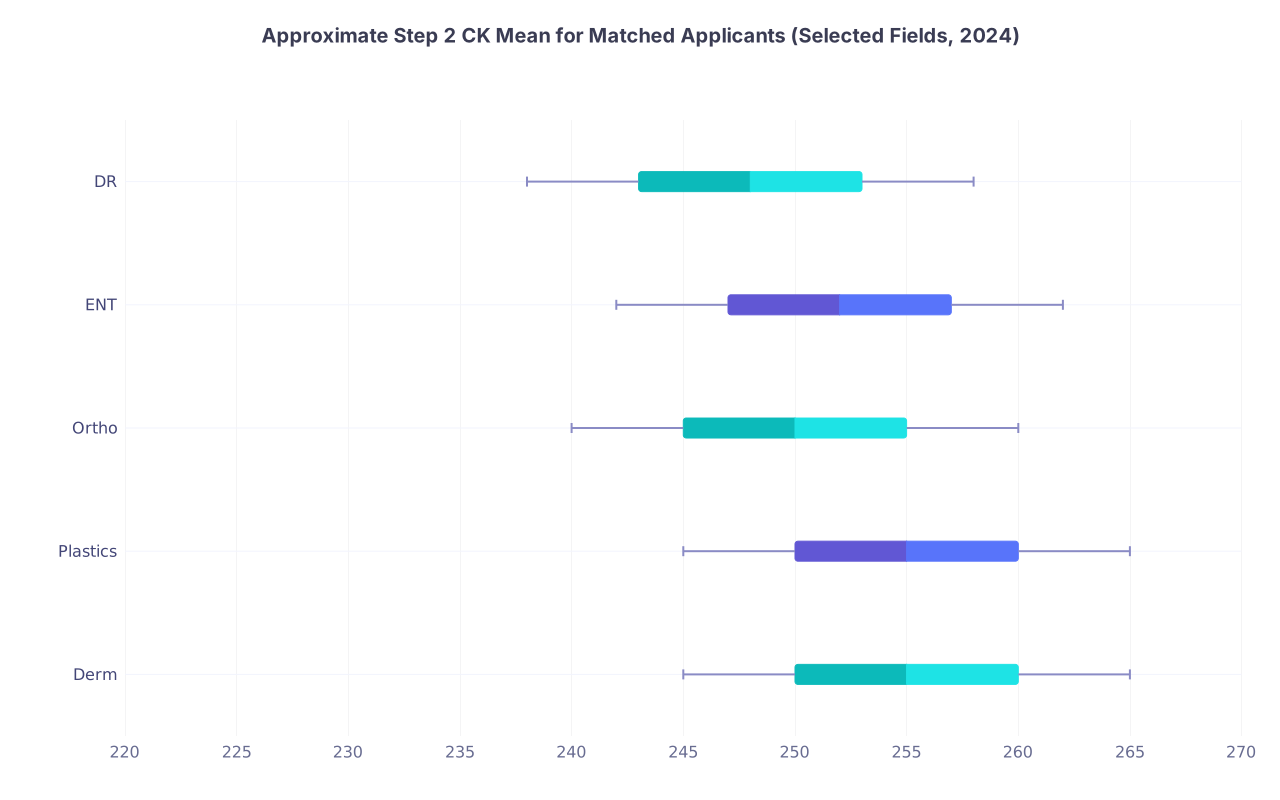
| Category | Min | Q1 | Median | Q3 | Max |
|---|---|---|---|---|---|
| Derm | 245 | 250 | 255 | 260 | 265 |
| Plastics | 245 | 250 | 255 | 260 | 265 |
| Ortho | 240 | 245 | 250 | 255 | 260 |
| ENT | 242 | 247 | 252 | 257 | 262 |
| DR | 238 | 243 | 248 | 253 | 258 |
These are illustrative ranges, not exact NRMP-disclosed numbers, but they mirror what program directors report and what applicant self-reporting shows: a 250+ Step 2 CK is becoming the de facto norm for top-tier matches in several competitive fields.
What changed is not just the average. It is the compression at the top. You now have a dense cluster of applicants with:
- High Step 2 CK scores
- Double-digit research products
- Strong letters from subspecialty faculty
- High-prestige home institutions
The result? The difference between matching and not matching is often marginal, and pure metrics no longer guarantee safety in the hottest fields. That is exactly what “getting harder” looks like in the data.
6. Strategic Takeaways: Who Should Be Worried, Who Has Opportunity
If we boil down 2019–2024 trends, you get a clear stratification.
6.1 Fields That Got Meaningfully Harder
If you are targeting one of these, your bar is higher than it was five years ago:
- Dermatology
- Integrated Plastic Surgery
- Orthopaedic Surgery
- ENT (Otolaryngology)
- Diagnostic Radiology (especially at top programs)
You need to assume:
- Step 2 CK in the high 240s–250s or above for realistic chances at strong programs.
- Heavy research (often 10+ items, and not just poster-padding).
- Substantial specialty-specific exposure and letters.
6.2 Fields That Stayed Extremely Hard, But Stable
- Neurosurgery
- Integrated vascular and thoracic variants
- Some small, niche surgical subspecialties
Here, your strategy in 2024 is basically the same as it would have been in 2019: you must build your entire medical school profile around that specialty from early on.
6.3 Fields Where the Relative Barrier Has Eased or Plateaued
- Emergency Medicine (dramatically looser)
- Anesthesiology (stabilized, somewhat less overheated)
- Some segments of General Surgery and Internal Medicine subspecialty pipelines, depending on program tier
For strong applicants who might be on the cusp of the ultra-competitive bucket, these areas represent real opportunity. The data do not care about prestige gossip. They show where unfilled spots accumulate and where applicant pressure is receding.