
Only 3.5% of categorical dermatology positions went to DO seniors in 2024, despite DOs now constituting roughly 25% of all U.S. medical students.
That gap is the story. And it has been for a decade.
USMD seniors still dominate the most competitive specialties. IMGs are still largely locked out of a few fields. DOs have gained ground in some areas but hit a ceiling in others. The NRMP data from 2014–2024 are brutally consistent.
Let’s walk through what the numbers actually show—USMD vs DO vs IMG—across competitive specialties over the last decade: dermatology, plastic surgery, orthopedic surgery, otolaryngology, neurosurgery, integrated vascular, and radiation oncology, plus the “semi-competitive” cluster (anesthesiology, EM before the crash, etc.).
I will not sugarcoat it. The data are clear.
1. Macro Trends: Who Actually Fills Competitive Spots?
Over the last decade, three things happened simultaneously:
- US MD schools modestly increased class sizes
- DO schools expanded aggressively
- IMGs kept applying at high volume, especially to less competitive fields
Yet in the highly competitive specialties, the proportions of USMD vs DO vs IMG have not shifted nearly as much as enrollment would suggest.
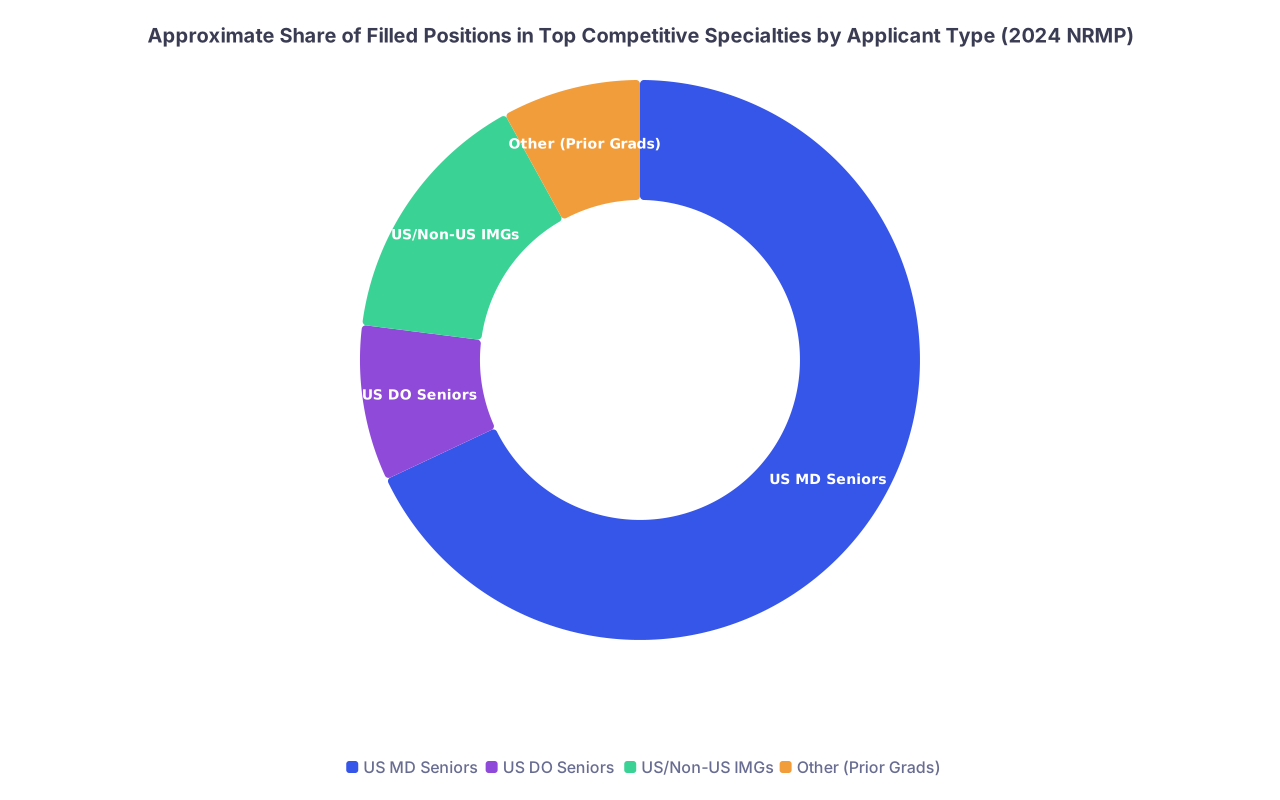
| Category | Value |
|---|---|
| US MD Seniors | 68 |
| US DO Seniors | 9 |
| US/Non-US IMGs | 15 |
| Other (Prior Grads) | 8 |
These values are aggregated across a basket of competitive specialties (Derm, Ortho, ENT, Plastics, Neurosurgery, Integrated Vascular, Rad Onc). The exact breakdown varies per specialty, but the pattern is stable:
- USMD seniors: majority in every truly competitive specialty
- DO seniors: single-digit or low-teens percentage in most of these fields
- IMGs: near-zero in several of the most competitive surgical subspecialties
The proportion of DOs in the overall Match climbed sharply after the MD/DO residency merger (ACGME single accreditation era). But in the top-competition fields, growth is incremental, not explosive.
2. Dermatology: Slightly More Open, Still USMD Territory
Dermatology is a good test case because it is brutally score-driven and interview-constrained.
Across the last decade, dermatology has remained one of the most USMD-heavy specialties. Yet DO representation has edged upward from essentially nonexistent into low single digits.
| Year | USMD Seniors | DO Seniors | IMGs (US + Non-US) |
|---|---|---|---|
| 2014 | ~82% | <1% | ~5–6% |
| 2018 | ~80% | ~1–2% | ~6–7% |
| 2021 | ~77% | ~2–3% | ~7–8% |
| 2024 | ~74% | ~3–4% | ~9–10% |
What the data show:
- USMD share is slowly drifting down, but still dominant.
- DO penetration is real but modest: a few percent, not parity.
- IMGs (especially US-IMGs from Caribbean schools) appear in small numbers at community or newer programs, rarely at the high-prestige academic centers.
I have seen this play out in applicant lists: dermatology programs may interview one or two DOs per cycle, sometimes none. An IMG on a derm rank list is still an exception, not a norm.
Key drivers over the decade:
- Rising pressure on Step scores historically, then the Step 1 pass/fail shift.
- Heavy emphasis on home dermatology departments, research years, and connections.
- Many DO schools still lack strong in-house dermatology departments or established pipeline rotations at academic derm programs.
Bottom line: dermatology slightly more diverse by degree than a decade ago, but still sharply stratified.
3. Orthopedic Surgery and ENT: DO Gains, IMG Wall
Orthopedic surgery and otolaryngology (ENT) are where DOs have made actual measurable inroads, particularly post-merger. IMGs, meanwhile, remain almost entirely blocked.
Orthopedic Surgery
Historically, there were separate AOA (DO) ortho programs. After the ACGME merger, many of these became ACGME-accredited and technically “open” to MD and DO alike. The result: DO numbers have stayed visible, and in some regions, quite strong.
| Year | USMD Seniors | DO Seniors | IMGs (US + Non-US) |
|---|---|---|---|
| 2014 | ~79% | ~7–8% | ~1–2% |
| 2018 | ~76% | ~9–10% | ~2% |
| 2021 | ~73% | ~11–12% | ~3% |
| 2024 | ~70% | ~12–13% | ~3–4% |
What changed:
- DOs kept a foothold via legacy AOA programs, then increased presence through the unified accreditation system.
- Certain regions (Midwest, South) have ortho programs with DO-heavy resident rosters.
- IMGs remain effectively excluded from most ortho programs; the few that match typically have U.S. research years, strong connections, or advanced degrees.
Otolaryngology (ENT)
ENT used to be near-zero DO and near-zero IMG. That has shifted slightly.
- USMD seniors still fill the vast majority of ENT positions (>80%).
- DO seniors have gone from “statistical rounding error” a decade ago to a few percent of matched applicants.
- IMGs remain extremely rare. Some cycles have only a handful of IMG matches nationwide in ENT.
I have sat in ENT rank meetings where an IMG file was called “an outlier” simply because there were none in the applicant pool. That is not about merit. It is about pipeline and exposure; ENT away rotations are heavily USMD-centric.
4. Plastic Surgery, Neurosurgery, Integrated Vascular: The Hard Ceiling
There are specialties where the door is barely open for DOs and almost completely shut for IMGs. Integrated plastic surgery, neurosurgery, and integrated vascular surgery are prime examples.
Integrated Plastic Surgery
Over ten years, integrated plastics has increased positions, but not much diversity of entrant background.
Rough pattern:
- USMD seniors: consistently 75–85% of matched PGY-1s
- DO seniors: usually 0–3 spots per year nationwide, sometimes none
- IMGs: almost completely absent; an IMG integrated plastics match is a “talked-about” event
Programs in this field are extremely prestige- and research-sensitive. Multi-year research, multiple first-author publications, and home institution advocacy are standard. Many DO and IMG students simply never get onto that on-ramp.
Neurosurgery
Neurosurgery is similar: heavy USMD dominance, vanishingly few DOs, almost no IMGs.
Across the decade:
- USMD seniors: often 80–90% of categorical positions
- DO seniors: low single digits, often fewer than 5 total per Match
- IMGs: near zero; occasionally a US-IMG or non-US IMG with extensive U.S. research and mentorship
Neurosurgery program directors repeatedly rank “attendance at a U.S. allopathic medical school” as a major factor. That shows in the numbers.
Integrated Vascular Surgery
Integrated vascular is smaller but follows the same pattern:
- USMD seniors: strong majority
- DO seniors: a handful nationwide, often clustering in only a few programs
- IMGs: effectively blocked; most IMG vascular surgeons still come through general surgery followed by fellowship, not integrated pathways
Collectively, these three specialties show what I call the “hard ceiling” effect: even as DO and IMG applicants increase, match outcomes in these fields change very slowly.
5. Radiation Oncology and Anesthesiology: A Different Kind of Shift
Not all trends are simply USMD hold vs DO push vs IMG exclusion. Some are driven by the supply–demand imbalance in the specialty itself.
Radiation Oncology
Radiation oncology is the cautionary tale. Around 2014–2017, rad onc was hyper-competitive, dominated almost entirely by USMDs with high scores and heavy research.
Then applications fell, the job market looked soft, and unfilled positions started appearing.
The shift over the decade:
- Early 2010s: Almost entirely USMD, with a few IMGs and essentially no DOs
- Late 2010s: Still USMD-dominant, but unfilled spots begin to appear in the Match
- Early 2020s: Unfilled positions large enough that programs scramble in SOAP; DO and IMG matches rise modestly simply because programs must broaden who they interview and rank
By 2024, DO and IMG seniors are visibly present in radiation oncology match lists, but still in the minority. This is one of the few competitive-ish specialties where the barrier lowered because applicant interest dropped, not because gatekeepers became more enlightened.
Anesthesiology (and EM pre-2020 shock)
Anesthesiology has been semi-competitive, not at the level of derm or plastics, but still selective. DO and IMG shares have grown here more than in the hyper-elite subspecialties.
Rough anesthesiology pattern over the decade:
- USMD share decreasing from ~65–70% down into the 50–60% range
- DO seniors now regularly filling 15–20% of anesthesiology PGY-1 spots
- IMGs gradually filling a noticeable fraction, often 15–20% of positions, especially at community and non-top-tier academic programs
Emergency medicine, before the recent drop in interest and spike in unfilled positions, showed a similar shift: USMD dominance early, increasing DO and IMG participation over time. Post-2020, the overcorrection in applicant interest has scrambled that field.
These specialties show what happens when total positions outstrip the pool of USMDs willing to apply: gatekeeping relaxes, and program directors visibly increase comfort with DO and IMG trainees.
6. Step Scores, Pass/Fail, and How Screening Really Worked
You cannot talk about the last decade without talking about USMLE Step 1 (and COMLEX) and how they were used.
For years, the unofficial algorithm was simple:
- Filter by Step 1 score cutoff (often >240 or >250 for the top specialties)
- Filter by medical school type and reputation
- Only then read entire applications
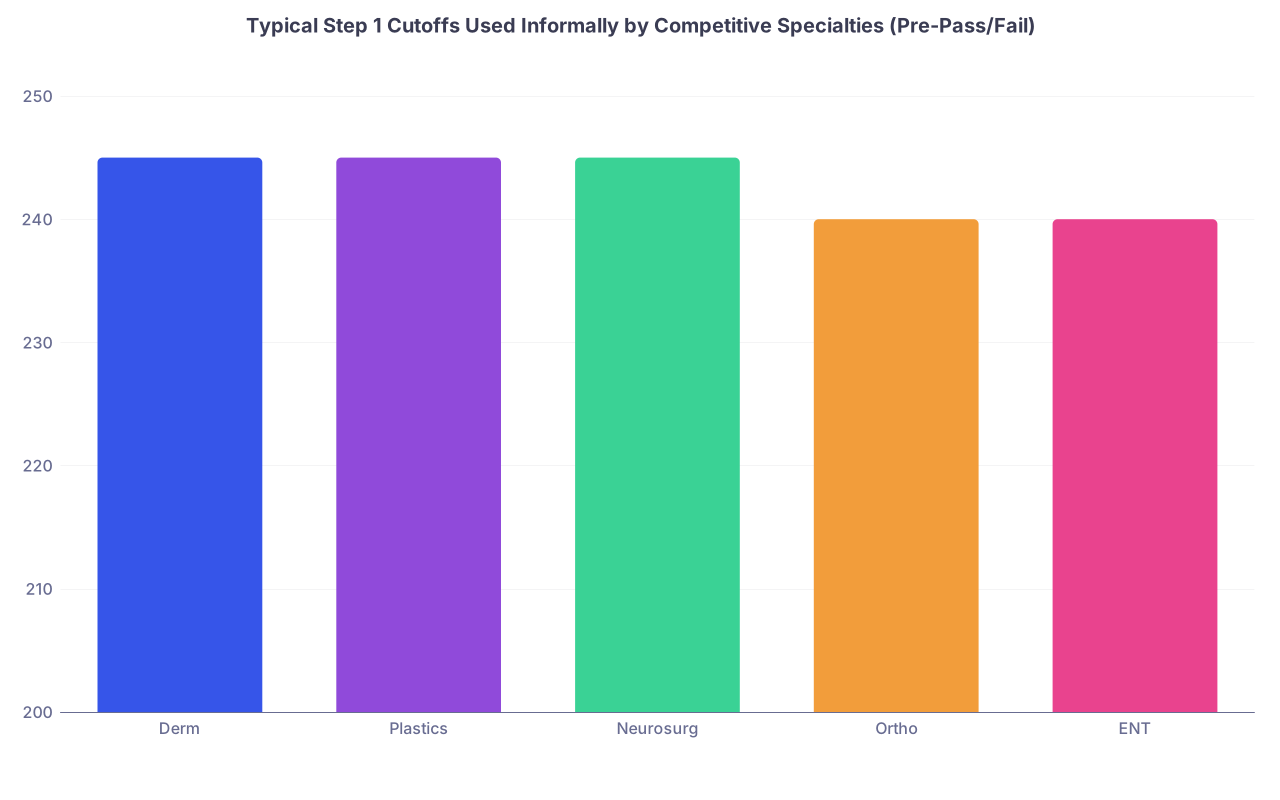
| Category | Value |
|---|---|
| Derm | 245 |
| Plastics | 245 |
| Neurosurg | 245 |
| Ortho | 240 |
| ENT | 240 |
Dermatology, plastics, neurosurgery, ENT, and ortho consistently reported some of the highest Step 1 means and cutoffs in NRMP Program Director Surveys.
For DO and IMG applicants, this created compound disadvantages:
- Some programs did not consider COMLEX-only scores and insisted on USMLE.
- Others explicitly screened out non-USMDs even above the score cutoff.
- IMGs faced visa and institutional policy barriers before anyone looked at their board performance.
Post-2022, Step 1 became pass/fail. Program directors shifted focus to:
- Step 2 CK numerical score
- Home institution and clerkship performance
- Research output and letters
- School name recognition (even more)
This change has not yet translated into major structural shifts in who matches derm, plastics, or neurosurgery. If anything, early data suggest that removing Step 1 may make it harder, not easier, for a stellar DO or IMG at an unknown school to break through. Numbers were at least objective; reputation is not.
I still see residency selection meetings where someone says, “I do not know this school” and the file quietly drops on the pile. That is not captured anywhere in the NRMP tables, but it is one of the largest invisible forces in the data.
7. USMD vs DO vs IMG: Strategic Implications by Group
Let me be blunt and data-driven by applicant type.
If you are USMD
The last decade has been kind:
- You occupy the majority of spots in every competitive specialty.
- Even in years when applications spike, your baseline credibility is high.
- Program directors know your curriculum, grading system, and hospital network.
Your main risk is ignoring how much the bar has risen within your cohort. The average successful USMD derm or plastics applicant now often has:
- Step 2 CK well above national mean
- Multiple publications (often >5)
- Strong, specialty-specific letters and meaningful research or away rotations
The competition is not DOs or IMGs. It is other USMDs with even more polished CVs.
If you are DO
The single accreditation system gave you access. It did not guarantee outcomes.
The decade-long data show:
- Real, meaningful progress in fields like orthopedics, anesthesiology, EM (pre-crash), PM&R.
- Modest and fragile gains in ENT and derm.
- Almost no movement in integrated plastics, neurosurgery, and some elite academic programs.
Strategically, DO applicants who match into competitive specialties usually share a few characteristics:
- They take USMLE in addition to COMLEX (programs still use those numbers heavily).
- They actively secure away rotations at ACGME academic centers and make themselves known.
- They have strong faculty advocates who are already “trusted” by the target programs.
I have seen DO applicants with excellent numbers and publications still get shut out of integrated plastics interviews purely because no one recognized their school name. That is the invisible tax you pay. You have to overperform the median USMD applicant to be considered “equivalent” in many places.
If you are IMG (US-IMG or non-US IMG)
The harsh truth across the last decade:
- Your realistic chances in derm, plastics, ENT, neurosurgery, and integrated vascular are near zero, statistically. There are exceptions, but they are exactly that—exceptions.
- Your opportunities are materially better in internal medicine, family, peds, neuro, pathology, and increasingly anesthesiology and some prelim/transitional years.
The most successful IMG matches in competitive specialties almost always involve:
- Several years of U.S.-based research at a top institution
- High Step scores (before) or high Step 2 CK (now)
- U.S. clinical experience and strong letters from big-name faculty
- Often, a non-traditional profile (prior residency, PhD, etc.)
If your primary goal is to match in the U.S. at all, chasing derm or plastics as a non-U.S. IMG is usually a catastrophic risk decision when you look at the data across the decade. The expected value is extremely low.
8. Where the Next Decade Is Likely Heading
Projecting trends is risky, but the pattern over ten years gives some fairly solid directional bets.
- USMD dominance in the top 3–4 specialties (derm, plastics, neurosurg, ENT) will persist. There is no structural reason that would suddenly open those fields wide to DO and IMG applicants.
- DO representation will probably continue to increase modestly in orthopedics, ENT, anesthesiology, and some surgical subs. The ceiling will rise slowly, not overnight.
- IMGs will likely remain strongly represented in primary care and hospital-based fields, with incremental gains in anesthesiology and maybe EM once the current market stabilizes. Competitive surgical subspecialties will stay almost entirely USMD.
The one wild card is specialty interest volatility. Radiation oncology already showed what happens when a “prestige” field becomes perceived as a bad job market: USMD interest drops, programs scramble, and doors crack open a bit wider for DOs and IMGs.
You might see echoes of that in EM and possibly in others if the workforce data swing hard enough. But those are situational windows, not a fundamental leveling of the playing field.
9. Summary: The Signal in a Decade of Data
Over ten cycles, the numbers say three things very clearly:
- USMDs still control the match in the most competitive specialties. DO and IMG applicants have made gains at the margins, but the structural hierarchy has not been overturned.
- DOs have achieved real progress in select fields, not universal acceptance. Ortho, ENT, anesthesiology, and EM show meaningful DO presence; plastics, neurosurgery, and integrated vascular do not—yet.
- IMGs remain functionally excluded from a few top-tier surgical subspecialties. Their real opportunities lie in less competitive fields and in programs willing to look beyond school name.
If you understand those three points and plan accordingly, you are already operating ahead of most applicants who are still guessing instead of reading the data.