
Most personal statements for competitive specialties self-destruct in the first two paragraphs.
If you’re aiming for derm, ortho, plastics, neurosurgery, ENT, ophtho, rad onc, or any of the other bloodbath specialties, you can’t afford that. The bar isn’t “good enough.” It’s “does not give anyone a reason to screen you out.”
Let me walk you through the traps I’ve seen applicants fall into year after year—and how you can sidestep them before you hit submit.
1. The “I’m Special Because I Want This Badly” Trap
Programs in competitive specialties assume you want it badly. That’s the baseline. Writing 800 words that boil down to “I’m passionate and I work hard” is a fast way to get labeled generic.
The mistake
You write things like:
- “I have always been fascinated by surgery.”
- “Dermatology is the perfect combination of medicine and procedures.”
- “Radiology allows me to combine my love of technology and diagnostics.”
Every committee member has read those exact sentences hundreds of times. They mean nothing.
Worse, in hyper-competitive fields, vague “passion” language comes across as:
- Underprepared
- Naive
- Interchangeable with 50 other applicants
The fix
You have to show, not announce, that you’re serious.
Ask yourself:
- Where is the tangible evidence that I’ve already been acting like someone in this specialty?
- What have I done that required sacrifice, not just interest?
Instead of saying “I am committed to neurosurgery,” you write about:
- Waking up at 3:30 a.m. repeatedly to pre-round on the neurosurgery service even when you were on another rotation
- Spending Friday nights revising a QI project with the chief because you actually cared whether your pathway got implemented
- Taking ownership of a complex spine patient, following them across services, and then emailing the attending 6 months later with a functional update because you were still thinking about that case
That’s commitment. Let them infer, not be told.
Red flag test: If you can copy-paste your “why this specialty” paragraph into any other specialty with 1–2 word swaps, it’s garbage. Rewrite it.
2. The “Competitiveness Brag Sheet” Trap
In competitive specialties, the instinct is to flex. Step scores. Research. Class rank. All of it.
The problem? Your ERAS already screams your stats. Using your personal statement as a second CV turns it into a boring recitation and makes you sound insecure.
The mistake
Paragraph structure I see all the time:
- Paragraph 1: Vague passion story
- Paragraph 2: “During my research year, I presented X posters and Y publications”
- Paragraph 3: “On the orthopedic service, I received strong evaluations and was told I worked like an intern”
- Paragraph 4: “These experiences have prepared me well for a career in orthopedic surgery”
This isn’t a story. It’s a performance review written by a robot who’s scared they’re not enough.
The fix
You still show competitiveness—but through depth, not volume.
Pick 1–2 anchor experiences that demonstrate:
- How you think
- How you respond to difficulty or failure
- How you interact on a team
- How you actually behaved on the competitive service
Then build around them with concrete detail:
- Not “I did research with Dr. X.”
But: how you reacted when your first manuscript was rejected, and what that says about how you handle setbacks. - Not “I worked hard on my sub-I.”
But: the exact moment an intern trusted you to run with a sick patient, what you did, and what you learned.
In competitive fields, maturity and realism are differentiators. You don’t earn those by piling on achievements. You earn them by showing you actually understand what this life looks like.
3. The “Ultra‑Competitive + Ultra‑Generic” Combo (Kiss of Death)
Here’s the harsh truth: the more competitive the specialty, the less generic you can afford to be.
Program directors in these fields are drowning in “great” applicants. If your statement makes them think “Sure, fine, whatever,” you’re done.
The mistake
Overusing safe, vague language:
- “I strive for excellence.”
- “I value teamwork and communication.”
- “I want to contribute to research and teaching.”
Those are bare minimum expectations. Nobody’s saying, “I strive for mediocrity and hate communication.”
In ultra-competitive specialties, this reads as either:
- You’re copy-pasting from a template
- You have nothing real to say
- You don’t actually know what the specialty culture is like
The fix
Anchor your values in specific, field‑flavored scenarios.
Example for ENT:
- Instead of: “I value teamwork.”
- Use: “On my ENT rotation, our 5 a.m. pre-op huddles were the only time the whole head and neck team aligned. I watched a PGY-4 run that room with ruthless clarity—confirming scans, rechecking consent, reminding anesthesia about the free flap timing. I started to understand that in this field, ‘teamwork’ means protecting a 10-hour case from falling apart before the first incision.”
Notice:
- It’s specific to ENT
- It shows that you’ve seen the work, not just read about it
- It adds a little grit, which competitive specialties respect
If you can’t connect your “values” to actual scenes from rotations, research, or patient care, they don’t belong in your statement.
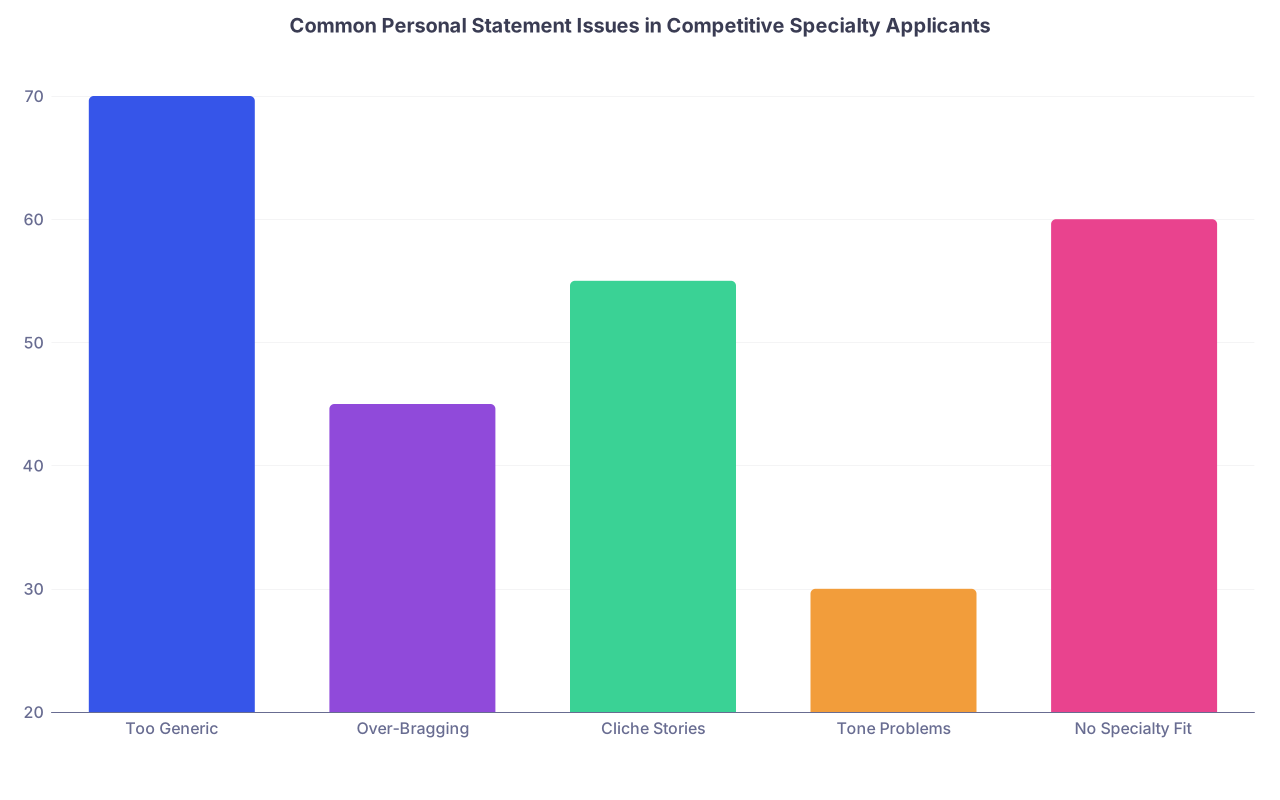
| Category | Value |
|---|---|
| Too Generic | 70 |
| Over-Bragging | 45 |
| Cliche Stories | 55 |
| Tone Problems | 30 |
| No Specialty Fit | 60 |
4. The “Lifestyle Worship” and “Prestige Thirst” Traps
You’d think no one would say, “I want derm for the lifestyle” or “ortho attracted me because of the compensation.” They do. Or they get close enough that the intent is obvious.
Programs in competitive specialties are hypersensitive to this. They’re sick of people chasing money, lifestyle, or clout.
The lifestyle mistake
You subtly telegraph that you’re here for:
- Schedule control
- Procedural fun without longitudinal responsibility
- Image of the specialty
Phrases that get you quietly discarded:
- “Dermatology offers a good work–life balance that will allow me to be present for my family.”
- “Radiology allows me to work in a controlled environment with predictable hours.”
- “I value the lifestyle that will let me pursue my interests outside of medicine.”
Is work–life balance legitimate? Yes.
Is it a smart thing to center in a personal statement to a cutthroat field? No.
The prestige mistake
You hint that what you really want is status:
- “As one of the most competitive fields…”
- “I have always aspired to become a neurosurgeon, the pinnacle of surgical training.”
- “Dermatology attracts some of the strongest applicants, and I hope to join their ranks.”
This makes you sound like you care more about winning the game than doing the work.
The fix
You can acknowledge reality without worshipping it.
Better moves:
- Emphasize type of work, not hours: procedural vs cognitive, level of acuity, continuity vs episodic care, anatomy you love.
- Emphasize temperament fit: you like long complex cases, you have high tolerance for ambiguity, you enjoy iterative troubleshooting, etc.
- Emphasize patient impact: what sort of problems you want to spend your life solving.
If you want to even hint at balance, do it indirectly:
- “The faculty I admire most model careers that are sustainable over decades—still curious, still teaching, still operating at a high level. That’s the kind of arc I want.”
You’re allowed to want a life. Just don’t frame the specialty as your ticket out of work.
5. The “Copy‑Pasted Trauma Story” Trap
This one’s ugly but real.
Certain specialties (derm, plastics, ENT, ophtho) are absolutely flooded with trauma stories that feel remarkably similar:
- Teen acne and self-esteem
- Relative with skin cancer / breast cancer / disfiguring trauma
- Elderly grandparent losing vision or hearing
The problem isn’t that these experiences aren’t meaningful. It’s that they’ve been written poorly and predictably so many times that readers are numb.
The mistake
You use a deeply personal story as a cheap hook that:
- Could be swapped with any other applicant’s near-identical story
- Has almost no connection to what you actually did in med school
- Ends with “This is why I want to go into [specialty].”
There’s almost always a tone mismatch: heavy emotional opener → generic “I enjoyed my rotation” middle → canned conclusion.
The fix
Ask yourself two brutal questions:
- If I removed this trauma story, would my reasoning for this specialty collapse?
- Does this story actually explain my professional choices, or just my initial exposure?
If the answer to #1 is yes, or #2 is “not really,” you should either:
- Cut the story entirely, or
- Shrink it to 1–2 sentences of context and move on to who you are now
If you keep it, you must:
- Tie it to specific actions you’ve taken since (research focus, advocacy, teaching, long-term volunteering)
- Show growth, not just pain
- Avoid melodramatic language—competitive specialties skew allergic to emotional excess
Your personal story should illuminate your trajectory. Not substitute for it.

6. The “I Don’t Actually Understand This Field” Trap
This one kills a shocking number of otherwise strong applications.
Competitive specialties assume you’ve done your homework. When your statement reveals you haven’t, you get labeled as a tourist.
The mistake
You:
- Describe only the glamorous parts of the work (big cases, rare diseases, procedures)
- Never mention the unsexy but constant parts (documentation, clinic grind, pager chaos, call, complications)
- Mix up basic specialty realities (e.g., talking about long-term primary care continuity as your main draw to radiology)
- Use language that clearly came from marketing blurbs, not lived experience
Readers think: “This person has no idea what they’re signing up for.”
The fix
Show field literacy without turning the statement into a job description.
That looks like:
- Naming tradeoffs honestly (long hours, emotionally heavy cases, high complication risk) and explaining why you still want it
- Mentioning realistic challenges you’ve seen (e.g., NEUROSURGERY: devastating outcomes despite perfect technique; DERM: managing patient expectations in cosmetic work; RAD ONC: counseling patients through long courses with uncertain benefit)
- Describing how you reacted internally the first time you saw that side of the work
Example:
- “My first 12-hour spine case felt like a triumph—until the patient returned with a wound infection. Watching my attending spend far more time in the following weeks managing complications than he did operating was sobering. It pushed me to pay attention not just to the technical brilliance of neurosurgery, but to the follow-through and ownership it demands.”
That’s someone who’s actually looking.
7. The “Perfect Robot” Tone Trap
Competitive specialties attract high-achievers. Many of you have been rewarded for sounding polished, formal, and utterly inoffensive.
In a personal statement, that can backfire. You come across as:
- Plastic
- Over-coached
- Dishonest by omission
The mistake
Your entire essay sounds like:
- “I am honored to apply…”
- “I have been fortunate to have had the opportunity…”
- “These experiences have prepared me well to pursue a career in…”
You glide past failure. You do not admit weakness. Everything is smooth upward trajectory.
Program directors in these fields know that residency will break that version of you in two seconds.
The fix
You do not need to confess your darkest secrets. But you should sound like a human who has been knocked around a bit and learned something.
Places to safely show this:
- A research project that did not work and what you changed the next time
- A harsh but fair piece of feedback from a resident/attending and how you responded
- A rotation where you initially struggled with the pace, the culture, or the procedures
Key: you must own it without self-pity.
Bad: “I was unfairly criticized by an attending but worked hard to overcome this.”
Better: “On my first day on ortho, the chief told me my consult note was ‘too internal medicine.’ He was right. I was burying the plan under paragraphs of detail. I spent the next week asking interns to show me how they structured their notes. By the end of the rotation, my sign-outs were getting adopted almost word-for-word.”
That sounds like someone coachable—gold in any competitive program.

| Step | Description |
|---|---|
| Step 1 | Draft Statement Done |
| Step 2 | Add Specific Cases |
| Step 3 | Reframe to Work and Fit |
| Step 4 | Add Realistic Tradeoffs |
| Step 5 | Add One Growth Story |
| Step 6 | Get Senior Review |
| Step 7 | Too Generic? |
| Step 8 | Lifestyle or Prestige Focus? |
| Step 9 | No Evidence of Field Literacy? |
| Step 10 | Zero Failure or Growth? |
8. The “Wrong Audience” Trap: Writing for Yourself, Not the Reader
You are not writing for:
- Your classmates
- Your mom
- The faculty mentor who loves flowery language
You are writing for:
- A tired PD
- A jaded APD
- A senior resident on their 10th application in a row at 11:30 p.m. post-call
The mistake
You aim for emotional catharsis or literary beauty instead of clarity.
- Overlong metaphors about light, scars, journeys, or puzzles
- 300 words on childhood background before you ever mention the specialty
- Trying too hard to be “creative” in a field that values concise, accurate communication
In competitive specialties, patience is short. If your first few paragraphs are self-indulgent, the reader won’t wait for your point.
The fix
Test your draft with this simple exercise:
- Read only the first 5 sentences.
- Ask: “Does this tell a tired surgeon/radiologist/dermatologist why I belong in their field?”
- If the answer is no, your opening is wrong.
- If the answer is “sort of, but it’s buried,” cut until it’s not buried.
Also:
- Kill all extended metaphors unless a faculty member in that specialty has told you, “Keep this, it works.”
- Aim for clear, clean writing over “poetic.”
- Assume your reader may skim—make your core points obvious enough they’ll still catch them.
| Trap Category | What It Looks Like |
|---|---|
| Generic Interest | Could fit any specialty with 1–2 word changes |
| Lifestyle/Prestige | Explicit or implied focus on hours, money, status |
| Trauma-as-Hook | Emotional story unrelated to actual training choices |
| No Field Literacy | Only glamor; no tradeoffs or real-world details |
| Robot Tone | No failure, growth, or specific personal voice |

9. How to Actually Fix Your Draft (Step‑By‑Step)
Here’s the fast, ruthless way to repair a personal statement for a competitive specialty.
Delete your first paragraph
- 80% of the time, it’s fluff.
- Start where you actually begin acting like a future [derm/ortho/ENT/etc.] resident.
Highlight every sentence that could appear in another applicant’s statement unchanged
- “I work hard.”
- “I value teamwork.”
- “I am passionate about X.”
- You get the idea.
Replace at least half of them with specific examples or cut them.
Find the lifestyle and prestige landmines
- Anything talking about “balance,” “schedule,” “compensation,” “competitive field,” or “top-tier.”
- Reframe to: type of work, patient problems, temperament fit, or long-term impact.
Add one honest struggle + growth moment
- Not a catastrophe. Just something that shows you don’t crumble when pushed.
- Tie it directly to how you’ll function as an intern/resident.
Send it to the right reviewer
- Not your writing-center friend who wants to make it pretty.
- A resident or attending in the specialty who will say, “This sounds fake” if it does.
Do the 60-second skim test
- Have someone skim for exactly 60 seconds.
- Ask them:
- What specialty do you think I’m applying to?
- What 2–3 qualities stand out?
- If they can’t answer both, you still haven’t been specific enough.

FAQ (Exactly 5 Questions)
1. Do I need a dramatic patient story for a competitive specialty personal statement?
No. That’s one of the most overrated expectations. You need clarity, specificity, and evidence of fit—not a cinematic moment. If you have a case that genuinely changed how you think or solidified your specialty choice, use it briefly and concretely. If you’re forcing a story just to “sound powerful,” you’re probably making your statement weaker and more cliché.
2. How much should I talk about research for fields like derm, ortho, or neurosurgery?
Enough to show seriousness and follow-through, not so much that your statement becomes a PubMed list. One or two projects that you can describe in terms of your role, your thinking, and what you learned are far more persuasive than listing six poster titles. If your research is your main strength, focus on depth: obstacles, revisions, and how it shaped your understanding of the field.
3. What if my reason for the specialty really is lifestyle or financial stability?
Then you keep that reason to yourself. Simple as that. Programs know those factors exist, but if you center them in your narrative, you’ll be read as self-serving and short-sighted. Your job in this document is to articulate why you’re a strong fit for the work—the patients, the problems, the skills—not why the job is a good deal for you.
4. Can I reuse a similar personal statement for different competitive specialties “just in case”?
That’s a fast way to sound like you don’t actually belong in any of them. Competitive programs are highly attuned to generic “surgery” or “procedural” essays that could go to three different fields. If you’re applying to more than one specialty, each deserves its own statement with specialty-specific experiences, language, and reasoning. Yes, it’s more work. That’s the cost of competing at this level.
5. How long should my personal statement be for a competitive specialty?
Long enough to say something real without wasting the reader’s time. For ERAS, that usually lands around 650–750 words. Under 500 often feels superficial; over 850 usually means you’re rambling or repeating yourself. The more competitive the field, the more ruthless you should be about cutting fluff. If a sentence doesn’t either (a) show specialty fit, (b) demonstrate maturity, or (c) reveal how you actually operate on a team, cut it.
Open your current draft right now and delete one generic sentence—just one. Replace it with a specific moment that actually happened to you on that specialty’s service. Then keep going, line by line, until there’s nothing left a tired PD can roll their eyes at.