Your Step score is lower than you wanted. Your specialty of choice is brutally competitive. Those two facts do not automatically cancel each other out.
They do mean you cannot afford fantasy-level advice or vague optimism. You need a salvage plan. A real one.
This is that plan.
1. Face the Numbers, Then Decide if You Are Still In
Before you can fix anything, you need a hard, unflinching read of where you stand. Not vibes. Not “my friend matched derm with X”. Actual data and context.
Step 1: Put your score in the right bucket
Use this rough framework for Step 2 CK (since Step 1 is now pass/fail, but the logic is similar if your school/program still looks at Step 1):
| Bucket | Score Range | Reality Check |
|---|---|---|
| Strong | 255+ | Score will help you |
| Solid | 245–254 | Neutral to mildly helpful |
| Borderline | 235–244 | Will raise concern at some programs |
| Low | 225–234 | Clear red flag for top specialties |
| Very Low | <225 | Severe barrier, requires major offsets |
For the “big four” competitive specialties (Derm, Ortho, Plastics, ENT), plus things like NSGY, Rad Onc, and some IR/Optho programs, anything below ~240–245 starts to hurt. Below 230 is a serious problem.
Step 2: Look at historical realities
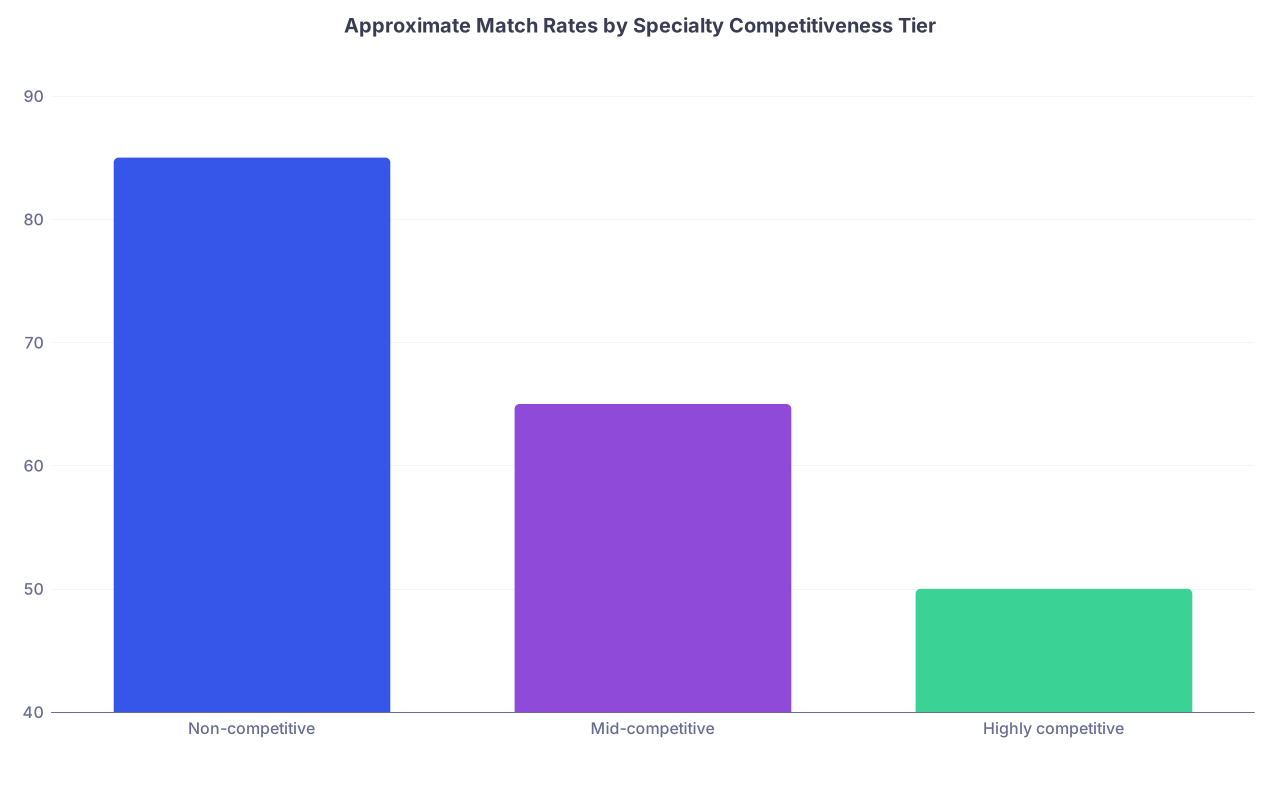
| Category | Value |
|---|---|
| Non-competitive | 85 |
| Mid-competitive | 65 |
| Highly competitive | 50 |
Those are ballpark numbers, but they illustrate the pattern:
- Non‑competitive specialties: You can often compensate for weaker scores with solid clinical work and a normal application.
- Mid‑competitive (e.g., EM, Anesthesiology, General Surgery at many programs, PM&R at many places): You have some maneuvering room.
- Highly competitive (Derm, Ortho, Plastics, ENT, NSGY, some Rad Onc, IR): The bar is very high. Score deficits must be actively counterbalanced.
Step 3: Make a binary decision
You have to answer one question honestly:
“Am I willing to do disproportionate work, tolerate uncertainty, and accept a higher risk of not matching to stay in the game for this specialty?”
If the answer is no, that is not failure. That is strategy. You can pivot early and crush a different field.
If the answer is yes, then the rest of this article applies to you.
But you must stop thinking “I will be fine if I just explain the score.” You will not be fine. You need to build a structured, aggressive salvage plan that turns your application into, “The score is the only weak part, and everything else is exceptional.”
2. Choose Your Exact Battlefield: Tiered Strategy by Specialty and Score
Not all “competitive” is equal. Ortho and Rad Onc are not the same situation. And a 236 is not the same as a 215.
A. If you are aiming at Derm, Plastics, ENT, or NSGY
These are brutal. You are competing against:
- 255–270+ Step 2 scores
- Multiple first‑author pubs in the field
- Research years at big‑name places
- Letters from national names
If your Step 2 is under ~240:
- Matching straight through without substantial research time or a backup plan is extremely unlikely.
- You either:
- Commit to a research year (or more) at a strong institution in that field, or
- Strategically pivot to another specialty that shares some overlap (e.g., NSGY → Neurology, Plastics → General Surgery with later Plastics fellowship, etc.)
If your Step 2 is 240–249:
- You are below the average but not necessarily dead.
- You need:
- At least one year of targeted research (ideally with pubs/abstracts)
- Gold‑level letters from core faculty in the specialty
- Strong away rotations where you perform at the very top of the student pool
- A well-defined backup specialty from day one
If your Step 2 is ≥250 but Step 1 was a visible weakness (pre‑P/F):
- Use Step 2 as your “rebuttal exhibit A”.
- You still probably benefit from research but you are not in purely salvage mode. You are in “prove consistency” mode.
B. If you are aiming at Ortho, EM, Anesthesia, IR, or very competitive Gen Surg
These fields are highly competitive but have more heterogeneity across programs.
If Step 2 is 235–245:
- Focus on:
- Targeted away rotations at mid‑tier and community‑heavy programs
- Honest program list with a lot of breadth
- Serious work on letters, research, and performance on rotations
If Step 2 is <235:
- A research year is strongly advised if you insist on staying in Ortho or IR.
- For EM or Anesthesia, you might still have a chance without research if:
- You have truly outstanding SLOEs (for EM) / letters
- Strong clinical evaluations
- You apply very broadly and include many community and less‑known programs
C. Decide if you need a research year
Here is the blunt version:
| Situation | Research Year Recommendation |
|---|---|
| Derm, Plastics, ENT, NSGY with Step 2 < 245 | Strongly advised to mandatory |
| Ortho with Step 2 < 240 | Strongly advised |
| IR with Step 2 < 240 | Strongly advised |
| EM/Anesthesia with Step 2 < 230 | Considered but not always required |
If you are in a “strongly advised to mandatory” category and refuse research time, then your realistic options are:
- Pivot to a related but less competitive specialty
- Accept a very high risk of not matching
3. Build a Concrete Salvage Plan: 12–18 Month Playbook
Vague “I’ll work harder” promises are useless. You need a structured plan, month by month.
Step 1: Lock down your narrative
You must be able to answer two questions in one or two sentences each:
- “Why are your scores low?”
- “Why should we believe your performance in residency will be different?”
You do not say:
- “I am not a good test taker.” Every PD has heard this a hundred times.
- “There were personal issues.” That is too vague and often sounds like an excuse.
You say something like:
- “I underweighted question-bank repetition and time management early on and did not recognize how much timed practice I needed. Since then, I changed my approach, completed over 3,000 timed questions with tracked improvement, and my shelf scores and in‑service exam have been consistently above average.”
The narrative is: “I identified the problem, changed behavior, produced objective evidence of improvement.”
Step 2: Upgrade every other part of your file to “asset” level
Low scores mean you cannot afford any other weaknesses. Your application components must look like this:
- Clinical evaluations: Outstanding, with multiple “top 10% of students” type comments
- Letters: Strong, specific, in‑specialty, from people programs recognize
- Research: At least some tangible, specialty‑relevant output (abstracts, posters, papers, QI projects)
- Personal statement: Focused, mature, shows insight into your own weaknesses and growth
Where do you start?
A. Clinical performance
On your core rotations and especially on away rotations you must:
- Be early, be prepared, and stay late smartly (not just standing around)
- Know the patients and your specialty’s bread‑and‑butter conditions cold
- Offer to present, follow up on tasks, and close the loop
- Make residents’ lives easier, not harder
You want written comments like:
- “Worked at the level of an intern”
- “One of the best students I have worked with in years”
Those comments become powerful in letters and MSPE.
B. Letters of recommendation
The worst thing you can do is end up with generic letters because you did not actively cultivate relationships.
Fix it:
- Identify 2–3 faculty in your specialty of interest who are known for good mentorship or who are program leadership.
- Ask them explicitly for feedback on your performance and for ways to improve. Implement their advice and circle back.
- When you ask for a letter, ask this exact question:
- “Would you feel comfortable writing a strong letter of recommendation for my application to [specialty]?”
If they hesitate, back off. You cannot afford “damning with faint praise” letters.
4. If You Have Time: Use a Research Year Strategically, Not Symbolically
A bad research year is a waste: no pubs, minimal mentorship, and a year of your life gone.
A good research year is a weapon.

Choosing the right research position
Look for:
- Institution with a residency program in your target specialty
- A mentor who has:
- A track record of publications in the last 3–5 years
- A history of mentees matching into competitive specialties
- A role where you will be:
- Writing manuscripts
- Presenting at conferences
- Interacting with residents and faculty regularly
Red flag: “Research” roles where you do unpaid scut, chart reviews for a year, and never get your name on anything.
Goals for a 12‑month research year
By the end of the year, you should aim for:
- 2–4 abstracts/posters presented (regional/national meetings)
- 1–2 manuscripts submitted (accepted is ideal but not fully under your control)
- 2–3 letters from:
- Research mentor
- Clinical faculty you met through the department
- Possibly the program director if you integrated well
You are not trying to become an R01‑level scientist in a year. You are trying to become “the applicant with low scores but very serious commitment and output in this specialty.”
5. Away Rotations: Where You Win or Lose Your Shot
For competitive specialties, away rotations are often more important than marginal score differences. They are your live audition.

| Step | Description |
|---|---|
| Step 1 | Low Step Score |
| Step 2 | Away Rotation |
| Step 3 | Strong Letter + Rank Boost |
| Step 4 | Neutral or No Letter |
| Step 5 | Red Flag and Lost Program |
| Step 6 | Performance |
How to pick away rotations when you have low scores
You are not shopping for Instagram‑famous programs. You are shopping for:
- Programs with a history of:
- Taking applicants from less fancy schools
- Valuing clinical performance over pure numbers
- Matching their away rotators at a reasonable rate
Tactics:
- Talk to recent grads from your school who matched in your specialty. Ask specifically:
- “Where did you rotate that actually helped?”
- Look for programs slightly below the ultra‑top tier but still solid academically. Think excellent clinical training, not pure prestige.
How to perform on an away with a known score deficit
On day one, you have two jobs:
- Make the residents’ and attendings’ lives easier
- Be obviously coachable and hungry without being annoying
Concrete behaviors:
- Know basic pre‑op, post‑op, or bread‑and‑butter conditions better than any other student there
- Volunteer for follow‑ups, notes, and presentations
- Study cases the night before and come with 3–5 focused questions
You cannot be a passive shadow. You need to be the student they talk about in the workroom after you leave the room: “That one is sharp.”
6. Program List Strategy: How to Apply Without Self‑Sabotage
This is where many ambitious but low‑score applicants implode. Their list is half fantasy, half random.
You need a structured program list:
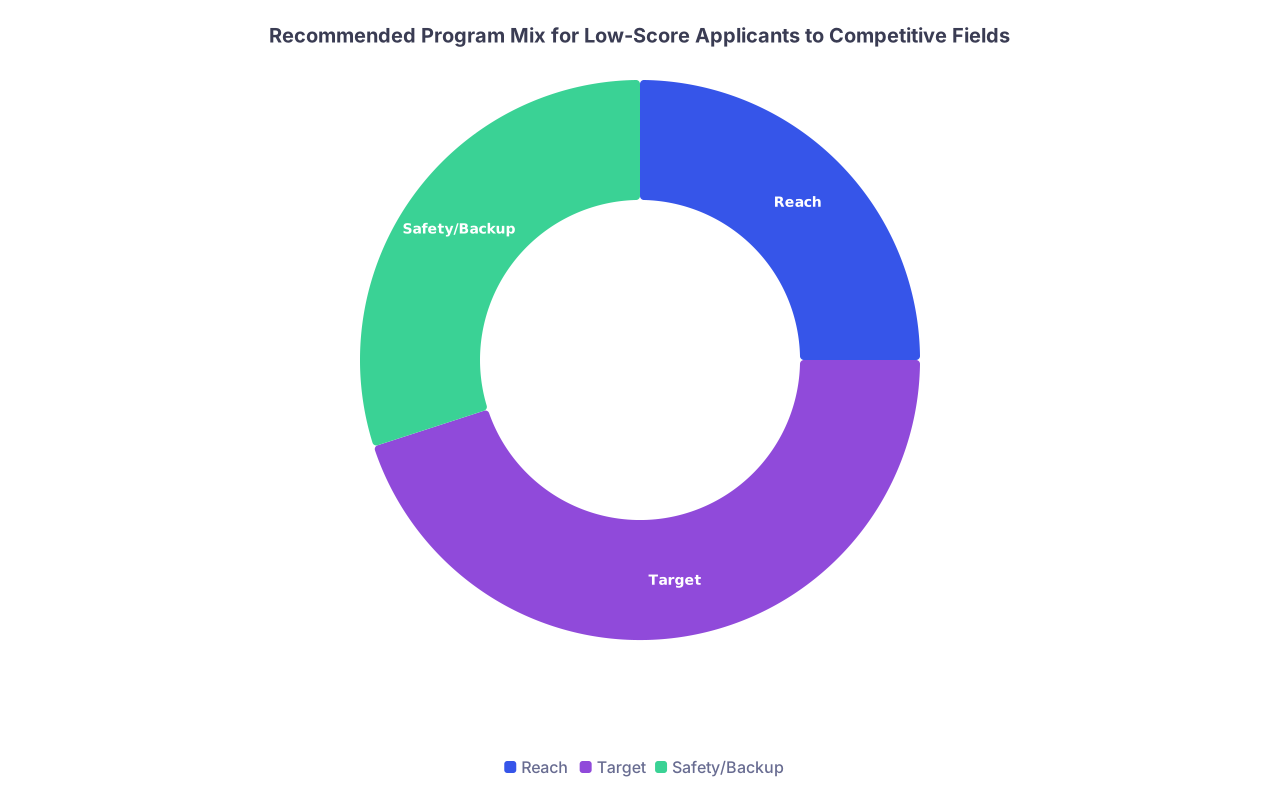
| Category | Value |
|---|---|
| Reach | 25 |
| Target | 45 |
| Safety/Backup | 30 |
Reach vs target vs safety
For a competitive specialty with low scores:
- Reach (top academic, elite, brand‑name programs): ~20–25% of your applications
- Target (solid academic or strong community with resident research and decent name recognition): ~40–50%
- Safety/backup within specialty (community heavy, newer programs, smaller markets): ~25–30%
And then a separate backup specialty list if you are truly at risk.
Geographic realism
You lose the right to be picky about geography when your scores are weak and your specialty is cutthroat.
- Expand your radius: Midwest, South, smaller cities, non‑coastal regions often have programs more open to strong clinical performers with lower scores.
- Include places you have a real tie to: family, grew up there, previous schooling, etc. Mention this in your application where appropriate.
7. Communication and Damage Control: How to Talk About Your Score
Programs will see your score. You do not need to lead every conversation with it, but you cannot pretend it does not exist.
In your personal statement
You generally do not spend a paragraph on your low score unless:
- There is a clear, concrete, and resolved cause (illness, family crisis, documented learning disability)
- You have objective evidence of rebound (shelf scores, in‑service, Step 2 improvement)
If you address it, do it in 2–3 sentences, max:
“My Step 1 score does not reflect my current capabilities. During that period, I mishandled time management and test strategy. Since then, I overhauled my approach, completed over 3,500 timed questions, and my subsequent exams, including Step 2 and clinical shelves, have been significantly stronger.”
Then move on. The essay is about why you love the specialty and why you’ll be a high‑performing resident.
In interviews
Interviewers will sometimes say, “Talk to me about your Step score.”
Your structure:
- Brief context (what went wrong)
- Concrete changes you made
- Evidence of improvement
- Tie it to residency readiness
Example:
“My Step 1 score was lower than I expected. I underestimated how early I needed to start full-length timed exams and over‑relied on passive review. I changed that before Step 2; I did weekly NBMEs, a strict timed question schedule, and structured review of missed concepts. Since then my Step 2 and in‑service style exams have been markedly stronger. I am confident in my ability to handle your in‑training exams and boards.”
No self‑pity. No blame. You are calm, factual, and focused on growth.
8. Backup Plans That Are Actually Strategic (Not Panic‑Driven)
You should design a backup plan at the same time as your salvage plan. Not later, when panic starts.

Three serious backup strategies
Related specialty with fellowship pathway
- Example:
- Cannot reasonably reach Plastics straight out → Strong General Surgery program with the goal of applying to Plastics fellowship later.
- Competitive IR program feels out of reach → Diagnostic Radiology with ESIR (early specialization in IR).
- Pros: You stay close to your clinical interests.
- Cons: Still competitive down the line; scores follow you.
- Example:
Mid‑competitive specialty where you can be a standout
- Example: Anesthesia, PM&R, Neurology, Pathology, some IM programs with subspecialty pathways.
- Pros: You can turn yourself into a very strong candidate with good letters and performance.
- Cons: Might not be the original dream field, requires mindset shift.
Pre‑lim or transitional year with plan to reapply
- High risk, high stress. Only acceptable if:
- You have clear faculty support
- You are addressing score/test issues aggressively
- You have realistic reapplication targets
- High risk, high stress. Only acceptable if:
Do not do this
- Do not go into a backup specialty you actively dislike just because someone said it was “easier.” You will be miserable.
- Do not double apply without a coherent story. If you apply to Derm and FM with the same personal statement tone, PDs will smell the desperation.
You need a defensible narrative for any backup choice:
“I am applying to both [Specialty A] and [Specialty B]. My core interest is in [shared clinical domain], and both specialties allow me to work closely with [specific patient population or disease processes]. If I match in [B], my plan is to pursue [subspecialty/fellowship] that keeps me in that space.”
9. Time Management: How to Fit All This Into Your Actual Life
Ambition is cheap. Execution is where most people fall apart.
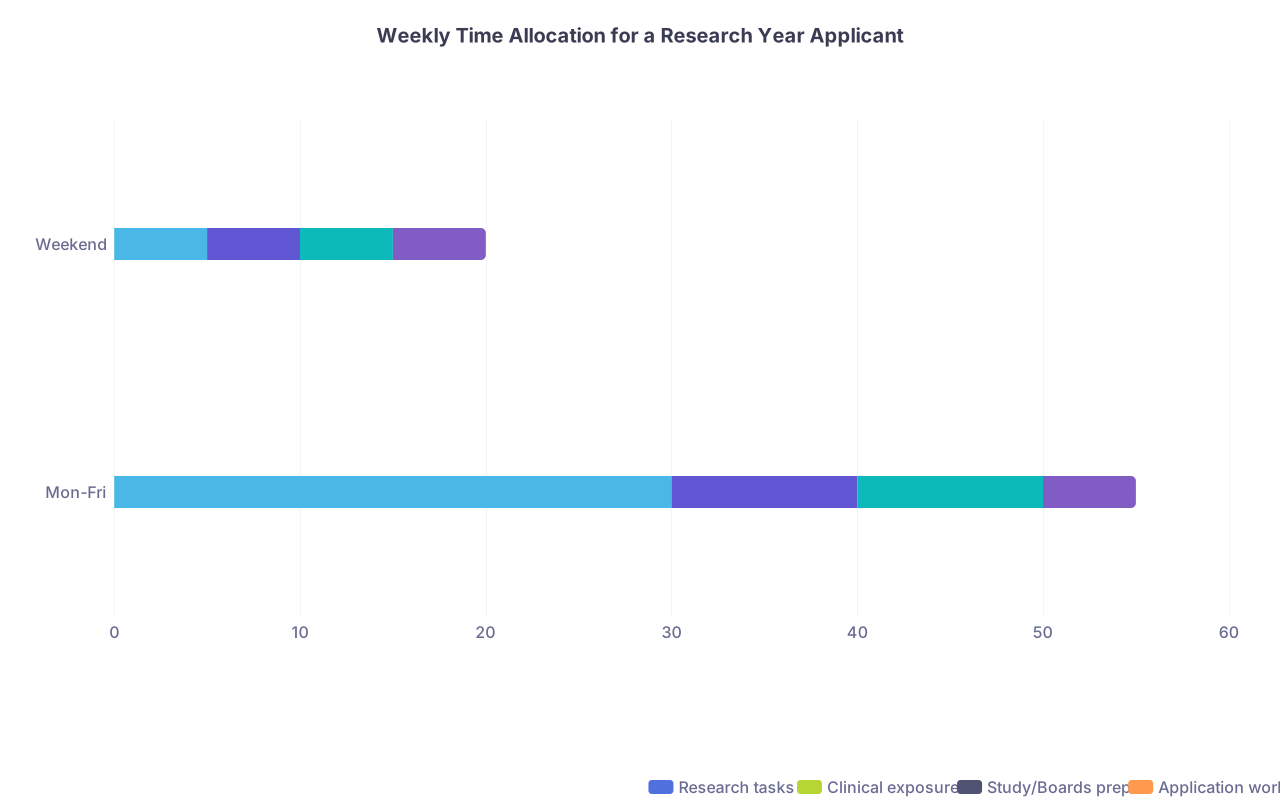
| Category | Research tasks | Clinical exposure | Study/Boards prep | Application work |
|---|---|---|---|---|
| Mon-Fri | 30 | 10 | 10 | 5 |
| Weekend | 5 | 5 | 5 | 5 |
This is a realistic split during a research year. If you are still in core rotations, re-balance, but the principle is the same: you must intentionally carve out time for:
- Board‑style questions and content review
- Research and tangible output
- Relationship building (mentors, letters)
- Application construction (personal statement, ERAS, program list)
You cannot just “see what happens.” Put this on a calendar and protect it.
10. The Mindset Shift You Actually Need
You are not trying to “overcome” a low Step score with motivational quotes. You are trying to build an application where programs say:
“Yes, the score is lower than we like. But look at everything else. This person has proven they can perform, and we will regret it if we pass.”
That requires you to stop treating your score like a fatal flaw or a moral failing. It is one data point. A bad one, yes. But still just one.
You fix this by:
- Taking radical responsibility: no excuses, only explanations + actions
- Being relentlessly coachable: ask for feedback, implement it, show improvement
- Playing the long game: research years, backup specialties, and non‑linear paths are not failures; they are strategy
Key Takeaways
- A low Step score does not automatically kill your chances at a competitive specialty, but it does force you into a more disciplined, higher‑effort path: research, standout clinical performance, and brutally realistic program lists.
- Your job is to make every other part of your application so strong that your score becomes the only obvious weakness, paired with clear, objective evidence that you have already fixed the underlying issues.
- Design a parallel backup plan from day one. Ambition is good; delusion is not. A smart salvage plan protects both your dream and your future.