Most people build backup specialties the wrong way—and accidentally weaken both their dream application and their safety net.
You are not going to “out-hustle” match statistics with vibes and hope. For competitive specialties (derm, ortho, plastics, ENT, neurosurg, ophtho, rad onc, integrated IR, etc.), you need a backup plan that:
- Does not poison your credibility in your dream field.
- Actually matches you somewhere you can live with.
- Can be executed with finite time, finite energy, and a very noisy 3rd/4th year.
Let me walk you through how to do that, step by step, like I would with a student in my office who just admitted they are “low-key terrified of not matching.”
Step 1: Accept the Brutal Math (Quietly, Not Dramatically)
First, you need to anchor in reality. Emotionally. Quietly.
For competitive specialties, “average” often means “does not match.”
If you are applying to:
- Dermatology
- Orthopedic surgery
- Neurosurgery
- Plastic surgery
- ENT
- Ophthalmology
- Integrated IR
- Rad Onc (yes, still volatile)
…then you must assume:
- Even solid applicants can go unmatched.
- Your “backup” is not optional. It is risk management.
Here is what I tell students when they ask, “Do I really need a backup?”
| Situation | Backup Needed? |
|---|---|
| Step 2 score below specialty mean | Yes |
| No home program in dream field | Yes |
| 0–1 strong letters from dream field | Yes |
| Red flags (LOA, failed course/board) | Yes |
| Non-US MD / DO for ultra-competitive | Yes |
If you are in 2+ of those boxes and you are still pretending “I’ll just apply broadly,” you are not being strategic. You are gambling.
Fine. Reality accepted. Now the fix: build a backup without broadcasting doubt to your dream specialty.
Step 2: Choose the Right Type of Backup (Not Just “What Is Less Competitive?”)
The worst backup plan is “I’ll just throw in some IM or prelims at the end.” That is not a plan. That is panic.
Your backup specialty needs to meet four criteria:
- You could actually tolerate doing it.
Not your parents. Not your classmates. You. Day in, day out. - It is realistically matchable with your current metrics.
No point backing up derm with another reach specialty. - There is a believable narrative bridge between dream and backup.
You need a story that makes sense to both sides. - It does not obviously signal to your dream field that you are “half in.”
Some combinations scream “I do not believe in myself.”
Common Strategic Pairings (That Actually Work)
| Dream Specialty | Common Strategic Backup |
|---|---|
| Dermatology | Internal Medicine, Pathology |
| Ortho / Neurosurg / Plastics | General Surgery |
| ENT | General Surgery, Internal Medicine |
| Ophthalmology | Internal Medicine, Neurology |
| Integrated IR | Diagnostic Radiology, Internal Medicine |
| Rad Onc | Internal Medicine |
This is not “these always go together.” It is “I have seen these pairings defended convincingly in real applications without setting off alarm bells.”
How to Test a Backup Choice in 30 Seconds
Ask yourself:
“If an attending from my dream specialty asked, ‘So why did you also apply to X?’—could I answer in one sentence that does not sound like I am hedging out of fear?”
Examples that work:
- Derm → IM: “My long-term interest is complex medical dermatology, and I enjoy longitudinal care; IM allows that path if dermatology residency does not work out.”
- Ortho → Gen Surg: “I want an operative career with high-acuity patients; general surgery would still allow me to work in a procedural, team-based environment.”
- IR → DR: “I am drawn to image-guided procedures, but I also really enjoy diagnostic imaging and multidisciplinary consult work, so DR is a natural fit as well.”
If your answer sounds like:
- “It is my backup.”
- “I just wanted to keep options open.”
- “My advisor told me to.”
Then you do not have a real backup narrative yet.
Step 3: Decide Your Application Strategy Early (Dual vs. Stacked)
There are only three sane structures for a dream + backup approach:
- Dual concurrent applications from the start.
- Primary dream, late add-on backup (stacked).
- Primary backup with a very narrow dream attempt.
Each has pros and cons.
1. Dual Concurrent Applications
You apply to both specialties in the same ERAS season from the start.
Best if:
- Your metrics are borderline for the dream field.
- Your letters/research overlap both fields reasonably.
- You have the bandwidth to handle more interviews and two narrative tracks.
Risks:
- If you are sloppy, both specialties see a weird, split identity.
- You must be meticulous with personal statements, program signaling, and interview answers.
Use this if: You are a realistic but not guaranteed candidate for your dream specialty.
2. Stacked Strategy (Dream First, Backup Late)
You start with a full-force dream application, then add backup applications:
- After interview offers are clearly low.
- Or after a pre-planned date (e.g., November 1) if certain metrics are not met (very few invites, bad feedback, etc.).
Best if:
- Your dream specialty is extremely competitive (derm, plastics, neurosurg).
- You want to avoid sending a split signal early.
- Your backup specialty is flexible with later applications and uses many prelim or categorical spots (IM, prelim surgery, TY).
Risks:
- You are betting that the backup specialty will still have interview space when you pivot. Some will. Some will not.
- Requires brutal honesty and a hard deadline to pivot—most people wait too long.
Use this if: You are higher risk but emotionally committed to giving the dream specialty a clean, focused shot.
3. Backup-Primary with Narrow Dream Attempt
You treat the backup as your primary application:
- Apply broadly and early.
- Dream specialty is applied to only a small set of programs where you have real leverage (home, strong away rotation, connections).
Best if:
- Your metrics are clearly below the usual range for the dream specialty.
- You are not willing to go unmatched just to “take a shot.”
- You still want to test the waters where your odds are not zero.
Risks:
- Your dream shot is very limited.
- You must accept that you are more likely to match backup, emotionally and practically.
Use this if: You are realistic about statistics and want security but cannot fully let go of the dream.
Step 4: Build Parallel Narratives That Do Not Contradict Each Other
Here is where people blow it.
They write one personal statement about “lifelong passion for dermatology since childhood eczema,” and another about “always knowing I was meant to be an internist.” Programs talk. Attendings move. Your statements may be seen by faculty in both fields.
You need one core story with two rational branches.
Core Story Exercise (Do Not Skip This)
Write this sentence:
“At baseline, I am someone who is drawn to _______ type of patients, _______ type of problems, and working in _______ type of teams.”
Examples:
- “High-acuity surgical patients; complex, anatomy-driven problems; tight, procedure-heavy OR teams.”
- “Chronic, multi-system patients; diagnostic puzzles; multidisciplinary inpatient and outpatient teams.”
- “Cancer patients; longitudinal, emotionally intense care; research-active academic teams.”
Now bridge that to both fields.
Example: Ortho (dream) + General Surgery (backup)
Core:
“I am drawn to high-acuity surgical patients, complex anatomy, and tightly coordinated OR teams.”
Ortho personal statement angle:
- Musculoskeletal pathology
- Restoring function, sports, trauma
- Ortho mentors, specific cases
Gen Surg personal statement angle:
- Broad operative exposure
- Critically ill patients, ICU, trauma
- General surgery mentors, complex abdominals, etc.
The emotional engine is the same. You like operating on sick people in teams. You are just pointing that engine at two slightly different roads.
That is how you avoid sounding like two completely different people.
Step 5: Letters and Rotations—How to Signal Without Sabotage
Letters and rotations are where your strategy either becomes believable or obviously desperate.
Step 5A: Rotation Planning
You cannot be everywhere. So you prioritize like this:
- Home + away in dream specialty (if available and high yield)
- One substantial experience in backup field that can yield:
- At least one strong letter
- A real understanding of the workday so you are not faking it on interviews
For a competitive dream field, a common pattern:
- 2–3 rotations in dream specialty (home + 1–2 aways).
- 1 rotation in backup specialty (4 weeks, taken seriously, ask for a letter).
If you only ever show up to your backup field for 2 days on a random elective and then ask for a letter, they will smell that.
Step 5B: Letter Distribution
For dual applications, a simple, functional mix:
- 2–3 letters from dream specialty
- 1–2 letters from backup specialty
- 1 from a core field (IM, surgery, etc.) if relevant
You then:
- Assign the field-specific letters appropriately in ERAS.
- Use shared “core” letters (e.g., IM attending praising your work ethic and clinical reasoning) for both sets.
If your backup specialty sees zero letters from their own field, they will either:
- Assume you are not serious.
- Or assume you panicked and added them late.
Neither is great.
Step 6: Research and CV Positioning
You do not have time to reinvent your CV for two fields. You also do not need to.
The trick is:
- Anchor your research and experiences around skills and themes that matter to both specialties.
- Then selectively emphasize different parts when talking to each field.
Example: Dream = Dermatology, Backup = Internal Medicine
You did:
- Derm research on autoimmune blistering diseases.
- IM rotation with interest in rheumatology.
To derm you say:
- “I am interested in complex medical dermatology and autoimmune disease; my research in blistering diseases built a foundation in immunology and multidisciplinary care.”
To IM you say:
- “I enjoy systemic autoimmune disease and complex diagnostics; my dermatology research taught me how systemic immunologic disease presents in the skin and how to work with rheum and derm jointly.”
Same activities. Different emphasis. No lying. Just framing.
If you truly have zero overlap (e.g., all your research is in ophtho and your backup is anesthesia), you do not hide that. You spin it:
- “My ophthalmology research taught me rigorous study design, meticulous chart review, and advanced imaging interpretation, which are transferable skills to complex perioperative care in anesthesia.”
Is that slightly stretched? Yes. Is it believable? Also yes—if you say it with a straight face and you actually know your own work.
Step 7: Interview Season—What to Say, What Not to Say
This is where students get cornered.
The Trap Questions
- “What other specialties did you apply to?”
- “If you matched here and in [other specialty], how would you decide?”
- “Why this specialty over [related specialty]?”
Rule #1: Never lie. They can and do find out.
Rule #2: Never volunteer more confusion than they asked for.
Practical Scripts
Scenario: Interview in dream specialty.
Q: “Are you applying to any other specialties?”
A: “Yes, I also applied to internal medicine programs. My primary goal is to match in dermatology, but given the competitiveness of the field, I felt it was responsible to apply in a related area where I could still work with complex medical patients and potentially pursue a derm-related fellowship.”
You:
- Acknowledge reality.
- Reaffirm dream specialty as primary.
- Tie backup to a coherent career path.
Scenario: Interview in backup specialty.
Q: “Did you apply to any other fields?”
A: “I did apply to dermatology as well. I am very interested in complex inflammatory disease and systemic medicine, and I see both dermatology and internal medicine as paths to that. That said, I am not treating internal medicine as a placeholder. The programs I applied to are ones where I could see myself training and building a career.”
You:
- Admit the dual application.
- Connect them with a shared disease interest.
- Explicitly state you could be happy there.
If the program director pushes:
“Which would you choose if you matched in both?”
You do not play coy. Say:
- “At this point, I would rank programs based on overall fit and training environment, not just specialty label. I know that is easy to say, but I committed to applying only to places I could genuinely attend.”
Is that a little political? Yes. But it is honest: by interview season, you should not be interviewing at places you would never attend.
Step 8: The Rank List—How Not to Torch Yourself
People overcomplicate this. You rank in the order of where you most want to train, assuming you must actually go there.
But with a backup plan, you need a rule set you commit to ahead of time.
A Rational Ranking Protocol
- List all your dream specialty programs top to bottom by where you would truly want to be.
- Draw a line where you think your odds become unrealistic based on:
- Interview vibe
- How many interviews you actually had in that specialty
- Your metrics vs historical data
- Below that line, start integrating your backup programs, again in true preference order.
Here is the key:
Do not auto-rank all dream programs above all backup programs if:
- Some dream programs gave you bad vibes,
- Or are in locations you would hate,
- Or are malignant.
Matching “the field” but hating your life is not winning. I have watched that play out. It is ugly.
You are not obligated to worship the dream specialty more than your own well-being.
Step 9: If You Go Unmatched—Use the Backup Intelligently
You did every step right and still went unmatched in your dream. It happens.
Your backup strategy now becomes:
- SOAP into backup or transitional/prelim positions.
- Or reapply with a shifted primary specialty next year.
If you did the work:
- You already have one rotation and letter in the backup area.
- You already have a narrative that links your interests.
- You can immediately pivot your energy to those programs without fabricating a new identity from scratch.
What you do not do:
- Panic-apply to 15 random specialties in SOAP with zero explanation or track record.
- Tell each field they are your “new dream” three hours after the match email.
Your prior dual strategy lets you pivot with some dignity and coherence.
Step 10: The Red-Line Checklist (If You Remember Nothing Else)
If you are applying to a competitive specialty and thinking about a backup, here is the condensed operational checklist.
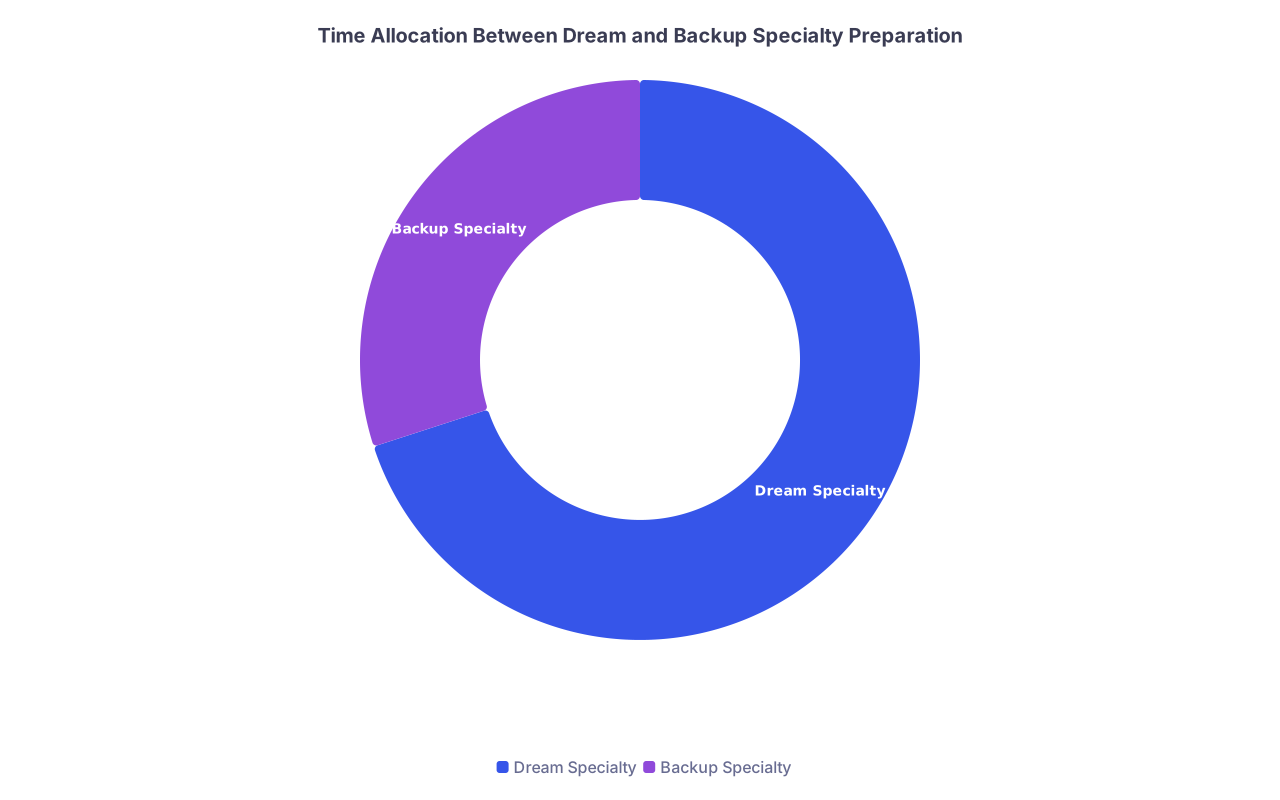
| Category | Value |
|---|---|
| Dream Specialty | 70 |
| Backup Specialty | 30 |
You aim for something like 70% of your energy to dream, 30% to backup—not 99/1 and not 50/50.
Minimum Viable Backup Plan
You should have, at minimum:
- 1 full rotation in backup field
- 1 strong backup-field letter
- 1 tailored backup personal statement
- A believable narrative linking both fields
- An explicit decision about:
- Dual-from-start vs stacked vs backup-primary
If any of those are zero, your backup is not real.
Visualizing Your Application Strategy
Here is how this process typically looks across MS3–MS4:
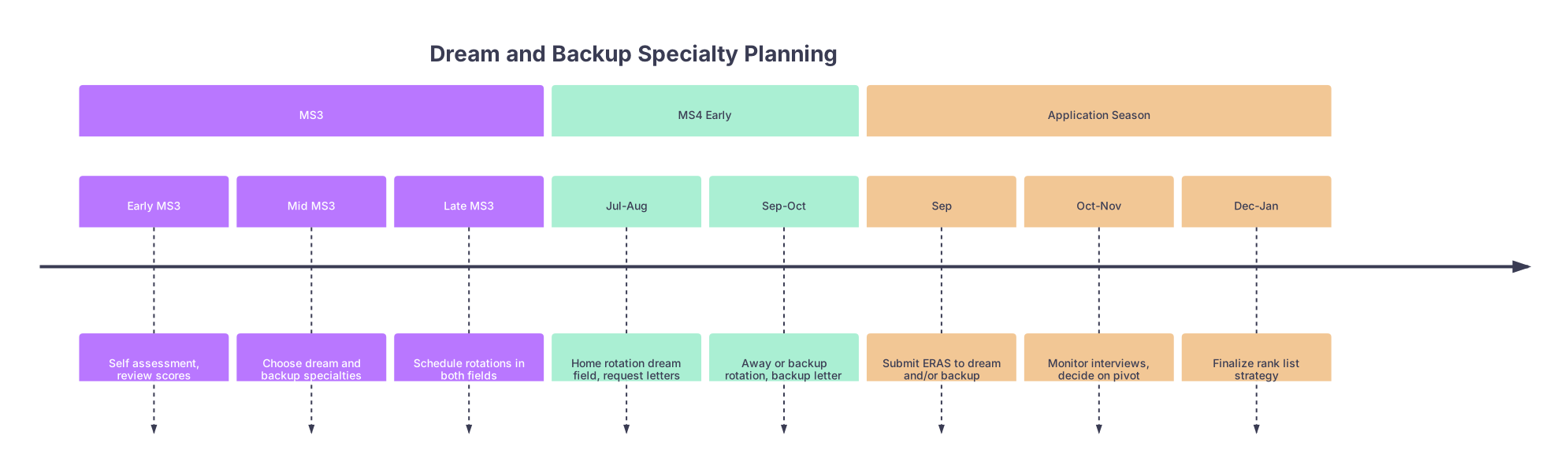
| Period | Event |
|---|---|
| MS3 - Early MS3 | Self assessment, review scores |
| MS3 - Mid MS3 | Choose dream and backup specialties |
| MS3 - Late MS3 | Schedule rotations in both fields |
| MS4 Early - Jul-Aug | Home rotation dream field, request letters |
| MS4 Early - Sep-Oct | Away or backup rotation, backup letter |
| Application Season - Sep | Submit ERAS to dream and/or backup |
| Application Season - Oct-Nov | Monitor interviews, decide on pivot |
| Application Season - Dec-Jan | Finalize rank list strategy |
Use that to sanity-check where you are and what you still need.
Example Scenarios (To Make This Concrete)
One more step: three quick real-world style examples.
Scenario 1: Slightly Below-Average Derm Applicant
- US MD, Step 2 just below derm mean, decent research, no home derm program.
Strategic plan:
- Dream: Dermatology
- Backup: Internal Medicine
- Strategy: Dual concurrent application
- Actions:
- Do 2 derm aways + 1 strong IM Sub-I
- 3 derm letters, 1 IM letter
- Two personal statements sharing interest in complex inflammatory disease
- Apply broadly in derm and robustly but not insanely in IM
- Rank by genuine preference, not by field alone
Scenario 2: Ortho Hopeful With Big Red Flag (Step 1 fail)
- US MD, strong clinical evals, one failed Step attempt, now good Step 2.
Strategic plan:
- Dream: Orthopedics
- Backup: General Surgery
- Strategy: Stacked (dream first, backup prepared)
- Actions:
- Home ortho rotation + 1 away.
- Early GS Sub-I, secure strong GS letter “just in case.”
- If ortho interviews < X by mid-November, trigger backup plan: send GS apps with pre-written PS.
- On interviews: honest about failure, heavy emphasis on resilience and improved performance.
Scenario 3: International Graduate Shooting for Neurosurgery
- Strong scores, some US clinical experience, but IMG.
Strategic plan:
- Dream: Neurosurgery (narrow, targeted list)
- Backup: Internal Medicine (broad)
- Strategy: Backup-primary with narrow dream attempt
- Actions:
- Treat IM as primary: early, broad, strong letters from US IM rotations.
- Neurosurg apps only to places where they have concrete connections or prior IMGs matched.
- Rank by true preference but fully accept that IM is the likely outcome and build a real IM career narrative.
One Last Thing: Protect Your Sanity
You are trying to hold two futures in your head at the same time. That is cognitively and emotionally expensive.
To keep it under control:
- Decide your overall strategy early (dual vs stacked vs backup-primary). Stop revisiting it every 48 hours.
- Build your narratives on shared themes (type of patients, problems, teams). That coherence will keep you from feeling “fake” in either interview.
- Set hard pivot points (date or interview-count thresholds) rather than winging it based on anxiety spikes.

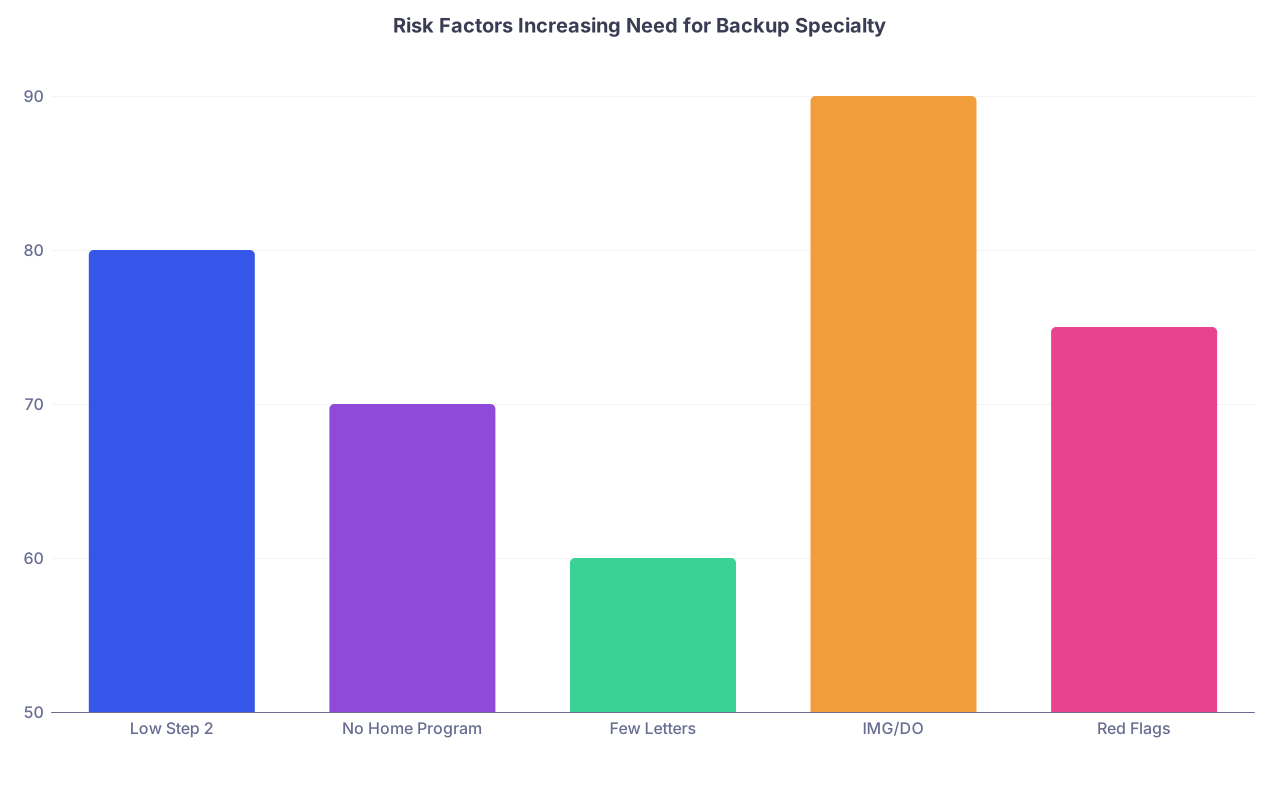
| Category | Value |
|---|---|
| Low Step 2 | 80 |
| No Home Program | 70 |
| Few Letters | 60 |
| IMG/DO | 90 |
| Red Flags | 75 |

Key Takeaways
- A real backup specialty is not a panic move; it is a structured plan with rotations, letters, and a coherent narrative that fits who you are.
- Your dream and backup should share an underlying theme—type of patients, problems, and teams—so you sound like one consistent person with two reasonable paths, not a different personality for each field.
- Decide your strategy (dual, stacked, or backup-primary), execute it deliberately, and rank in true preference order. Do that, and you dramatically cut your chances of an avoidable disaster without undercutting your shot at the dream match.