
The worst advice reapplicants in competitive specialties get is, “Just apply broadly and hope for the best.” That is how you waste another year.
You do not need hope. You need a tactical rebuild.
You went through a match cycle in a competitive field—derm, ortho, plastics, ENT, neurosurg, urology, integrated vascular, rad onc, maybe even EM in a brutal year—and you are now a reapplicant. That label can hurt you if you handle it passively. It can help you if you handle it correctly.
This is the playbook for that second path.
Step 1: Brutal Post‑Mortem Of Your Last Application
You cannot fix what you will not measure. Start with a hard, unsentimental audit of last cycle.
1. Collect the data
You need everything in front of you:
- ERAS application PDF from last cycle
- All personal statements and supplemental essays
- MSPE (Dean’s Letter) and transcript
- Letters of recommendation (at least who wrote them, what year, and what they were used for)
- List of programs you applied to, interview invites, rejections, and ghosting
- USMLE/COMLEX scores, attempt history, and dates
- Any away rotations / audition electives and how they went
Now you turn that into a diagnostic.
| Factor | Derm (approx) | Ortho | ENT | Plastics |
|---|---|---|---|---|
| Step 2 avg | 250+ | 245+ | 250+ | 250+ |
| Research items | 10–20+ | 5–15+ | 5–15 | 10–20+ |
| AOA/Top quartile | Strong plus | Strong | Strong | Strong |
| Home/away evals | Critical | Critical | Critical | Critical |
These are not hard cutoffs. They are reality checks.
2. Identify where you actually lost
Be honest. You did not “just have bad luck.” Programs are not rolling dice. They filtered you out somewhere in the pipeline:
Screening failure
- Low Step/COMLEX for the field.
- Red flags: failures, professionalism issues, major gaps.
- No home program or weak institutional reputation without compensating strengths.
- Lack of signal: few or no field‑specific letters, weak research, no away rotations.
Application content failure
- Generic personal statement (“I love the continuity of care and the procedures…” – I have seen that line 200+ times).
- CV looked flat next to peers: no depth in your chosen field.
- Poorly curated experiences. Everything listed, nothing highlighted.
- Letters from people who barely know you or are outside the specialty.
Interview failure
- Looked good on paper; did not convert interviews to ranks.
- Behavioral misfires: defensive about being a reapplicant, weak “Why this specialty?” or “Plan B?” answers.
- Fit issues: came off as disinterested, arrogant, or awkward.
Your mission right now: categorize your situation.
- If you had 0–2 interviews → your problem is largely screening + application content.
- If you had several interviews but no match → your problem is interview performance + rank strategy.
- If you had no interviews at realistic programs for your stats → you chose targets badly or lacked necessary signals.
Write down, in one paragraph, your honest diagnosis. No excuses. That paragraph will guide your rebuild.
Step 2: Choose Your Strategic Path – Stay, Pivot, or Hybrid
Reapplicants in competitive fields often make the wrong big decision. They either stubbornly reapply without change, or they panic and abandon the field they care about.
You have three rational options.
Option A: Full recommit to the competitive specialty
You choose this if:
- Your scores are within shouting distance of typical matched applicants (even if not stellar).
- You had some interest last cycle—maybe fewer interviews than you wanted, but not zero from realistic programs.
- You are willing to sacrifice a year (research, prelim, extra rotations) to build a truly competitive application.
In this route, you are not “trying again.” You are restructuring your life for 12–24 months to become an obviously better candidate.
Option B: Pivot to a less competitive field
You choose this if:
- Your board scores, transcript, or red flags make matching in that competitive specialty extremely unlikely, even with another year.
- You have a genuine interest in another specialty that you can articulate without sounding like you are settling.
- You cannot afford another risky cycle (financially, emotionally, or in terms of visa/timeline constraints).
Here, you still need a rebuild. Just in a different direction.
Option C: Hybrid plan (competitive field + safety field)
This is the messy one. For example:
- Reapplying ortho + also applying prelim surgery and categorical IM
- Reapplying ENT + also applying categorical gen surg
- Reapplying derm + also applying IM with a derm-heavy narrative
Hybrid approaches can work, but only if you do not look like you have no idea what you want.
If you do hybrid, you must:
- Have two distinct personal statements targeting each path.
- Tailor experiences and letters appropriately.
- Be ready to explain your thinking without sounding like you are giving the backup field second‑class treatment.
My bias: If your competitive specialty chances are truly single‑digit percent, commit to a pivot. Half‑committed people underperform in both lanes.
Step 3: Core Rebuild Pillars (Next 12–18 Months)
This is where you stop “being a reapplicant” and start being a stronger applicant. Different mindset.
There are four pillars:
- Competitive metrics (scores, transcript, failures addressed)
- Specialty‑specific credibility (research, rotations, letters)
- Narrative coherence (why this specialty, why now, why you)
- Professional growth and maturity (how you used the off‑cycle year)
Pillar 1: Fix the metrics you can fix
You cannot change Step 1 to pass/fail or a previous score. You can fix what is still open.
Step 2 CK / COMLEX 2
- If you have not taken it and you are in a competitive field, your target is not “pass.” Your target is “strengthen my narrative.”
- If you scored below average for your field, strongly consider:
- Dedicated retake (if allowed) or
- Crushing your in‑training exam (if in a prelim) and having attendings mention this in letters.
Clerkship and sub‑I performance
- If your grade profile is weak, you do not fix it with one rotation. But you can build recent A‑level feedback in your chosen field, especially on sub‑Is and aways.
- Ask explicitly for narrative comments you can reuse: “One of the hardest‑working students I have worked with in 10 years,” etc.
Red flags
- Failures, LOA, professionalism issues. These must be acknowledged, reframed, and followed by clean, strong performance.
- You need a clear, concise explanation and at least one letter writer explicitly vouching for your reliability now.
You do not need perfection. You need a trajectory that clearly slopes upward.
Pillar 2: Build undeniable specialty‑specific credibility
In competitive fields, “interest” is cheap. Everyone “loves” the field. Programs look for proof.
Here is how you build it during your rebuild year.
A. Research that actually helps
Stop chasing random PubMed entries that have nothing to do with your target specialty. Depth beats scatter.
You want:
- Projects within your specialty or closely related (e.g., ortho + sports med, ENT + head and neck, derm + rheum overlap).
- A mix of quick‑win outputs (case reports, chart reviews, review articles) and at least one longer‑term project (prospective study, QI, or multi‑center project).
Target metrics that actually move the needle in competitive fields:
- 3–5 new field‑relevant activities (posters, abstracts, papers) this year
- Ideally at least one presentation (local, regional, or national) where you are first author or presenter
- Evidence of sustained involvement (monthly lab meetings, regular data work, manuscript contributions)
Where to find these:
- Your home department’s research director
- Cold email faculty in your specialty (attach CV, Step scores, and a 3–4 line pitch)
- National societies’ resident/fellow sections—many have open projects desperate for manpower
If you are an IMG or at a school without your specialty, a formal research fellowship can be huge. Yes, that means a year or two in a research track. It is often the only realistic path into derm, plastics, or ortho from a disadvantaged starting point.
B. Clinical presence in the field
You need people in the specialty who will say, “We know this person well. They will be good in our field.”
Away rotations / audition electives
- You are no longer random. You are the reapplicant who chose to come back and prove something.
- Show up early. Pre‑round hard. Be the first to volunteer for scut that helps the team.
- You are playing for two things: a letter and a reputation.
Post‑match clinical job
- If you did not get a prelim or TY, work as:
- Clinical research coordinator in the specialty
- Medical assistant / scribe in a specialty clinic
- Hospitalist extender roles in internal medicine if pivoting there
- Programs respect someone who stayed clinically engaged instead of disappearing.
- If you did not get a prelim or TY, work as:
Letters matter more than you think. A strong, specific letter from a known faculty member in your field beats an extra two PubMed IDs every time.
Pillar 3: Build a coherent, upgraded narrative
Reapplicants often sabotage themselves here. They keep the same bland story, slap “I learned a lot from not matching” into one paragraph, and hope no one notices.
That is lazy. And obvious.
You need a new narrative that does three things:
- Owns the failed match cycle without self‑pity.
- Shows concrete growth (skills, insight, maturity).
- Makes your continued interest in the specialty seem more credible, not less.
Your narrative spine
Answer these in writing:
- What actually went wrong last cycle, in one or two sentences, without blaming the system?
- What did you do in the 12–18 months after not matching that proves you are not the same applicant?
- Why this specialty, specifically, after knowing exactly how hard it is to get in?
- What do attendings in this field actually say about working with you now?
You fold those answers into:
Personal statement (reapplicant version)
- First half: your authentic connection to the specialty, with 1–2 specific clinical stories. No fluff.
- One short, precise paragraph on being a reapplicant:
- “I applied to [specialty] previously and did not match. My application was limited by [brief reason—no more than 2 factors]. Over the past year, I have [specific actions + outcomes]. These experiences confirmed for me that [specialty] is the right field for me and strengthened the skills I will bring as a resident.”
- Last part: what you will contribute to a program now.
Interview framing
- You do not open with “So, I did not match last year.”
- When asked about it, you respond calmly and precisely because you have rehearsed it 20 times. You emphasize growth, not grievance.
You are not “explaining a failure.” You are showing judgment and resilience.
Pillar 4: Demonstrate professional growth
Every PD is asking themselves one core question about a reapplicant:
“What did they do with the year they did not match?”
The wrong answers:
- Traveled.
- “Took time to reflect” with no concrete output.
- Completely unrelated non‑clinical jobs without a story that ties back.
The right answers look like:
- Research fellowship with concrete outputs.
- Prelim or TY year where you have glowing evaluations and strong letters.
- Clinical role (scribe, coordinator, MA) closely tied to your specialty or your pivot specialty.
- Significant leadership or teaching roles that produced something visible (new curriculum, QI project, protocol, peer‑reviewed work).
You want your CV to make a PD think: “They took a hit and came back stronger. That is exactly the kind of resilience we need.”
Step 4: Tactical Program Targeting For Reapplicants
Now we talk about where you actually send your application. This is where many reapplicants quietly tank themselves.
1. Reset your expectations using real data
Look at your actual profile versus matched data.
- Use NRMP Charting Outcomes + specialty‑specific match guides.
- Talk to a faculty mentor who is blunt, not just nice.
- Compare your metrics (scores, research, school type, AOA, red flags) to people who matched into your target last year.
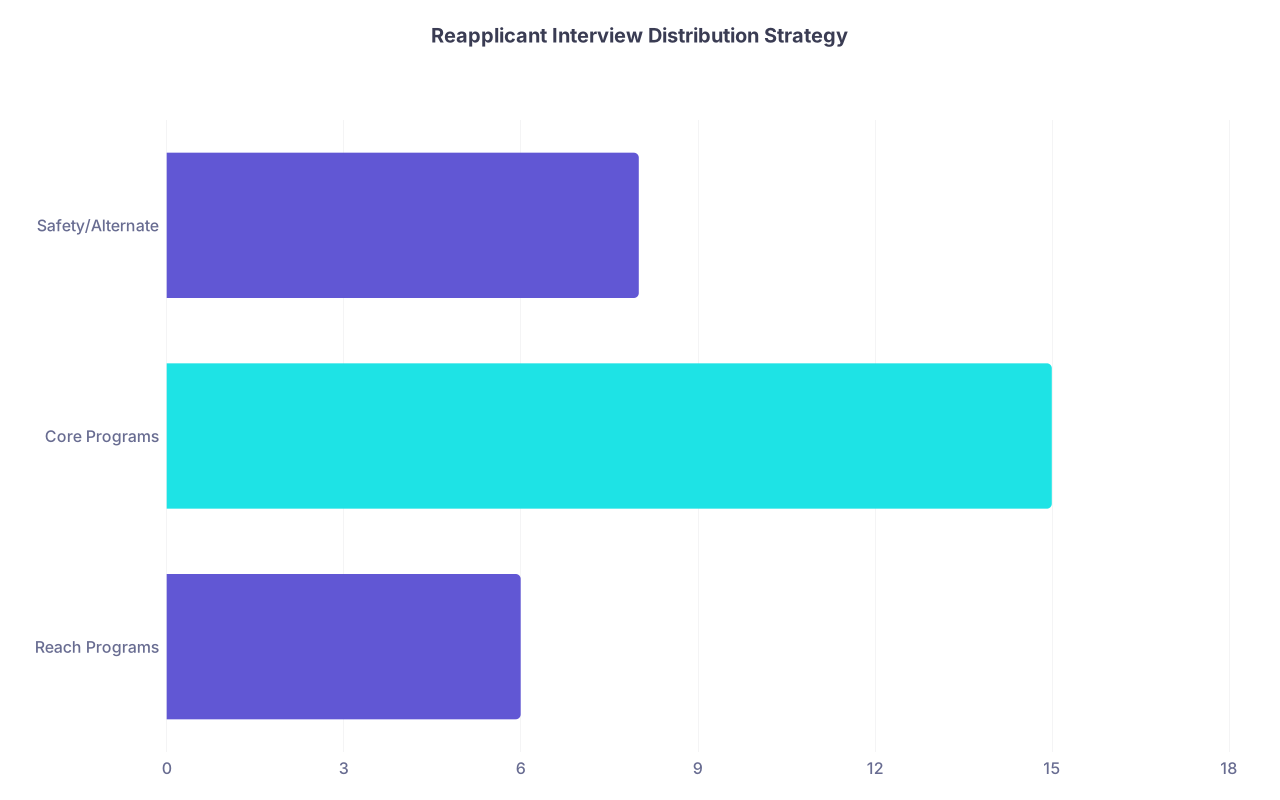
You need three program tiers:
- Reach – top programs or very competitive locations, where you are now at least plausible, not purely aspirational.
- Core – realistic matches where your metrics are within or near the middle of their usual range.
- Safety/alternate – prelims, TYs, or alternative specialty programs that match your pivot strategy.
| Category | Value |
|---|---|
| Reach Programs | 6 |
| Core Programs | 15 |
| Safety/Alternate | 8 |
You aim for a distribution like that for interviews, not just applications. If all your interviews are “reach,” you are in trouble.
2. Identify reapplicant‑friendly environments
Some programs genuinely give reapplicants a chance, especially if:
- You have strong new letters from people they know.
- Your research year was at their institution or a peer institution.
- You rotated there and knocked it out of the park.
Your best bets:
- Programs where you did:
- A research fellowship
- An away rotation
- A prelim year
- Mid‑tier academic and strong community programs that are more interested in work ethic and team fit than pure Step‑score flexing.
Be realistic about geographic preference. If you are a reapplicant in ENT, derm, ortho, etc., and you insist on matching only in California or NYC, you are intentionally lowering your odds.
Step 5: Rebuilding Your Letters – The Quiet Make‑or‑Break
Letters can rescue a reapplicant application. Or sink it quietly.
You need to upgrade three things:
- Who writes
- What they say
- How recent they are
Who should write
Ideal letter stack for a competitive field reapplicant:
- 2–3 letters from faculty in the specialty (or very closely related field)
- At least one from someone who has supervised you this year
- For prelim/TY routes: a letter from your current PD or chief who can vouch for your clinical performance and professionalism
If your previous letters were generic or lukewarm, retire them. A mediocre letter from a “big name” is worse than a strong letter from a mid‑level faculty who actually knows you.
What they should say
You cannot script their letter, but you can influence it by what you give them and how you work.
You want them to hit:
- Concrete evidence of improvement since last year
- Comparison to peers (“top 10% of residents/students I have worked with”)
- Specific strengths relevant to the specialty (technical skills, clinic efficiency, ownership of patients)
When you request a letter, ask directly:
“Do you feel you can write me a strong letter for [specialty] residency as a reapplicant?”
If they hesitate, you thank them and ask someone else. That hesitation is your warning.
Step 6: Fix Your Interview Game (If You Got Interviews But Did Not Match)
If your interview‑to‑rank conversion was poor last time, you cannot ignore this.
Common problems I see:
- Long, rambling answers.
- Defensive attitude about being a reapplicant or about red flags.
- Weak “why this specialty” answers that sound generic or rehearsed.
- No thoughtful questions for programs; you look like you are just collecting invitations.
Concrete fixes
Record yourself answering:
- “Tell me about yourself.”
- “Why [specialty]?”
- “Why did you not match last year and what have you done since?”
- “Tell me about a time you failed.”
- “What will you do if you do not match again?”
Watch the recordings with:
- A brutally honest friend,
- A senior resident in the field, or
- Faculty who will not sugarcoat it.
Tighten your answers:
- 60–90 seconds max for most questions.
- One clear structure: situation → action → result → what you learned.
Practice your reapplicant story until it is:
- Matter‑of‑fact
- Non‑defensive
- Focused on growth, not blame
You want them thinking, “This person has taken a hit, learned from it, and is more mature for it.”
Step 7: Match‑Week Contingency Planning (If It Happens Again)
You plan as if you will match. You prepare as if you might not. That is not pessimism. That is professionalism.

| Step | Description |
|---|---|
| Step 1 | Post match failure |
| Step 2 | Diagnostic review |
| Step 3 | Research or prelim year |
| Step 4 | Pivot specialty |
| Step 5 | Rebuild metrics and letters |
| Step 6 | Targeted reapplication |
| Step 7 | Start residency |
| Step 8 | SOAP and backup plan |
| Step 9 | Stay in field? |
| Step 10 | Matched? |
If you do not match again:
Be fully ready for SOAP:
- CV and personal statements for your backup specialty already drafted.
- Mentors on standby who know they may need to make calls or send emails.
- Realistic list of fields and programs you would accept if offered a spot.
Know your lines in the sand:
- Are you willing to take any prelim or TY to stay clinically active?
- Would you rather take another research year than a prelim in a specialty you hate?
- How many cycles are you willing to spend chasing this specific competitive field?
This is not about pessimism. It is about not panicking when the screen says, “We are sorry, you did not match to any position.”
Quick Reality Check: When To Walk Away From A Competitive Field
Someone needs to say this out loud.
If all of these are true:
- Your board scores are well below typical matched applicants in your field,
- You have restructured your life for at least one full extra year with focused research and clinical work,
- You still generate either no interviews or only low‑probability interviews,
- And the thought of pivoting to a related field (IM, gen surg, anesthesia, etc.) does not fill you with dread,
Then yes, it might be time to move on. That is not “giving up.” That is choosing to practice medicine in a way that is sustainable.
Better to be an outstanding internist, surgeon, anesthesiologist, or hospitalist who likes their life than a three‑time reapplicant clinging to a fantasy.
Final Snapshot: Your Tactical Rebuild Checklist
In one page, what you are doing this year should look like:
- Clear decision: recommit to [specialty] / pivot / hybrid
- Measurable upgrades:
- New research: [X posters, Y papers, Z ongoing projects]
- New clinical experiences: [prelim/TY, aways, clinic roles]
- New letters: [at least 2 specialty‑specific, 1 reflecting this year]
- Clean story:
- One crisp paragraph explaining last year
- One page that shows how you used this year to become better
- Targeted strategy:
- Realistic program list, updated for this cycle
- Interview practice cut‑throat enough that you actually improve
Reapplicants do match into derm, ortho, ENT, plastics, neurosurg—every year. The ones who make it do not “try again.” They rebuild strategically.
FAQs
1. Should I tell programs outright that I am a reapplicant?
Yes. They will see it anyway. Own it briefly in your personal statement and discuss it calmly if asked. The key is to pair that fact with clear evidence of growth in the intervening year—new letters, research, stronger clinical performance.
2. Is a research year or a prelim year better for a reapplicant in a competitive field?
It depends on your specific deficit. If your biggest gap is specialty‑specific research and visibility, a research year with strong mentorship can be powerful. If your gap is clinical performance, professionalism concerns, or lack of U.S. clinical experience, a well‑done prelim/TY with glowing evaluations may help more. Many successful reapplicants do one of each over two years.
3. How many times is it reasonable to reapply to a competitive specialty?
For most people, one serious, well‑planned reapplication is the limit. A second reapplication (third total attempt) is rarely successful unless something dramatic has changed (e.g., major research productivity at a top institution and strong inside letters). After one focused rebuild cycle without success, you should seriously consider a pivot or a different long‑term plan.