
You decided late. The specialty is competitive. That is not a death sentence. It just means you cannot afford a sloppy plan.
A late pivot into a competitive specialty is not about “following your passion.” It is about constructing, fast, a version of yourself that programs in that field recognize as one of their own. That is a very specific, practical task. And there is a way to do it.
Below is the playbook I would walk you through in my office, whiteboard out, with your ERAS or CaRMS timeline on the wall and your transcript on the desk.
1. Get Honest: How Late Are You, Really?
Before you start running, you need to know your starting line. “Late” means something very different as an MS2 than as a PGY-1.
A. Define Your Timeline
Use this as a rough classification:
| Stage | How Late Are You? | Reality Check Priority |
|---|---|---|
| Preclinical (MS1–early MS2) | Not really late | Build foundation |
| Early clinical (first 2-3 clerkships) | Mildly late | Aggressive planning |
| End of clerkship / MS4 start | Truly late | All-out pivot |
| During/intern year | Very late | Parallel plans needed |
| After unmatched attempt | Critical | Risk control first |
The later you truly are, the more you must:
- Narrow target programs.
- Accept geographic constraints or less “prestigious” names.
- Build a parallel safety path (prelim/TY, backup specialty).
B. Brutal Self-Assessment
You cannot pivot intelligently if you lie to yourself about your stats.
You need:
- Step 1 / Level 1 (if applicable)
- Step 2 CK / Level 2
- Clinical grades (especially in core rotations)
- Any prior specialty signals (research, interest, mentorship)
Score ranges matter. Programs will not say this on their websites, but their behavior is consistent.
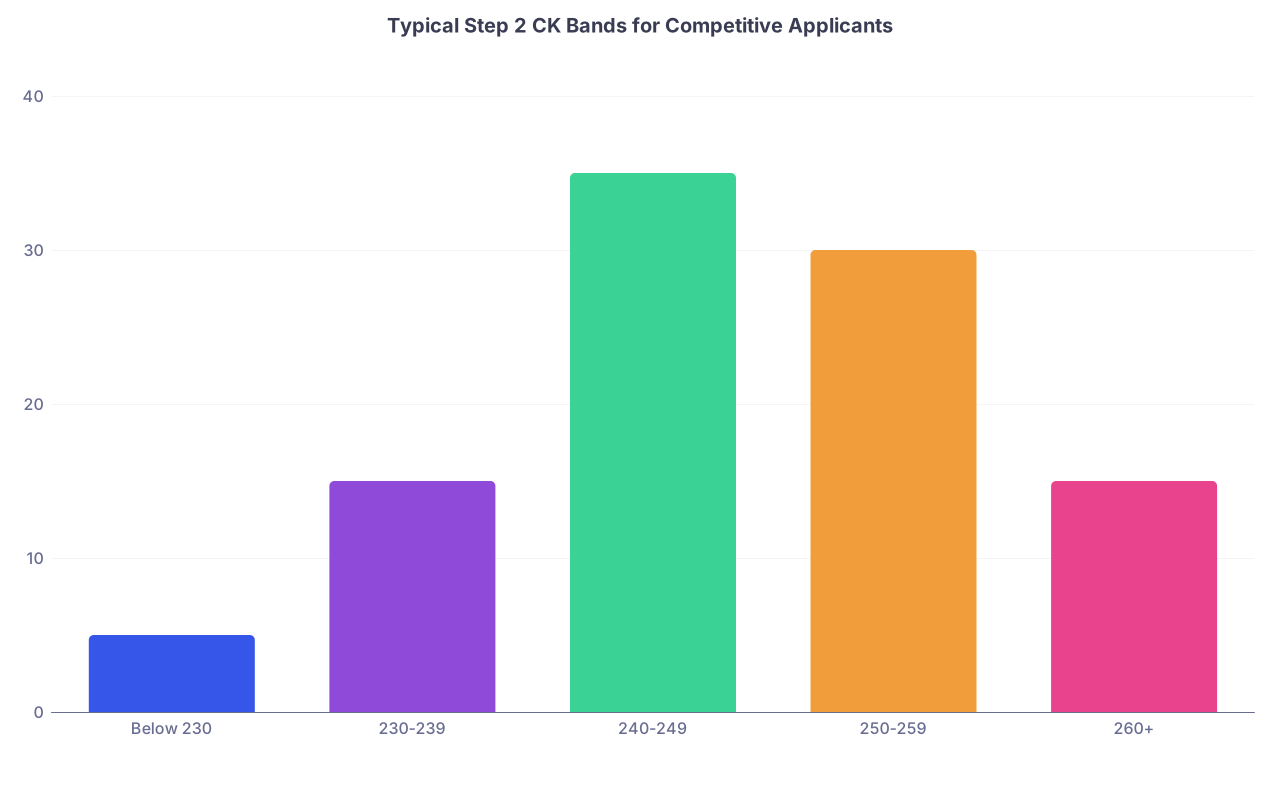
| Category | Value |
|---|---|
| Below 230 | 5 |
| 230-239 | 15 |
| 240-249 | 35 |
| 250-259 | 30 |
| 260+ | 15 |
Interpretation (broad strokes):
- Below 230: You need an almost perfect story, strong connections, and a realistic backup plan.
- 230–239: You are viable mainly at mid/lower tier or home/regional programs if everything else is strong.
- 240–249: Solid for most programs if the narrative and experiences are aligned.
- 250+: You have more room for mistakes, but a late pivot still requires discipline.
You also need to understand the specialty’s competitiveness. Dermatology, plastic surgery, neurosurgery, ENT, ortho, integrated vascular, radiation oncology (less popular now but still insular), and some fellowships (GI, cardiology) are in a different league than, say, community internal medicine.
If you are late and targeting a top-10 derm program with a 236 and no derm research? That is fantasy. You can still do dermatology. Just not that way.
2. Decide the Exact Target: No Vague Goals
“Competitive specialty” is useless as a goal. You must define:
- Which specialty.
- Which tier of programs look remotely realistic.
- Which geography you are willing to accept.
- Whether you will accept an indirect route (prelim, different primary specialty then fellowship).
A. Get Program-Level Reality
Pick 10–15 specific programs and dissect them:
- Look at resident bios.
- Count how many have:
- Home med school match.
- Multiple publications in the field.
- Research years.
- Honors/AOA/Gold Humanism.
- Note how often they take:
- DOs.
- IMGs.
- People without a PhD or T32-level research.
If 80% of their residents have 10+ publications and a dedicated research year, and you have zero publications and are 8 months from ERAS? Stop fantasizing. Shift your focus to programs whose residents look like you could plausibly become in a year.
3. Clarify Your Story in 1 Page
You need a coherent, fast, believable narrative for why you are pivoting now. Not three paragraphs of fluff.
Write this down (even if rough):
- What you thought you wanted before.
- What you saw, did, or realized that changed direction.
- What you have already done that clearly aligns with the new specialty.
- What you are doing right now to prove commitment.
- Where you want to go within that field (rough sub-interest, type of practice).
This is not for your personal statement yet. This is your internal script. It must pass the “attending eye-roll test.” If it sounds like:
“I love teamwork and continuity of care and procedures and critical thinking…”
That is wallpaper. You need specific, grounded reasons: types of patients, disease processes, procedural profile, acuity level, lifestyle reality you have seen first-hand.
4. Build a 6–12 Month Pivot Plan (Compressed)
Now we build the actual playbook. This is the part nobody sits down and organizes for you.
A. The Four Pillars of a Late Pivot
You are racing the clock on four fronts:
- Relationships – Mentors, sponsors, letter writers.
- Exposure – Rotations, electives, sub-Is, away rotations.
- Signal – Research, QI, presentations, conference abstract, any field-specific footprint.
- Application optics – Personal statement, CV structure, LOR mix, no mixed-signal chaos.
You cannot do everything perfectly. You need enough in each pillar to cross the threshold where a program says, “Yes, this person belongs in our pile.”
B. Condensed Timeline Blueprint
Assume you are ~9–12 months from applying.

If you have less time, you do the same things, just more ruthlessly prioritized.
5. Relationships: Your Single Biggest Lever
A late pivot without strong advocates is basically gambling. The fastest way to gain ground is to get real people, in that specialty, to care about your outcome.
A. Identify the Right People
You want:
- 1 program director or associate PD (APD) in the field.
- 1–2 respected faculty who are known as “people developers” rather than pure researchers.
- 1 junior faculty or senior resident who remembers exactly what this struggle feels like.
Find them by:
- Asking older students / residents who is actually invested in mentoring.
- Looking at who supervises the subI/elective.
- Seeing who regularly appears on residents’ mentorship acknowledgments in posters/papers.
B. How to Approach Without Wasting Their Time
Send a direct, concise email:
- 3–4 sentences.
- Attach CV.
- Ask for a 20-minute meeting.
Structure:
- Who you are / year / school.
- Your prior trajectory in one line.
- Your current interest in [specialty], recent clinical experiences that triggered this.
- What you want: advice on making a late but serious pivot, and whether it is realistic at your institution.
Then you show up prepared:
- Bring a printed CV with annotations for field-relevant things.
- Have 3 questions written down:
- “Given my timeline and stats, what level of programs should I realistically target?”
- “What specific experiences at this institution would carry the most weight (subI, research, QI)?”
- “What would you do in my position over the next 6 months?”
Then shut up and write things down. People take you seriously when you treat their advice like it matters.
C. Turn Faculty into Sponsors
You are not just looking for “mentors.” You need sponsors. People who will:
- Email colleagues at other programs.
- Bring your name up in rank meetings.
- Push through a project so you have something to point to.
How to earn that:
- Perform at a very high level on their rotation. Show up early, stay late, do the annoying work.
- Follow through with absurd reliability: if you say “I will send you a draft by Friday,” you send it by Thursday.
- Make their life easier. Help with data, literature searches, teaching slides.
Programs notice when Dr. X emails and says, “This student turned things around late, but I would absolutely take them in my program.”
6. Exposure: Stack the Right Rotations
You cannot pivot into a specialty if nobody in that field has ever seen you function.
A. Must-Have Rotations
For a genuine late pivot into a competitive field, aim for:
- 1 core sub-internship / acting internship in that specialty at your home institution.
- 1 away rotation at a realistic program in a region you would actually attend.
If you are even later, prioritize:
- Home subI in your target field.
- Away at a program likely to rank you highly (not just famous).
The away rotation is not tourism. It is a month-long interview.
B. How to Behave on a High-Stakes Rotation
You are being graded on three main axes:
- Work ethic and reliability – Are you where you should be, early, ready?
- Team fit – Do residents like working with you, or are you exhausting?
- Baseline competence – You do not need to be perfect technically, but you must be safe, prepared, and improving.
Specific tactics:
- Learn the resident’s names on day one. Ask how they like students to help.
- Volunteer for the boring tasks: pre-round labs, discharge summaries, patient education.
- Prepare one short, well-structured presentation during the month.
- Ask for mid-rotation feedback and then actually change something based on it.
At the end, if things went well, explicitly ask:
“Would you feel comfortable writing me a strong letter for [specialty]?”
You want “absolutely,” not “sure.”
7. Signal: Minimal Viable Research Footprint
No, you are not going to crank out five first-author publications in 8 months. But you also cannot have zero.
The goal is to show:
- You can work as part of a scholarly team.
- You care enough about the field to invest beyond the rotation.
- You have at least one tangible product (abstract, poster, publication) with your name on it in that specialty.
A. Choose Fast-Cycle Projects
Prioritize:
- Case reports and case series (if the field values them).
- Retrospective chart reviews that are already running.
- Joining existing projects at the data or writing stage.
- Quality improvement projects with clear timelines.
Avoid:
- Basic science starting from scratch.
- Massive multi-year RCTs where you are the 12th author and nothing publishes for 3 years.
When you meet with a potential research mentor, ask:
- “What project are you working on that is most likely to yield a submission in the next 6–9 months?”
- “Where could I plug in so that my contribution is meaningful and time-bounded?”
You are not trying to become a world expert in 6 months. You are sending a clear signal of commitment and capability.
8. Application Optics: Clean Up the Mixed Signals
A late pivot applicant often looks schizophrenic on paper: 2 years of neurosurgery research, then suddenly asking for radiology. You must tame that.
A. Reframe Your CV
- Field-specific experiences at the top.
- Translatable skills right under them.
- Old specialty-specific things that do not help you? Do not erase them, but downplay or reframe.
Example: You were deep into surgery, now pivoting to anesthesia.
- “Sub-internship in General Surgery” becomes an asset: heavy OR exposure, perioperative management.
- Emphasize overlaps: hemodynamics, airway issues, ICU time.
What you do not do is leave a giant section titled “Career in Orthopedic Surgery – 3 Years of Research” when you are now applying to radiology. That just shouts “I am rebounding.”
B. Personal Statement: One Clear Angle
You do not have time for philosophical essays. Your statement needs to:
Explain your pivot in 2–4 honest, tight sentences.
- “I entered medical school convinced I would pursue X. On my [rotation/specific patient], I was struck by Y.”
Show what you have done in the last 6–12 months to align with the field.
- Concrete: rotations, projects, conferences, mentors.
Tie your previous path into this new one, instead of pretending it never existed.
- “My time in [prior area] gave me an appreciation for [skills] that I now bring to [target specialty].”
One page. No literary acrobatics.
C. Letters: The Right Mix
For a competitive field with a late pivot, your ideal mix:
- 2 letters from faculty in the new specialty (including at least one from a subI/away).
- 1 letter from someone who has known you longer, even in another field, who can attest to your work ethic and growth.
- Optional: 1 research letter if the project was significant and recent.
Avoid relying on:
- Letters from totally unrelated specialties.
- Old letters that pre-date your pivot and clearly talk about a different career plan.
9. Program Strategy: Do Not Apply Randomly
Spraying 80 applications at every famous program in the country is how you end up poor and unmatched.
You need three tiers:
- Reach – A few dream programs where you are slightly below their usual profile but have a hook (home program, strong letter writer connection, regional tie).
- Core realistic – Where your stats and profile match their typical residents.
- Safety / indirect route – Programs in less desired locations, small academic/community hybrids, prelim positions, or a related but less competitive primary specialty.
| Tier | Program Type | Approx % of List |
|---|---|---|
| Reach | Big-name academic centers | 10–20% |
| Core realistic | Regional academic, strong community | 50–60% |
| Safety/Indirect | Less popular locations, prelim/TY, backup specialty | 20–30% |
Your mentor or PD should look at your draft list and mark:
- “No realistic shot.”
- “Reasonable.”
- “Strong shot.”
Adjust accordingly.
10. Parallel Plan: Protect Yourself
For very competitive specialties with a late start, you are playing with non-trivial risk. Pretending otherwise is irresponsible.
You need a parallel plan tailored to your situation:
- Prelim/TY + re-apply – For surgical fields, anesthesiology, radiology, this can work if you are willing to grind during intern year.
- Different primary specialty then fellowship – Example: Internal Medicine → Cardiology instead of straight categorical Cardiology (if it existed), or IM → GI instead of early GI attempts.
- Recalibrated target specialty – Moving from derm to medicine with strong procedural track and clinic, or from ortho to PM&R with sports focus.
The key is to decide this before you apply, not in the panic after an unmatched email.
11. If You Are an IMG/DO and Late
Your margin for error is slimmer. But the principles are the same, just with more emphasis on:
- Home institution rotations where they actually match IMGs/DOs into that field.
- Geographically clustered applications where your visa/residency status is common.
- Programs known to take your school’s graduates into that specialty.
You must be even more pointed with your relationships and exposure. Cold applications without strong institutional ties for ultra-competitive fields are usually a waste.
12. Handling the Emotional Side Without Wasting Time
You will be tempted to spiral: “I wasted time,” “everyone else decided earlier,” “programs will think I am flaky.” Some may. Most care about whether you can do the work and will not quit.
Here is the reality I have seen repeatedly:
- Plenty of people decide early and still wash out because they were chasing status, not fit.
- Some of the strongest residents were late pivots who had lived in another corner of medicine first and brought that perspective with them.
- Programs know the system pushes students to “decide” before they are ready.
Use that energy, but do not wallow.
Two practical rules:
- Limit “processing” time. Give yourself a specific evening or weekend to vent, grieve the old plan, talk to friends. Then shift into execution mode.
- Anchor to weekly tangible outputs:
- One new email sent to a mentor/faculty.
- One concrete step on a project.
- One part of your application cleaned up.
Momentum beats rumination.
13. A Concrete Example Walkthrough
Let me make this real. Say you are:
- MS3, April, just finished internal medicine and surgery.
- Thought you wanted IM → cards. Now you are obsessed with anesthesia after an ICU month and OR time.
- Step 1 pass/fail, Step 2 predicted ~245, good clinical comments, no research in anesthesiology.
What I would tell you to do, month by month:
Month 1–2 (now):
- Meet with anesthesia clerkship director and PD.
- Lock in:
- 1 home anesthesia subI in the next 3–4 months.
- 1 away anesthesia rotation at a realistic, mid-tier academic program you would actually attend.
- Ask for introductions to anesthesia faculty doing quick-turn projects.
Month 2–3:
- Start helping with one retrospective project or case series. Offer to do data extraction, chart review, Intro/Methods drafting.
- Shadow 2–3 OR days outside of formal rotations; get your face known.
Month 3–4:
- Crush your home anesthesia subI.
- Ask mid-rotation for feedback and correct course.
- End of rotation: ask 1–2 attendings for letters.
Month 4–5:
- Away rotation. Treat it like a month-long interview.
- If it goes well, ask their PD or a key faculty for a letter.
- Finish first abstract or case for submission to a regional anesthesia meeting.
Month 5–6:
- Finalize personal statement with a clear, honest pivot story: internal medicine and ICU exposure leading to anesthesia interest.
- Reorganize CV: anesthesia at top, IM/ICU framed as foundation rather than “wrong path.”
- Sit down with PD and review program list: 10–15 reaches, 30–40 core programs, 10–15 safety/less popular locations.
Backup:
- Discuss with PD the wisdom of also applying to a small number of prelim medicine or transitional year spots in places you would be okay spending a year if needed.
Is this comfortable? No. Is it doable? Yes. I have seen nearly this exact path work multiple times.
14. When to Cut Your Losses and Recalibrate
Not every late pivot should be pursued to the bitter end. Red flags that you may need to shift down a gear:
- Every honest attending in the field looks uncomfortable when you ask about your chances.
- You cannot secure even one strong letter in the specialty after a subI and an away.
- Your exam scores are significantly below the typical range and you have no major compensating factors (research powerhouse, unique background, prior career).
In that case, a smart move is not “giving up.” It is repositioning to:
- A less competitive but related field where your interests still align.
- A two-step path where you train broadly first, then specialize through fellowship.
The worst outcome is insisting on a long-shot plan for 2–3 years, burning time, money, and morale, only to end up in a place you never wanted anyway.
15. Final Tight Summary
You are late to a competitive specialty. That is a constraint, not a verdict. If you want the short version of this whole playbook, here it is:
- Be brutally honest about your position (timing, scores, prior trajectory) and use that to target realistic programs and paths.
- Execute a focused, 6–12 month sprint around four pillars: relationships, exposure, signal (research/QI), and clean application optics that tell one coherent story.
- Protect yourself with a parallel plan so you are taking a calculated risk, not gambling your entire career on a single late decision.
Do those three things with discipline, and a late decision stops being a panic move. It becomes a deliberate pivot. And those can work very well.