
The myth that you “need a perfect CV” for competitive specialties is wrong. You need a strategically dense CV. There is a difference.
Most applicants waste energy on low-yield fluff—generic clubs, untracked “interest groups,” random volunteer hours—then panic in third year when they realize their CV looks thin next to the derm / ortho / plastics crowd.
Let me be blunt: if your CV feels weak and you are chasing a competitive specialty, you do not have time for vanity projects. You need high-yield additions that residency program directors actually care about.
This is the playbook.
Step 1: Diagnose Your CV Like a Program Director
Before you “fix” anything, you must know what is broken.
Pull up a blank document and make four columns:
- Research / Scholarly output
- Leadership / Impact
- Clinical distinction & specialty alignment
- Teaching / Mentorship
Now map every CV line you have into those four buckets. Be strict. If the activity does not clearly belong in a bucket, it is probably not helping you.
You are likely to see one of these patterns:
- Problem A – No research: Maybe 1 poster from M1 summer, nothing else.
- Problem B – Zero leadership depth: You “attended” ten clubs, but never led anything.
- Problem C – No specialty signaling: Your CV could belong to an internal medicine or family medicine applicant. Nothing screams “ortho” or “derm.”
- Problem D – All clinical, no academic: Great evals, good Step scores, but no output that suggests you will be an academic contributor.
You fix a thin CV by over-correcting one or two of these areas with focused, high-yield moves. Not by doing ten more low-impact things.
Step 2: Understand What Competitive Programs Actually Value
I will simplify the noise. For derm, ortho, plastics, ENT, neurosurgery, optho, and similarly brutal specialties, program directors are scanning for three things:
- Proof of academic productivity
- Proof of long-standing interest in their specialty
- Proof you can lead and work in teams without being a problem
Scores and letters matter, but those sit elsewhere. Here we focus on what you can still add.
Here is how these priorities usually break down for competitive specialties:
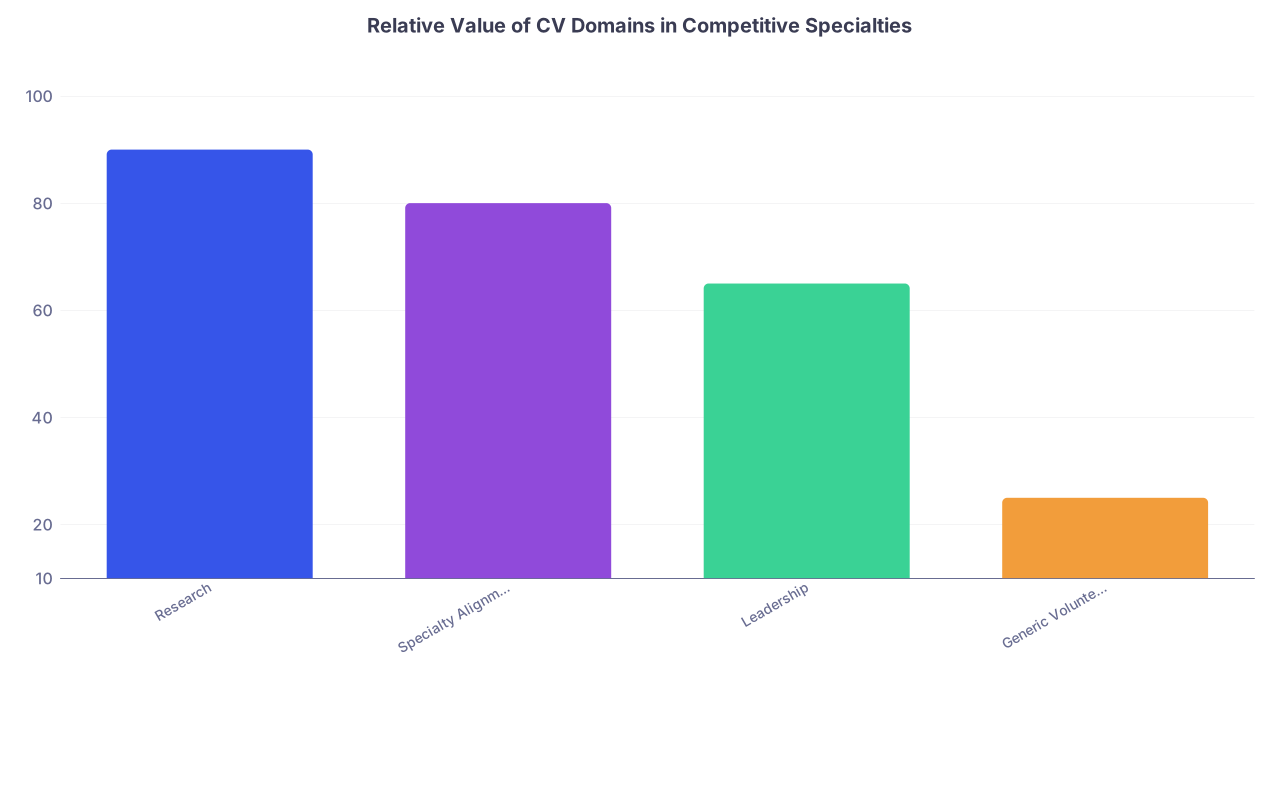
| Category | Value |
|---|---|
| Research | 90 |
| Specialty Alignment | 80 |
| Leadership | 65 |
| Generic Volunteering | 25 |
If your CV is thin, you must pack density into the first three. Generic volunteering is almost always low-yield unless it is truly unique and sustained.
Step 3: High-Yield Research Fixes (Even if You Are Late)
If you are applying to a competitive specialty with zero or minimal research, you are in trouble. Not doomed. But behind.
Move 1: Rapid-Fire Case Reports and Briefs
Before you chase an R01-level lab, get some fast-turnaround wins.
How to do it:
- Identify a research-friendly attending in your target specialty.
- Ask residents: “Who here is good for case reports or QI projects?” They know.
- Approach with a concrete ask.
- “Dr. X, I am very interested in [specialty]. I noticed you see a lot of [specific pathology]. I would be grateful to help write up any interesting cases or quality improvement projects you have in mind. I have the bandwidth to draft quickly and do the grunt work.”
- Execute with ridiculous reliability.
- You do the chart review, literature search, first draft.
- You return revisions within 24–48 hours, not 2 weeks.
You are aiming for:
- 2–4 case reports
- 1–2 brief reviews or clinical images pieces
These can be pushed to:
- Smaller specialty journals
- “Case of the Month” series
- Online case repositories linked to societies
Are case reports lower tier than big studies? Yes. Still massively better than “no research.”
Move 2: High-Visibility, Low-Data Projects
You might not have time for a big prospective study. You do have time for:
- Retrospective chart reviews (simple inclusion/exclusion, basic stats)
- Survey studies (distributed to your medical school, residents, or alumni)
- Educational projects (curriculum changes, skills workshops, OSCE redesigns)
Pick one with a clear, quick path. Do not join a massive multi-year trial you will never finish.
Process:
- Find an attending with an IRB-approved project stuck “on a shelf.”
- Offer to be the engine: data collection, SPSS / R basics, first draft.
- Set a strict timeline: data in 4–6 weeks, draft in 2–3 more.
Move 3: Poster / Abstract Blitz
You want your name on program websites before ERAS locks.
High-yield options:
- Local institutional research day
- Regional specialty meetings (state or regional chapters)
- National society meetings (even e-posters count)
Your pipeline goal:
| Year/Stage | Realistic Target |
|---|---|
| Before M3 | 1–2 posters |
| During M3 | +2 posters or abstracts |
| Before ERAS | 1 publication, 3–5 total abstracts/posters |
| Best case | 2–4 publications, 6–8 posters |
If you are late (M3 or early M4), you can still stack 3–5 abstracts in six months if you align yourself with a productive mentor and stop chasing perfection.
Step 4: Leadership That Actually Matters (Not “Member” of Everything)
Most “leadership” on student CVs is fluff: “Treasurer, XYZ Bowling Club,” with 30 inactive members and no measurable output. Program directors can see through that instantly.
High-yield leadership has three components:
- Real responsibility
- Measurable impact
- Continuity over time
Move 4: Take Over Something Broken and Fix It
Easiest path: grab something that already exists but is weak.
Examples:
- Specialty interest group with poor attendance
- Student-run free clinic night that needs restructuring
- Peer tutoring program that lacks organization
How to convert it into high-yield leadership:
- Step into a named role: President, Coordinator, Director of Education.
- Implement 2–3 concrete changes. For example:
- Doubling event frequency
- Creating a “Sub-I prep” workshop series
- Starting a resident panel or journal club
- Track metrics:
- Attendance numbers
- Number of events per semester
- New initiatives launched
Then your CV bullet becomes:
- “President, Ortho Interest Group – Expanded events from 3 to 10 per year, increased average attendance from 8 to 35 students, created a new resident-led skills workshop series.”
That reads differently than “Member, Ortho Interest Group.”
Move 5: Build a Specialty-Relevant Initiative from Scratch
If you still have at least 9–12 months before applying, you can launch something new and real.
Examples by specialty:
- Derm: Skin cancer screening initiative at student-run clinic, structured telederm follow-up system.
- Ortho: Pre-op joint class for patients, fracture reduction teaching lab for students.
- ENT: Dysphagia screening protocol project with speech therapy, “voice clinic” education sessions.
- Neurosurgery: Neuro exam bootcamp for early medical students, brain tumor patient support group.
Rule: if it would sound like a fluff student club, skip it. If it changes a process, educates people, or touches patient outcomes, do it.
Step 5: Specialty Signaling – Make Your CV Scream Your Choice
The biggest mistake thin CV applicants make is genericism. Your file looks like it could go to ten specialties. That is death for competitive programs.
Your goal is to make it obvious—in 15 seconds—that you live and breathe your specialty.
Move 6: Stack Specialty-Specific Activities
You want convergence:
- Research in that specialty
- Leadership tied to that specialty
- Clinical electives and sub-Is in that specialty
- Teaching or outreach that involves that specialty’s pathology
Think in clusters:
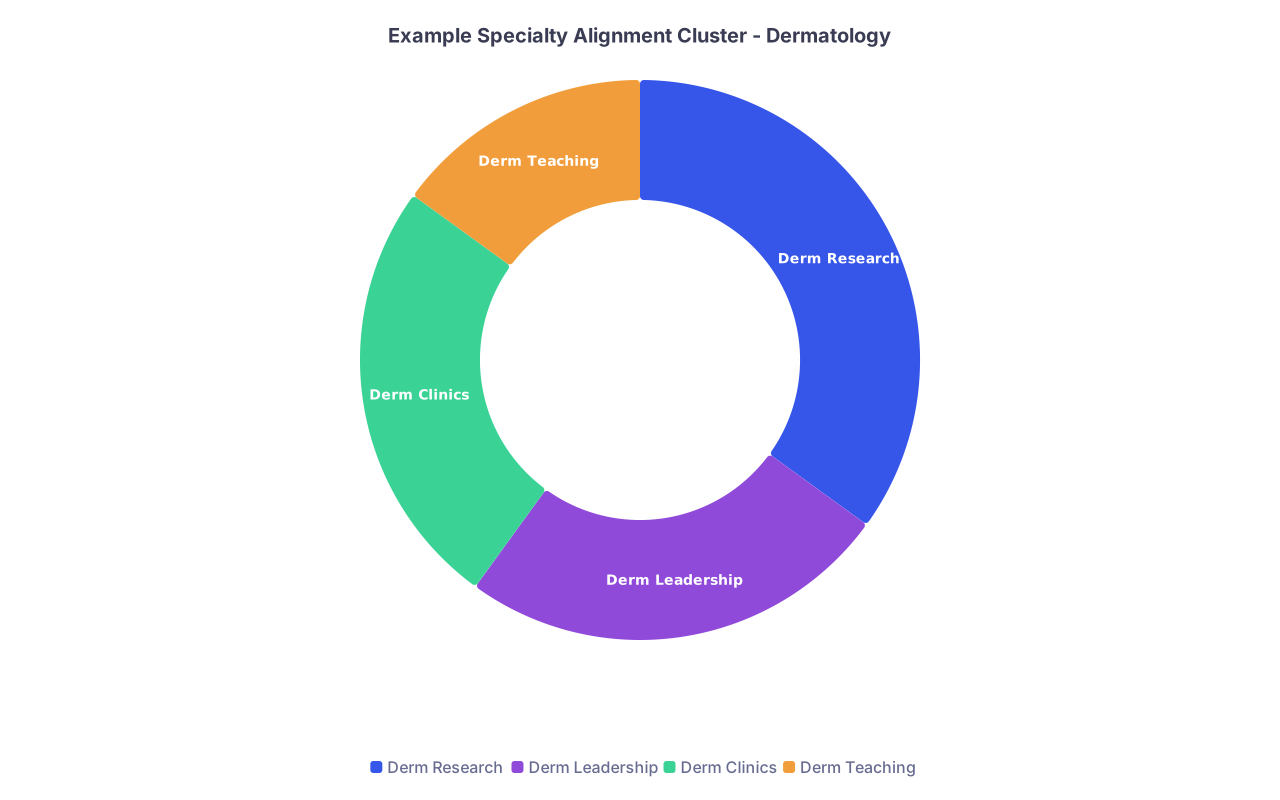
| Category | Value |
|---|---|
| Derm Research | 35 |
| Derm Leadership | 25 |
| Derm Clinics | 25 |
| Derm Teaching | 15 |
Example conversions:
- Instead of generic community service → Skin cancer screenings with dermatology department.
- Instead of “general interest group” work → Procedure workshops for your chosen specialty.
- Instead of random shadowing → Longitudinal clinic presence with one specialty attending.
Your ERAS activities section should look almost obsessive for that field. That is not a bug. That is the design.
Step 6: Teaching and Mentorship – The Underrated Multiplier
For academic and competitive programs, teaching is not optional. It is expected.
Thin CVs are often missing any credible teaching experience.
Move 7: Structured, Repeated Teaching Roles
Skip the one-off “I gave a talk once” stuff. Aim for recurring, documented roles:
- Anatomy TA across one or more semesters
- Peer tutor for M1/M2 courses (neuro, path, phys)
- OSCE standardized patient trainer for junior students
- USMLE tutoring (organized through your school, not just informal)
How to upgrade teaching from fluff to impact:
- Commit to at least one semester of a teaching role.
- Ask for formal feedback from students or faculty.
- Track hours and outcomes: number of sessions, exam score improvements (if available).
Then your bullet reads:
- “Neuroanatomy TA – Led weekly review sessions for ~30 M1 students; course pass rate improved from 88% to 96% after implementing structured review materials and practice questions.”
Teaching also gives you a pathway to strong letters—from faculty who see you in a different light.
Step 7: Strategic Away Rotations and Home Sub-Is
If your CV is thin, your rotations must carry more weight.
This is where many applicants blow it.
Move 8: Maximize Your Home Program First
Before you dream of aways at “top 10” names, do not neglect your own institution.
Checklist for your home specialty:
- At least one sub-I in your chosen field at your home program.
- Request to work with research-active attendings during that month.
- Ask for a project linked to those attendings 3–6 months before the rotation.
- Show up prepared: know the common cases, instruments, workflows.
Your home program judges whether you are worth interviewing. They also call their friends at other programs, for better or worse.
Move 9: Targeted Away Rotations for Impact, Not Name Chasing
You probably have 1–3 away rotation slots. Use them wisely.
Criteria for high-yield aways:
- Program actually interviews its rotators.
- Reasonable Step and CV expectations (not a place that only matches MD/PhD with 20+ pubs).
- Geography you are truly willing to move to.
I have seen students waste an away at a “dream” name that never interviews rotators unless they are rock stars. With a thin CV, you are not playing that game.
On away, your job is:
- Show up early, be enthusiastic, ask for feedback.
- Volunteer for teaching moments with junior students.
- Show sustained interest in research / QI if it comes up.
- Secure at least one letter from a core faculty member.
Step 8: Time Management – How to Stack These Without Burning Out
You cannot fix a thin CV by doing everything. You fix it by doing the right 3–5 things extremely well.
Let us build a simple priority plan for someone starting late M2 or early M3.
| Quarter | Main Focus | Secondary Focus |
|---|---|---|
| Q1 (3 mo) | Join active specialty research; secure 1–2 case reports | Take or assume real leadership role |
| Q2 (3 mo) | Push abstracts/posters out; present locally | Start recurring teaching role |
| Q3 (3 mo) | Sub-I at home, continue project work | Formalize specialty-specific initiative |
| Q4 (3 mo) | Away rotation(s); letters locked | Finalize manuscripts, update CV |
Think in weeks, not vague months. A rough time allocation during a relatively lighter block:
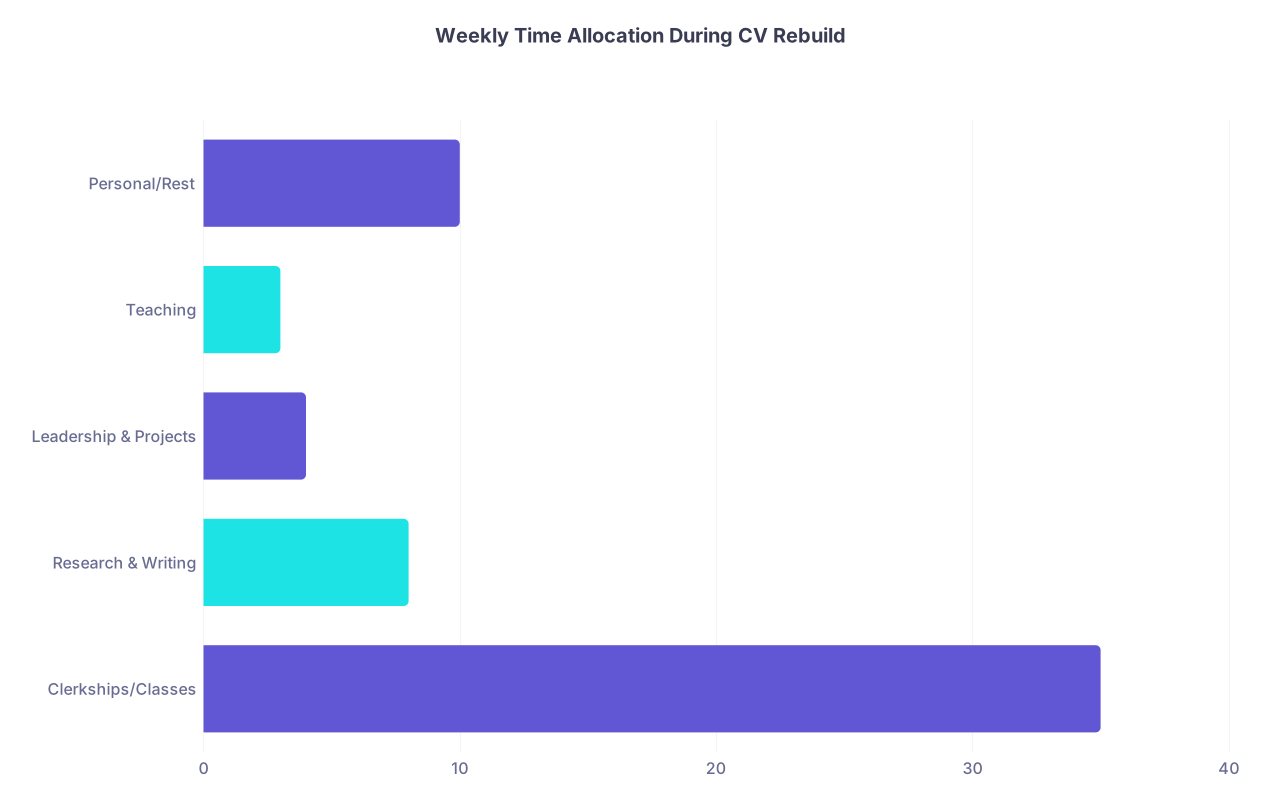
| Category | Value |
|---|---|
| Clerkships/Classes | 35 |
| Research & Writing | 8 |
| Leadership & Projects | 4 |
| Teaching | 3 |
| Personal/Rest | 10 |
This is realistic. Not easy. But realistic.
If you are on an 80-hour surgery rotation, scale back temporarily. Use lighter blocks for heavy lifting.
Step 9: Rewriting Your CV So It Does Not Look Thin
You cannot lie. But you also do not need to undersell.
Common mistakes:
- Listing every committee and minor role equally.
- Vague descriptions: “helped with research,” “participated in clinics.”
- No metrics. No scope. No context.
Fixes:
- Group minor items together instead of separate lines:
- “Member, 3 student interest groups (IM, Ortho, EM)” – one line, not three.
- Use strong verbs and numbers:
- Increased, created, developed, implemented, organized, led.
- Attendance numbers, frequency, duration, number of sessions.
- Move high-yield items up in each category. Your best work goes first.
Example transformation:
- Weak: “Volunteer, community clinic. Helped see patients and assisted physicians.”
- Strong: “Student clinician, student-run community clinic – Provided supervised care for uninsured patients during 2–3 clinic sessions per month over 18 months; led logistics for pilot evening clinic expansion.”
Same thing. Different perceived weight.
Step 10: Managing the Damage if You Are Very Late
If you are 3–6 months before ERAS and your CV is genuinely thin, you are not going to build a research empire. You focus on what still moves the needle:
High-yield emergency moves:
- Intensive specialty-aligned research attachment
- Join a productive attending, knock out 1–2 case reports quickly.
- Aim for online-first or “submitted” status before ERAS.
- Strong Sub-I performance with documented teaching
- Ask chief residents: “Can I run a teaching session for students on the rotation?”
- Hyper-focused, unique leadership accomplishment
- Even a 3–4 month project can count if concrete: build a specialty-specific patient education resource, design a concise QI protocol that is actually implemented.
And you adjust your application strategy:
- Apply very broadly.
- Include slightly less competitive but still related fields or programs.
- Consider PD emails explaining your late pivot if relevant and genuine.
Do not double down on magical thinking. Play the board in front of you.
Mistakes That Waste Your Time (Stop Doing These)
A quick hit list:
- Joining five more clubs so your CV “looks fuller” – useless.
- Starting a brand-new longitudinal project 4 months before ERAS – will not mature in time.
- Signing onto a giant basic science lab with zero chance of first authorship before you apply.
- Doing “random” volunteer outings unrelated to your specialty when you already lack specialty-focused work.
- Polishing your CV format for 5 hours instead of producing substance to go into it.
Your energy is finite. Protect it.
Pulling It Together: What a “Fixed” CV Actually Looks Like
Let us take an example: an applicant aiming for ortho with previously thin CV.
Before:
- 1 generic summer research project in cardiology, no outputs
- Member of Ortho interest group
- Occasional clinic volunteering
- No teaching
- No leadership
After 12 focused months:
- 2 ortho case reports (submitted/accepted)
- 3 ortho posters at local/regional meetings
- President, Ortho interest group – revitalized programming
- Co-founder, “Fracture Skills Workshop” for M2 students
- Anatomy TA for two semesters
- Regular clinician at ortho-focused student-run clinic night
- Home ortho sub-I with strong letter
- 1 away ortho rotation with another strong letter
Is this a “top-5 program guaranteed” CV? No. But it is no longer thin. It is aligned, productive, and defensible.
What You Should Do Today
Do not start by “working harder.” Start by working on the right thing.
Today, do this:
- Open your current CV or ERAS activities list.
- Force every entry into one of four buckets:
- Research / Scholarly
- Leadership / Impact
- Specialty Alignment
- Teaching / Mentorship
- Identify your two weakest buckets.
- Send two emails today:
- One to a specialty attending asking for a concrete research or case report opportunity.
- One to a student leader or faculty member about taking on a real leadership or teaching role (or fixing something broken).
If you have not sent those two emails by tonight, you are not “fixing a thin CV.” You are just worrying about it.