
The default fourth-year schedule will quietly kill your shot at a competitive residency.
If you want dermatology, ortho, plastics, ENT, neurosurgery, IR, rad onc, or integrated anything, you cannot “just follow the school template” and hope it works out. You need to treat fourth year like a military operation: clear objective, precise timeline, minimal wasted motion.
Here is how to restructure your entire M4 year to actually target competitive specialties – not just coast to graduation.
Step 1: Lock Down Your Timeline Reality
Before you touch your schedule, you need a hard, honest map of the application year. Most students underestimate how early the important stuff must happen.
Core timeline you are working against
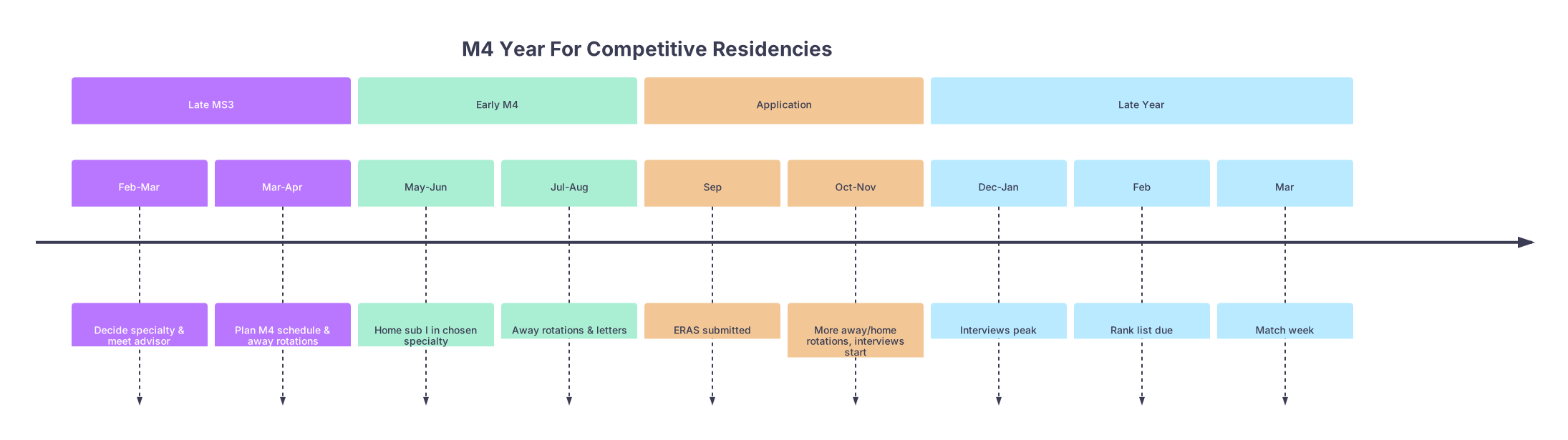
| Period | Event |
|---|---|
| Late MS3 - Feb-Mar | Decide specialty & meet advisor |
| Late MS3 - Mar-Apr | Plan M4 schedule & away rotations |
| Early M4 - May-Jun | Home sub I in chosen specialty |
| Early M4 - Jul-Aug | Away rotations & letters |
| Application - Sep | ERAS submitted |
| Application - Oct-Nov | More away/home rotations, interviews start |
| Late Year - Dec-Jan | Interviews peak |
| Late Year - Feb | Rank list due |
| Late Year - Mar | Match week |
Key constraints:
- Letters of recommendation deadline:
Competitive programs want 2–3 strong specialty-specific letters in ERAS by early–mid September. - Audition rotations (“aways”) peak:
Most meaningful away rotations occur July–September. October is already late for some fields. - Step 2 CK timing:
For competitive specialties, you want Step 2 CK taken and scored before ERAS submission unless your Step 1 is stellar.
So the simple rule:
Everything that matters for MATCHING in a competitive field must happen before September of your M4 year.
Your schedule must front-load value and back-load fluff.
Step 2: Decide Your Specialty – And Commit Early
You cannot design an effective fourth year while “seeing what happens” between ENT, ortho, and radiology. By April of MS3, you should have:
- Shadowed your top 1–2 fields
- Talked to at least one faculty advisor in each
- Reality-checked your competitiveness (Step scores, grades, research)
If you are still undecided between two competitive specialties by May of MS3, here is the rule:
- Pick a primary (the one you apply to mostly)
- Pick a backup (real backup, not wishful thinking)
Then design your M4 year for the primary while keeping the backup alive.
If you do not commit, the calendar will decide for you – and it never decides in your favor.
Step 3: Understand What Competitive Programs Actually Look For
Stop guessing. Every competitive field has the same basic pillars, just weighted differently.
| Specialty Group | Top 3 Program Priorities |
|---|---|
| Derm / Plastics | Research output, strong letters, class rank |
| Ortho / ENT / NSGY | Sub I performance, letters, board scores |
| IR / Rad Onc | Research, letters, board scores |
| Integrated Surg Fields | Away rotation performance, letters, interviews |
Translated into fourth-year structure, that means you need to deliberately build:
- Sub-internships / acting internships (AIs) in your specialty
- Strategic away rotations at target programs
- Protected time for Step 2 CK (if relevant)
- Deliverables: research abstracts, manuscripts, posters before September
- Buffer time for ERAS, personal statement, and interview prep
Your M4 schedule is not about filling 12 months. It is about creating specific outputs by specific dates.
Step 4: Anchor Your Year Around Four Non-Negotiables
There are four things that must be strategically placed before you fill anything else.
1. Home Sub-internship in Your Specialty
Target timing: May–June or June–July (early as possible)
Why this early:
- You need home letters from faculty who see you function like an intern.
- You want practice before going on away rotations where the stakes are higher.
- You want a chance to confirm, “Yes, I can actually do this specialty.”
Tactical goals for your home sub I:
- Impress 2–3 faculty who routinely write strong letters for applicants.
- Ask for feedback halfway through; fix anything they mention.
- Explicitly say at the end: “I plan to apply in [specialty] and would be grateful for a strong letter if you feel you can support me.”
Do not wait until August for your first real sub I. That is for people who want to scramble.
2. Away Rotations (“Auditions”)
Target timing: July–September (one, sometimes two, max three)
Competitive specialties use away rotations as extended interviews. You need to pick them like sniper shots, not spray-and-pray.
How many aways?
- Overly competitive, small fields (derm, plastics, ENT, NSGY, ortho):
2–3 total rotations in the field, usually 1 home + 1–2 away. - Fields with fewer aways or where they matter less (IR via DR, rad onc):
Sometimes 1 away is enough, but check your advisors and current residents.
How to choose where:
- One rotation at a realistic “reach” or “target” program you would actually rank highly.
- One rotation at a moderately competitive, realistic program where your stats are solidly within their range.
- If a third rotation: prioritize geographic region or program style that matches your long-term goals.
And do not stack three hyper-elite programs unless your application is genuinely elite. You need at least one rotation where you are not the bottom of the pile walking in.
3. Step 2 CK Window
If Step 1 is pass/fail, Step 2 CK is your traction. For competitive specialties:
- If your Step 1 was borderline or low pass:
Take Step 2 earlier (late MS3 / very early M4) so a strong CK can offset it. - If your Step 1 equivalent was strong:
You still should have Step 2 done and released by ERAS or shortly after. Programs are increasingly expecting it.
Practical scheduling options:
- Option A: Early CK (recommended if Step 1 is weak or average)
- 2–4 weeks dedicated study between MS3 and M4
- Then start home sub I after CK
- Option B: CK squeezed between sub I and aways
- High risk. You are exhausted and trying to cram. Avoid if possible.
If you have zero protected time for CK on your school’s default schedule, that is the first thing you push to be changed.
4. Research Delivery Date
You are not just “doing research.” You are producing something with a date on it.
Goal for competitive specialties:
- Have at least one accepted abstract/poster or clear submitted manuscript by September.
- For derm, plastics, ENT, NSGY, orthopedics: more is better, but volume without quality is obvious and unimpressive.
So you back-plan:
- Abstract submission deadlines for major specialty conferences are often January–April.
- That means serious data collection and writing must happen MS3 and early MS4, not “I will find a project during my away.”
Schedule in blocks of research elective time to finish and submit, not to “start something new for the CV.”
Step 5: Build a Model Fourth-Year Schedule (Then Customize)
Let me give you a concrete example. Say you are aiming for orthopedic surgery, which is brutally competitive. You are MS3 finishing in April.
Here is how a strong M4 restructured year might look:
| Month | Rotation Type | Primary Goal |
|---|---|---|
| May | Home Ortho Sub I | Letters, skills, confirm fit |
| June | Research Elective + CK Study | Finish projects, prep CK |
| July | Away Ortho #1 (target) | Audition, get letter |
| August | Away Ortho #2 (realistic) | Audition, backup letter |
| September | Lighter Elective + ERAS Time | Submit ERAS, finalize letters |
| October | Required Non-Ortho Sub I | Graduation requirement |
| November | Interview-Friendly Elective | Light schedule, travel time |
| December | Additional Interviews / Elect | Flex for interviews |
| Jan–Mar | Fill remaining requirements | Chill, minor requirements |
Key structural choices:
- Sub I in May gives you a home letter and confidence.
- June is protected for CK + research – extremely high yield.
- July–August aways maximize face time before programs finalize interview lists.
- September is intentionally light to finish ERAS, minor tweaking, and breathe.
- Heavy requirements and “check-the-box” rotations are pushed to post-application.
You can modify this template for other fields, but the skeleton stays: early sub I, research + CK before aways, aways in July–September, fluff after September.
Step 6: Fix the Biggest Structural Errors (Before They Happen)
I see the same self-sabotaging patterns every cycle. If you avoid these, you are already ahead of most of your competition.
Error #1: Late Sub I (August or later)
Problem: Your best clinical letter arrives after a lot of programs have screened applicants.
Fix:
- Move your specialty sub I to May–June or June–July.
- If your school “does not allow” early sub Is, push back. Get your advisor involved. Use words like “graduation requirement flexibility,” “Match risk,” and “specialty advising.”
Error #2: No Protected Time for Step 2 CK
Problem: You are on a 70–80 hour away rotation and trying to study at midnight. That never ends well.
Fix:
- Carve out a 2–4 week block between clinical-heavy stretches.
- If your school insists you be constantly on rotations, ask about:
- “Independent study” credit
- “Board prep” elective
- Shortened vacation blocks reorganized into a single study window
You do not need a 6-week CK bootcamp. You need 2–4 focused weeks without clinical chaos.
Error #3: Wasting Early Months on Low-Yield Requirements
Problem: Heavy non-specialty required rotations in May–July.
Fix:
- Push required medicine sub I, ICU, or other core requirements to October–January where possible.
- Argue your case with this logic: “I need specialty-specific exposure and letters early to have a realistic chance to match, which ultimately reflects on our school’s match outcomes.”
If your administration cares about match lists (they do), they will listen if you are persistent and professional.
Error #4: Too Many Away Rotations
Problem: Three or four aways in a row. You think it shows dedication. Programs see desperation and burnout.
Fix:
- 2 aways is ideal for most competitive specialties if you already have a strong home program.
- 3 aways only if:
- Your home program is weak or nonexistent in your specialty.
- You are regionally locked and need multiple geographic options.
Remember: every away is a month where you are on display 12+ hours daily. Quality > quantity.
Step 7: Formalize Your Rotation Strategy By Specialty Type
Different specialties tweak the framework slightly. Here is a quick comparative snapshot.
| Cluster | Home Sub I Timing | Away Count | Research Priority Level |
|---|---|---|---|
| Derm / Plastics | May–June | 1–2 | Very high |
| Ortho / ENT / NSGY | May–June | 2 | High |
| Integrated Vasc / CTS / PRS | May–June | 2 | High |
| IR (via DR) / Rad Onc | May–June (field) | 1–2 | Very high |
You still follow the same skeleton: early sub I, structured CK and research time, aways in mid-summer, ERAS buffer in September.
Step 8: Rebuild Your Year With a Real Process
Do not just open the scheduling website and start clicking. Sit down and follow this sequence.

| Step | Description |
|---|---|
| Step 1 | Set Specialty Goal |
| Step 2 | Meet Specialty Advisor |
| Step 3 | Map Non Negotiables |
| Step 4 | Place Home Sub I Early |
| Step 5 | Block CK Study Window |
| Step 6 | Schedule Away Rotations |
| Step 7 | Insert Research Electives |
| Step 8 | Backfill Requirements |
| Step 9 | Confirm With Dean Office |
Step-by-step restructuring protocol
Set the specialty target and level of risk
- Single specialty vs dual-apply
- How competitive you are within that field
Meet with a real specialty advisor
Someone who actually sits on the residency selection committee or is known to mentor applicants in your field. Not just a generic dean.Map out your non-negotiables:
- Boards (Step 2 CK timing)
- Minimum research products needed
- Number of sub Is and in what months
- Required core rotations that cannot move
Place your home sub I(s)
One in May–June. If your specialty expects more, add one later (Oct–Nov) when the pressure is lower.Create your CK window
insert 2–4 weeks for CK prep before aways if at all possible.Choose and schedule aways
Use filters: geographic, program style, competitiveness tier, existing connections.Add research electives in meaningful locations
Not random “protected time” in February. Blocks before application season to finish, submit, and present work.Backfill with requirements and lighter electives
Put heavy and less relevant stuff after September. Add light electives during interview season.Run your draft schedule past:
- Specialty advisor
- Dean’s office / registrar
- Recent matched residents in your chosen field
Do not stop adjusting until at least two people who successfully matched in your specialty say, “Yes, this looks like a competitive schedule.”
Step 9: Design Electives That Actually Help You Match
Electives are not vacations. At least your pre-September electives are not.
Structure them with intention:
Pre-application electives (May–September):
- Specialty-imaging (for IR, ortho, neurosurg)
- Specialty clinics (derm clinic, ENT clinic, etc.)
- Research blocks to close projects, write, and submit
- Related fields that reinforce your narrative (e.g., rheum for ortho, neurology for neurosurgery)
Post-application electives (October–January):
- Interview-friendly electives (short hours, flexible)
- Advanced subspecialty exposure that might shape your rank list
- Remaining core requirements
The simple rule:
Electives before September must produce something you can write in your ERAS application or personal statement.
Step 10: Use Data To Prioritize Where You Spend Time
You should not be guessing where to invest your rotation months. Look at some basic numbers: interviews per application, how many interviews you need, typical match statistics.
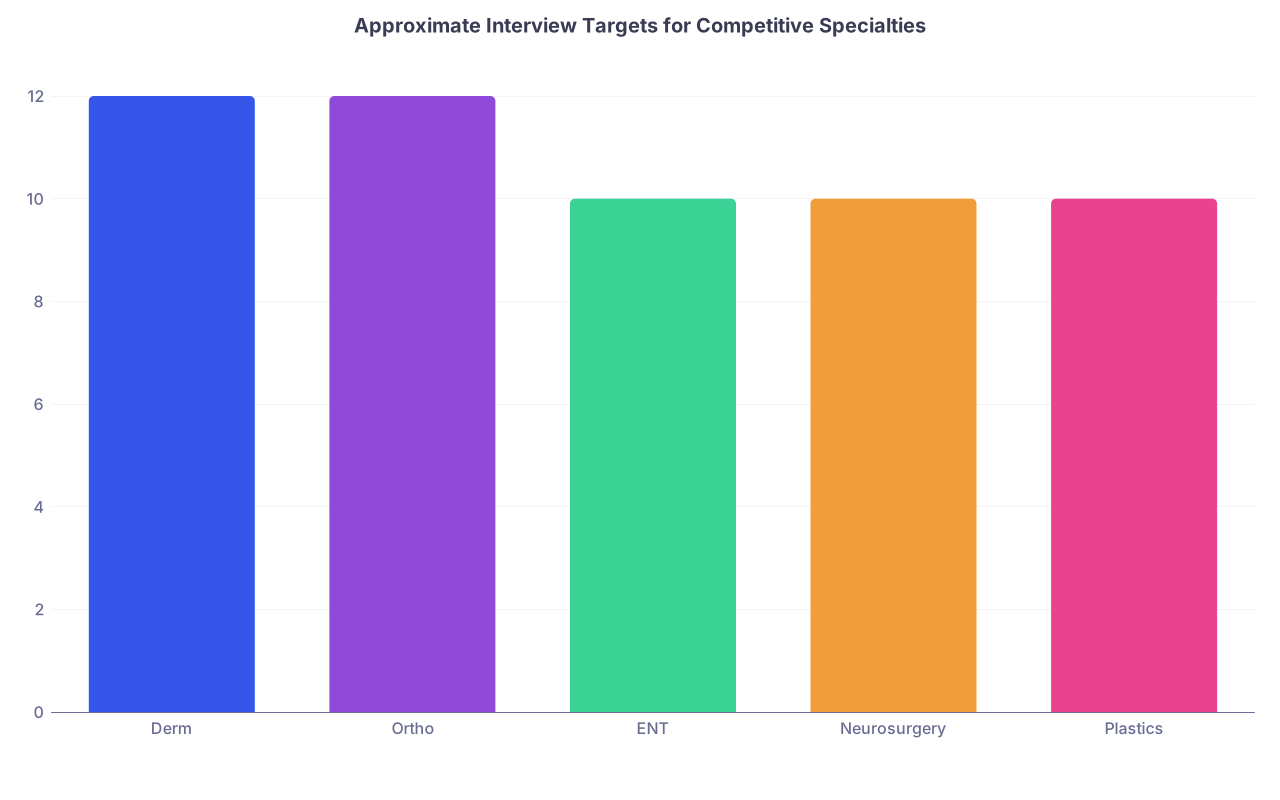
| Category | Value |
|---|---|
| Derm | 12 |
| Ortho | 12 |
| ENT | 10 |
| Neurosurgery | 10 |
| Plastics | 10 |
You want roughly:
- 10–12 interviews in most highly competitive fields to feel reasonably safe.
- That means:
- Strong letters (from sub Is and aways)
- Solid scores (Step 2 if applicable)
- Competitive research output
If you are below average in one of these pillars, your schedule must compensate:
- Weak scores → earlier CK + more research and stronger clinical performance.
- Weak research → more research blocks with mentors who publish quickly.
Do not try to be “well rounded.” Try to be undeniably excellent in two pillars and solid in the rest.
Step 11: Practical Tips For Not Crashing And Burning
Fourth year for competitive applicants is not a vacation. But you also cannot run at MS3 surgery clerkship pace for 12 straight months.
A few non-fluffy ways to keep yourself functional:
Avoid three high-intensity months in a row.
Do not stack: May sub I → June sub I → July away. Insert at least one slightly lighter month somewhere early.Protect sleep during aways.
You are being judged on your consistency. A rock star on Monday and a zombie by Thursday is not impressive.Document your work as you go.
Keep a running log of cases, research roles, teaching, and feedback in a simple spreadsheet. Makes ERAS writing much faster.Ask for letters early and clearly.
End of each high-yield rotation: “Dr. X, I am applying in [specialty]. Would you feel comfortable writing a strong letter of recommendation for me?”Adjust on the fly.
If a May sub I goes poorly, you may need:- A September sub I at home or elsewhere for a better letter
- A recalibrated specialty target or backup plan
Do not wait until November to admit something is off.
Step 12: What This Actually Looks Like Week to Week
Here is a real snapshot of how a fourth year feels when structured correctly:
May: You are working like an intern on your sub I. Long hours, lots of learning. You go home tired but feel yourself getting better daily. By the end, at least one attending says, “You are very strong; I will support your application.”
June: You shift gears. Morning: 6–7 hours of Step 2 questions and review. Afternoon: 2–3 hours of finishing a manuscript and prepping a poster. You take Step 2 at the end of the month, exhausted but well prepared.
July–August: You hit your away rotations. You show up early, volunteer for cases, read at night. You are careful not to be a try-hard clown, but you are clearly engaged. Residents say good things to your face, and the PD knows your name by week 3.
September: Lighter month. You spend serious hours polishing ERAS, tweaking your personal statement, confirming all letters are in. You submit early, not on the last day.
If that feels intense, good. Matching into a competitive specialty is intense. But it is very different from “random schedule and random hope.”
Final Check: How To Know Your Fourth Year Is Properly Restructured
You should be able to answer yes to most of these:
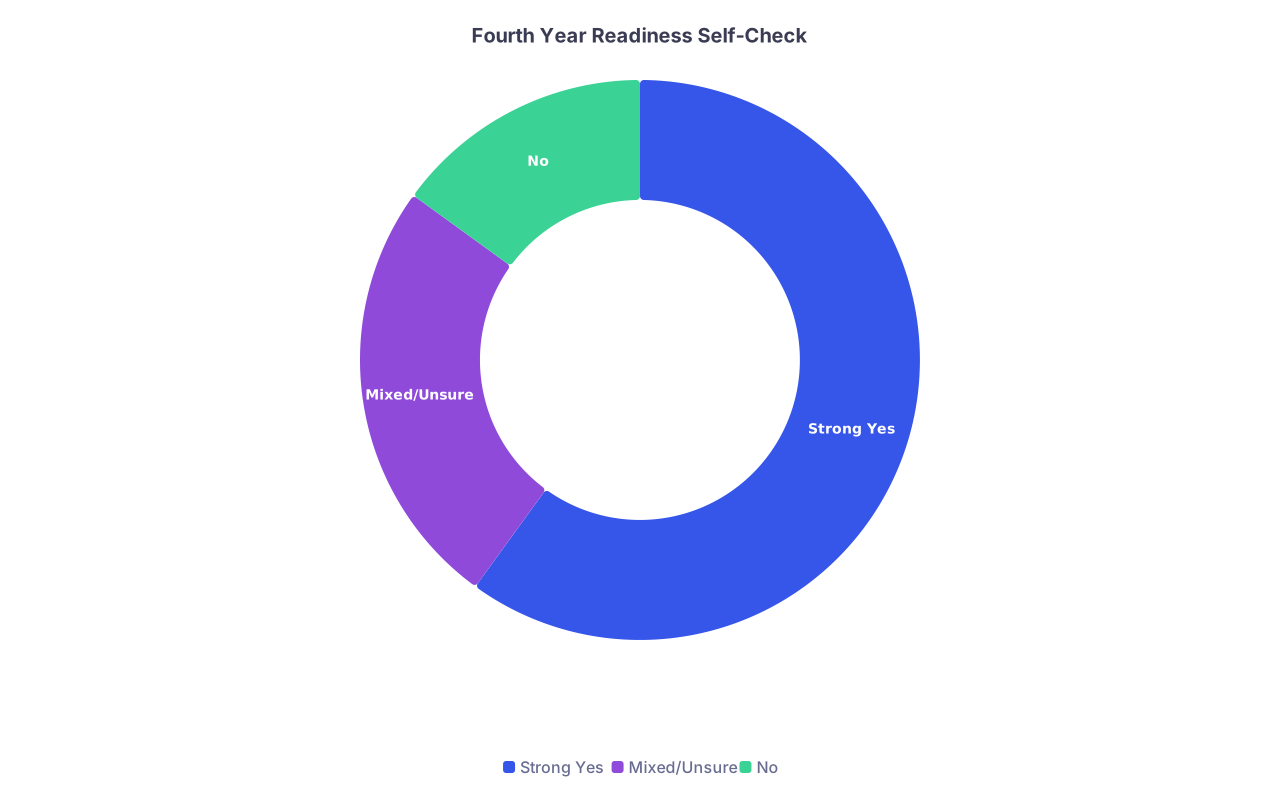
| Category | Value |
|---|---|
| Strong Yes | 60 |
| Mixed/Unsure | 25 |
| No | 15 |
- Do you have a home sub I in your specialty scheduled before or during June?
- Do you have 2–4 weeks blocked for Step 2 CK prep before busy aways?
- Are your away rotations placed in July–September and limited to 1–3 high-yield sites?
- Do you have research time scheduled to finish and submit at least one project before September?
- Is your September relatively light to allow ERAS and letter management?
- Are heavy, noncritical requirements pushed to after application submission when possible?
If you are answering “no” more than “yes,” you are not ready. Fix the calendar before it fixes your match outcome.
Three Things To Remember
- Fourth year structure is not cosmetic. For competitive residencies, it is the difference between being taken seriously and being filtered out.
- Front-load value: early sub I, research completion, CK, and aways. Back-load fluff: generic requirements, electives, and anything not clearly supporting your application.
- Do not build your schedule alone. Use specialty advisors and recent successful applicants as your reality check, then be relentless about getting the calendar to match your goals.