
The match isn’t “holistic.” Not in the specialties you’re aiming for.
In competitive residencies—derm, plastics, ortho, ENT, ophtho, neurosurg, rad onc, IR, certain IM subspecialty tracks—there are hard, silent filters that decide your fate before a human ever reads your personal statement. Programs will smile and tell you they review “the whole application.” Then they walk back to the conference room, open a spreadsheet, and start deleting names.
Let me walk you through what actually happens on the other side of ERAS. Because if you do not understand these unspoken rules, you will waste years of your life and thousands of dollars on an application that dies in the first 90 seconds of a coordinator’s screen.
How Applications Are Really Sorted: The First 5 Minutes
Here’s the part students never see.
The coordinator or chief resident exports all applications into a sortable spreadsheet. Columns: school, Step 1 (if still visible for older cohorts), Step 2 CK, class rank, AΩA, research count, home vs away, visa, prior grad, etc. Then someone with actual power says something like:
“Okay, for our first pass, set Step 2 CK cut at 245 and hide any non-LCME schools unless they’re US MD or our top Caribbean pipeline.”
That one sentence kills a third of the pool. Sometimes half.
They don’t call it a “filter” in public. Internally they’ll say “we need to be efficient,” or “we just can’t read 900 applications.” But functionally, it’s a digital guillotine.
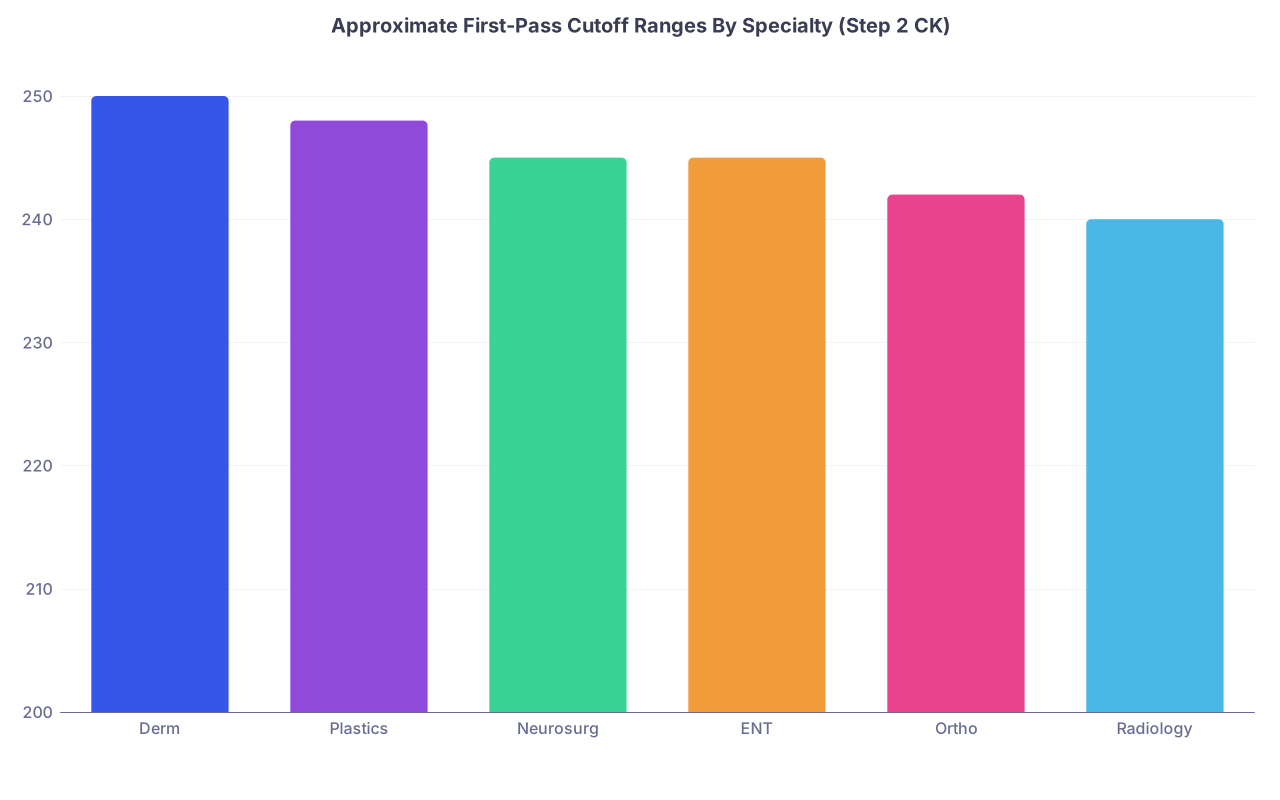
Different programs, different thresholds, but the logic is always the same: narrow fast, then pretend the rest is holistic. Let’s quantify it.
| Category | Value |
|---|---|
| Derm | 250 |
| Plastics | 248 |
| Neurosurg | 245 |
| ENT | 245 |
| Ortho | 242 |
| Radiology | 240 |
Those are not official numbers. They’re the ballpark ranges where I’ve heard attendings and PDs throw out lines like, “We really need 250+ for derm unless they’re AΩA at a heavy-hitter school.”
You’ll never see these cutoffs on a website. You’ll see “we do not use strict score cutoffs.” Which is technically true. Because they’ll always keep the right to make exceptions—for the dean’s kid, for the superstar from a partner school, for the MD/PhD with three Nature papers.
For ordinary applicants? The filter is real.
Silent Filter #1: Step 2 CK – The New Gatekeeper
With Step 1 now pass/fail, Step 2 CK became the blunt instrument.
Before, competitive programs used Step 1 as the first line of defense. Now, Step 2 CK is the score that gets projected onto the conference room screen.
Here’s what actually happens:
A junior faculty or chief resident will say, “Let’s sort by Step 2 descending and look at the top 200.” Then they build the “A-list” from the top end and let the rest drown in the noise.
A few brutal truths:
- In top-tier derm, ENT, plastics, neurosurg, ortho programs, a sub-240 Step 2 CK often means you’re getting screened out unless you’ve got something huge to offset it (true AΩA + high-powered letter + big-name PI + home advantage).
- Mid-tier but still very competitive programs may ease that into the 235–240 range, but not much lower unless you’re an internal or have serious connections.
- The step-up from 245 to 255 is huge in their minds. I’ve watched committees literally say, “We’ve already got plenty of 255+; do we really need this 242 unless there’s something special?”
The nuance students miss: they don’t sort by numeric cutoff in ERAS. They sort and feel the distribution. Program directors scan a column of numbers and get a “vibe” of where to start drawing lines.
In one conference I sat in on at a big-name ortho program, here’s what the PD actually said:
“Top end is loaded. Let’s keep everyone over 250 for now, plus any 245+ who are from our regional schools or have strong ortho research. Everyone else, set aside unless home student.”
No one wrote “cutoff = 250” anywhere. But practically, it was.
Silent Filter #2: School Prestige & Type (And Yes, It Matters)
You’ve heard the lie: “We treat all schools equally.”
They do not.
On the application spreadsheet, your school is a sorting category. Not just MD vs DO vs IMG—though that’s part of it—but also which MD, which DO, which foreign school.
Programs tend to have a mental three-tier system:
| Bucket | Typical Examples | How Competitive Programs React |
|---|---|---|
| Tier 1 | Top 20 US MD, big-name research schools | Extra attention, lower tolerance for weaker parts of app but huge upside |
| Tier 2 | Most US MD, top DO, strong regionals | Default pool; judged primarily on scores + letters |
| Tier 3 | Lower-tier DO, Caribbean, other non-US IMG | Need to massively overperform to clear the first cut |
In competitive specialties, Tier 3 applicants often don’t even make it to the “let’s discuss” pile. The PD doesn’t say, “We reject Caribbean.” They say:
“Given volume, let’s prioritize LCME US MD and a few of our known DO partner schools.”
Same outcome.
There are also “feeder” relationships nobody tells you about. Certain derm or ortho programs are basically pipelines for 4–5 specific med schools. You’ll notice this if you stalk resident bios carefully: the same handful of med schools show up again and again. That’s not random.
I’ve literally watched a PD say, “She’s from [X School]—we’ve had good people from there; flag her.” That’s the flip side of the silent filter. Your school’s reputation either buys you the benefit of the doubt, or it doesn’t.
For DO and IMGs in competitive specialties, the silent filter is vicious:
- Some programs quietly don’t review any DO apps unless the DO student rotated there and crushed it.
- Carib grads in derm, plastics, ENT? Ninety-nine out of a hundred are dead on arrival, no matter what they did. The one exception has insane research and deep connections.
Nobody will write that on a website. But every resident in those departments knows it.
Silent Filter #3: Research – Not Just Quantity, But Who You’re Attached To
In the really competitive fields, “3–5 publications” on ERAS is basically background noise. Everyone has some research. The question is: with whom, and where did it land?
Here’s what screens people in vs out:
The name of the PI or lab
Committees recognize certain names instantly. The derm chair who’s on every guideline. The ortho sports surgeon everyone in the region knows. The rad onc PI who runs half the multicenter trials.
If your ERAS shows multiple pubs/posters under that name, you suddenly get read more carefully—even if your Step is a few points lower.The signal vs fluff ratio
Ten “online journal” case reports can hurt you. They scream desperation and lack of mentorship.
Two solid abstracts at a national meeting + one legit paper in a decent journal looks far better than a laundry list of bottom-tier case reports.Timing and consistency
A block of intense research during a dedicated year is expected. But if it’s completely disconnected from your home institution and specialty (like doing GI research for a year then applying to ortho with nothing ortho-specific), people notice the incoherence.
I sat in on a derm file review where an applicant with a 248 Step 2 and three strong derm pubs with a known national name beat out someone with a 258 and a handful of unrelated, low-impact research. The PD said:
“The 248 actually looks like a derm person. The 258 is just a high scorer who decided on derm last minute.”
That’s the calculus in real time.
Silent Filter #4: Home/Away Rotation Politics
Away rotations in competitive specialties are not “auditions” in the cutesy, feel-good way schools describe. They are extended job interviews with much higher stakes than your grades suggest.
Three invisible filters here.
1. Home Program Bias
If a program has an associated med school, your home students are getting first crack at interview slots unless they’ve actively burned bridges. A PD will say:
“We have to take care of our own.”
On a practical level, that means:
- A home student with a 238 and strong internal support often gets an interview where an external with 250+ and no connection gets tossed.
- If you have no home program in your specialty, you’re starting with a handicap. Some committees will explicitly sort for “home vs non-home” and show more generosity to their own.
2. Away Rotation Performance as a Binary Filter
Your month at an away program doesn’t just “help” if you do well. It can absolutely nuke your chances across the entire region if you do poorly. People talk.
Real example from an ortho away: a student was late twice, mildly entitled, and bad at receiving feedback. The fellow’s comment to the PD was, and I quote:
“Do not rank. Would be miserable to work with.”
That line echoed in two adjacent programs via word of mouth within weeks. That student’s entire geographic strategy in that region quietly collapsed.
On the positive side, a strong away where someone writes, “Top 5% of students we’ve had in the past five years, would recruit enthusiastically,” can override a somewhat softer Step 2.
3. “Token” Rotations vs Real Interest
Programs are not stupid. If you shotgun four aways in random regions with no clear pattern, they read it as desperation. If you rotate at their rival program in town and clearly tell them that rival is your #1, that will get around.
An honest but quiet truth: some PDs have egos. They do not want to be your backup. Students who are clearly using a program as a safety often get quietly deprioritized when interview numbers get tight.
Silent Filter #5: Red Flags You Don’t Think Are Red Flags
Students assume the only “red flags” are failures or misconduct. That’s naive. Committees see flags in patterns and context, not just discrete events.
Here are the ones that kill apps in competitive specialties:
Late Step 2 CK without a clear story
If everyone else in your class took Step 2 in June and you took it in October “because you wanted more time,” committees will assume you were worried about failing or scoring low. In some competitive programs, that alone triggers a soft reject if paired with a mediocre score.Excessive time off or extra years without obvious productivity
A research year that produced nothing. A “personal reasons” year with vague explanations. An unexplained switch from one specialty to another late in the game with no coherent narrative.
None of that is automatic death, but in a field with 800 apps for 4 spots, they will always choose the straightforward, low-risk narrative over your complicated one unless you bring serious upside.Uneven letters
People think every letter is glowing. That’s false. Faculty know how to read between the lines.
“Solid clinical skills, dependable, would do fine in any residency” = generic.
“One of the best students I’ve worked with in years, I would be thrilled to recruit [Name] to our program” = strong.
Slight hedging phrases like “with appropriate supervision” or “will continue to grow” can tank you in a competitive field where others have unequivocal praise.Too many applications across wildly different specialties
This one is more subtle. If a PD learns that you also applied to IM, anesthesia, and neurology while claiming their ultra-competitive surgical subspecialty is your “one true passion,” they’re not impressed.
Yes, ERAS doesn’t show your entire specialty list to every PD, but word gets around when you dual-apply heavily within the same department (e.g., IR + DR + preliminary medicine at the same place).
The Hidden “Soft Filters”: Personality, Fit, and the Politics You Don’t See
Once you’re past the initial hard filters—scores, school, research, rotations—there is a second layer of softer, but very real sorting.
Here’s the part almost no one explains well: programs are matching to a social ecosystem, not just a CV.
A few quiet but harsh realities:
- If a program just had a toxic, narcissistic resident who blew up the department, they will be hyperallergic to any hint of arrogance or “gunner” energy in the next cycle. Your ultra-aggressive, “I know what I want and I go get it” persona might read as a liability, not a strength.
- If a program just graduated three residents into academics and now desperately needs service-oriented workhorses, they will gravitate to the “reliable grinder” archetype over the “aspiring NIH superstar,” even with the same scores.
- Some chiefs have enormous influence. I’ve watched a PD let a senior resident basically veto an otherwise solid applicant with one sentence: “They just feel off, I would not want to take call with them.”
And then there’s geography.
Programs in big cities quietly assume a lot of people want their location. Programs in less glamorous places are suspicious of applicants with strong ties to coastal metros applying out of the blue with no stated reason.
I’ve heard a PD in the Midwest say about an applicant from California with no midwest connection:
“She’s not going to stay here. We’re just a backup for her big-city list.”
That applicant never got an interview. Scores were excellent. Letters strong. Geography killed it.
What You Can Actually Do About These Filters
Let me be blunt: you cannot beat every filter. But you can stop playing blind.
Targeted strategies:
- If you’re gunning for a hyper-competitive specialty, you cannot treat Step 2 CK as “just pass and do fine.” For you, it is the price of entry. You need to study like it’s still Step 1 pre-pass/fail.
- If you’re at a lesser-known school (or DO/IMG) and aiming high, you must anchor yourself to recognizable names: mentors, PIs, rotations at places known to your target programs.
- If you have any red flag or nontraditional path, your story has to be coherent. PDs hate incoherence more than they hate imperfection. “I failed, fixed it, and then crushed the next phase” is infinitely better than fuzzy vagueness.
- Stop shotgun-rotating without strategy. Choose aways that either a) you’d honestly be happy to match at, or b) feed reputationally into a cluster of other programs that respect that site.
And the most uncomfortable truth of all: sometimes the best move is to pivot. If the numbers and institutional background are just completely misaligned with derm, plastics, or neurosurg, and you’re not willing to do a full extra research year with real production, forcing it is self-harm. There are incredibly rewarding, competitive enough specialties where your profile might actually get seen.

| Step | Description |
|---|---|
| Step 1 | Application Submitted |
| Step 2 | Coordinator Exports Spreadsheet |
| Step 3 | Silent Reject |
| Step 4 | Low Priority Pool |
| Step 5 | High Priority Pool |
| Step 6 | Discuss In Committee |
| Step 7 | Maybe List For Extra Interviews |
| Step 8 | Reviewed Only If Spots Left |
| Step 9 | Step 2 CK Above Local Line |
| Step 10 | School In Preferred Buckets |
| Step 11 | Research And Mentor Signal |
| Step 12 | Home Or Strong Away Rotation |
| Category | Value |
|---|---|
| Screened Out Early | 60 |
| Considered But Not Invited | 25 |
| Interviewed | 15 |
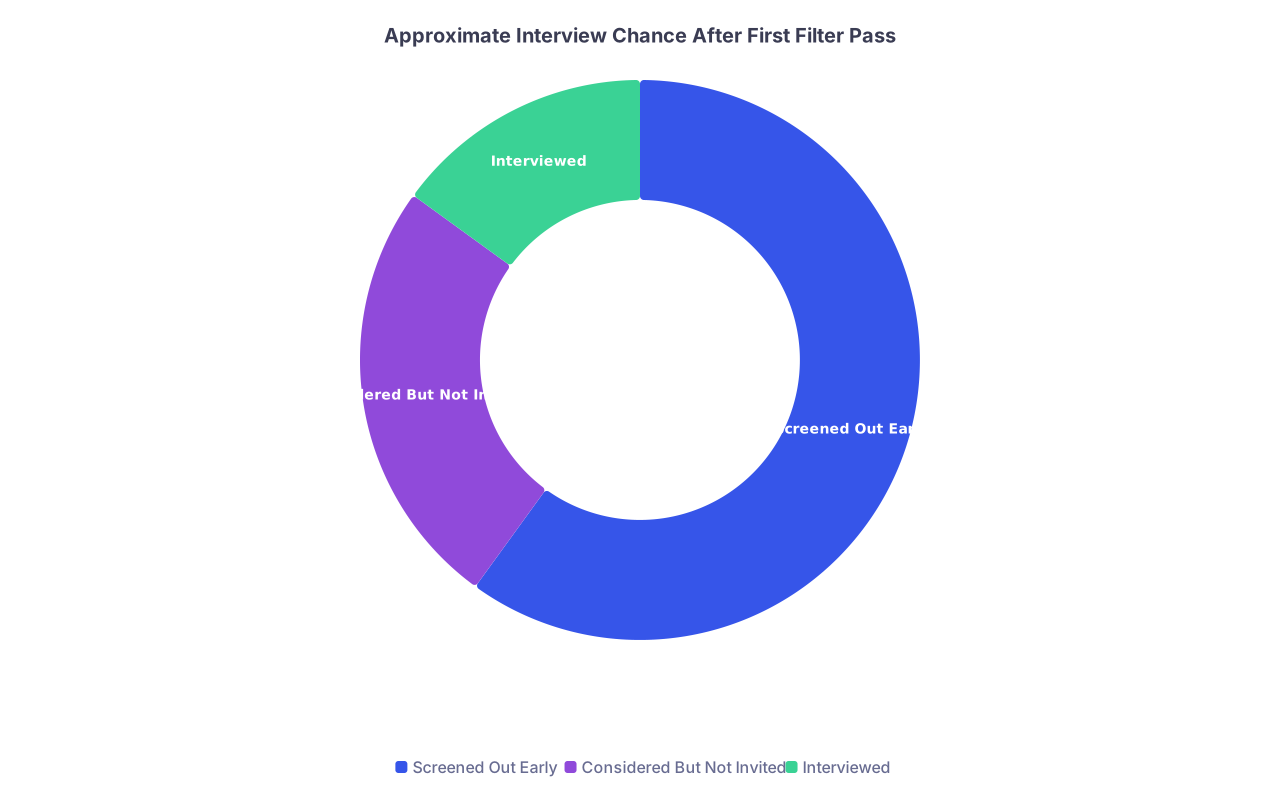
In a lot of competitive programs, roughly 60% never really get read beyond the quick filter stage. About 25% are “maybe” applicants who get skimmed but not invited. The final 15% get interviews. You’re fighting to stay out of that first 60%.

How Committees Talk When You’re Not in the Room
This is where the myth of pure merit completely falls apart.
Actual phrases I’ve heard in selection meetings:
- “She’s from [X top-5 med school], we should probably at least interview her.”
- “Scores are a little soft, but [well-known PI] loves him. That carries weight.”
- “We already have two from [Y School] in our current classes; do we really want a third?”
- “This letter is lukewarm. If that’s the best they can get, I’m worried.”
- “Great numbers, but something about the personal statement feels… off.”
- “We have enough academic guns; we need someone who won’t bolt in three years.”
None of that is on a rubric. Yet it shapes who gets ranked where.
You can’t script every variable. But you can position yourself to at least get into the room where these conversations happen. That means respecting the silent filters, not pretending they don’t exist.

FAQ (Exactly 4 Questions)
1. Is it even possible to match a competitive specialty with a below-average Step 2 CK?
Possible, yes. Common, no. If your Step 2 is significantly below the typical range (say <240 for derm/ENT/ortho at strong programs), you need strong counterweights: a powerhouse mentor who will go to bat for you, multiple high-quality pubs in that specialty, truly outstanding away rotation performance, and a realistic target list (more mid-tier and regionals, fewer ivory-tower programs). If none of that is true, you’re not “underdog inspiring,” you’re just not getting past the first filter.
2. How many research projects do I actually need for a competitive specialty?
There isn’t a magic number. But here’s the internal reality: 1 well-executed project with a recognizable name, presented at a legit national meeting or in a solid journal, carries more weight than 7 no-name, low-impact case reports. For top-tier derm/plastics/ENT/ortho, most serious applicants will have at least 2–3 real specialty-related projects with clear output. For mid-tier programs, solid engagement with one good project plus strong rotations can be enough.
3. I’m at a DO/Caribbean school and want a hyper-competitive specialty. Am I delusional?
Not automatically. But the bar is brutally high and the path is narrower than anyone will admit publicly. For DOs, you need top-end Step 2, strong specialty-specific research ideally at an MD institution, and glowing letters from people MD programs respect. For Caribbean, in certain ultra-competitive fields, it’s almost lottery odds. Sometimes the smartest move is to aim for a competitive but more attainable specialty where your profile has a fighting chance instead of chasing a field that screens out almost all non-US-MD at step zero.
4. Should I take a research year to “fix” my chances?
A research year is only worth it if you’re in an environment where your work will actually be productive and visible. A token “research year” that produces one poster and a half-finished manuscript is a waste. If you can plug into a strong lab or busy clinical research group in your target specialty, with a mentor who’s known and invested in you, then yes, it can move you from “filtered out” to “taken seriously.” But you have to be honest: are you truly going to generate output that changes how a PD reads your file—or are you just hiding from a weak application for 12 more months?
Key points: The filters are real, mostly invisible, and brutally efficient. Scores, school, research, and rotation performance decide whether you’re read like a human or deleted like a row in Excel. Your job is not to pretend the system is fair. Your job is to understand how it actually works and then build an application that survives the first cut.