Your school’s name on your diploma is not what keeps you out of a competitive specialty. Your lack of a deliberate strategy is.
You are not at Hopkins, Mayo, UCSF, or Penn. You do not have a branded research factory dropping NEJM papers in your lap. Program directors are not flying in to tour your labs.
Good. That just means you cannot be lazy. And most applicants are.
If you want dermatology, plastics, ortho, ENT, neurosurgery, urology, radiation oncology, or another competitive field from a “non-powerhouse” school, you need a different playbook. Not fantasy. Not vibes. A system.
Here is how you build specialty credibility when your school name does not do the talking for you.
Step 1: Get Your Baseline Reality On Paper
Before you can “fix” anything, you need a brutally honest snapshot of where you stand. No optimism. No self-loathing. Data.
1.1 Define your target specialty’s real bar
Not Reddit rumors. Actual numbers and patterns.
Do this:
- Pull the latest NRMP “Charting Outcomes” for your specialty.
- Look at:
- Matched vs unmatched US MD/DO stats
- Step 2 CK score distributions
- Average number of:
- Research products
- Programs applied to
- Ask your home faculty (if you have any in that specialty) or nearby programs:
- “What Step 2 score makes people comfortable ranking you here?”
- “What gaps sink an otherwise good applicant?”
You are not aiming to be “acceptable.” You are aiming to remove doubt.
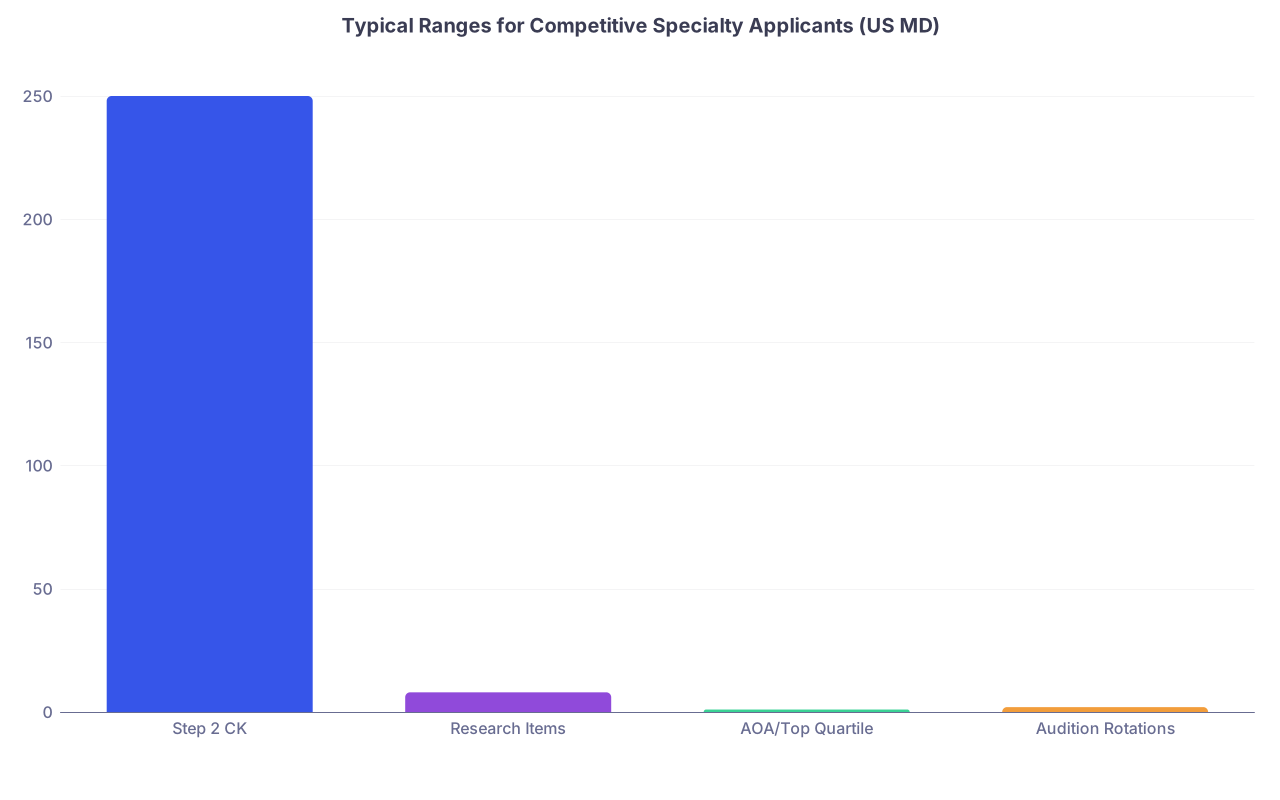
| Category | Value |
|---|---|
| Step 2 CK | 250 |
| Research Items | 8 |
| AOA/Top Quartile | 1 |
| Audition Rotations | 2 |
Interpretation:
- Step 2 CK: 245–255 range is where people stop sweating
- Research: 5–15 products (abstracts/posters/pubs) is common
- Class rank: top quartile helps a lot, AOA is gold
- Away rotations: 2–3 well-chosen auditions are standard in some fields
If your numbers are below these, you can still match. But you cannot be average in everything.
1.2 Audit your current profile
Write this out:
- Current Step 1 result (P/F but note timing and school context)
- Practice Step 2 NBME/CCS range
- Class rank / quartile / AOA potential
- Research:
- Any specialty-specific work?
- Clinical:
- Honors in core rotations?
- Any letters already lined up?
- Networking:
- Mentors who know your name and answer your emails?
- Any connections at outside institutions?
Now circle:
- 1 academic strength (e.g., high scores, strong writing, data skills)
- 1 personality/work style strength (e.g., “machine” on the wards, great with patients, leadership)
- 1 resource access advantage (e.g., nearby academic center, former career in data science, fluent in Spanish, etc.)
Those three will be your leverage points. You cannot fix everything. You build around what you already have.
Step 2: Replace “Brand Name School” With a Credibility Stack
Big-name programs give you automatic credibility. You do not have that. So you replace it with four pillars:
- Objective performance
- Specialty-specific output
- Strong letters from known people
- Demonstrated commitment and fit
Let us build each deliberately.
Step 3: Crush Objective Metrics (Because You Have To)
Is it unfair that you have to “overperform” to offset your school? Yes. Do program directors care about that? No.
3.1 Step 2 CK: Non-negotiable anchor
For competitive specialties from a smaller school, your Step 2 CK should be:
- Target:
- “Reach” specialties (derm, plastics, neurosurg, ortho at top programs): 250+
- Still-competitive but somewhat broader (anesthesia, EM at busy places, some subspecialties): 240–245+
- Minimum comfort zone:
- You want to be clearly above the national mean for matched applicants in your specialty.
If your practice tests are not consistently in range:
- Push your test date back. The score matters more than the month on the calendar.
- Set a 6–8 week laser-focused plan:
- 40–80 UWorld questions per day, timed, random, with ruthless review
- NBME practice every 1–2 weeks; adjust time based on results
- One primary resource (AMBOSS, Boards & Beyond, Onlinemeded) for weak systems—no resource hoarding
If you have already taken Step 2 and it is lower than ideal:
- You cannot change the number.
- You must compensate with:
- Stronger research output
- Stronger letters
- Stronger audition rotations
- A smart program list
3.2 Clinical grades: Visible signal at non-elite schools
At powerhouse schools, “Pass” on surgery or medicine is common. At smaller schools, those Honors and High Pass stamps matter more.
Protocol for upcoming core rotations (especially Medicine, Surgery, Pediatrics):
- Show up early. Always.
- Own:
- Pre-rounding
- Notes
- Follow-up pages
- Ask your senior:
- “What does an Honors student look like on this service?”
- Then actually hit those behaviors (not just “work hard” but: clear presentations, independent follow-up, calling consults correctly)
If you are already in clinical years, prioritize:
- Medicine
- Surgery
- Whatever matches your target specialty’s workflow
You want at least one core clerkship evaluation that screams, “Top student I have worked with in years.”
Step 4: Manufacture Research Firepower Without a Big Engine
You are not at a research powerhouse. That does not mean you “cannot do research.” It means you must be aggressive and opportunistic.
4.1 Build a research map in 1 week
Your goal: identify 3–5 potential mentors who are:
- In your specialty OR
- In a related field with overlapping topics (e.g., rheum for derm, neurology for neurosurg, hospitalist for EM)
Do this:
Go to:
- Your school’s website
- Nearest academic center’s departments pages
- PubMed with your city/university as an affiliation keyword
For each potential mentor:
- Check:
- 2–3 recent publications
- Whether they publish with medical students
- Score them:
- 2 points: regularly publish with students
- 1 point: regular publishing but unclear about students
- 0 points: almost no output
- Check:
Aim for 5–10 emails total. But not trash emails.
4.2 Email that actually gets a response
Subject line options that work:
- “Med student with data skills – interested in [mentor’s topic] help”
- “Student seeking concrete help on [specific project type]”
- “Willing to do the grunt work – [field] student interested in your research”
Body (tight, specific, 4–6 sentences):
- Who you are: school, year, interest in their specialty
- What you have: concrete skills (Excel, R, Python, REDCap, chart review stamina, writing)
- What you want: “I am looking for ongoing or short-turnaround projects where I can contribute meaningfully and eventually earn authorship.”
- Offer a call: “I would be happy to hop on a 10–15 minute call to see if there is a fit.”
Do not send: “I’m passionate about research and would love to get involved.” That is background noise.
4.3 Choose the right types of projects
At a non-powerhouse school, you do not have time for a 4-year bench project with a tiny chance of publication.
You want fast-cycle, student-driven work:
- Retrospective chart reviews
- Case series
- Single interesting cases with clear teaching points
- Quality improvement projects with before/after data
- Systematic reviews / narrative reviews (if mentor is publication-heavy and efficient)
Aim for:
- 2–3 projects total, not 9 half-finished messes
- At least one that is clearly in your specialty of interest
- At least one first-author or co-first-author opportunity
| Project Type | Time to Output | Chance of Publication | Good for MS3/4? |
|---|---|---|---|
| Case report | 1–3 months | Moderate | Yes |
| Chart review study | 4–9 months | High | Yes |
| QI project | 6–12 months | Moderate–High | Yes |
| Bench lab work | 1–3 years | Variable | Usually No |
4.4 Present something, somewhere
You want your name on:
Abstracts at:
- Specialty regional or national meetings
- Institutional research days
Posters or oral presentations:
- These count as “research products” in ERAS and NRMP data
If your mentor is slow:
- You offer to:
- Draft the abstract
- Build the poster in PowerPoint/Canva
- Submit to concrete conferences (with deadlines you send them)
You are not waiting for the research powerhouse machine. You are becoming the machine.
Step 5: Get Letters from People Who Actually Have Weight
You cannot control your school’s brand. You can absolutely control who writes about you.
5.1 Prioritize letter writers with three traits
You want:
- Specialty-aligned (or close enough)
- Known quantities (program leadership, fellowship directors, or people who sit on committees, publish, and present)
- Witnesses to your actual work ethic, not just “nice to have around”
If your school does not have your specialty:
- Identify:
- Nearby academic center’s department
- Community physicians who trained at name-brand places and remain connected
- Plan:
- Do an away rotation or “visiting student” elective there
- Or longitudinal shadow + research combo over months
5.2 How to deserve and secure a strong letter
On rotation:
- Week 1:
- Tell your attending, “This is my target specialty, I am hoping to be evaluated at the level of someone aiming for that.”
- Week 2–3:
- Ask for mid-rotation feedback and fix whatever they say. Fast.
- Week 3–4:
- Ask directly, “Do you feel you could write a strong letter of recommendation for me for [specialty]?”
If they hesitate, do not use them. You cannot afford a lukewarm letter.
Give them a packet:
- CV
- Step scores
- Personal statement draft or short paragraph on why this specialty
- Bullet list: 5–7 cases or moments on the rotation that show your strengths
You are doing the cognitive work for them. The better the raw material, the better the letter.
Step 6: Use Away Rotations as Your Proxy “Big Name”
For many competitive specialties, away rotations are the unofficial internship interview. They become your brand when your school’s does not carry weight.

| Step | Description |
|---|---|
| Step 1 | Choose Specialty |
| Step 2 | Identify 10-15 Programs |
| Step 3 | Sort by Tier and Fit |
| Step 4 | Apply to 3-4 Away Rotations |
| Step 5 | Crush Rotation Performance |
| Step 6 | Secure Letters and Advocates |
| Step 7 | Rank and Apply Strategically |
6.1 Pick away sites strategically
Do not just chase the Top 10 name. You need a spread:
- 1 “reach” program (if you have the numbers)
- 1–2 mid/high-tier academic programs with:
- Strong clinical volume
- Historically taking students from smaller schools
- 1 program in a geographic region where you have ties (home state, family, prior work)
Check:
- How many residents they take
- Whether they commonly rank/do not rank rotators
- Whether they have taken students from “schools like yours” before
6.2 Behave like a junior resident on away rotations
This is where people at big-name places get exposed. A brand name on your badge does not save you if you are unreliable. You are going the opposite direction: your work will outweigh your badge.
Do this:
- Arrive before the team. Leave after last key task is done.
- Volunteer for the annoying, necessary jobs:
- Calling consults
- Tracking down records
- Following up pathology/radiology reports
- Present succinctly, clearly, no drama.
- Ask seniors/attendings:
- “What can I take off your plate?”
- Better: “I have already done X; would you like me to also handle Y?”
You want 2–3 attendings and at least one chief resident to say, “I would absolutely train this person.”
Then ask for letters while you are still on service.
Step 7: Compensate With a Clean, Coherent Story
If your school is not your identity, your trajectory must be.
Program directors hate randomness:
- Derm interest + zero derm exposure + a last-minute derm away + one derm case report = risk.
You need a narrative that sounds like this:
- Early exposure → progressive involvement → increasing responsibility → clear commitment.

7.1 Build your “specialty credibility timeline”
On a single sheet, list by month:
- Shadowing or early exposure
- First research steps
- Key rotations and honors
- Away rotations
- Presentations / posters
This is not for show; it is so your personal statement and interviews line up with reality.
7.2 Tighten your personal statement
Skip the “since childhood” drama. Instead:
- 1 brief, specific clinical story that actually happened and shaped your interest
- 2–3 concrete experiences that prove you understand the work:
- A busy call night
- A longitudinal patient
- A research question that forced you to think like someone in the specialty
- 1 paragraph linking your traits to specialty demands
- 1 short paragraph on career goals:
- Academic vs community
- Research vs clinical vs mixed
You want them to think: “Yes, this person has seen real [specialty] and still wants it.”
Step 8: Build Visible Presence Beyond Your Home Institution
If your school does not project prestige, you must project yourself.
8.1 Specialty organizations and listservs
Join national organizations as a student member:
- Derm: AAD resident/student sections
- Ortho: AAOS, Orthopaedic trauma groups
- ENT: AAO-HNS
- Neurosurgery: CNS, AANS, medical student chapters
What to actually do:
- Get on student committees
- Volunteer for:
- Abstract review (with faculty support)
- Task forces
- Webinar planning
You want your name showing up in emails, meeting attendance lists, Slack groups, whatever they use.
8.2 Digital footprint that helps, not hurts
You do not need a personal brand empire. You need a clean, professional footprint:
- LinkedIn:
- Filled out, updated, clear about your target specialty
- Simple academic website or Notion page:
- CV
- Research links (posters, publications)
- Brief “about” section with your interests
Nothing flashy. Just searchable proof that you exist and you produce.
Step 9: Build a Smart Program List, Not a Fantasy One
You will not brute-force your way into every single Top 10 powerhouse program. That is not negativity. That is how math works.
So you play the game.
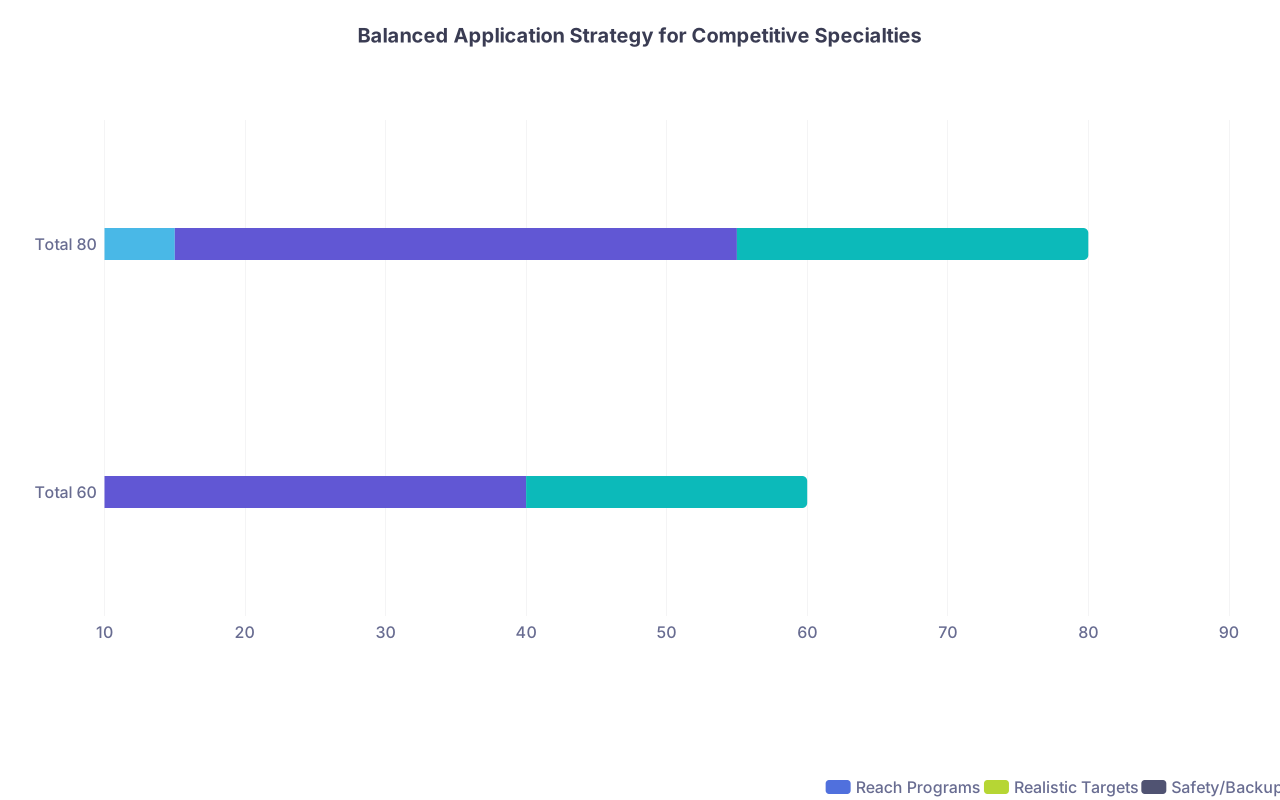
| Category | Reach Programs | Realistic Targets | Safety/Backup |
|---|---|---|---|
| Total 60 | 10 | 30 | 20 |
| Total 80 | 15 | 40 | 25 |
9.1 Categorize programs honestly
For each program you are considering:
- “Reach”:
- Historically dominated by elite-school grads
- Very high average scores / stacked CVs
- “Realistic target”:
- Mixed pedigree of residents
- Has taken applicants with similar profiles to yours
- “Safety/backup”:
- Community or hybrid programs
- Less research-heavy emphasis
Use:
- Program websites → resident bios (schools + interests)
- PubMed → look for resident publications (to see how research-heavy they really are)
- PD/assistant PD talks/webinars where they outline what they actually care about
You want the bulk of applications in that middle band where your profile fits.
9.2 Geographic and personal ties are currency
Outside big names, programs care a lot about:
- “Are you actually going to come here and stay?”
- “Do you have any reason to like this region?”
So emphasize:
- Home state / undergrad state
- Family in the area
- Prior work or military service nearby
- Language ties to patient population
Spell this out in:
- ERAS geographic preference signaling
- Secondary questions
- Interview answers
Step 10: Tight Interview and Post-Interview Strategy
Once you get the interview, your school’s name fades. Now they are evaluating whether you are trainable, reliable, and not a headache.

10.1 Own your non-powerhouse background
Do not apologize for your school. Do not over-explain it either.
If asked:
- “Tell me about your school and clinical training.”
You say something like:
- “We are a smaller program without a big research machine. The upside is that I got a tremendous amount of hands-on responsibility early. I had to be proactive about finding research and mentorship, which is why I sought out [X] projects and [Y] away rotations. That experience made me very comfortable jumping into new systems and doing the legwork.”
Short. Confident. You turned a “weakness” into evidence of initiative.
10.2 Hit the three things PDs want to hear
For competitive specialties, PDs are filtering for:
- Will you work hard without falling apart?
- Are you actually committed to this field, not chasing prestige?
- Are you going to be easy to train and safe for patients?
So:
Bring specific examples of:
- Long, tough stretches on call
- Owning patient follow-up
- Fixing your own mistakes
Avoid:
- Complaining about your school
- Blaming others
- Vague “I care deeply about patients” with no evidence
10.3 Post-interview communication that is not cringe
You do not need 50 dramatic “You are my top choice” emails.
Instead:
- Send 1–2 sentence thank-yous that mention:
- A specific conversation moment
- How it clarified your interest
Example:
- “Thank you again for discussing your resident-run clinic. Hearing how PGY-3s independently manage complex [specialty] patients confirmed that this is the kind of responsibility and environment I am looking for.”
If a program truly is your top choice near the end:
- One honest, clear signal to the PD:
- “After interviewing broadly, your program is my top choice, and I would be thrilled to train there.”
Do not say this to three programs. They talk.
A Realistic 12–18 Month Blueprint
If you are somewhere between late M2 and early M3 with no powerhouse behind you, here is how you compress this.
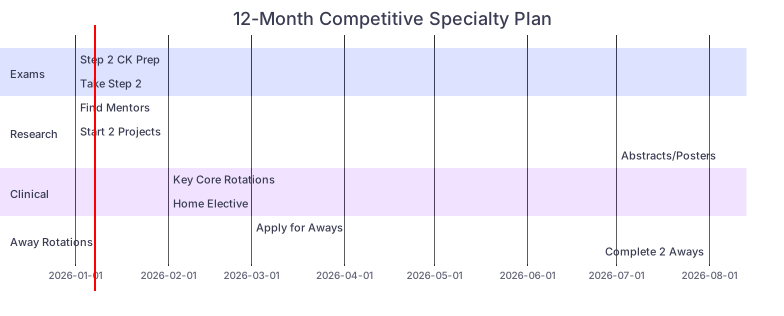
| Task | Details |
|---|---|
| Exams: Step 2 CK Prep | a1, 2026-01, 3m |
| Exams: Take Step 2 | a2, after a1, 1m |
| Research: Find Mentors | b1, 2026-01, 1m |
| Research: Start 2 Projects | b2, after b1, 6m |
| Research: Abstracts/Posters | b3, 2026-07, 4m |
| Clinical: Key Core Rotations | c1, 2026-02, 6m |
| Clinical: Home Elective | c2, after c1, 1m |
| Away Rotations: Apply for Aways | d1, 2026-03, 2m |
| Away Rotations: Complete 2 Aways | d2, 2026-08, 3m |
Rough flow:
- Months 1–3:
- Lock Step 2 CK prep and date
- Identify 3–5 research mentors, start 1–2 projects
- Months 4–6:
- Finish major core rotations with Honors/High Pass where possible
- Produce at least one abstract or poster
- Months 7–9:
- Do home elective in specialty (if available)
- Do first away rotation
- Secure 1–2 letters
- Months 10–12:
- Second away rotation
- Finalize research outputs
- Build program list and ERAS application
This is tight. But it is doable if you treat this like a professional project, not a vague “I hope I match somewhere good.”
Bottom Line
You do not need a research powerhouse school to match into a competitive specialty. You need:
- A serious Step 2 CK score
- A small but real portfolio of specialty-aligned work
- Strong letters from people whose opinions matter
- Evidence that you thrive in real clinical roles, not just talk about them
- A strategic, not delusional, application and rotation plan
Most applicants from smaller schools lose because they act like they are at Harvard without the infrastructure. You cannot do that. You have to build your own structure.
You are not powerless. You are just out of excuses.
Do this today:
Open a blank document and write down:
- Your target specialty
- Your current Step 2 (or practice) score
- Your current number of research products
- Names of 3 potential research mentors you could email this week
Then write the email to the first mentor. Do not perfect it for 3 hours. Send it within 30 minutes.
That is the difference between “non-powerhouse” and “non-competitive.” Action.