Weak research on a CV does more damage in competitive specialties than no research at all.
If you are aiming at derm, ortho, plastics, ENT, neurosurgery, rad onc, IR, or any other “CV bloodbath” specialty, you cannot afford research entries that scream: inflated, meaningless, or dishonest. Program directors in these fields are trained, almost professionally, to hunt down research fluff.
I am going to walk you through the CV lines that quietly kill applications. Not the obvious disasters like “fake publications” (though people still do that). I mean the subtle, common, “everyone else does it too” mistakes that instantly sort you into the “not serious” pile.
You are applying to specialties where:
- Everyone has research.
- Many have strong research.
- A minority have outstanding research.
Your job is simple: do not get knocked out in the first 15 seconds because of how you list your work.
Let me show you where people blow it.
1. The “Research Experience” That Isn’t Research
The first and most common mistake: calling anything with a PubMed ID “research” and anything with an IRB number “substantial experience.”
Program directors are not impressed by the label “research.” They care about:
- Rigor
- Continuity
- Your actual role
- Evidence that you can finish what you start
If your CV suggests you do none of the above, that line backfires.
Red-flag CV lines
These are the types of entries that make readers roll their eyes:
- “Research Assistant, Department of Orthopaedic Surgery, 2022 – 2022”
- Bullets: “Reviewed charts. Entered data. Attended meetings.”
- “Clinical Research Volunteer, Dermatology”
- Bullet: “Helped recruit patients and collected data for multiple studies.”
- “Research Experience: Neurosurgery, 1st Author Manuscript in Preparation”
On the surface, these are fine. But if that is your entire story, here is what they actually say:
- You did low-level, replaceable tasks for a few months.
- You probably never saw a project from question → design → execution → analysis → presentation.
- You are exaggerating the significance of your role.
How to avoid this trap
Stop calling everything “research experience”
If all you did was data entry and recruitment for 3 months, list it honestly:- “Clinical Data Assistant – Department of X”
- “Undergraduate Research Volunteer – Data Entry and Patient Enrollment”
You will not impress anyone by inflating the title. You will annoy them. That is worse.
Specify what you owned
Replace vague “helped with” language. When you truly did hands-on work:- “Abstracted data from 200+ charts for study on XYZ.”
- “Managed recruitment tracking log for 3 ongoing trials.”
- “Coordinated follow-up calls to maintain 90% retention at 6 months.”
Flag continuity and progression
If this is one of several experiences with the same PI or lab, make that crystal clear. Longitudinal work is much more compelling:- “Joined lab as a first-year and continued through 3rd year, contributing to 2 abstracts and 1 manuscript.”
Short version: low-level research tasks are fine. Calling them “robust research experience” is not. The mistake is not what you did. The mistake is pretending it was something else.
2. “Manuscript in Preparation” — The Most Abused Phrase on CVs
If you are applying to a competitive specialty, you must treat the phrase “in preparation” as radioactive. Overused, inflated, and very often meaningless.
Program directors know the game: half the “in preparation” manuscripts never see daylight.
When “in preparation” backfires
These lines are killers:
- “First author manuscript in preparation for NEJM.”
- “Multiple manuscripts in preparation.”
- “Several projects currently being written up.”
Here is what experienced readers think:
- “If this were real, you would list the actual target journal once it is under review or accepted. Not now.”
- “'Multiple' and 'several' usually equal 0–1 weak papers that never get finished.”
- “This applicant does not understand what ‘publication track record’ actually means.”
Safer, honest alternatives
Use these rules:
Do not list: “In preparation” at all
If it is not at least submitted, consider leaving it off the “Publications” section. At most, mention it under “Current Projects” with no fake citation details.If you must include early-stage work, separate it clearly
Example structure:
- Publications (peer-reviewed)
- Publications (accepted, in press)
- Abstracts and Posters
- Presentations
- Ongoing Projects (not yet submitted)
Under “Ongoing Projects”:
- “Retrospective review of XYZ in 200 patients – data collection completed, manuscript drafting with mentor.”
No fake journal names. No fake “in press” unless you have official acceptance.
Never fabricate status
I have seen applications claiming “accepted” when the paper was just submitted. Then the faculty interviewer actually knows the journal’s editorial board and asks about it.That conversation ends badly.
If your “research productivity” collapses without all the “in preparation” smoke, good. That means you finally see what you need to fix.
3. Fake or Fuzzy Authorship: When Your Name Order Betrays You
Competitive specialties care about where your name appears. And so they should. First and second author (sometimes last author with a mentor later) suggest leadership and contribution. Buried middle positions communicate something else.
But here is the landmine: trying to “optimize” authorship presentation.
Common CV sins with authorship
Hiding the order
Listing: “Smith J, Doe A, et al.” when you are 7th of 9. Or worse, just: “Smith J, et al.” with no position and no bolding of your name. They will look it up.Reordering names
Putting your name first on the CV “for clarity” when the actual paper has you 4th. Yes, people do this. And yes, they get caught.Listing yourself as first author on something where you are co-first but not clearly designated
If the publication does not specify co-first status, you are not co-first.
How to present authorship without self-sabotage
Always list authors in the exact order of the publication
Example:- “Smith J, YourLastName Y, Patel R, et al. Title. Journal. Year;Volume(Issue):Pages.”
Bold your own name. That is it. Clean and honest.
Do not try to hide a deep-middle author slot
If you are 12th of 20, they will see that on PubMed anyway. Let the work stand for what it is.If co-first is officially recognized, state it explicitly once
- “Co–first author; authors listed alphabetically.”
Stop pretending middle-author on 7 weak papers equals first-author on 1 solid project
It does not. And programs know that.
If you feel tempted to manipulate name order, that is not a formatting problem. It is a productivity problem. Fix the latter.
4. Questionable Journals, Predatory Publishers, and “CV Trash”
This part stings. Some applicants proudly list “10 publications,” then a faculty member pulls them all up during the interview. Five minutes later, everyone realizes:
- None are in recognizable journals.
- Several are in obvious predatory outlets.
- The topics have nothing to do with the specialty.
- The work is low-rigor case reports and filler.
More lines is not always better. In competitive specialties, it is often worse.
How predatory and low-quality journals hurt you
Red flags:
- Journal names you can barely say out loud without laughing.
- “International Journal of Advanced Innovative Clinical Medicine and Surgery” level nonsense.
- Article processing charges you personally paid to “get a pub.”
- Journals that accept a manuscript in under 48 hours.
Program directors know the predatory list patterns. A CV full of these sends a clear message:
- You were chasing lines, not learning science.
- Your mentors were either disengaged or complicit.
- You are more interested in padding your CV than in substance.
When fewer, stronger lines beat a long, weak list
If your research section looks like this:
- 1 strong, peer-reviewed paper in a legitimate specialty journal
- 2 posters at national meetings
- 1 local oral presentation
- Several ongoing, real projects (not overhyped)
That is much better than:
- 8–10 papers in borderline or predatory outlets
- No meaningful conference work
- No clear, deep project
One honest, high-quality project signals seriousness and integrity. Ten junk pubs signal desperation.
Practical guardrails
- If you had to pay significant money personally just to get the paper accepted, be suspicious.
- If the journal is not indexed in PubMed or reputable databases and has an obviously spammy website, be very suspicious.
- If your mentor warns you it is sketchy and you do it anyway “for the line,” understand that some interviewers will view that harshly.
When uncertain, ask a trusted faculty member outside the project: “Would you be comfortable with this journal on your own CV?” If they hesitate, listen.
5. Overstated Roles and Inflated Impact
This is the subtle dishonesty that kills credibility. Not outright lies. Just small exaggerations repeated across the CV until a reader starts circling phrases and thinking: “This feels off.”
Phrases that raise suspicion
- “Led multiple projects examining…” (when you were a sub-I doing what your resident told you)
- “Principal investigator of study on…” (as a second-year med student, on a chart review your attending designed)
- “Designed and implemented…” (when you helped with part of data collection)
Competitive specialties are full of people who actually:
- Designed full projects
- Wrote IRBs
- Performed analyses
- Defended work in front of committees
If your experience is not at that level, do not pretend it is.
How to be accurate without underselling yourself
Instead of “Led multiple projects,” write:
- “Contributed to 3 projects focused on X, Y, and Z under Dr. Smith.”
Instead of “Principal investigator,” write:
- “Student co-investigator on retrospective review of …”
Instead of “Designed and implemented protocol,” write:
- “Assisted with protocol refinement and standardized data collection forms for…”
You do not need to be the hero of every bullet point. Programs like team players who understand the scope of their role.
6. “Random” Research That Disconnects From Your Specialty Story
Another big one: your research does not remotely match your supposed passion.
You say you are deeply committed to dermatology. Your research:
- 3 case reports in internal medicine
- 1 retrospective study in nephrology
- 2 quality improvement projects in hospital medicine
Nothing derma-related. Not even close.
Experienced readers ask: “So why this specialty?” The suspicion becomes:
- You decided on derm late and are now forcing a narrative.
- You chased prestige, not genuine interest.
- You lacked initiative to seek out aligned work.
When off-specialty research is fine
You do not need 100% specialty-pure research. Reasonable portfolios for competitive specialties often look like:
- Early general medicine or surgery projects
- Later pivot into specialty-aligned work
- A mix of QI, clinical, maybe some basic science
What does look bad is zero linkage.
How to fix or soften this problem
If you are early: pivot now
Seek any project in your target field, even a small retrospective or case series, to show direction.If you are late: explain the arc
Your CV can show a story:- Pre-clinical: general IM research (exposed you to scholarship)
- Clinical: discovered love for rad onc, joined lab, contributed to 1–2 projects
In your bullets, subtly connect skills to your specialty
Even a cardiology project can be framed:- “Gained experience with large imaging datasets and outcome modeling, skills now applied to [specialty] research.”
Do not overdo this. But a clear trajectory sells better than a pile of unrelated one-offs.
7. Overcrowded, Disorganized, or Misleading Sections
Sometimes the issue is not what you did, but how you present it. Poor structure can make mediocre research look worse and good research look mediocre.
Common structural mistakes
- Dumping everything together: case reports, posters, abstracts, QI, full manuscripts all in one blob.
- Counting abstract submissions or unaccepted posters as “presentations.”
- Listing the same project three times in three different sections without labeling that it is the same work (looks like padding).
A cleaner, “non-sleazy” structure
This kind of layout avoids suspicion:
| Section Order | Content Type |
|---|---|
| 1 | Peer-Reviewed Publications |
| 2 | Accepted / In Press Publications |
| 3 | Abstracts and Posters (Presented) |
| 4 | Oral Presentations |
| 5 | Quality Improvement Projects |
| 6 | Ongoing Research Projects (Unsubmitted) |
A few rules:
Do not inflate oral presentations. If you gave a 5‑minute med student day talk to your class, call it what it is.
Do not mix “submitted abstracts” with “accepted and presented” ones.
If the same work appears as abstract → poster → paper, that is fine, but:
- Label that clearly: “(same project as #2 above)” or use consistent titles so the relationship is obvious.
Clutter and gamesmanship are both red flags. Clean structure is underrated.
8. Timeline Red Flags: Gaps, Sudden Bursts, and “Application-Year Miracles”
Research has a rhythm. Program directors can see when your research timeline does not make sense.
Patterns that worry people
Long gap, then magical explosion in the application year
No activity for 2–3 years, then: “5 manuscripts, 3 abstracts, massive productivity” all within 6 months. That does not match real-world research cycles.Step-score crash plus sudden “research flood”
Looks like compensatory padding.Everything dated very close to ERAS submission or application deadlines
Suggests frantic last-minute line chasing.
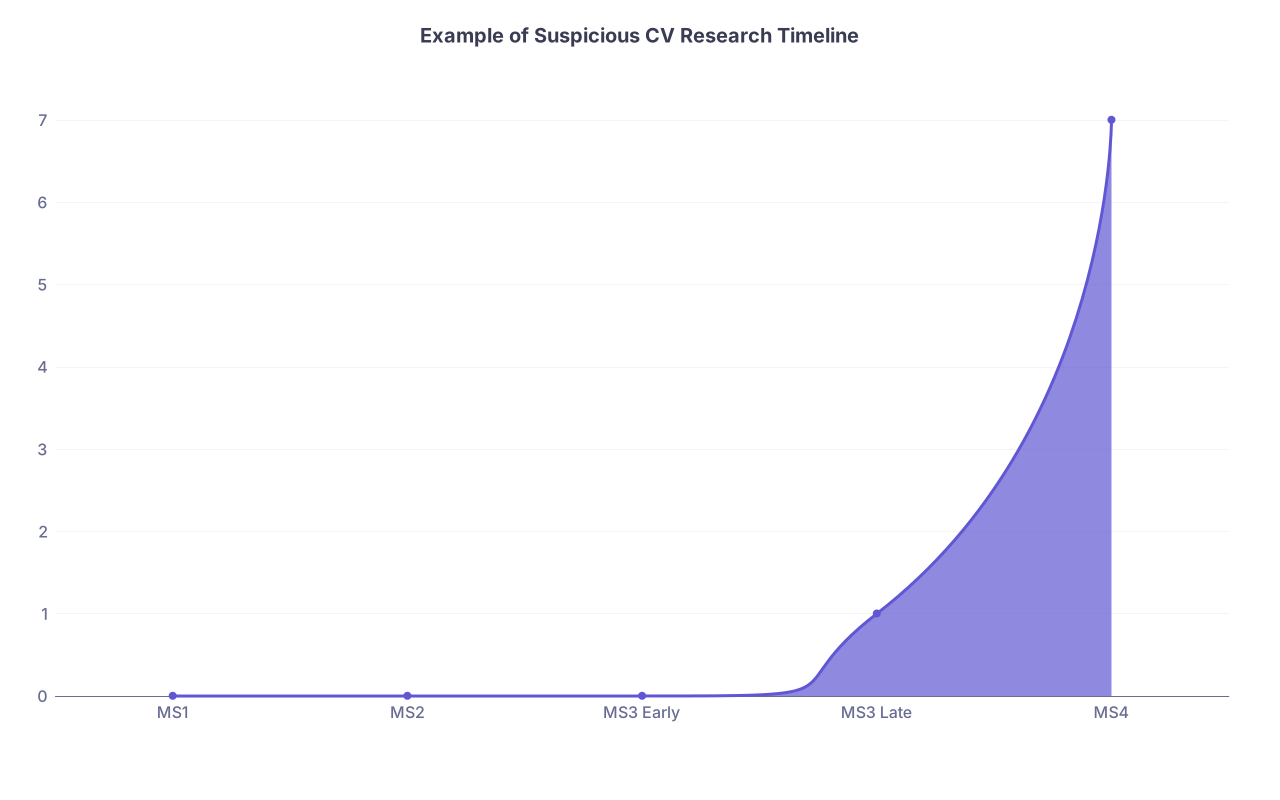
| Category | Value |
|---|---|
| MS1 | 0 |
| MS2 | 0 |
| MS3 Early | 0 |
| MS3 Late | 1 |
| MS4 | 7 |
What a healthier timeline looks like
Even modest, but real, longitudinal engagement:
- MS1: Join project, help with data → maybe 1 poster.
- MS2: Continue same project, start second → 1 abstract accepted.
- MS3: Submit paper from the first project, maybe 1 more abstract.
- MS4: One accepted or in press paper.
You do not need huge numbers. You need evidence that you stuck with something.
If your timeline is already weird
You cannot rewrite history. But you can:
- Make sure your dates are accurate. Do not compress everything into June–September just to “look busy.”
- Use personal statement or interviews (if asked) to explain a realistic story: maybe a long project finally producing outputs, rather than 7 disconnected miracles.
If the timeline looks fake, people assume what you fear: that it is mostly fluff.
9. The “Project That Never Dies” — Listing Eternal, Never-Completed Work
Many students cling to zombie projects. Started in MS1. Maybe. Still “ongoing” in MS4. No abstract. No poster. No paper. Just bullets.
Listed as:
- “Retrospective study on X – ongoing.”
- “Prospective trial – data collection ongoing.”
No endpoints. Ever.
Why this undermines you
It tells committees:
- You do not finish things.
- Your mentors did not prioritize your output.
- You may not understand how to move a project to completion.
How to handle half-baked or stalled projects
If it is truly dead, kill it on your CV
If your role stopped 2 years ago, and there has been zero movement, consider dropping it or shrinking it to one line under “Past Research Experience” with accurate dates.If your role was small, do not call it “ongoing project”
Just list what you actually did and the timeframe.If there is a realistic chance of output, specify current status clearly
- “Data collection completed; manuscript being drafted by PI. My contributions concluded in 2023.”
That is honest, finite, and does not promise what you cannot control.
10. Sloppy Details That Signal You Do Not Care
This looks minor. It is not. In competitive fields, where programs are choosing between people with almost identical metrics, sloppiness is a tie-breaker. In the wrong direction.
Tiny, avoidable mistakes that irritate reviewers
- Inconsistent citation format across entries.
- Wrong journal titles or misspellings.
- Listing “in press” for something that is actually just “accepted, awaiting proof.”
- Typos in author names, including your own.
- Using different dates for the same publication in different sections.
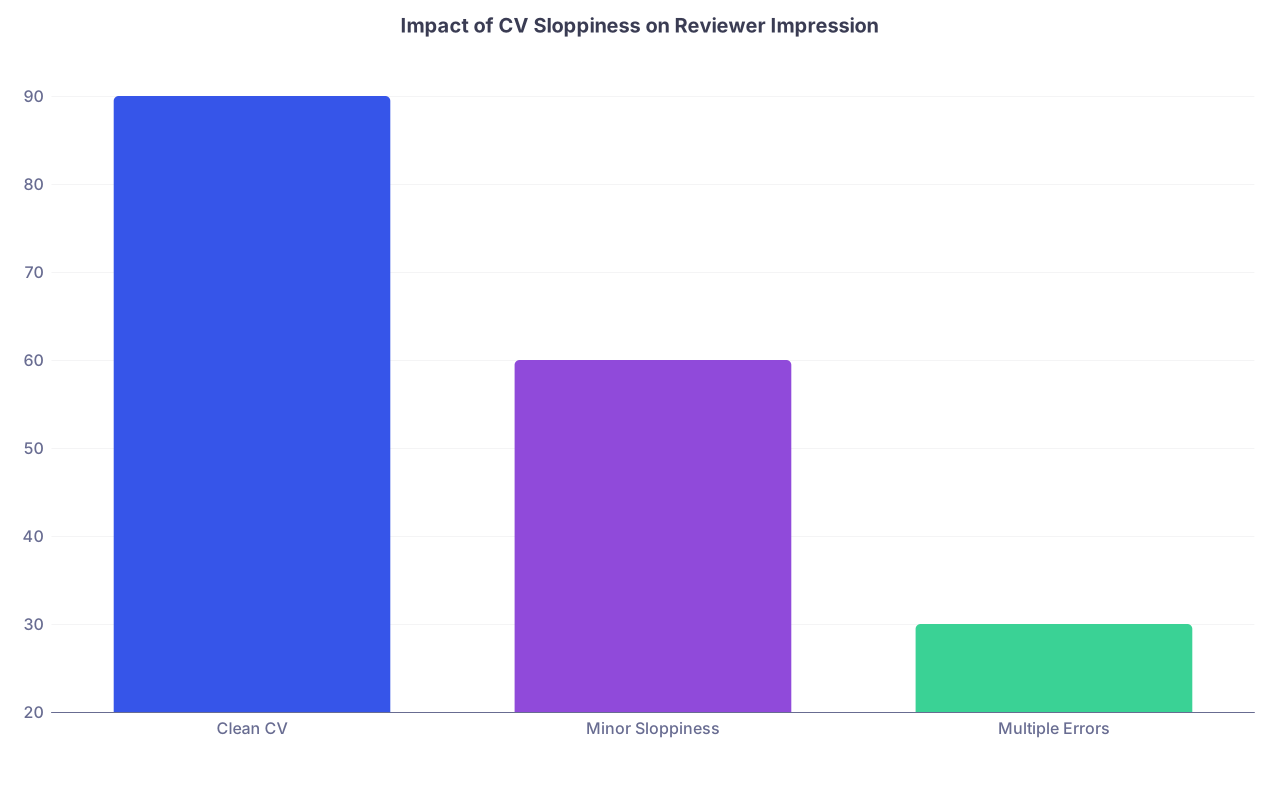
| Category | Value |
|---|---|
| Clean CV | 90 |
| Minor Sloppiness | 60 |
| Multiple Errors | 30 |
These details make reviewers think:
- “If they are this careless with their own CV, what about patient care? Data integrity? Operative notes?”
No, it is not entirely fair. But that is how these decisions get made.
Simple quality check before you submit
- Pull every DOI / PubMed ID and confirm: titles, authors, year, journal, pages.
- Standardize one citation style and apply it everywhere.
- Ask someone outside the project—ideally a resident in your target specialty—to read your research section only and circle anything that looks vague or inflated.
If you cannot keep your own research record clean, it is hard to argue you belong in a field obsessed with precision.
11. The One Thing You Must Not Fake: Integrity
Let me be blunt. In hyper-competitive specialties, some people lie. They:
- Inflate their authorship
- Promote submitted as “accepted”
- Claim involvement in projects they barely touched
- List ghost “manuscripts in preparation” they will never work on
Occasionally, they get away with it. For now.
But when they do not, fallout is brutal:
- Programs talk to each other.
- Faculty you want letters from later do not forget.
- Your reputation inside a very small field is damaged before you even start.

| Step | Description |
|---|---|
| Step 1 | Draft CV |
| Step 2 | Revise to match actual role |
| Step 3 | Clarify status or remove |
| Step 4 | Ask mentor to review |
| Step 5 | Submit with confidence |
| Step 6 | Any inflated claims? |
| Step 7 | Any unverifiable projects? |
Your research section is not just about productivity. It is a character test written in bullet points. People in competitive fields read it that way, whether you like it or not.
Your Next Step Today
Open your CV and go straight to the research section. Line by line, ask yourself three questions:
- Would my mentor or PI agree with every word of this description?
- Could an interviewer pull this up on PubMed or ask me detailed questions without exposing exaggeration?
- If this were the only research line on my application, would it still reflect well on my judgment and integrity?
If any entry fails those tests, fix it or delete it. Today.