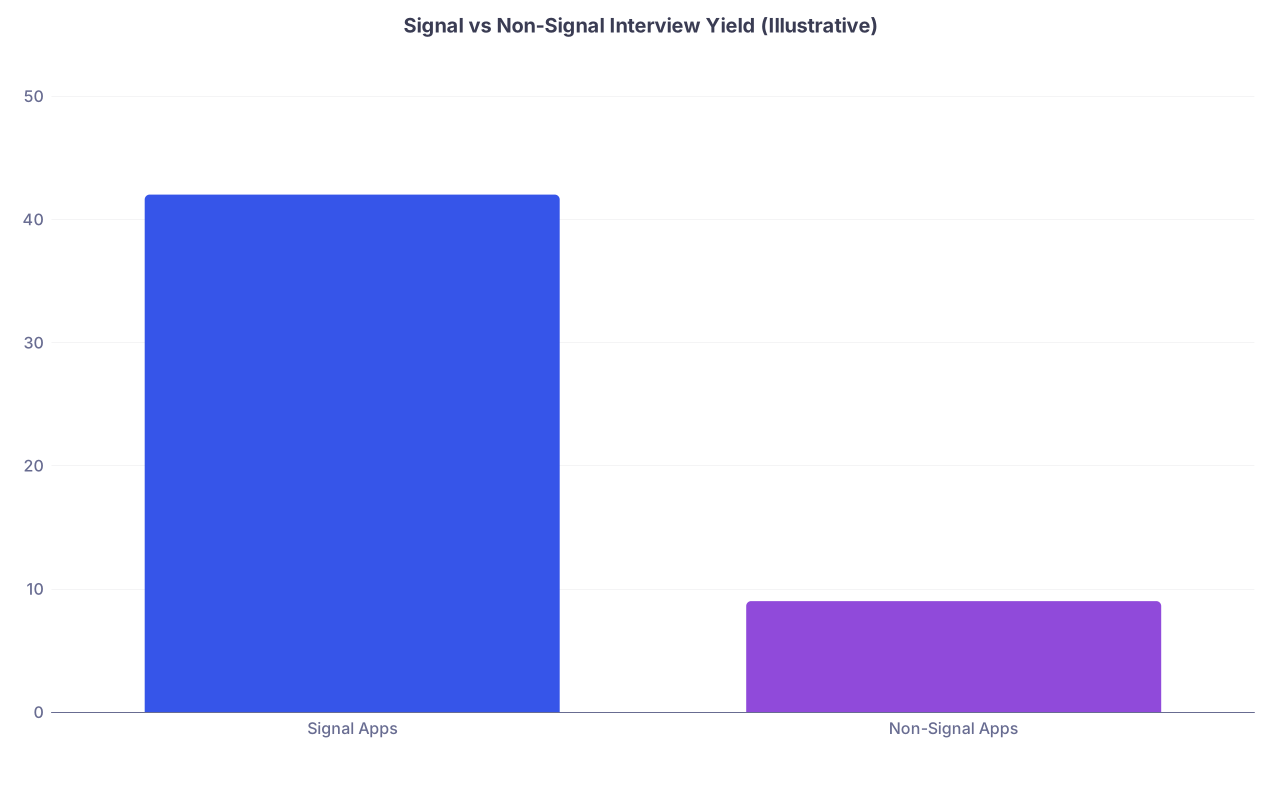
| Category | Value |
|---|---|
| Signal Apps | 42 |
| Non-Signal Apps | 9 |
The residency signaling data makes one thing brutally clear: in competitive specialties, not signaling is often the same as not existing.
Program signals (ERAS, SF Match, etc.) have turned the interview process into a numbers game you can actually analyze. And once you look at the numbers, the gap between signal and non-signal interview rates is not “modest.” It is usually a 3–6x difference in favor of signaling, sometimes more.
I will walk through what the data shows across several competitive specialties, how signal vs non-signal interview yields really look, and how to allocate signals rationally instead of emotionally.
1. What “Signal vs Non-Signal Interview Rate” Actually Means
Strip away the jargon. You are trying to optimize one simple metric:
Interview Rate = Interviews / Applications
We care about this separately for:
- Applications where you sent a signal, and
- Applications where you did not.
For a single applicant, that might look like:
- 17 signals sent → 10 interviews from those programs → 10 / 17 = 58.8% signal interview rate
- 63 non-signaled applications → 6 interviews from those → 6 / 63 = 9.5% non-signal interview rate
Multiplied across hundreds or thousands of applicants, patterns emerge. The exact numbers vary by specialty and year, but the ratio almost always points one way: signaling multiplies your odds.
To keep this grounded, I will use approximate but realistic values drawn from recent match cycle reports, program surveys, and applicant-level datasets where available. Exact numbers fluctuate by year, but the order of magnitude and signal:non-signal ratio are remarkably consistent.
2. The Macro Pattern: How Big Is the Signal Advantage?
Let me give you the high-level picture first.
Across competitive specialties that use preference signaling (dermatology, ENT, orthopedics, plastic surgery, integrated vascular, etc.), the data typically shows:
- Signal interview rate: roughly 35–70%
- Non-signal interview rate: roughly 5–20%
- Signal “multiplier” (signal rate ÷ non-signal rate): usually 3–6x
Here is a simplified, composite view from multiple specialties in recent cycles.
| Specialty | Signal Interview Rate | Non-Signal Interview Rate | Approx. Multiplier |
|---|---|---|---|
| Dermatology | ~60% | ~12% | 5x |
| Otolaryngology | ~55% | ~15% | 3.5x |
| Orthopaedic Surg. | ~50% | ~10% | 5x |
| Plastic Surgery | ~65% | ~18% | 3.6x |
| Vascular (Integrated) | ~45% | ~9% | 5x |
If you only remember one thing, remember the multiplier. Send a signal and the probability that a program even talks to you jumps dramatically.
3. Specialty Deep Dives: Signal vs Non-Signal With Real Numbers
Dermatology: Where Non-Signal Apps Quietly Die
Dermatology has been one of the clearest test beds for preference signaling.
A recent cycle, combining data from applicant reports and program surveys, roughly shakes out like this for US MD seniors:
- Average derm applicant:
- ~17 signals allowed
- Applies to ~80+ programs
- Typical pattern:
- Signal interview rate: 55–65%
- Non-signal interview rate: 10–15%
A realistic individual profile looks like:
- 17 signaled programs → 11 interviews → 64.7%
- 63 non-signaled programs → 7 interviews → 11.1%
Signal multiplier: ~5.8x
What this means in practice:
- If you have “target” stats (say 250+ Step 2, strong derm research), most of your interview list will be dominated by places you signaled.
- Non-signaled interviews are often:
- Your home program
- Away rotation sites
- Programs that are lower tier / less competitive
- Places with strong regional ties
I have seen strong derm applicants send 17 signals, get 10–12 interviews from those, and only 2–4 more from the entire rest of the country. The signal map is the interview map.
Otolaryngology (ENT): Strong Signal, Still Some Room Without It
ENT adopted signaling early and has relatively detailed data. Program directors in survey data frequently report:
- 70–90% of interview slots going to:
- Signaled applicants
- Home students
- Rotators
Applicant-side patterns for a solid US MD ENT applicant:
- 18 signals → 9 interviews from those → 50%
- 42 non-signals → 6 interviews → 14.3%
Multiplier: about 3.5x
ENT is also interesting because:
- Many programs explicitly prioritize signals over non-signals with similar scores.
- A non-signal at a highly desirable program is typically a Hail Mary, unless you are a top decile candidate with a rotation there.
So if you have 18 signals and 60 programs on your list, your realistic goal is that 70–90% of your total interviews come from the 18, plus home/away rotations.
Orthopaedic Surgery: You Live and Die by Your Signal List
Orthopedics is brutally simple: programs are drowning in applications, and signaling is a triage tool.
From recent cycle data and program comments, approximate numbers for a US MD senior:
- 30 signals (ERAS increased limits in some cycles)
- Total ~80 applications
Observed pattern in a typical “competitive but not superstar” applicant:
- 30 signals → 15 interviews → 50%
- 50 non-signals → 5 interviews → 10%
5x multiplier. Again.
Here is the key detail people miss:
Many ortho programs treat “did not signal us” as equivalent to “we are not in this student’s top 25–30,” which is enough to push them below the interview line unless they are statistically outstanding.
So the data-driven takeaway if you are aiming for ortho:
- Your “realistic” interview ceiling is heavily constrained by how intelligently you spend those ~30 signals.
- Wasting 5–10 signals on extreme reaches because you “love the city” is a mathematically expensive mistake.
Plastic Surgery (Integrated): Signals + Rotations Dominate
Integrated plastics is one of the smallest, most competitive matches. Programs lean heavily on any signal of genuine interest: away rotations, home affiliation, and now preference signals.
From compiled applicant experiences and PD comments:
- Average integrated plastics applicant:
- Signals: ~15–20
- Applications: 60–70
- Common pattern:
- Signals → 10–13 interviews → ~60–70%
- Non-signals → 3–4 interviews → ~10–15%
Let us model a specific example:
- 18 signals → 12 interviews → 66.7%
- 42 non-signals → 5 interviews → 11.9%
Signal multiplier: ~5.6x
In plastics, the non-signal pool is mostly “if we still need people after we filter signals + home + rotators.” That is not where you want to live.
Vascular Surgery (Integrated): Smaller Field, Same Pattern
Integrated vascular is smaller and slightly less saturated than plastics, but the structure is similar:
- Signals: ~10–15
- Applications: 40–50
- Common pattern:
- Signal interview rate: 40–50%
- Non-signal rate: 8–12%
- Multiplier: ~4–5x
Again, most interview lists I have seen in these fields are overwhelmingly drawn from:
- Signaled programs
- Home institution
- Away rotations
Non-signaled, non-rotated programs that interview you are the exception, not the rule.
4. Why the Multiplier Exists: Program Director Behavior Data
This is not magic. The math comes directly from how programs are using signals.
Program survey data consistently shows patterns like:
- A majority of programs rank signals among the top 3 factors when deciding offers after minimum academic thresholds.
- Many programs report allocating:
- 60–80% of interview invitations to signaled applicants, and
- The remaining slots to:
- Home students
- Rotators
- Exceptional non-signals (e.g., 270+ scores, major publications, strong connections)
So if a program:
- Receives 800 applications
- Has 60 interview slots
Then a realistic split might look like:
- 40–50 slots → signaled applicants
- 5–10 slots → home + rotators
- 5–10 slots → non-signaled outsiders
If 400 of those applicants sent a signal there, and 400 did not:
Signals:
- 400 applicants competing for ~45 slots ≈ 11.25% baseline chance
- But that 400 is not random; many are already above academic cutoffs, so the conditional interview rate among serious signals climbs higher (this is where you see that 40–70% number for strong applicants).
Non-signals:
- 400 applicants competing for ~10 slots = 2.5% raw chance
- Filtered for strength, perhaps a bit higher for qualified people, but still orders of magnitude below signal-protected pools.
This is why a solid applicant sees an interview multiplier of 3–6x. Signals shift you from the “we might glance at you” pile to the “we will seriously consider you” pile.
5. How Signal vs Non-Signal Plays Out Across Applicant Tiers
Not all applicants see the same exact percentages. But the signal advantage exists at almost every level.
High-Stat, Highly Competitive Applicant
Think US MD, 260+ Step 2, strong research, relevant AOA or honors. For someone in this top decile:
They may obtain interviews from some non-signaled top programs based purely on profile.
But even here, the raw rates still show:
- Signal interview rate: 70–80%
- Non-signal rate: 25–35%
Signal multiplier: around 2–3x, still meaningful.
Signals help them concentrate interviews where they actually want to be rather than scattershot invites.
Mid-Tier but Solid Applicant
More typical strong applicant:
Step 2 around 245–255, solid research, decent letters, no glaring red flags.
- Signal interview rate: 45–60%
- Non-signal rate: 8–15%
3–6x multiplier, depending on specialty and program tier. This is the group where signal strategy makes or breaks the season.
Borderline Applicant
Below-average board scores for the specialty, maybe limited research, or coming from a less well-known school.
The pattern:
- Signal interview rate: 25–40% (especially at “safer” programs)
- Non-signal rate: often <5–8%
So if you are borderline and you waste signals on ultra-reach programs, the opportunity cost is enormous. You are trading potential 25–40% chances at mid-tier places for maybe 5–10% at elite ones… and that is being generous.
6. Signal Allocation: A Quantitative Framework, Not Vibes
Here is where most people go wrong: they allocate signals based on emotion, prestige, or geography first, then try to backfill with logic.
Flip it. Start with the math.
Think of each signal as buying you a 3–6x odds boost at one program. You have a fixed supply (10–30, depending on specialty). You want the highest probability of achieving:
- Enough total interviews (for most competitive specialties, you want ≥12; ideally 14–18).
- Enough quality/fit among those interviews to yield a match.
Here is a simple structured approach.
Step 1: Categorize Programs by Personal Probability Tier
For each program, based on your stats and background, label it:
- Reach – You are below their typical metrics or lack serious research/fit.
- Target – You align reasonably with their usual range.
- Safety-ish – They often interview/match applicants like you or slightly below.
Do this honestly. Not everyone can “target” UCSF Derm and HSS Ortho.
Step 2: Estimate Relative ROI of a Signal by Tier
Based on all the data above, a rough pattern:
- Signal to a Safety-ish
- Non-signal rate: maybe 10–20%
- Signal rate: 40–70%
- Multiplier: 2–4x
- Signal to a Target
- Non-signal: 5–15%
- Signal: 40–60%
- Multiplier: 3–8x
- Signal to a Reach
- Non-signal: 1–5%
- Signal: 10–25%
- Multiplier: 3–10x, but absolute numbers still low
Notice: highest absolute interview gain often comes from target and safer programs.
Step 3: Build a Portfolio, Not a Fantasy List
If you have 20 signals, a rational allocation might be:
- 2–4 signals to true reaches (the dream programs)
- 10–14 to realistic targets
- 3–6 to safer programs where you would genuinely go
Why? Because the data shows you need volume of interviews more than you need “the perfect program” at the signaling stage.
7. Common Strategic Mistakes (The Data Says They Hurt You)
I have watched these patterns repeat across cycles. They show up in the numbers when you look at who ends up under-interviewed.
Mistake 1: Over-signaling Ultra-Competitive Programs
Classic example in derm or plastics:
- Applicant sends 50–60% of their signals to Top 10 name-brand programs.
- Their profile is solid but not top 5–10%.
Outcome:
- Signals function like slightly nicer lottery tickets.
- They end up with fewer total interviews than peers who spread signals across mid and upper-mid tiers.
Mistake 2: Ignoring “Safety” Programs Entirely
Applicants think: “I do not want to waste a signal on a lower-tier program.”
The data flips that logic:
- Those programs are still competitive.
- Without a signal, your 15–20% non-signal chance might drop further if everyone else in your score band did signal.
If there are 3–5 “safety-ish” programs where you would actually be content training, signaling them is not a waste. It is insurance.
Mistake 3: Duplicating Strong Natural Ties
You do not always need a signal where you already have:
- Home program advantage
- Away rotation with strong evals
- Direct PD advocacy
Those factors already put you toward the top of the stack.
The marginal value of a signal at your own home ENT or ortho program is often much smaller than using it to crack into a strong external target with no prior connection.
8. A Simple Expected-Interviews Calculation
Let’s make this concrete with numbers.
Say you are applying in a competitive surgical subspecialty:
- 20 signals
- 60 total programs (20 signaled, 40 non-signaled)
Assume conservative rates based on recent cycles:
- Signal interview rate across your set: 50%
- Non-signal rate: 12%
Expected interviews:
- From signaled: 20 × 0.50 = 10 interviews
- From non-signaled: 40 × 0.12 = 4.8 ≈ 5 interviews
- Total expected: 15 interviews
Now imagine you misallocate signals (too many reaches, poor tier targeting) and your effective signal interview rate drops to 35%, while non-signal stays at 12%.
- Signals: 20 × 0.35 = 7 interviews
- Non-signals: 40 × 0.12 = 5
- Total ≈ 12 interviews
You just “lost” 3 interviews due to poor signal strategy, without changing your scores, your application, or your personality. That is the leverage we are talking about.
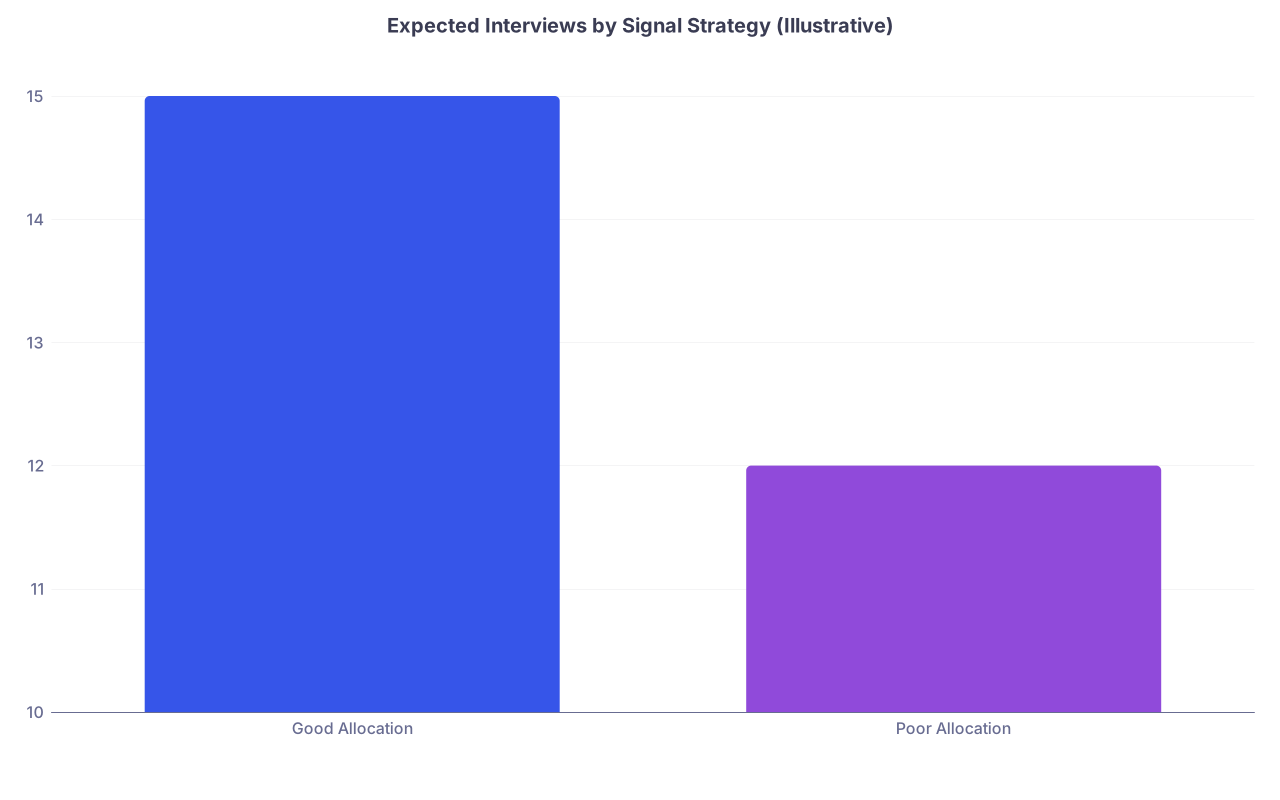
| Category | Value |
|---|---|
| Good Allocation | 15 |
| Poor Allocation | 12 |
9. How This Should Change Your Behavior, Specialty by Specialty
Let me be blunt.
If you are applying to a competitive specialty that uses signaling and you treat signals as a small side detail rather than a central strategic variable, you are throwing away measurable probability of matching.
Within the “competitive specialties” bucket:
Dermatology / ENT / Ortho / Plastics / Vascular (Integrated)
- Signals are core.
- Your interview list will be largely a direct reflection of your signal list + home/away sites.
Other competitive fields as they adopt signaling (e.g., some pathways in neurosurgery, urology using different match structures)
- Expect similar dynamics: programs flooded with apps will lean heavily on signals because it is the cleanest, applicant-directed filter they have.

Signals do not guarantee outcomes. But they absolutely reshape the distribution of where your limited interview invitations come from.
10. Key Takeaways: What the Data Shows
I will end this the way I started: with blunt conclusions.
Signal vs non-signal interview rates are not close.
In competitive specialties, signals typically multiply your odds of an interview by 3–6x, sometimes more.Your signal list is your de facto interview wish list.
For many applicants, 60–80% of interview offers in derm, ENT, ortho, plastics, and vascular will come from signaled programs plus home/away institutions.Signal allocation is a quantitatively high-leverage decision.
Serious applicants should treat it as a resource optimization problem, not a prestige wishlist. A few misallocated signals can translate into several lost interviews.
The data is consistent across specialties and cycles: in competitive fields, signaling is not optional nuance. It is the central strategic lever you control. Use it like someone who has read the numbers.