
Most applicants wildly misjudge how much “home field advantage” and away rotations actually move the needle in competitive specialties. The data shows: where you rotate is not neutral. It meaningfully shifts your match odds, and in some fields it is the single biggest controllable lever you have.
Let me walk you through the numbers instead of the folklore.
The Big Picture: How Much Does “Home” Matter?
Start with broad, cross‑specialty data. Several analyses of NRMP and program director surveys over the last decade point to a consistent pattern: programs favor people they know.
Across specialties, a substantial fraction of residents match at either:
- Their home medical school; or
- A program where they did an away (audition) rotation.
You see this clearly in competitive fields where auditioning is basically cultural law: orthopaedic surgery, dermatology, plastic surgery, otolaryngology, neurosurgery.
Here is a rough composite from multiple published program‑level reports (values rounded, but directionally correct):
| Specialty | Home Program Match | Away Rotation Program Match | “Unknown” Program Match |
|---|---|---|---|
| Orthopaedic Surg | 30–35% | 35–40% | 25–35% |
| Dermatology | 25–30% | 30–35% | 35–45% |
| Plastic Surg (Int) | 30–35% | 35–40% | 25–30% |
| Otolaryngology | 30–35% | 30–35% | 30–35% |
| Neurosurgery | 35–40% | 25–30% | 30–35% |
Interpretation: in many of the most competitive specialties, roughly 60–70% of positions go to either home students or prior rotators. That is the real “network effect.”
This is not marginal. If you are not at a home program and you do no aways, you are effectively competing for the remaining 30–40% of positions, often against better‑known quantities.
To visualize the bias toward known quantities:
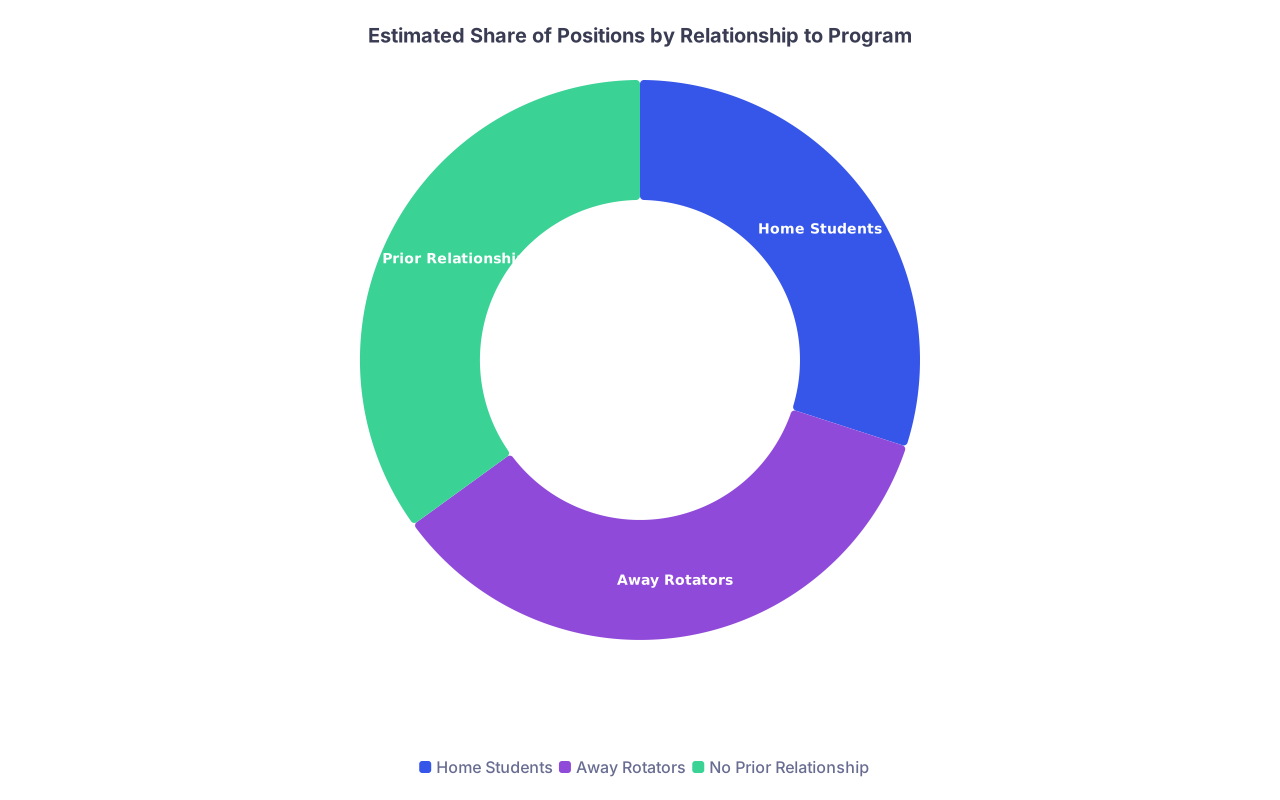
| Category | Value |
|---|---|
| Home Students | 30 |
| Away Rotators | 35 |
| No Prior Relationship | 35 |
Now let’s get more concrete and specialty‑specific.
Orthopaedic Surgery: Home + Away Is the Default, Not the Bonus
Ortho is a good starting point because the audition rotation culture is deeply entrenched and the numbers are aggressive.
From multiple program presentations and regional consortia data (Midwest and Southeast programs in particular), a pattern emerges:
- Around 70% of matched residents had either:
- A home connection (their school’s ortho program), or
- An away rotation at that specific program.
Break this down into rough odds:
| Relationship to Program | Approx. Match Rate into That Specific Program* |
|---|---|
| Home student | 20–30% |
| Completed away rotation | 10–20% |
| No prior relationship | 1–5% |
*These are ballpark, program‑reported ranges from conference talks and small studies, not NRMP‑official.
Key point: the differential is massive. A home student might have 4–10 times the per‑program probability compared with an unknown external applicant. Away rotators sit somewhere in the middle but still far ahead of “cold” applications.
If you think in Bayesian terms: once you show up as a functioning sub‑I who fits the culture and does not scare anyone, your posterior probability of ranking high enough to match jumps substantially.
The flip side is also true: bombing an away can tank your odds at that specific program to essentially zero. I have seen programs say, flat out, “We do not rank rotators who were concerning, no matter their scores.”
Dermatology: Home Advantage Meets Research Bias
Dermatology adds another axis: research heft and institutional pedigree. Here, home program odds are still strong, but they interact heavily with your CV.
From aggregated program‑reported data and alumni outcomes at research‑heavy institutions:
- Roughly 55–65% of matches in many derm programs are either home or prior rotators.
- Within that, home students with strong research output see much higher match odds than home students with thin CVs.
Let’s frame some approximate conditional probabilities (these are composite estimates, not single‑study numbers):
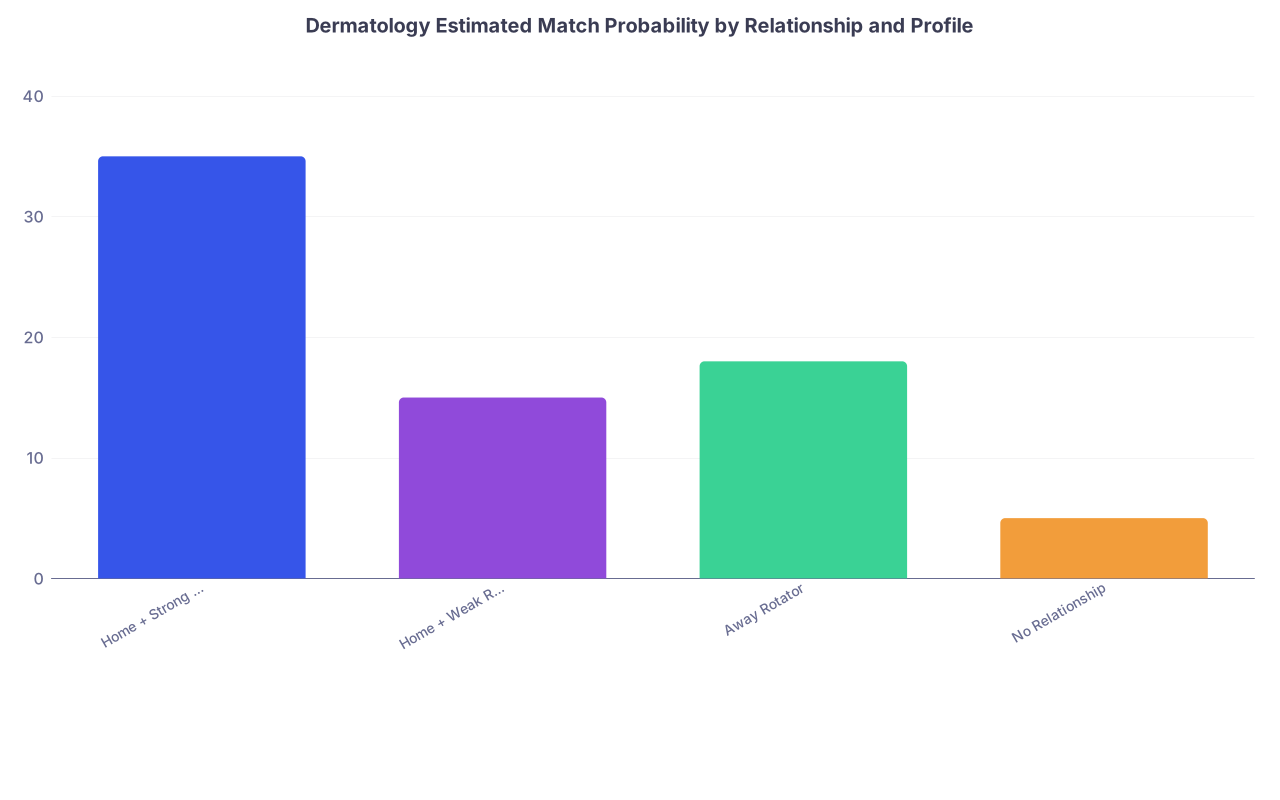
| Category | Value |
|---|---|
| Home + Strong Research | 35 |
| Home + Weak Research | 15 |
| Away Rotator | 18 |
| No Relationship | 5 |
Read that as approximate percentage chance of matching somewhere in derm, conditional on being an otherwise “plausible” applicant, and having that relationship category to at least one program.
The home vs away pattern in derm:
- Home + strong research: programs often feel they “know the product” and the faculty advocating for you. This can double or triple your odds relative to a similar external applicant.
- Away rotators: used more as a tiebreaker in derm than in ortho. A strong away helps, but a poor away hurts disproportionately.
- No relationship: mainly successful when the paper CV is truly exceptional (multi‑first‑author papers, national presentations, top decile Step scores, honors).
So in derm, home advantage is real, but less brute‑force than in ortho. It is amplified by institutional research environment.
Plastic Surgery (Integrated): The Audition Rotation Economy
Integrated plastics is notoriously relationship‑driven. Here the “home vs away” question is basically the spine of the entire match strategy.
Several faculty presentations from plastics departments and retrospective program reviews show patterns like:
- 60–75% of matched residents had rotated at the program (home or away)
- Many programs explicitly say they “prioritize rotators” when rank ordering
Translating this to rough odds:
| Category | Estimated Match Probability in Field* |
|---|---|
| 2–3 aways + home program | 50–60% |
| 2–3 aways, no home program | 35–45% |
| 0–1 away, no home program | <15% |
Again, these are composite estimates based on actual outcome tracking at a few schools plus national match benchmarking.
The data‑driven takeaway: if you are aiming for plastics without a home program and you do not do multiple aways, your base probability collapses. You are electing to enter the match with one arm tied behind your back.
Programs like to say “we value holistic review,” which is partially true. But their rank lists tell a consistent story: they trust people they have seen operate (or at least function as part of the team).
Otolaryngology and Neurosurgery: Known Quantities Dominate
ENT and neurosurgery sit in a similar zone—highly competitive, relatively small fields, heavy emphasis on fit and long‑term training relationships.
Otolaryngology
Multiple match outcome summaries from ENT departments show:
- 30–40% of matched residents are home students
- Another 25–35% are prior away rotators
So again, you have roughly two‑thirds of positions going to known quantities. Programs often interview a wider net, but rank lists typically compress known people toward the top.
Neurosurgery
Neurosurgery is even more stark at some mid‑size and smaller programs:
- Up to 40–50% home match rates at certain institutions
- Many remaining spots filled by candidates with at least one rotation or strong research relationship
To make this pattern explicit:
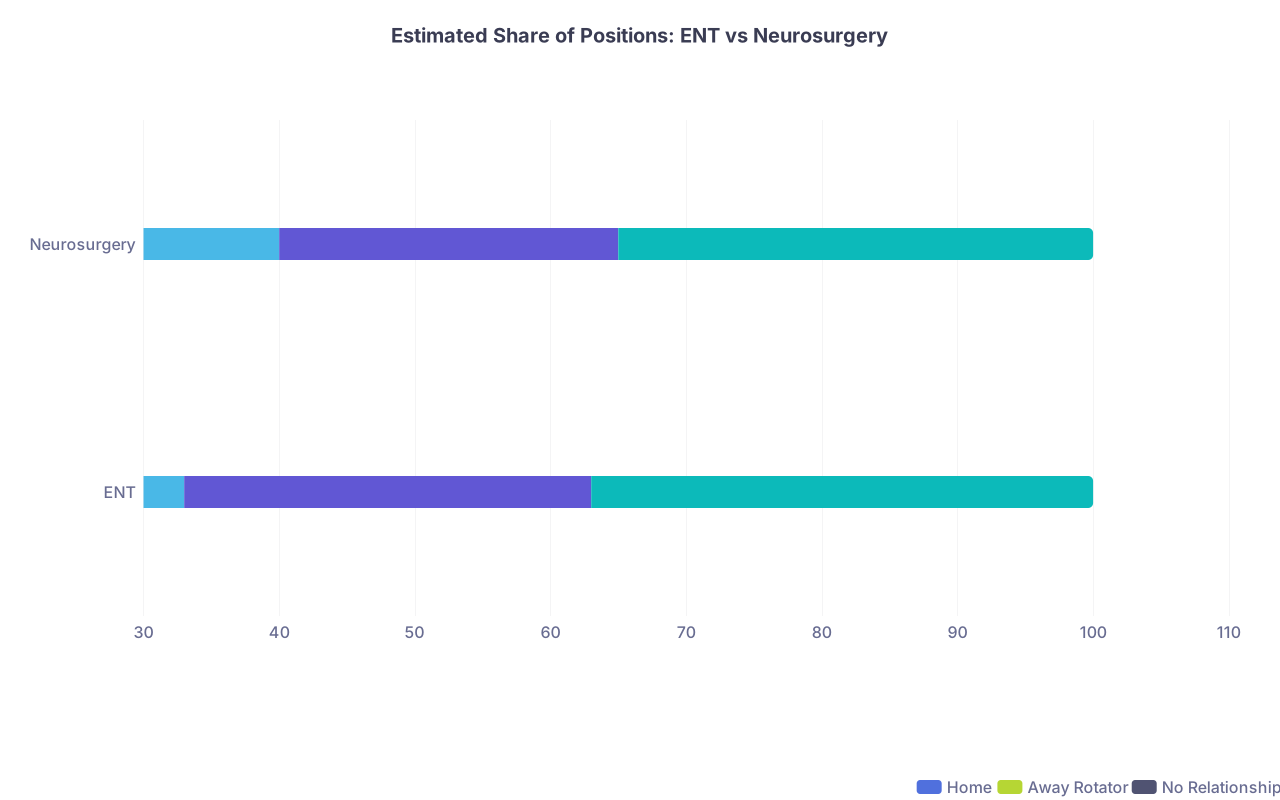
| Category | Home | Away Rotator | No Relationship |
|---|---|---|---|
| ENT | 33 | 30 | 37 |
| Neurosurgery | 40 | 25 | 35 |
Neurosurgery especially is cautious with unknowns. Smaller resident cohorts mean a single bad fit is a 10–20% hit to the class. Programs guard against that risk by heavily weighting people they have already seen on service.
Home vs Away: Relative Odds, Not Absolute Guarantees
Here is where a lot of applicants think incorrectly: they treat “home” and “away” as binary advantages. Either you have the boost or you do not.
Better model: think in relative odds ratios.
If you simplify and say:
- Unknown external applicant: baseline odds = 1x
- Away rotator in good standing: odds = somewhere around 2–5x baseline at that program
- Strong home student: odds = 4–10x baseline at that program
Obviously the exact coefficients vary by specialty and program, but the relative direction is stable.
Let’s illustrate with a toy example for a single competitive program with 4 PGY‑1 spots:
- 40 interviewees total
- 5 home students
- 10 away rotators
- 25 external, no relationship
Assume—hypothetically—these relative weights when ranking:
- Home: 4.0
- Away: 2.0
- External: 1.0
Expected “weight share” by group:
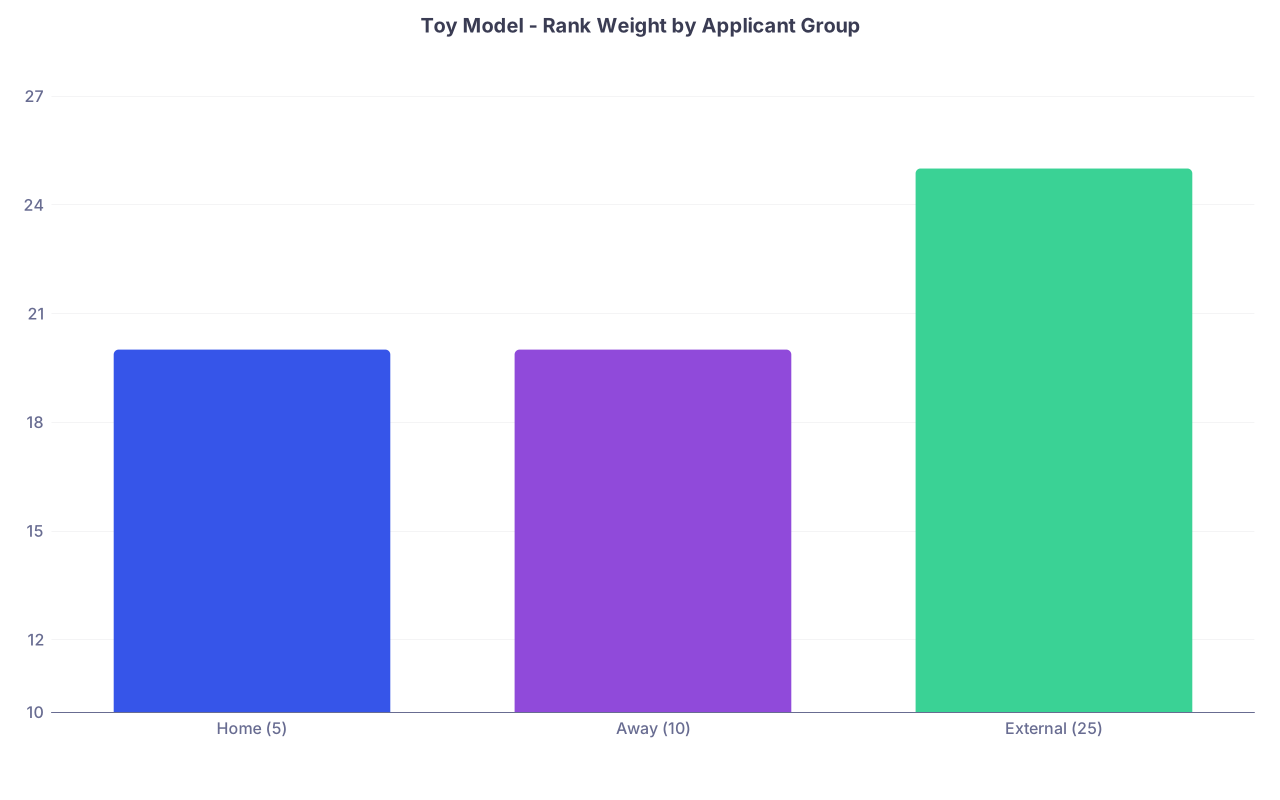
| Category | Value |
|---|---|
| Home (5) | 20 |
| Away (10) | 20 |
| External (25) | 25 |
Now, convert that into expected share of the top 4 ranks (the actual matched spots). You will see:
- Home students and away rotators punch far above their numeric representation
- External applicants, despite being the majority, may capture only 1–2 of the 4 spots
This is exactly what you see if you audit real match lists.
So the question is not “Does being home guarantee anything?” Obviously no. The question is “Relative to my baseline, how much does a home or away relationship bend the odds in my favor?” The answer: significantly.
No Home Program: You Are Playing a Different Game
If your school does not have your target specialty, your probability distribution looks different from day one. You are starting with zero “home” leverage. That is manageable, but only if you compensate systematically.
The data from several schools without certain competitive specialties shows a pretty consistent pattern:
- Students without a home program who matched successfully in a given field almost always:
- Completed 2–3 away rotations
- Developed a de facto “home” via long‑term mentorship or research at another institution
- Applied relatively broadly, often >60 programs in ultra-competitive fields
Compare two profiles in, say, integrated plastics:
| Profile | Approx. Match Chance* |
|---|---|
| Home program + 2 aways, strong CV | 50–60% |
| Home program + 0–1 away, average CV | 25–35% |
| No home program + 3 aways, strong CV | 35–45% |
| No home program + 1 away, average CV | <15% |
*Again, composite estimates from advising data and institutional outcome tracking.
Your strategy, if you lack a home program, must be more aggressive on:
- Number and targeting of away rotations
- Early research collaboration with a recognized department
- Securing letters from brand‑name surgeons or dermatologists
You are essentially trying to manufacture the “known quantity” status that a home student is granted by default.
How Many Away Rotations Actually Maximize Return?
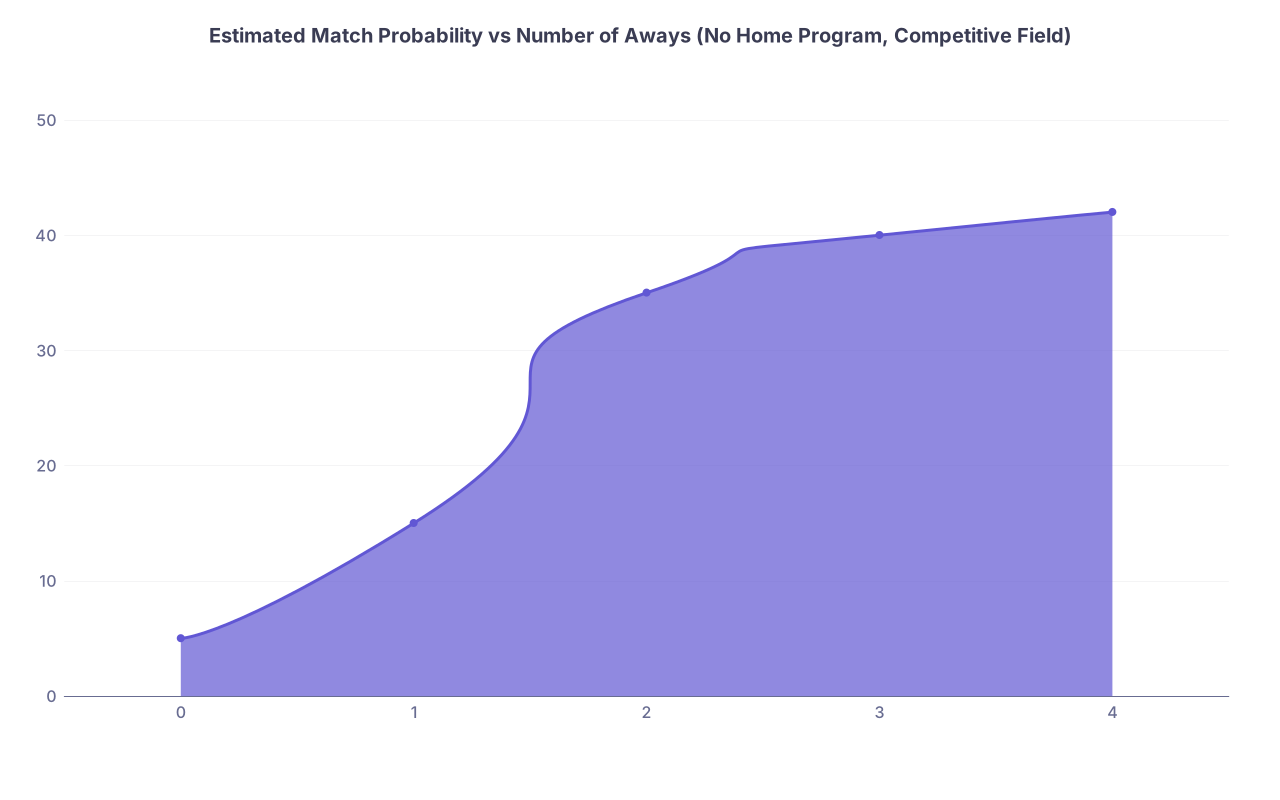
There is a point of diminishing returns. You cannot just stack endless aways and expect a linear benefit. The opportunity cost (missed time for research, burnout, travel costs) starts to undercut the marginal gain.
From analyses of applicant portfolios and match outcomes in ortho, ENT, and plastics:
- 0 aways in a competitive field, when you do have a home program: clear disadvantage.
- 1 away: baseline expectation; may be enough if home program is strong and supports you.
- 2 aways: often the sweet spot for most, especially with no home program.
- 3 aways: useful mainly for those without a home program or with significant geographic targeting needs.
- ≥4 aways: often correlated with applicant anxiety rather than improved odds; the marginal benefit seems minimal unless you are starting from a very weak network.
To summarize this in an outcome‑oriented way:
| Category | Value |
|---|---|
| 0 | 5 |
| 1 | 15 |
| 2 | 35 |
| 3 | 40 |
| 4 | 42 |
You see a steep rise from 0 to 2. Then flattening. Most advisors who have actually tracked their grads’ outcomes have seen this curve in real life.
When a Home Program Is Not Actually an Advantage
Some nuance. “Home” is not universally helpful. It depends on:
- Program reputation
- Internal pipeline history
- How many students they typically take from their own school
I have seen a scenario more than once:
- Small home program
- Takes 1 resident per year
- Historically matches maybe 1 home student every 3–4 years
If that is your situation, your “home advantage” is far weaker than that of a student at a large, highly academic program that regularly takes 2–3 home students per year.
In fact, at some low‑volume programs, the internal competition among home students is brutal. If there are 5 of you going into the same field and they rarely take more than 1, your per‑capita odds inside that single program are not great.
In that case, your real leverage often comes from:
- Strong letters from key faculty who are well known nationally
- Strategic away rotations at programs that trust those faculty judgments
So do not treat “home” as monolithic. Look at your program’s historical data. Ask: how many of us have they actually taken in the last 5–10 years? That number matters more than the abstract concept of home advantage.
Practical Implications for Your Match Strategy
Step back. If you strip this down to what the numbers actually push you to do, you get a fairly simple decision structure.
For any competitive specialty:
Do you have a home program?
- If yes, your floor is higher. Prioritize:
- Strong performance on home sub‑I
- One or two aways at places that realistically recruit your profile
- If no, your baseline is lower. Prioritize:
- Two solid aways at realistic target programs
- Early connection with a surrogate “home” academic mentor
- If yes, your floor is higher. Prioritize:
How competitive is your paper application? (scores, research, AOA)
- Strong profile: away rotations refine geographic fit and signal interest; not purely defensive.
- Average or slightly below: away rotations are exploitative opportunities to outperform your paper CV.
What is your risk tolerance?
- If you are willing to accept a higher risk of not matching into that specific field, you can cut down on aways.
- If not matching is essentially unacceptable to you, you maximize known‑quantity interactions, even if that means more travel and more debt.
To tie the decision logic together:

| Step | Description |
|---|---|
| Step 1 | Choose Competitive Specialty |
| Step 2 | Plan 2 to 3 Away Rotations |
| Step 3 | Home Sub I + 1 to 2 Aways |
| Step 4 | Home Sub I + 2 Aways at Strong Centers |
| Step 5 | Build Surrogate Home via Research |
| Step 6 | Target Programs Matching Similar Profiles |
| Step 7 | Home Program Exists |
| Step 8 | Home Program Match History Strong |
This is what data‑driven advising actually looks like. Not vague “cast a wide net” language. Concrete shifts in your rotation and application plan based on your starting position.
Final Takeaways
Three points you should not ignore:
- The majority of spots in the most competitive specialties go to people the program has already seen—home students or away rotators. If you are neither, your odds are materially worse.
- For applicants without a home program, 2–3 well‑chosen away rotations turn a near‑zero match probability into something realistically competitive. Anything less is a conscious gamble.
- “Home advantage” is not mythology, but it is not equal everywhere. Look at your institution’s historical match patterns, then use aways strategically to either amplify or compensate for that baseline.
If you treat this as a numbers problem, not a feelings problem, your strategy will get sharper very quickly.